
Pomodoro Technique Mistakes: 5 Pitfalls Killing Your Focus
 ·
Last Updated: February 10, 2026 ·
14 min read
·
Last Updated: February 10, 2026 ·
14 min read

If you’ve struggled with focus, you’ve likely realized that pomodoro technique mistakes can turn a world-class productivity tool into a source of immense frustration. I used to hate this method because I thought it was for people who didn’t have real work to do—for task-checkers and email-answerers, not for people doing deep, creative work that requires sustained flow states.
Then I realized something: I wasn’t failing the technique. I was following a 1980s version of the method that didn’t account for modern digital dopamine loops, remote work chaos, or the complexity of knowledge work.
The 25-minute bell felt like a drill sergeant interrupting my best thinking. I felt like a failure because I couldn’t “stick to the rules.”
But here’s the truth: the rules were wrong for my work, not the other way around.
Once I identified the five critical mistakes—and learned the modern fixes—the technique transformed from an annoying interruption into a biological trigger for deep work.
If Pomodoro isn’t working for you, you’re probably making one of these mistakes. The good news? They’re all fixable.
|
The Mistake |
Why it Kills Focus |
The 2026 Fix |
|---|---|---|
|
Working Through Breaks |
Causes “Attention Residue” |
The 90-Second Buffer Rule |
|
Vague Task Selection |
Triggers Decision Fatigue |
Verb-Noun-Constraint Formula |
|
Smartphone Breaks |
High-Dopamine Reset |
The “Digital Sabbath” Break |
|
Rigid 25-Min Rule |
Interrupts Natural Flow |
Adaptive “Flow” Intervals |
|
Ignoring Internal Distractions |
Compounds Cognitive Load |
The “Parking Lot” Method |
Why Most People Fail the Pomodoro Technique
The mistakes most people make aren’t about willpower or discipline. They’re about misunderstanding what the technique is actually designed to do.
The timer isn’t a productivity weapon. It’s a psychological safety net.
As Francesco Cirillo discovered when he invented the method as a struggling university student, time is only a predator if you don’t have a system to contain it. The 25-minute interval creates containment—a boundary that makes starting feel less scary and finishing feel achievable.
But here’s where people go wrong: they treat those boundaries as prison walls instead of scaffolding.
The psychological rebellion effect is real. When something external (like a timer) tells you what to do, your brain resists. This is especially true for:
- Creative professionals who need extended flow states
- People with ADHD whose nervous systems rebel against rigid structure
- Knowledge workers whose tasks don’t fit neatly into 25-minute chunks
- Anyone working in 2026’s distraction-saturated digital environment
The solution isn’t to abandon Pomodoro. It’s to stop making these five critical mistakes.
Mistake #1: The “Just Five More Minutes” Trap

The mistake: The timer rings. You’re mid-sentence, mid-thought, or mid-breakthrough. You think: “Just five more minutes to finish this.”
So you keep working. The break can wait.
Why this kills focus:
Working through your break creates what psychologists call “biological feedback fatigue.” Your prefrontal cortex—the part of your brain responsible for focus, decision-making, and executive function—runs on glucose and oxygen. After 25 minutes of intense cognitive work, it’s depleted.
If you don’t rest it, several things happen:
- Attention quality degrades: Your next 25 minutes produces lower-quality work
- Decision fatigue compounds: Every choice becomes harder
- Cognitive debt accumulates: You’ll pay back those “five more minutes” with two hours of brain fog later
It’s like driving your car past empty because you don’t want to stop. Eventually, you’re stranded on the side of the road.
Warning: Working through your break is a “Productivity Debt” that you will pay back with 2 hours of brain fog in the afternoon. The break isn’t a reward—it’s preventative maintenance. Skip it and watch your focus collapse by 3pm.
The Fix: The “Immediate Stop” rule
When the timer rings, stop immediately. Even mid-sentence. Even mid-word.
This feels wrong. Your instinct screams to finish the thought. Resist it.
Here’s the trick: before you stop, write down exactly what you were about to say or do next. Literally finish the sentence on paper: “…and then the marketing strategy should focus on…”
Now take your break.
When you return, you have a clear restart point. The thought isn’t lost—it’s captured. And your brain got the rest it needed.
The 90-Second Buffer Rule:
Before diving back in after your break, take 90 seconds to:
- Read what you wrote
- Close your eyes and visualize the next step
- Take three deep breaths
- Resume work
This buffer prevents the “wait, what was I doing?” disorientation that makes returns feel hard.
Mistake #2: Choosing Tasks That Are Too Big
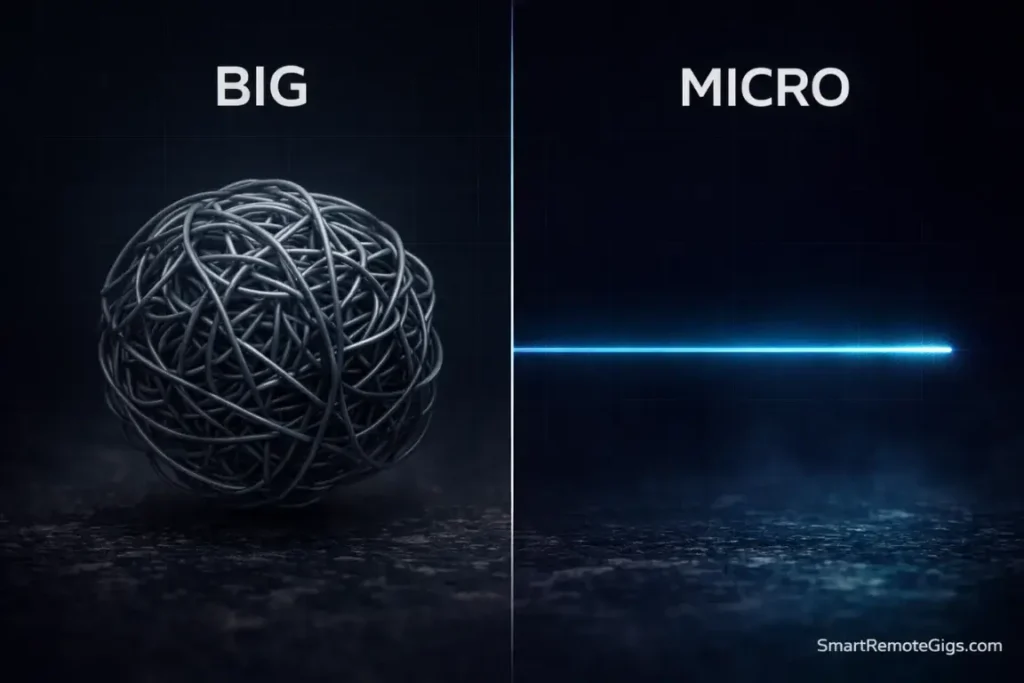
The mistake: You write “Work on presentation” or “Write report” or “Plan marketing campaign” and start your timer.
Twenty-five minutes later, you’ve barely made a dent. You feel unproductive. The task still feels overwhelming.
Why this kills focus:
Vague, large tasks trigger decision fatigue before you even start. Your brain sees “Work on presentation” and immediately asks:
- Which section?
- What format?
- What’s the goal?
- Where do I even begin?
Each question requires cognitive effort. By the time you’ve figured out where to start, you’ve used precious focus energy on planning instead of doing.
Even worse: large tasks lack a clear “definition of done.” You can work for 25 minutes and still not feel like you’ve accomplished anything. No completion. No dopamine. No motivation to continue.
The science of task initiation:
Your brain’s reward system needs a clear target. “Write report” is too abstract. “Write the three-sentence executive summary” is concrete. Your brain can visualize completion, which triggers the motivation to start.
The Fix: The Verb-Noun-Constraint Formula
Break every task into micro-deliverables using this structure:
[Action Verb] + [Specific Deliverable] + [Limiting Constraint]
Bad task selection:
- “Work on proposal”
- “Research competitors”
- “Update website”
Good task selection:
- Draft [verb] the budget section [deliverable] using only bullet points [constraint]
- List [verb] five competitor pricing models [deliverable] in a spreadsheet [constraint]
- Rewrite [verb] the homepage headline [deliverable] in three variations [constraint]
The constraint is crucial. It defines “done” and prevents scope creep during your sprint.
Pro Tip: If a task takes more than 3 Pomodoros, it’s not a task—it’s a project. Break it down further. Each Pomodoro should have one clear, completable outcome.
The implementation:
Before starting your Pomodoro, write down:
- What exactly I will produce in 25 minutes
- What “done” looks like for this specific sprint
- Where I will save/document the output
This 30-second investment eliminates the decision paralysis that wastes the first 10 minutes of most sessions.
Mistake #3: The “Dopamine-Sponge” Break (Phone Scrolling)
The mistake: The timer rings. You take a break. You immediately check Instagram, TikTok, email, or news.
Five minutes later, the break ends. But returning to work feels impossible. The task that felt engaging 30 minutes ago now feels unbearably boring.
Why this kills focus:
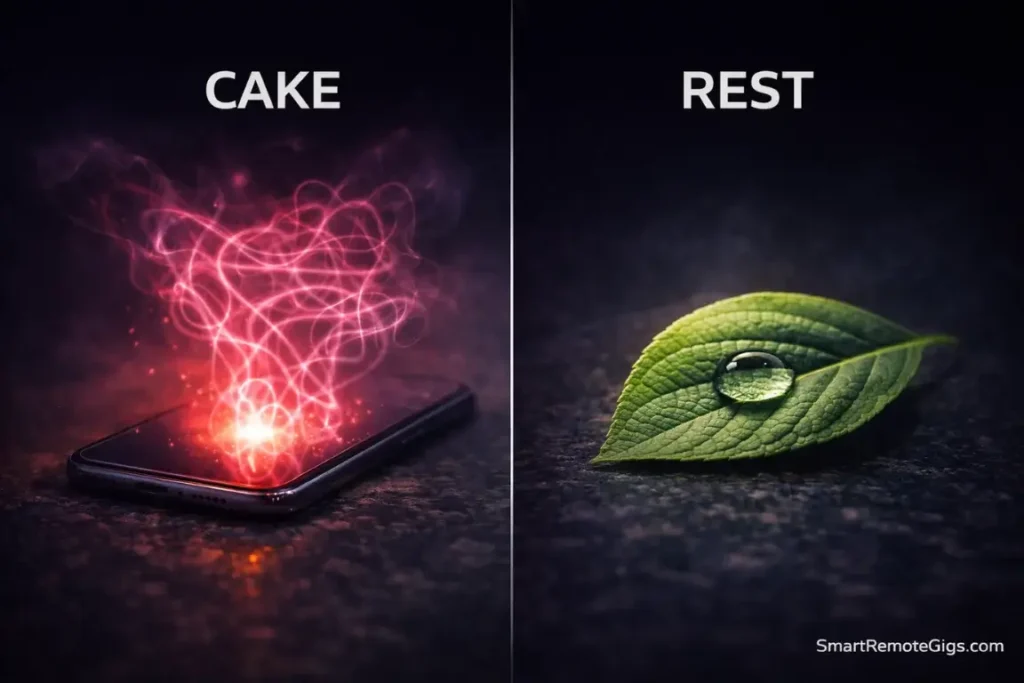
This is the “broccoli vs. cake” dopamine problem.
Your brain just got a massive dopamine spike from scrolling social media—the content is engineered to hijack your reward system with infinite novelty, social validation, and sensory stimulation.
Now you’re asking your brain to return to writing a budget spreadsheet or debugging code. Tasks that provide much slower, smaller dopamine rewards.
Neurologically, you’re asking your brain to choose broccoli after eating cake. It won’t do it. The resistance you feel isn’t weakness—it’s your reward system operating exactly as designed.
The research:
Studies on context switching and dopamine show that high-stimulation activities during breaks don’t restore focus—they deplete it by creating a dopamine comparison that makes returning to work neurologically painful.
Your break becomes what I call a “pseudo-rest”—you stopped working, but you didn’t actually recover. You just switched to a different high-cognitive-load activity (processing infinite content streams).
The Fix: The “Digital Sabbath” Break
Your breaks must be:
- Analog (no screens)
- Movement-based (physical activity)
- Restorative (genuinely relaxing)
Good break activities:
- Walk around the block (or just to another room)
- Do 10-20 jumping jacks or push-ups
- Stretch, especially neck and shoulders
- Make tea or coffee mindfully
- Look out a window and let your eyes focus on distant objects
- Pet your dog/cat
- Do breathing exercises (4-7-8 pattern)
- Organize one small thing (your desk, a drawer)
Bad break activities:
- Checking email (work in disguise)
- Social media (dopamine hijacking)
- News or YouTube (infinite scroll trap)
- Texting (social obligation creating stress)
The goal is to restore your nervous system, not replace one cognitive load with another.
The “Analog Menu” strategy:
Before starting work, write down 3-5 break activities you’re allowed to do. Keep the list visible. When the timer rings, pick one—don’t negotiate.
If you find it impossible to ignore your phone during breaks, see our guide on Pomodoro for ADHD for specialized dopamine management strategies.
Mistake #4: Letting “Internal Distractions” Win
The mistake: You’re focused. Then you remember: “I need to email Sarah about that meeting.” Or “Did that package arrive?” Or “I should research that thing I just thought of.”
You stop working to handle the thought. Or you try to ignore it, but it keeps nagging at you. Either way, your focus is broken.
Why this kills focus:
Internal distractions are sneaky because they feel productive. “I’ll just quickly send this email” seems responsible. But each interruption:
- Breaks your cognitive load: Working memory resets
- Creates attention residue: Part of your brain stays on the interruption
- Compounds throughout the session: Each distraction makes the next one easier
By the end of the Pomodoro, you’ve handled six “quick things” and made zero progress on your actual task.
The Fix: The “Parking Lot” Method
Keep a piece of paper or digital note visible labeled “Later” or “Parking Lot.”
When an internal distraction hits:
- Write it down immediately (one line, exact action needed)
- Return to work without acting on it
- During your break, decide if it’s urgent
Examples:
- “Email Sarah re: Thursday meeting”
- “Check package tracking #XYZ”
- “Research React hooks tutorial”
- “Add milk to grocery list”
The practice:
This simple act of externalizing the thought eliminates the fear of forgetting it. Your brain can let go because the information is captured.
During your break, review the list. Most items aren’t actually urgent. The few that are can be handled then—or scheduled for a future Pomodoro.
The bonus:
Tracking internal distractions creates data about your distraction patterns. Do you think about email at the 15-minute mark every session? That’s a pattern you can address with better inbox management. Do food thoughts derail you before lunch? Eat a better breakfast.
Many tools in our Best Pomodoro Timer Apps list have built-in “Parking Lot” features to save these thoughts for later. Or, if you want zero friction and no features to distract you, use our Smart Remote Gigs Timer—just you, the clock, and your work. Once you’ve cleared your distractions using the Parking Lot method, it’s the fastest way to start a clean session.
Mistake #5: Rigidly Following the 25/5 Standard

The mistake: You’re a writer, developer, designer, or strategist doing deep creative work. You hit a flow state around minute 18. At minute 25, the timer rings. You stop because “those are the rules.”
You just interrupted your best work to obey a timer invented in 1987.
Why this kills focus:
The 25-minute standard is training wheels, not the final destination.
It’s perfect for:
- Building initial focus capacity
- Administrative tasks (email, scheduling, quick calls)
- People with ADHD who struggle with task initiation
- Anyone new to time-boxing
But it’s terrible for:
- Deep creative work (writing, design, strategy)
- Complex problem-solving (coding, analysis, research)
- Flow state activities that require 60-90 minutes to reach peak output
Research on ultradian rhythms and flow states shows that elite performers work in 90-minute biological cycles, not 25-minute sprints. Your body naturally operates in these longer waves of peak alertness followed by rest periods.
The “Advanced” search intent:
If you’re searching for “advanced Pomodoro” or “Pomodoro not working,” you’ve probably outgrown the beginner cycle. You need adaptive intervals.
The Fix: Adaptive “Flow” Intervals (The 50/10 Rule)
Match your interval to your task type:
For administrative work (email, calls, scheduling):
→ Standard 25/5 cycles work perfectly
For creative/strategic work (writing, coding, design):
→ Use 50/10 cycles (50 minutes focus, 10 minutes break)
For complex problem-solving:
→ Use 90-minute blocks with 20-minute breaks (aligned with ultradian rhythms)
The “Flow Exception” Protocol:
If you’re genuinely in flow when the timer rings:
- Check your body (hydrated? fed? comfortable?)
- If yes, reset for 15 more minutes
- When that timer rings, take your break—no exceptions
- Double your break duration to compensate for the extended session
This honors both flow (your brain’s peak state) and biology (your body’s recovery needs).
The implementation:
Start every new task or project with 25-minute intervals. Once you’ve built momentum and understand the task’s cognitive load, graduate to longer cycles.
Don’t prematurely jump to 90-minute blocks. Build your focus capacity systematically.
Read our complete Pomodoro Technique Guide for the full progression from beginner to advanced intervals.
Frequently Asked Questions
Why is the Pomodoro Technique not working for me?
Usually due to one of two issues: transition anxiety or choosing tasks that lack a clear “definition of done.”
Transition anxiety means you’re afraid that if you stop working, you won’t be able to restart. This is especially common for ADHD brains. The fix: write down your exact next step before breaking, and use external accountability like body doubling.
Vague task selection means your brain doesn’t know what “done” looks like for this session. Without a clear target, you drift. The fix: use the Verb-Noun-Constraint formula to create micro-deliverables.
Also check: Are you using screen-based breaks? Are you working through your rest periods? Are you trying to force 25-minute intervals on tasks that need longer cycles? These mistakes compound quickly.
Should I stop my Pomodoro if I’m in flow?
No—if you’re an advanced user who’s proven you can complete standard cycles consistently.
Use the Flow Exception Protocol:
- Acknowledge you’re in genuine flow (not just momentum)
- Extend for one more interval (15-25 minutes max)
- When that timer rings, stop without negotiation
- Double your break duration to compensate
Critical limits: Never push past 90 minutes without rest. Flow is depleting. Your brain needs glucose, hydration, and mental recovery.
For beginners: Honor the timer even in flow. You’re building discipline first, optimizing second. After 90 days of consistent practice, you earn the right to break this rule strategically.
How do I stop getting distracted during a Pomodoro?
Two strategies: environmental design and the “Note and Postpone” method.
Environmental design:
- Phone in another room (not just on silent)
- Close all browser tabs except what’s needed for the task
- Use website blockers for repeat offenders
- Headphones on (even if no music) to signal “do not disturb”
- Door closed or “in Pomodoro” sign visible
Note and Postpone:
- Keep a “Parking Lot” sheet visible
- Write down every internal distraction immediately
- Return to work without acting on the thought
- Review during your break
The goal isn’t to have zero distractions—that’s impossible. The goal is to capture and defer them instead of acting on them immediately.
Most distractions lose their urgency when you write them down and realize they can wait 18 more minutes.
Conclusion: Turning Failure into Flow
Here’s the truth about Pomodoro “failures”: they’re usually signs you’ve outgrown the beginner version, not signs the technique doesn’t work.
If the 25-minute timer feels like an interruption, you need longer cycles.
If you can’t stop scrolling during breaks, you need analog activities.
If you can’t start tasks, you need better task definition.
If you keep working through breaks, you need to understand biological necessity.
If distractions derail you, you need the Parking Lot method.
None of these are character flaws. They’re system design problems with system design solutions.
The mindset shift:
Stop asking: “Why am I failing at Pomodoro?”
Start asking: “How can I adapt Pomodoro to my actual work?”
The technique is a tool, not a religion. Francesco Cirillo invented it as scaffolding for focus, not as a cage for creativity.
Consistency over perfection:
A “failed” Pomodoro where you completed 18 minutes before distraction is still better than 60 minutes of unfocused drifting. Progress, not perfection.
Track your patterns. Notice what works. Adjust what doesn’t. The data reveals your optimal system.
The Verdict: Pomodoro is a tool, not a cage. If the 25-minute timer feels like a straitjacket, change the timer—not your goals. Graduate to adaptive intervals, customize your breaks, and design the system for your brain’s actual wiring.
Your move: Ready to start fresh? Go back to our Complete Pomodoro Guide and apply these fixes to your next session.
Download our Pomodoro Planning Worksheet and use the “Verb-Noun-Constraint” formula for your next task.
Don’t overthink it. Pick one fix. Test it for three days. Measure what changes.
The timer is running.
Need the foundation? Learn the core method in our Complete Pomodoro Technique Guide.
Want better tools? See our ranking of the 7 Best Pomodoro Timer Apps with features that support these fixes.
Have ADHD? Get specialized adaptations in our ADHD Pomodoro Guide for neurodivergent focus strategies.

![Build AI Second Brain Assistant 2026: Local Setup [Guide]](https://smartremotegigs.com/wp-content/uploads/2026/09/build-your-second-brain-ai-assistant-local-rag-hero-1024x577.webp)
![Second Brain with Claude & Obsidian 2026 [My Setup]](https://smartremotegigs.com/wp-content/uploads/2026/08/claude-obsidian-second-brain-mcp-hero-1024x577.webp)
![Why Your Second Brain Fails 2026: Retrieval Fix [Fix]](https://smartremotegigs.com/wp-content/uploads/2026/08/why-your-second-brain-fails-hero-1024x576.webp)