
Land a Remote Social Media Job in 4 Weeks (No Experience)
 ·
Last Updated: Jan 26, 2026
·
Last Updated: Jan 26, 2026

I stopped applying to “Entry Level” jobs that required 3 years of experience. Instead, I spent 4 weeks building a portfolio that made my experience irrelevant. I got hired on Day 26.
Here’s the Experience Paradox that keeps thousands of talented people stuck: you need a job to get experience, but you need experience to get a job.
It’s a rigged game. And the only way to win is to stop playing by their rules.
This isn’t a “learn social media theory for six months” guide. This is a production sprint. You’re going to build proof of competence so undeniable that hiring managers won’t care about your resume gaps.
You learn by doing. And you’re going to do a lot in the next 28 days.
🗓️ The 28-Day Sprint Calendar
|
Week |
The Mission |
The Deliverable |
|---|---|---|
|
Week 1 |
Build the “Mock” Portfolio |
3 Case Studies (PDF/Notion) |
|
Week 2 |
Optimize Your Digital Identity |
LinkedIn Profile + Resume Rewrite |
|
Week 3 |
The Outreach Blitz |
25 Cold Emails + 10 Applications |
|
Week 4 |
Interview & Close |
Mock Interviews + Negotiation Prep |
No shortcuts. No excuses. Just execution.
The “Permissionless” Mindset
Don’t wait for someone to give you a brand to manage. Create one.
The traditional path says: get a degree, apply for internships, work for free for six months, maybe get promoted to junior coordinator at $35K/year.
The permissionless path says: pick a real business with bad social media, create a month’s worth of content for them (without asking), package it beautifully, and show hiring managers what you can do.
One takes four years and $100,000 in tuition. The other takes four weeks and costs nothing.
The secret? Hiring managers don’t actually care about your education or job titles. They care about one thing: can you create content that drives engagement and revenue?
If you can prove that—with real examples, real metrics, real strategy—your lack of “official” experience becomes irrelevant.
Pro Tip: Hiring managers don’t care about certificates. They care about links. “I completed a 40-hour social media course” is meaningless. “Here’s a link to a campaign I built that generated 50K impressions” gets you the interview.
This is your new operating system: execution over credentials.
Week 1: The “Mock” Portfolio Sprint

This week is pure production. No overthinking. No perfectionism. Just create.
Day 1-2: Pick Your Target Business
You need three different businesses to show range. Here’s your selection criteria:
Business #1: Local service business (gym, salon, coffee shop, real estate agent)
Business #2: E-commerce or product-based business (boutique, skincare brand, local bakery)
Business #3: Personal brand (coach, consultant, author, podcaster)
Find businesses with terrible social media:
- Last post from 3+ months ago
- Fewer than 500 followers
- Blurry photos and no consistent aesthetic
- Zero engagement (no comments, no strategy)
These are easy targets because the “before” state is obvious. Your work will look transformational.
Day 3-5: Create 9 Posts Per Business
You’re creating one month of content (3 weeks at 3 posts per week). Each business gets:
3 Reels/Short Videos:
- Behind-the-scenes content
- Educational “How to” video
- Customer testimonial or transformation story
3 Carousel Posts:
- Tips or listicles (e.g., “5 Signs You Need a New [Their Service]”)
- Before/after transformations
- Common myths debunked
3 Static Image Posts:
- High-quality product/service showcase
- Quote graphics related to their industry
- Promotional offer or call-to-action
Use Canva for graphics (free version works fine). Use CapCut for video editing. Write compelling captions with clear CTAs.
Pro move: Actually shoot/edit one real video for each business. Go to the location, film 30 seconds of footage, edit it. This shows you can handle production, not just theory.
Day 6-7: Package Everything Professionally
Create a case study document for each business using Notion or a PDF:
Title: “Social Media Strategy: [Business Name] Rebrand”
Include:
- Problem statement: “Their current Instagram has 127 followers and hasn’t posted in 4 months”
- Strategy overview: “My approach focused on educational content + community building”
- Content grid: Show all 9 posts in a visual grid
- Sample captions: Include 2-3 full captions to show copywriting skills
- Metrics projection: “Based on similar accounts, this strategy should generate 500-1000 new followers and 5-8% engagement rate in 90 days”
Upload to a free Carrd landing page or host in Notion and make it publicly viewable.
The Verdict: A portfolio of fake work for real brands beats a resume of real work for fake brands. Nobody cares that you weren’t officially hired. They care that you know how to execute strategy.
By Day 7, you have three complete case studies. That’s more portfolio material than most people with “2 years experience” can show.
Week 2: Becoming “Huntable” (LinkedIn Optimization)
Week 2 is about making sure hiring managers can find you and take you seriously.
LinkedIn Profile Overhaul
Your headline is everything. It’s what shows up in search results and determines if people click.
Bad headline: “Recent Graduate | Looking for Opportunities | Social Media Enthusiast”
Good headline: “Social Media Strategist helping Local Businesses Grow | Content Creator | Available for Remote Roles”
See the difference? One screams “unemployed and desperate.” The other screams “professional with a specialty.”
Your About section structure:
- Paragraph 1: What you do and who you help (“I create social media strategies that turn followers into customers for service-based businesses”)
- Paragraph 2: Your approach/philosophy (“I believe the best content educates while it entertains”)
- Paragraph 3: Your availability and call-to-action (“Currently seeking remote social media manager roles. Let’s connect.”)
Keep it under 200 words. Make every sentence count.
The Featured Section: This is where you destroy the “no experience” objection.
Upload your three case studies here as PDFs or link to your Notion page. Add a headline for each: “Coffee Shop Rebrand Strategy,” “E-commerce Content Calendar,” “Personal Brand Growth Plan.”
Now when someone clicks your profile, they immediately see proof of your skills. Experience becomes irrelevant.
Skills section: Add these exactly: Social Media Management, Content Creation, Instagram Marketing, TikTok Strategy, Canva, Video Editing, Copywriting, Community Management, Analytics, CapCut.
Need help writing your bio? Use the tips in our Freelance Proofreading guide to keep it error-free and punchy.
Resume Rewrite
Your resume needs to reflect execution, not aspiration.
Instead of:
“Education: BA in Communications”
Write:
“Portfolio Projects:
- Developed 30-day content strategy for local fitness brand, projecting 800+ follower growth
- Created 12 short-form videos demonstrating product storytelling techniques
- Designed Instagram rebranding campaign for service business with 0% current engagement”
See what happened? You transformed “I went to school” into “I built things.”
List your mock projects like they’re real client work. Because functionally, they are—you did the work, solved real problems, created real deliverables.
Your resume is now a portfolio disguised as a traditional document.
Week 3: The Outreach Blitz (Job Boards Are Slow)
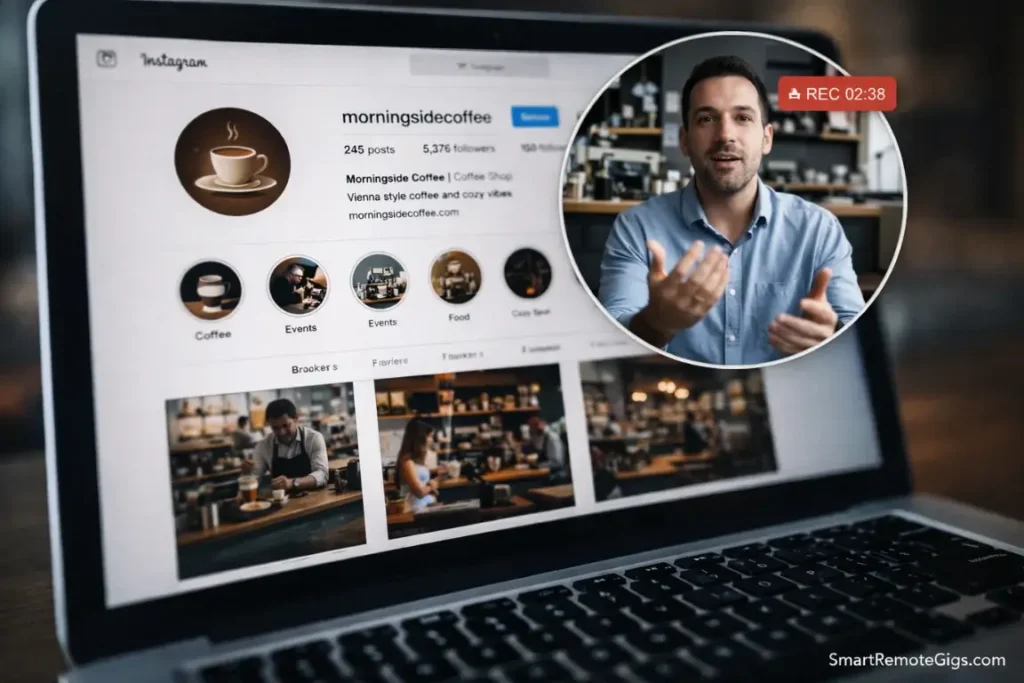
Job boards are where applications go to die. You’re competing with 500 other people for the same role, and 90% of them have “3+ years experience.”
You need to go where the competition isn’t.
Strategy A: The “Value Audit” (My favorite)
Find 25 businesses with bad social media. Create a 2-minute Loom video (free) walking through their Instagram:
“Hi [Name], I came across [Business] while researching [Industry] brands and noticed your Instagram hasn’t been active in a few months. I’m a social media strategist, and I recorded a quick audit of what’s working and what could be improved. No pitch—just wanted to share some quick wins you could implement this week. Here’s the link: [Loom]”
In your video:
- Point out 2-3 things they’re doing well
- Identify 3-5 missed opportunities
- Suggest one immediate action they could take
End with: “If you’re looking for help managing this consistently, I’d love to chat. Either way, hope this was helpful!”
Conversion rate: 20-30% will respond. Half of those will want to hire you or know someone who does.
Why this works: You’re providing value before asking for anything. You’ve already proven you can analyze and strategize. And video makes you memorable.
Strategy B: Niche Job Boards
Skip Indeed and LinkedIn Jobs. Go where remote-first companies actually post:
- We Work Remotely
- Remote.co
- FlexJobs ($15/month, worth it for curated listings)
- Angel List (startups always need social media help)
- Dynamite Jobs
Apply to 10 positions this week. Customize every application—reference something specific from their website or social media to prove you actually researched them.
Don’t know what to write? Use the templates in Freelance Cold Emailing.
Strategy C: Direct Company Outreach
Make a list of 20 companies you’d actually want to work for. Don’t check if they have open positions—just email their marketing director or founder:
“Hi [Name], I’ve been following [Company] for a while and noticed [specific observation about their social media]. I’m a social media strategist specializing in [their industry], and I’d love to explore if there’s an opportunity to contribute to your team—either as a contractor or full-time hire. I’ve attached a quick case study showing how I approach [relevant challenge]. Would you be open to a 15-minute call?”
Hit rate: 5-10% will respond. That’s 1-2 conversations from 20 emails.
Pivot Point: Hate applying? Skip the job search entirely and start your own agency. Read How to Start a Virtual Assistant Business to learn the freelance model where you’re the boss from day one.
Week 4: Nailing the “No Experience” Interview

You’re going to get asked about your lack of experience. Prepare for it now.
The Question: “You don’t have any professional experience in social media. Why should we hire you?”
Terrible answer: “I’m a fast learner and really passionate about social media!”
Winning answer: “I don’t have employment history in this field, but I have execution history. Last month I built a complete rebranding strategy for a local coffee shop—here’s the link. I created 12 pieces of content, wrote all the captions, and designed a 30-day rollout plan. The strategy projects 1,000+ new followers in 90 days based on engagement benchmarks in similar accounts. I learn by doing, and I’ve already done the work you’d be hiring me to do.”
Then you share your screen and walk them through your portfolio.
This destroys the experience objection. You’re not defending your lack of credentials. You’re proving they’re irrelevant.
Common Interview Questions & Your Answers
“What social media platforms are you most experienced with?”
“I’m strongest on Instagram and TikTok because that’s where short-form video performs best right now. I’ve also managed LinkedIn content for B2B brands and understand the different content strategies each platform requires. Here’s an example of how I’d approach your [Industry] audience differently on each platform…”
“How do you measure success?”
“It depends on the business goal. If we’re building brand awareness, I track reach and follower growth. If we’re driving sales, I focus on click-through rates and conversion tracking. For community building, engagement rate matters most. I always start by asking: what’s the business outcome we’re trying to achieve? Then I work backwards to identify the metrics that matter.”
“How would you handle a PR crisis on social media?”
“First, I’d assess severity—is this a legitimate complaint or a troll? For real issues, I’d acknowledge it publicly within 2 hours, move the conversation to DMs for resolution, and follow up publicly once resolved. I’d also loop in leadership before making any public statements. The goal is to show we’re responsive without escalating or feeding negativity.”
The Salary Question
When they ask “What are your salary expectations?” don’t lowball yourself.
For full-time remote roles: $40,000-$50,000/year is reasonable for entry-level remote social media positions.
For contract/freelance: $25-35/hour starting, with a plan to increase to $40-50/hour within 6 months.
Unsure about typical rates? Check our detailed breakdown in Remote Social Media Manager Jobs.
Power move: “Based on my research of similar remote roles, I’m targeting $45,000-$50,000 annually. But I’m flexible if the role offers strong growth potential and mentorship. What’s the range you’re working with?”
This shows you’ve done homework, have reasonable expectations, and are open to negotiation.
Frequently Asked Questions
Can I get a social media job with no degree?
Absolutely. Social media is a skills-based field where your portfolio matters infinitely more than your diploma. I’ve seen high school students get hired over marketing majors because they had better portfolios. Companies care about results—can you create engaging content and grow their audience? Prove that, and your education becomes a footnote.
Where do I find entry-level remote social media jobs?
We Work Remotely, Remote.co, FlexJobs, and Angel List post legitimate remote positions daily. Also search “social media coordinator” or “social media assistant” on LinkedIn—filter for remote and posted within the last week. Don’t sleep on direct outreach either—emailing companies you admire often works better than job boards.
What should be in a social media portfolio?
3-5 case studies showing different content types and industries. Each case study should include: the business/brand you created content for, the strategy/goal, 6-12 sample posts with captions, and projected metrics. Show variety—mix static posts, carousels, and video. Include actual analytics if you managed a real account, or benchmark projections if it’s mock work.
Conclusion: You Are Ready Now
Experience isn’t given. It’s created.
Every expert you admire started with zero credentials and built proof through action. They didn’t wait for permission. They didn’t wait for the “perfect time.” They just started creating.
You have everything you need right now. A laptop. Free design tools. Real businesses with bad social media. And 28 days to prove what you can do.
The difference between you today and you hired in four weeks isn’t talent. It’s execution.
Start Week 1 today. Pick a brand. Open Canva. Go.
Stop reading. Stop researching. Stop waiting for someone to give you a chance.
You’re giving yourself the chance. Right now.

![AI Content Writer Jobs: [My 2026 Survival Playbook]](https://smartremotegigs.com/wp-content/uploads/2026/04/ai-content-writer-jobs-survival-playbook-1024x577.webp)
![Remote Copywriting Jobs 2026: [High-Ticket Method]](https://smartremotegigs.com/wp-content/uploads/2026/04/remote-copywriting-jobs-high-ticket-method-guide-1024x577.webp)
![Remote Technical Writing Jobs: [The $80K/Yr Guide]](https://smartremotegigs.com/wp-content/uploads/2026/04/remote-technical-writing-jobs-hero.webp)