You’re reading a restaurant menu and you’ve already spotted two typos before the waiter arrives. If spotting errors feels like a reflex, you already have a monetizable skill. Becoming a freelance proofreader no experience needed is entirely possible in 2026. At Smart Remote Gigs, we built our platform to help detail-oriented introverts turn their natural quiet focus into a profitable career. The market has never needed human eyes more than it does right now.
With the explosion of self-publishing and AI-generated content, the demand for human polish has surged. Machines write fast. They also hallucinate, repeat themselves, and break grammar rules in ways that are subtle enough to slip past automated tools. Human proofreaders catch what software misses — and publishers, bloggers, authors, and businesses are paying real money for that catch.
This guide walks you through exactly how to go from “person who notices typos” to “person who gets paid to notice typos.” No degree required. No prior clients needed.
Warning: Proofreading is NOT the same as copy editing. A proofreader fixes mistakes — spelling, grammar, punctuation, formatting errors. A copy editor rewrites for clarity, flow, and structure. Many beginners over-edit and accidentally rewrite the author’s voice. That’s not your job. We draw that line clearly in Step 1.
The Proofreading Launchpad: What to Expect at Each Stage

Career Stage | Avg. Rate (Per Hour) | Time to First Client | Difficulty |
|---|---|---|---|
Beginner (General proofreading) | $15–$20/hr | 1–2 Weeks | Medium |
Intermediate (Niche specialization) | $25–$35/hr | 1 Month | High |
Expert (Technical / Legal / Medical) | $40–$75+/hr | 3 Months | Very High |
Step 1: Understand the Job (Proofreading vs. Editing)
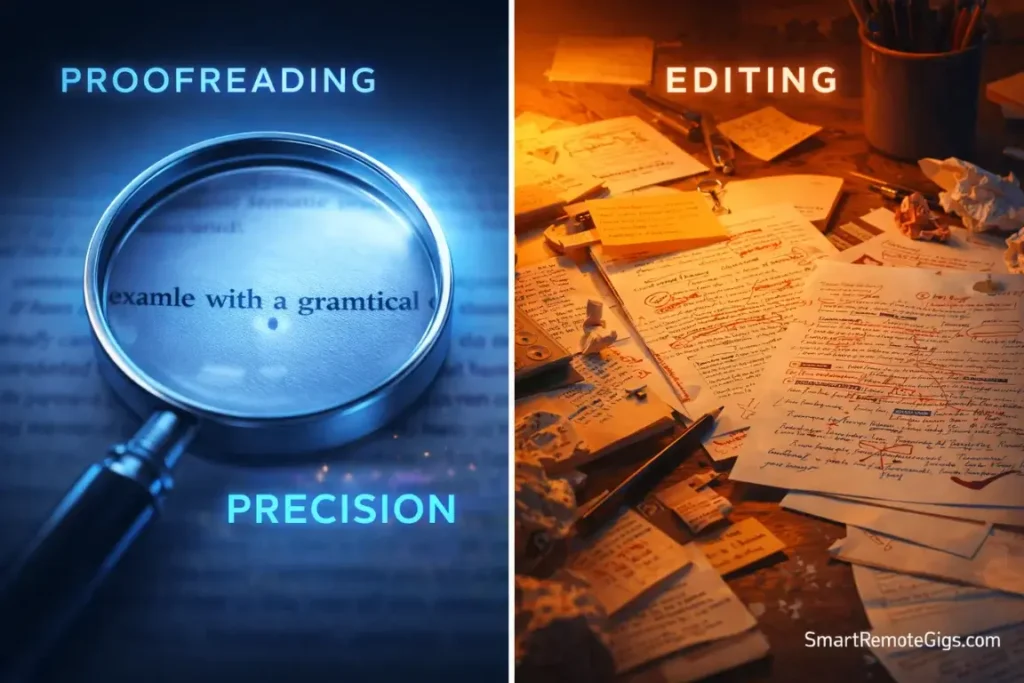
Before you take a single client, you need to understand exactly where your job starts and ends. This is the mistake almost every beginner makes: they over-edit. They rewrite sentences for clarity, restructure paragraphs, change the author’s word choices. And then the client is upset — not because the work was bad, but because it wasn’t what they hired for.
Proofreading is the final pass. It happens after editing is already done. You are the last set of eyes before something goes public. Your job is purely corrective, not creative.
Here’s the line drawn clearly:
Task | Proofreading ✅ | Copy Editing ❌ (Not Your Job) |
|---|---|---|
Spelling errors | Fix them | — |
Grammar mistakes | Fix them | — |
Punctuation errors | Fix them | — |
Formatting inconsistencies | Fix them | — |
Awkward sentence flow | Flag it (don’t rewrite) | Rewrite for clarity |
Weak word choices | Leave it alone | Suggest stronger alternatives |
Structural problems | Leave it alone | Reorganize sections |
Tone and voice | Preserve it exactly | Adjust for brand/audience |
The practical rule: If the author wrote it that way on purpose, leave it. If it’s objectively wrong by the rules of the chosen style guide, fix it. If you’re unsure, add a comment — never silently change it.
This discipline is what separates professional proofreaders from well-meaning friends who “clean up” someone’s writing and accidentally remove their personality.
If you find yourself drawn more to the big-picture work — structure, voice, narrative flow — proofreading might feel too constrained. In that case, check our Remote Jobs for English Majors guide, which covers the full range of writing and editing careers and helps you find the right fit.
Step 2: Essential Tools for the Modern Proofreader
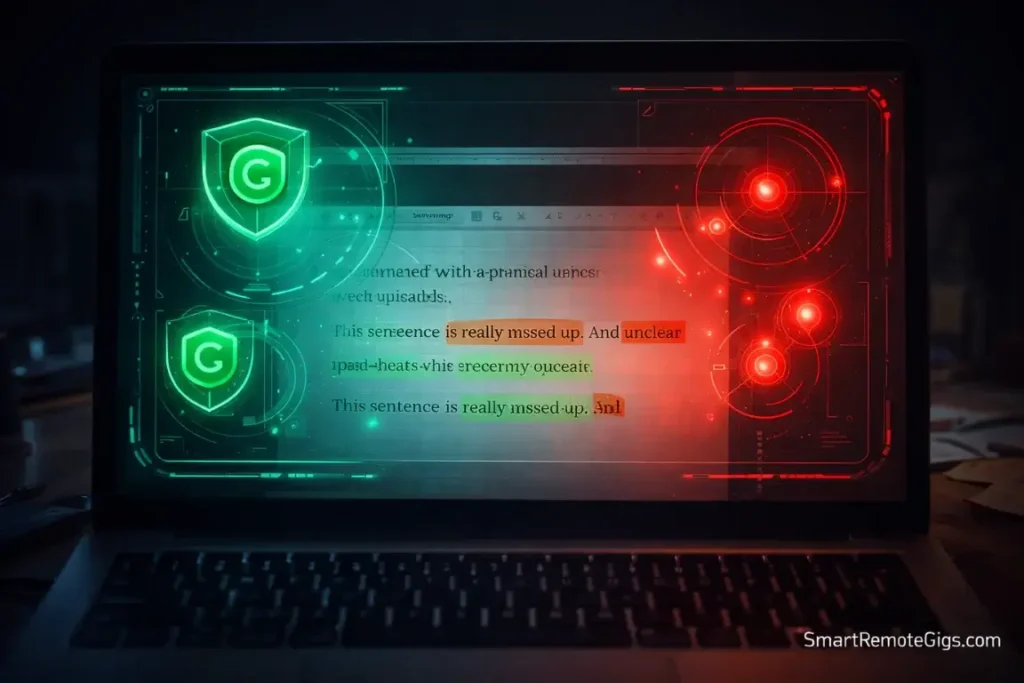
Forget the red pen. The modern proofreading workflow is entirely digital, and the right tools don’t just help you work faster — they act as a safety net for errors your tired eyes might miss on a sixth read-through.
Grammarly & Hemingway (The Safety Nets)
Grammarly is the industry standard for real-time grammar and spell-checking. Use it as a first-pass scanner — it catches low-hanging errors quickly so you can spend your actual attention on the subtler issues that software misses.
The important caveat: Do not treat Grammarly as the final word. It flags things that are stylistically unconventional but grammatically fine. It misses context-dependent errors (“the meeting is on Tuesday” when the document says it’s Wednesday). It is a safety net, not a replacement for your judgment.
Hemingway Editor is useful for flagging overly complex sentences and passive voice — more relevant if you’re crossing into light editing territory, but worth understanding so you can explain to clients what it flags.
The most important tool you actually need: Microsoft Word’s Track Changes feature, or Google Docs’ Suggesting Mode. These are how 90% of clients want corrections delivered. Every change you make is visible, reversible, and attributed to you. If you’re not already fluent in both of these, spend an afternoon on them before your first client job.
🛠️ Tech Assist: Beyond Grammarly, modern proofreaders use AI to catch complex structural issues. Browse the top-rated safety nets in our Paraphrasing & Editing Tools Directory to bulletproof your client deliverables.
Style Guides (The Rules)
A style guide is the rulebook that determines how you handle judgment calls — whether to use the Oxford comma, how to format numbers, whether to spell out “percent” or use the symbol. You cannot proofread professionally without knowing which guide governs the document you’re working on.
The two you need to know:
- AP Stylebook: Standard for journalism, blogs, online content, and most digital publishing. No Oxford comma. Numbers under 10 are spelled out. Clean, spare, web-optimized.
- Chicago Manual of Style: Standard for books, academic publishing, and long-form non-fiction. Oxford comma used. More detailed guidance on citations and footnotes.
Pro Tip: Pick one style guide to master first. If you’re targeting bloggers, content marketers, and online publications, start with AP Style — it covers 80% of the freelance market. If you’re targeting self-published authors and book manuscripts, start with Chicago. Trying to learn both simultaneously at the start is a fast path to confusion and inconsistency.
Step 3: Building a Portfolio Without Clients
This is the part everyone asks about. And it’s the part that feels like a catch-22: you need experience to get clients, and you need clients to get experience. Here’s how to break that loop without lying on your resume or working for insulting rates.
Volunteer Proofreading
The fastest way to get real samples is to offer free proofreading to organizations that produce written content but can’t afford professional editing.
Where to find them:
- Local non-profit organizations (newsletters, annual reports, donor letters)
- Student newspapers and literary journals at nearby universities
- Small churches or community groups with weekly bulletins or websites
- Reddit communities like r/destructivecriticism or r/writing, where authors actively seek feedback
What you get in return: Real documents, real corrections, and — if you ask directly — a written testimonial about your accuracy and professionalism. That testimonial is worth more than a certificate from an online course in the early stages.
How to ask for the testimonial: Don’t be passive. After completing the work, send a short note: “I’m building my freelance proofreading portfolio. If you were happy with the work, I’d love a one or two-sentence testimonial I can use on my website or Upwork profile. Even a few words about what you found useful would mean a lot.”
Most people say yes. Almost no one thinks to ask.
The “Beta Reader” Approach
Self-published authors on platforms like Amazon KDP and Smashwords are a massive underserved market. Many publish their first books with minimal editing budget and desperately need a careful reader.
The strategy: Join self-publishing communities on Facebook, Reddit (r/selfpublish, r/fantasywriters), or Absolute Write. Offer to beta read and proofread 10–20 pages of a manuscript for free in exchange for a written testimonial.
Be specific in your offer: “I’ll return a fully proofread sample chapter with all errors marked in Track Changes, along with a brief note on any style inconsistencies I noticed throughout.” That specificity signals professionalism and sets you apart from the casual readers they’re used to dealing with.
After two or three of these, you have real samples, real testimonials, and a clear service to describe on a profile.
If the idea of hunting for errors still feels like pressure and you want to build general remote work habits first, consider starting with Entry Level Data Entry Jobs to build your typing speed, digital file management habits, and screen-time endurance before pivoting to proofreading.
Step 4: Where to Find Your First Paying Gigs
Once you have two or three portfolio samples — even unpaid ones — you’re ready to start applying for real work. Here’s where to actually look.
General Freelance Marketplaces
When starting out, you need volume. Here are the best platforms to land those crucial first clients:
Upwork
Best for: Building a fast portfolio with one-off projects.
Upwork is the highest-volume freelance marketplace for proofreading. Set your rate low to start ($15–$18/hr), complete 3–5 jobs with strong reviews, then raise it incrementally. The review system is everything here — one 5-star review from a verified client is worth more than any credential.
Fiverr
Best for: Package-based, predictable gigs without writing proposals.
Create a gig: “I will proofread up to 1,000 words for $15.” The lower price point attracts beginner-friendly clients and lets you accumulate reviews quickly. Once you have 20+ reviews, raise your prices and let the algorithm bring clients to you.

Reedsy
Best for: Intermediate proofreaders targeting self-published book authors.
A curated marketplace specifically for book publishing professionals. It’s harder to get accepted as they review your portfolio, but the clients are serious authors with real budgets. Worth applying once you have three solid samples.
We reviewed the top platforms and their actual pay structures in our Best Freelance Websites for Beginners guide — including which ones have the most scam clients and which ones actually protect freelancer payments.
Cold Pitching Bloggers
This is the most underused client acquisition strategy in proofreading — and it works because the competition for it is almost nonexistent. Most new proofreaders sit on Upwork waiting. The smart ones go find clients directly.
The system:
- Find a blog with active publishing and visible errors. Search Google for topics you understand well (food, finance, travel, fitness) and read 3–4 recent posts from smaller blogs (10K–100K monthly visitors). You’re looking for consistent typos, punctuation errors, or formatting issues.
- Document 3–5 specific errors. Screenshot them or note the exact sentence and mistake. This is your proof of value.
- Send a short, non-creepy pitch. Use the contact form or a public email address. Keep it to four sentences:
“Hi [Name], I’ve been reading [Blog Name] and genuinely enjoy your content on [topic]. I noticed a few small errors across recent posts that might affect how professional the site reads to new visitors — happy to share specifics if helpful. I’m a freelance proofreader and I’d love to offer a free cleanup of three posts as an introduction to my work. If you’re interested, just reply here and I’ll send over what I found.”
- Deliver excellent free work on those three posts. Return clean documents, explain what you fixed, and be easy to work with.
- Pitch a retainer. “I could proofread all new posts before they go live — typically a 24-hour turnaround. Based on your posting frequency, that would be around X posts per month. I’d offer a monthly rate of $[price] for ongoing work.”
💡 SRG Tool Tip: When you land that first blogger retainer, don’t stress about the paperwork. Bill them professionally in 60 seconds using our Free Invoice Generator so you can focus on the words, not the accounting.
A single retainer client at $150–$300/month means predictable income while you build everything else. And bloggers who’ve experienced the difference between proofread and unproofread posts almost always say yes to the retainer.
Step 5: Setting Your Rates (Don’t Undersell)

Pricing is where most new proofreaders make their first and most lasting mistake. They charge so little that clients don’t take them seriously — and then burn out because they’re doing real work for $5 an hour.
Two pricing models to understand:
Per-hour pricing: You charge a flat hourly rate. Simple to communicate. But it penalizes you if you’re a naturally slower, more thorough reader — and it rewards you for rushing.
Per-word pricing: You charge based on the length of the document (e.g., $0.01 per word = $10 for a 1,000-word blog post). More common in publishing and manuscript work. Protects slower readers because your rate is fixed regardless of how long the document takes.
Per-page pricing: Common for academic and legal documents. Typically $3–$7 per page for general proofreading.
💰 SRG Tool Tip: Not sure what $0.01/word translates to based on your natural reading speed? Use our Free Freelance Hourly Rate Calculator to map your per-word rate to your monthly income goals and ensure you aren’t undercharging.
Verdict: Charge per word when starting. A rate of $0.01–$0.02 per word is the industry-standard beginner range. It protects you if you’re a methodical reader, and it’s easy for clients to calculate — they know exactly what they’ll pay before they commit. Once you have a reliable sense of how long different document types take you, you can switch to hourly pricing for greater efficiency.
Market rate reference:
- General blog proofreading: $0.01–$0.015/word
- Book manuscript proofreading: $0.015–$0.025/word
- Academic / research papers: $0.02–$0.04/word
- Legal / medical documents: $0.04–$0.08/word (requires specialized knowledge)
The psychological rule: Never price below what makes the work feel worth doing. If you’re charging $8 to proofread a 1,000-word post and you spend 45 minutes on it, you’ll start cutting corners. Clients don’t get your best work. You don’t get a sustainable career. No one wins.
Frequently Asked Questions About Freelance Proofreading
Do I need a degree to be a proofreader?
No — and this is one of the most liberating things about the profession. Clients don’t ask for your transcript. They give you a test document, or they review your portfolio samples, and they make a decision based on demonstrated accuracy, not credentials.
An English, Journalism, or Communications degree is helpful context, but it’s not a gatekeeper. I’ve seen biology graduates become excellent proofreaders because their scientific precision transferred directly to error-spotting. The skill matters far more than the diploma.
What does help: completing a recognized proofreading course. The Society for Editors and Proofreaders (CIEP) and Proofread Anywhere both offer structured training that clients recognize. Not required, but it signals commitment and gives you a structured learning path.
Is proofreading in demand in 2026?
Yes — and the AI boom is a significant part of why. As AI-generated content floods blogs, newsletters, marketing materials, and self-published books, human proofreaders are increasingly valuable for exactly the tasks AI handles poorly: catching contextual errors, preserving authorial voice, noticing when something reads as machine-generated and emotionless, and fact-checking claims against reality.
The irony is real: the same technology that some feared would eliminate proofreaders has actually increased demand for human oversight of written content. Publishers, brands, and authors who relied purely on AI writing tools quickly discovered that the output needs a human pass before it’s fit to publish.
How much do beginner proofreaders make?
Beginners typically earn $15–$25 per hour, or $0.01–$0.015 per word, in their first three to six months. That translates to roughly $200–$600/month part-time if you’re working evenings and weekends around another job.
Within 6–12 months of consistent work and niche specialization, $35–$50/hour is realistic. Specialized proofreaders in legal, medical, or academic markets earn $50–$75+/hour with an established client base.
The trajectory is slower than, say, freelance writing — but the ceiling is real, the work is deeply satisfying if you’re wired for it, and the competition thins dramatically as you move into specialized niches.
How do I handle it when a client pushes back on my corrections?
This happens, and it’s usually one of two things: the client disagrees with a style choice (which is their right — defer to them), or they don’t understand why something is wrong (which is a teaching moment, not a conflict).
Develop the habit of leaving brief comments explaining why you made a correction: “Changed to ‘its’ (possessive, no apostrophe) per AP Style §4.7.” That context prevents most disputes before they start. When a client pushes back, respond with the rule, not the argument. You’re the professional. You cite the style guide and let them decide.
Is This the Right “Quiet Career” for You?
Proofreading isn’t for everyone. Before you invest time building a portfolio, be honest with yourself about the following:
You’ll love proofreading if: Rules bring you comfort rather than frustration. You notice errors reflexively, without trying. You can read the same paragraph six times and find something new each time. You prefer correcting to creating.
You’ll find it limiting if: You want to rewrite and improve rather than just fix. Creative expression matters more to you than precision. You find rule-based work tedious rather than satisfying.
Verdict:
If you love rules and structure: Proofreading is your career. The discipline required — stay in your lane, don’t over-edit, master one style guide at a time — is a feature, not a bug, for the right personality.
If you prefer creative freedom: Writing or copy editing is a better fit. More latitude, different skills, similar income potential.
If you just want to type fast: Entry Level Data Entry Jobs will get you earning faster with lower barrier to entry.
Your first client is closer than you think. Start by proofreading your own LinkedIn profile with fresh eyes — treat it like a client document and fix every error you find.
At Smart Remote Gigs, we know that the best careers don’t always require the loudest voices. Check our master guide on the 15 Best Remote Jobs for Introverts to see the full landscape of quiet, text-based careers where your skills fit.
The typos are out there. Someone has to catch them. It might as well be you.