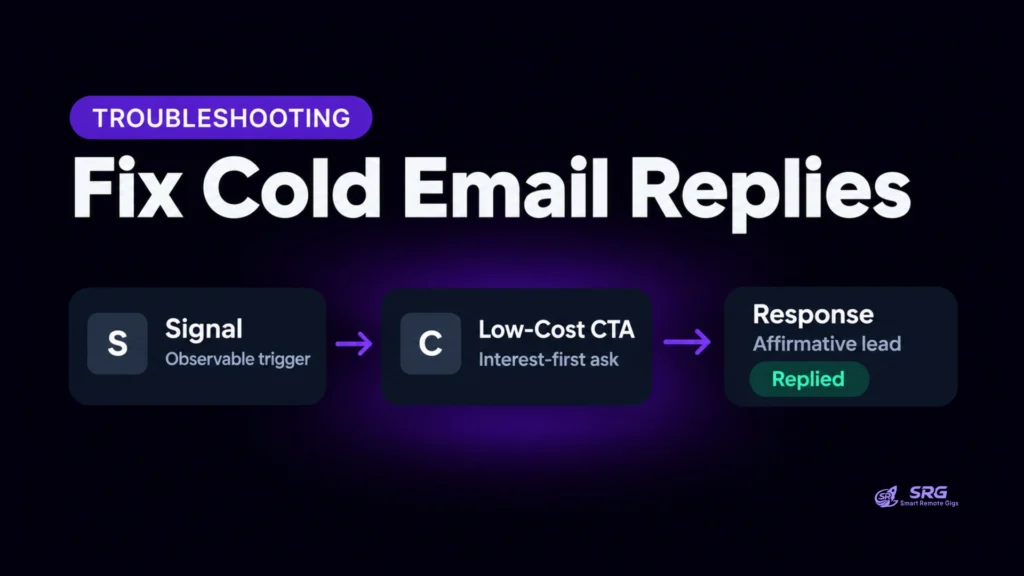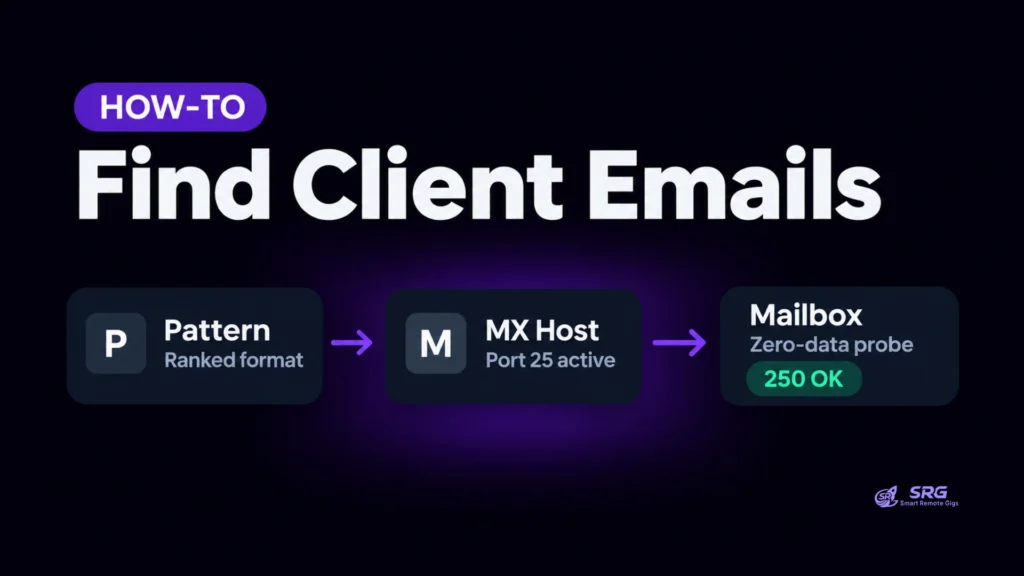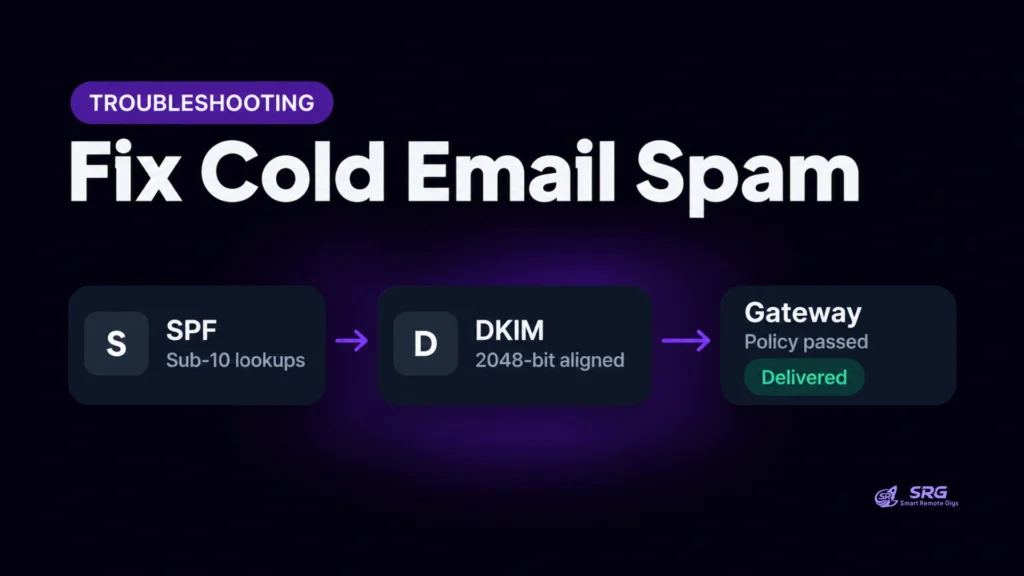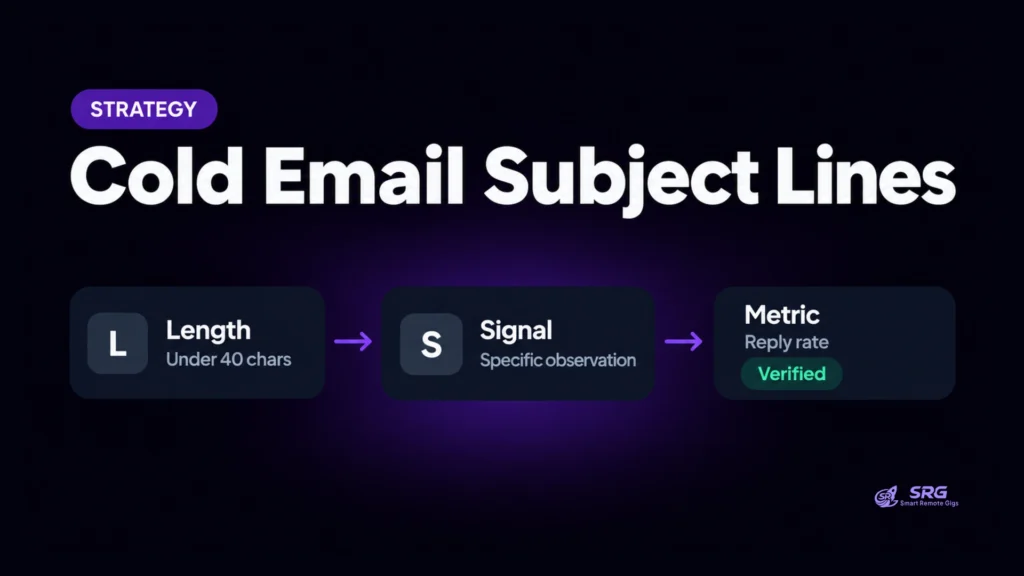


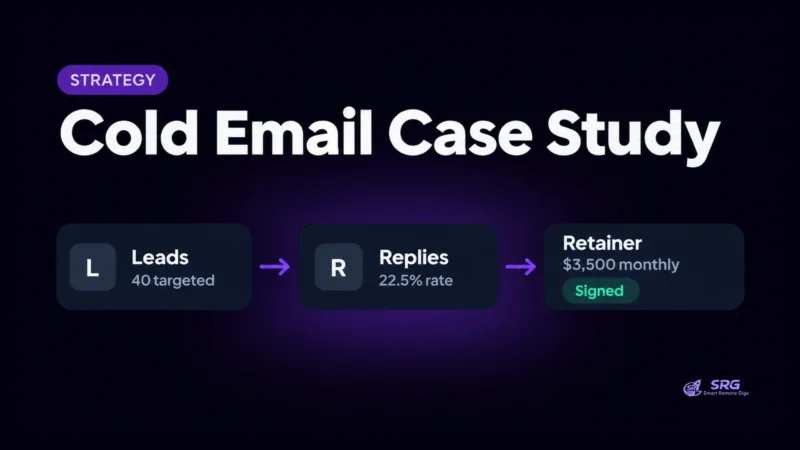
This freelance cold email case study follows a 40-account outbound sprint from first send to signed retainer: 39 messages delivered, 9 human replies, 4 discovery calls, and 1 contract at $3,500 per month. The central design choice was restraint. Hand-qualified accounts, authenticated secondary domains, and a four-touch cadence replaced high-volume broadcasting, which carries reputation risk as spam complaints approach the ceilings in Google’s Email Sender Guidelines.
The teardown is written for freelance consultants and technical solo operators who sell services to funded B2B software teams. It suits operators moving from mass-send templates to a measured pipeline. Every stage is logged, from sending infrastructure through objection handling and hours invested.
SRG Research Desk compiled the sprint logs and set each result against linked industry benchmarks. The sprint is one campaign, not a controlled experiment, and the text says so wherever that limit matters. Software pricing is excluded by design and sits in the Instantly platform specifications.
SRG Direct Answer: The 40-Lead Signal-First Protocol
- Campaign Scope: 40 hand-qualified B2B accounts, solo outreach execution.
- Delivery Integrity: 97.5% (39 of 40 delivered; 1 soft bounce; no spam complaints logged).
- Response Density: 22.5% account reply rate (9 replies across 4 touches; 23.1% of delivered messages).
- Pipeline Yield: 10.0% call conversion (4 discovery calls booked, 1 signed retainer at $3,500 per month).
- Governing Protocol: Logged sprint data plus linked industry benchmarks; no unsourced claims.
Core Execution Rules: (1) Qualify each account against a visible buying trigger before sending. (2) Authenticate secondary domains, warm them for 21 to 28 days, and pace sends well below mailbox caps. (3) Judge the campaign by replies and held calls, not opens.
Epistemic Classification: Documented Vendor Fact (linked benchmarks and platform rules) · Empirical Client Observation (logged sprint data) · SRG Operational Safeguard (derived procedures).
Three controls shape the sprint: targeting discipline, technical authentication, and diagnostic relevance in the message itself. Removing any one of them weakens the others. Weak targeting wastes sends, weak authentication loses inbox placement, and weak relevance turns delivered mail into ignored mail.
The sections below follow the campaign in order: parameters, funnel, messaging, replies, objections, economics, and failure points.
1. Campaign Parameters: The 40-Account Outbound Architecture
The sprint targeted 40 funded B2B software companies and sent from two authenticated secondary domains that had completed a 24-day warmup. This section documents the targeting criteria, the domain isolation model, and the authentication and pacing rules.
Account qualification. Each account matched one firmographic profile: Series A to B funded B2B SaaS companies with 25 to 150 employees in the United States or Canada, with a VP of Engineering or CTO as the contact. Each account also needed a visible buying trigger, such as open engineering roles that point to a team bottleneck, a recent tech stack migration, or an executive leadership transition.
Phase 1 took 3.5 logged hours and covered funding announcements, open engineering job posts on the Smart Remote Gigs Exchange, and CTO tenures. The method for building the account list is covered in how to build a prospect list.
Domain isolation. Sending ran from two secondary domains, @consulting-sprint.io and @techservices-outreach.com, configured in Google Workspace. This SRG Operational Safeguard keeps any reputation damage on the secondary domains instead of the primary corporate domain.
Authentication. Both domains carried an SPF record (v=spf1 include:_spf.google.com ~all), 2048-bit DKIM keys, and a DMARC policy set to p=quarantine. Google’s Email Sender Guidelines require every sender to configure SPF or DKIM. Senders above 5,000 messages per day to Gmail must configure both, publish a DMARC policy (minimum p=none), and align the From domain.
The three protocols are defined in RFC 7208 (SPF), RFC 6376 (DKIM), and RFC 7489 (DMARC). The sprint sent far below that threshold and still implemented all three, which is a safeguard choice and not a vendor requirement. The Google Workspace SPF configuration rules cover the SPF record format, and full DNS walkthroughs belong to why cold emails go to spam.
The same Google guidelines set the spam-rate targets that govern pacing: keep user-reported spam below 0.10% and never reach 0.30%.
Warmup and pacing. Both mailboxes ran an automated warmup for 24 days through an automated peer warmup network. In these networks, mailboxes exchange messages, mark them important, and trigger simulated reply threads to build sender reputation. MailReach’s email warmup documentation describes this mechanism over two to four weeks.
Instantly’s technical deliverability guide documents a 30-email daily cap per inbox, and both sources place the safe sending ceiling at 30 to 50 emails per mailbox per day after a 21 to 28 day warmup. The 24-day run sits inside that window.
The sprint paced Touch 1 at 10 sends per mailbox per day across two days. For tooling options see cold email outreach tools, and for plan-level details see the Instantly platform specifications.
2. The Quantitative Funnel: 40 Leads from Send to Retainer
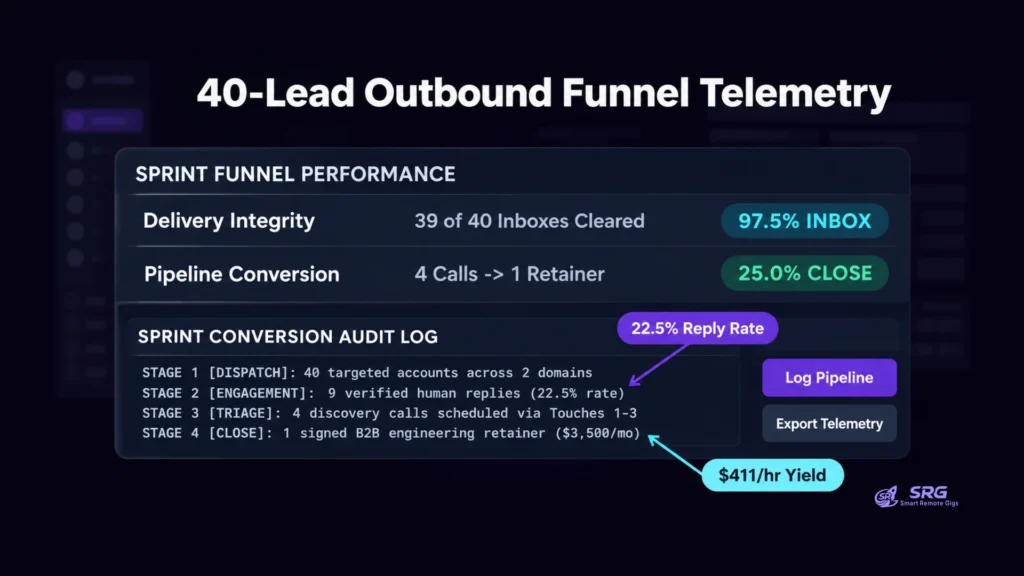
The sprint converted 40 targeted accounts into 39 delivered messages, 9 replies, 4 discovery calls, and 1 retainer. The table shows each transition, with every rate calculated by SRG from the logged counts.
| Funnel Stage | Volume | Stage Rate | Share of 40 Accounts |
|---|---|---|---|
| 1. Targeted accounts | 40 | 100.0% | 100.0% |
| 2. Mailboxes dispatched | 40 | 100.0% | 100.0% |
| 3. Messages delivered | 39 | 97.5% of dispatched | 97.5% |
| 4. Indicative opens logged | 31 | 79.5% of delivered | 77.5% |
| 5. Human replies | 9 | 23.1% of delivered | 22.5% |
| 6. Qualified discovery calls | 4 | 44.4% of replies | 10.0% |
| 7. Closed retainer ($3,500 per month) | 1 | 25.0% of calls | 2.5% |
Stage 2 depends on contact accuracy, covered in how to find client email addresses.
Delivery integrity. The 2.5% bounce rate came from a single soft bounce, and each address in a 40-account list moves the rate by 2.5 points. SRG’s research notes flag roughly 2% as the point where bounces begin to cancel warmup gains. The 2.0% to 3.0% range is a working reference band, not a vendor-documented threshold.
One bounce therefore sits just above the flag, which is why list validation before dispatch matters. Google Postmaster Tools logged a 0.00% spam rate for the sprint. Postmaster Tools can show empty or delayed metrics for senders under roughly 100 daily Gmail sends because of privacy sampling minimums, so read that zero as no reported complaints, not as a precise measurement.
The open rate mirage. The 79.5% open rate is not a readership figure. (Documented Vendor Fact.) Apple’s Mail Privacy Protection technical specifications state that Protect Mail Activity downloads remote content in the background regardless of whether the recipient engages. Postmark’s open tracking support documentation notes that this can produce a 100% open rate for Apple Mail recipients.
Litmus Apple Mail Privacy Protection resources put Apple at roughly 58% to 62.26% of opens, with Mail Privacy Protection affecting about 55% to 60% of opens. Both sources support an artificial inflation band of 15% to 35% in mixed recipient pools.
(Empirical Client Observation.) Telemetry on 11 accounts showed proxy pre-fetching from Apple iCloud Private Relay addresses within 180 seconds of delivery. Corporate security gateways can also pre-fetch images and scan links, adding distortion independent of Apple. Opens therefore serve only as a directional deliverability signal, such as spotting a severe block. Reply rates and held calls are the two metrics that pixel pre-fetching cannot inflate.
Benchmark comparison. Instantly’s 2026 Cold Email Benchmark Report documents a 3.43% platform-wide average reply rate, 5.5% for the top quartile, and 10.7% for the top decile. Belkins’ B2B response rate study documents 0.45%, measured as unique replies divided by total sends. The sprint’s 22.5% account reply rate is about 6.6 times the Instantly average and 50 times the Belkins figure (calculated by SRG). The Belkins comparison is the closer like-for-like, because both divide replies by total sends.
Three factors explain the gap. Denominators differ across studies, and the Instantly report’s average covers platform-wide senders. Manual account qualification and trigger-matched messaging likely raised relevance, which is an interpretation and not a logged finding. And the sample is small: one reply moves the account rate by 2.5 points. For managing funnel stages after replies arrive, see freelance lead tracking.
3. Anatomy of the Messaging Framework: Touchpoint by Touchpoint
The sprint used a four-touch cadence: a 65-word observation pitch on Day 1, a diagnostic follow-up on Day 4, a peer asset share on Day 8, and a break-up on Day 14. Each touch had one job and one low-friction ask.
Touch 1 (Day 1): the 65-word observation pitch. The body ran exactly 65 words, excluding greeting and sign-off. It followed a three-part structure: an observable operational bottleneck tied to a live engineering trigger, a low-commitment diagnostic value, and a zero-friction closing question (“Worth exploring, or are you fully covered?”). The email produced 3 replies from 39 delivered messages, a 7.69% step-one reply rate.
(Documented Vendor Fact.) Hunter’s 34-million email word count analysis found the highest reply rates under 80 words, with sharp drop-offs past 100. Overloop’s sales outreach length benchmarks report an 8.2% reply rate at 50 to 125 words against 3.9% for messages of 200 words and above.
Instantly’s 2026 Cold Email Benchmark Report states that top campaigns keep emails under 80 words. Boomerang’s 40-million email study found a peak near 51% response at 75 to 100 words, but it covers broader email correspondence, not cold outreach alone.
SRG Pro Tip: Count body words the way the sprint did, excluding greeting and sign-off, before comparing a draft against the 80-word benchmarks. Counting the full message can push a compliant email over the line.
Subject line and template mechanics are covered in cold email subject lines and cold email templates for freelancers. The interactive email subject line tester checks subject drafts before sending.
Touch 2 (Day 4): the frictionless diagnostic follow-up. Touch 2 replaced “did you see my last email?” with a concrete offer: a two-minute asynchronous architecture teardown or checklist. A nudge asks the prospect to do work, while a diagnostic gives the prospect something to evaluate.
Touch 3 (Day 8): the relevant peer asset share. Touch 3 shared a modular framework showing how similar Series A teams addressed the same bottleneck. It adds new information to the thread and keeps the ask light.
Touch 4 (Day 14): the clean break-up. The final touch relinquished commercial pressure, restated the positioning once, and offered a clean opt-out. Closing the loop politely leaves the door open without escalating pressure.
The sprint did not use calendar links with 30-minute commitments in cold touches. Downloadable sequence models are in the freelance cold email template pack, and cadence timing is covered in cold email follow-up strategy.
4. Reply Analysis: Categorizing Prospect Responses Under the Microscope
The sprint logged 9 replies: 3 on Touch 1, 3 on Touch 2, 2 on Touch 3, and 1 on Touch 4. Follow-up touches therefore produced 6 of 9 replies, or 66.7%.
| Touch | Replies | Share of Replies |
|---|---|---|
| Touch 1 | 3 | 33.3% |
| Touch 2 | 3 | 33.3% |
| Touch 3 | 2 | 22.2% |
| Touch 4 | 1 | 11.1% |
(Documented Vendor Fact.) Belkins sales follow-up data reports that 58.6% of replies arrive on sequence steps 2 through 6. The Backlinko outreach study found that a single follow-up lifted replies by 65.8%. Instantly’s cold email reply rate benchmarks point the other way: step one generated about 58% of platform replies and follow-ups the remaining 42%.
The sprint’s 66.7% follow-up share supports the hypothesis that most replies come from follow-ups in this campaign, while the platform-wide figures show the result varies by dataset. With 9 replies, the distribution describes this sprint and is not a forecast.
A plausible reading, offered as interpretation, is that high-context consulting outreach reaches decision-makers who lacked time for the first message, so later touches capture them.
Sentiment classification. All 9 replies fall into three states.
| Reply Sentiment | Count | Share of Replies | Share of 40 Accounts | Prospect Intent |
|---|---|---|---|---|
| Positive | 4 | 44.4% | 10.0% | Direct interest in scheduling a diagnostic call |
| Neutral or referral | 3 | 33.3% | 7.5% | Timing or budget constraints (2) and internal team redundancy (1) |
| Negative or opt-out | 2 | 22.2% | 5.0% | Direct requests to be removed |
Opt-out and suppression hygiene. Both opt-outs were logged in full and suppressed immediately. As an SRG Operational Safeguard, apply suppression across every sending mailbox so a removed contact cannot be re-sequenced, which also limits complaint exposure against the 0.10% and 0.30% spam-rate marks. Legal obligations around opt-outs, including CAN-SPAM and GDPR, vary by jurisdiction and fall outside this teardown.
5. Objection Teardown: Resolving Real B2B Resistance
Three objections shaped the neutral replies, and each has a different non-combative response. The first two scripts below were applied in the sprint. The third is an SRG Operational Safeguard that was not triggered by any of the 9 logged replies.
Objection 1: “We already have an agency or in-house team” (1 account). Arguing against an incumbent usually hardens the refusal, so the logged pivot repositions the consultant as overflow capacity and not as a replacement. It reframes the work around backlogged technical debt while core engineers keep shipping product. The prospect’s stated reason was: “Our internal team handles this internally; we do not use outside freelancers.” The logged script applied (quoted sender-side text):
“Completely respect that, [Name]. Most teams I work with have strong internal engineers. We typically handle the overflow auditing so your core team stays focused on product shipping. If priorities shift when you hit [Milestone], I am happy to be an on-call resource.”
Objection 2: “We don’t have budget, reconnect in Q1” (2 accounts). One reading, offered as interpretation, is that a specific budget cycle or date signals a genuine constraint, while a vague “not now” is more likely a polite brush-off. The logged prospect statement was: “We are locked into current sprint budgets until Q1. Check back in 90 days.” The future-pacing script acknowledges the timing, logs the exact reconnection date in the CRM, and offers an intermediate zero-friction teardown to keep the relationship warm:
“Understood, [Name]. I will document our notes and reconnect on [Exact Date]. In the interim, would it be helpful if I forwarded the teardown of how [Competitor] solved this specific infrastructure bottleneck?”
Bracketed items are variables the operator fills per account.
Objection 3: “Send over pricing and information” (0 accounts in this sprint). This request tends to invite a PDF rate card, which prices the work before the problem is scoped and slows the deal. The scoping pivot explains that deliverables depend on scope and offers a short diagnostic call before any quote. A framing script: “Scope depends on the specific bottleneck, so a number quoted today would be a guess. A 15-minute scoping call produces a figure tied to the actual problem.”
All three responses stay consultative. For diagnosing offer friction across a whole campaign, see why cold emails get no replies.
6. Unit Economics & Pipeline Yield: What 40 Cold Leads Actually Produced
The sprint consumed 8.5 logged hours and produced one retainer at $3,500 per month, a month-one yield of $411.76 per hour (calculated by SRG). Time was spread across five phases.
| Operational Phase | Logged Hours | Share of Total |
|---|---|---|
| 1. Account qualification and signals | 3.5 hrs | 41.2% |
| 2. Contact discovery and SMTP ping validation | 1.0 hr | 11.8% |
| 3. Copywriting and snippet personalization | 2.0 hrs | 23.5% |
| 4. Sequence dispatch and warmup monitoring | 0.5 hrs | 5.9% |
| 5. Reply triage and discovery calls | 1.5 hrs | 17.6% |
| Total | 8.5 hrs | 100.0% |
Qualification and copywriting together took 5.5 of the 8.5 hours, so the work is front-loaded. The ledger lists five phases and does not itemize domain registration or DNS setup time.
Commercial realization. Four discovery calls produced one signed retainer: $3,500 per month, or $10,500 across a three-month agreement.
- Acquisition yield: $3,500 / 8.5 hours = $411.76 per hour (calculated by SRG, month-one cash against acquisition hours only).
- Blended project yield: $10,500 / 53.5 hours = $196.26 per hour (calculated by SRG, acquisition hours plus an estimated 45 hours of delivery).
These figures describe one sprint and one closed contract. They are not a forecast or an income guarantee. Close rates, deal size, and speed depend on consultant positioning, domain expertise, and market demand, and a different operator or market may see different results. With four calls and one close, the 25.0% discovery-to-close rate is a single observation.
7. Operational Post-Mortem: 3 Critical Failure Points to Eliminate
Three failure points carry the most risk: sending before warmup, misreading non-response, and losing follow-ups to poor tracking. The first is a documented risk that the sprint’s pacing avoided, and the other two are execution traps.
Failure Point 1: premature transmission spikes. Google targets a user-reported spam rate below 0.10% and treats 0.30% as the hard ceiling in Google’s Email Sender Guidelines. Crossing it triggers graduated delivery throttling and spam rate quarantine: messages route to spam folders, delivery is deferred, and mitigation support is revoked.
Instantly’s technical deliverability guide and MailReach’s email warmup documentation place the per-mailbox ceiling at 30 to 50 sends per day. They scale volume by adding inboxes, not by pushing one address. The sprint stayed at 10 sends per mailbox per day and logged no delivery rejections or spam placement.
SRG Warning: Crossing a 0.30% user-reported spam rate triggers throttling and spam-folder routing against the sending domain. This is why the sprint isolated sending on secondary domains.
Failure Point 2: the 77.5% non-response reality. Thirty-one of the 40 accounts, including the single bounce, did not reply. The sprint log does not record why, so any explanation is interpretation: unaligned timing, different priorities, or inbox overload are plausible. Even so, the 22.5% account reply rate sits above the 10.7% top-decile threshold in Instantly’s 2026 Cold Email Benchmark Report. Most prospects still do not reply, so plan capacity around that.
Failure Point 3: lead tracking decay and follow-up leakage. Follow-up touches produced 6 of the 9 replies, so dropping them forfeits most of the response volume the sprint logged. As an SRG Operational Safeguard, record every touch, reply, and reconnection date in one dedicated CRM. See freelance lead tracking for stage management and the freelance cold emailing guide for the full strategy.
The Verdict: Documented Decision Boundaries
Choose a hand-qualified sprint of roughly 40 accounts if your service is high-context and you can invest around 8.5 hours per sprint. The sprint combined trigger-based qualification, authenticated secondary domains, and a four-touch diagnostic cadence, and it produced a 22.5% account reply rate. The result rests on one campaign and a small sample.
Choose higher-volume sending only if you can scale horizontally within the 30 to 50 sends per mailbox per day ceiling and keep spam complaints under 0.10%. Under that approach, expect the platform-wide averages documented by Instantly and Belkins, not the sprint’s figures. In either case, judge the campaign by replies and held calls, because opens are inflated by Apple’s background downloads.
Where to go next in the cluster:
- Strategy hub: the freelance cold emailing guide sets the full operating procedure.
- Targeting: how to build a prospect list, with hiring signals on the Smart Remote Gigs Exchange.
- Enrichment: how to find client email addresses.
- Deliverability: why cold emails go to spam.
- Copy and follow-up: cold email subject lines, cold email templates for freelancers, cold email follow-up strategy, and why cold emails get no replies.
- Pipeline: freelance lead tracking.
- Reusable assets: the freelance cold email template pack and the email subject line tester.
- Tooling: cold email outreach tools and the Instantly platform specifications.
SRG Bottom Line: Targeting discipline, technical authentication, and diagnostic relevance produced a predictable pipeline in this sprint: 40 accounts, 9 replies, 4 calls, and 1 retainer.
Based on official documentation, with hands-on validation limited to the steps and environment described in this guide. Reviewed against 15 official vendor sources as of October 2026.
Active opportunities for freelancers are listed on the Smart Remote Gigs Exchange, and sending-platform specifications are in the Instantly platform specifications.

Never Miss a New Remote Job
Remote job alertsGet notified about new remote jobs and access practical freelance tools from your phone.