
 Abdalfatah Elhoshy
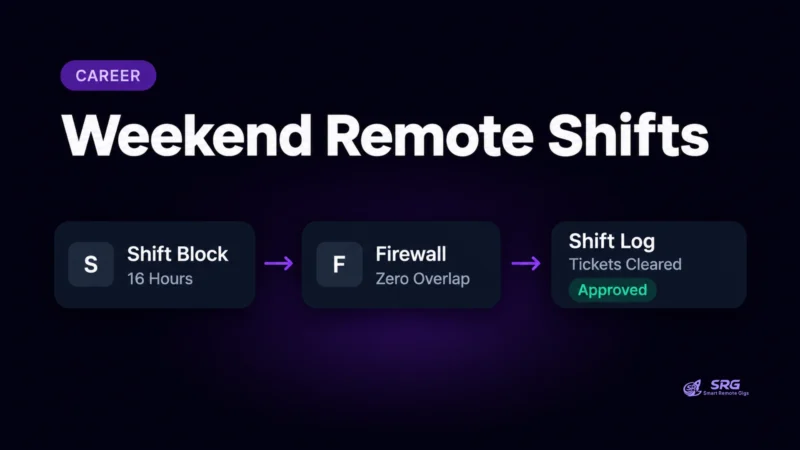
A full-time Monday–Friday job leaves one dependable block of remote capacity: the 16-hour Saturday and Sunday window. Legitimate weekend remote work uses that window as structured, dedicated shift operations built for moonlighters, such as queue coverage, incident triage, and scheduled reconciliation.
It is a different category from low-yield gig apps that pay by the task, and from postings that advertise “weekend flexibility” while quietly requiring weekday daytime availability. This guide covers how weekend shift models are built, which roles hire for them, what they pay at national baselines, how to vet contracts, and what moonlighting means for taxes and primary-employer obligations.
SRG Key Takeaways
- Core Technical Reality: Legitimate weekend remote roles are concentrated in 24/7 technical triage, weekend customer support queues, and asynchronous content/data auditing.
- Standard Shift Budget: Maximum 16 operational hours per week (two 8-hour Saturday/Sunday blocks or four 4-hour flexible weekend windows).
- Critical Moonlighting Boundary: Strict isolation of equipment, IP, and time prevents primary-employer contract violations. Contractors on 1099 agreements must also plan for 15.3% self-employment (SECA) tax.
Documented by the SRG Research Desk using official BLS occupational wage baselines and labor standards.
1. The 16-Hour Weekend Shift Architecture: Operating Models for Moonlighters
Weekend-only remote schedules generally follow one of two structures. Both fit inside a 16-hour weekly ceiling.
The Two-Day Block Model. Two 8-hour shifts, one on Saturday and one on Sunday, for 16 hours in total. This is the dominant structure for fixed queue coverage, because employers can staff a predictable block and workers can plan around it.
The Split-Coverage Window. Four 4-hour micro-shifts distributed flexibly across Saturday and Sunday, for example two on each day. This suits asynchronous queues and moderation work, where coverage matters more than a continuous eight-hour presence.
The Primary Employment Firewall
Moonlighting only works when the primary job is protected. The firewall has three parts:
- Calendar separation. Weekend work never overlaps Monday–Friday core business hours. This includes onboarding, training calls, and “quick” check-ins.
- Duty of loyalty. Primary employment agreements often restrict outside work that competes with, or creates a conflict of interest with, the employer. The agreement and employee handbook should be read before any weekend role is accepted. Where the employer requires disclosure of outside business activity, written clearance should be secured first.
- Resource separation. Accounts, devices, and communication channels for weekend work stay fully decoupled from the primary employer.
WARNING: Primary Employer Hardware & IP Violation
Never perform weekend contracting on a primary employer’s laptop, network, or VPN. Enterprise device-management software can log network connections and running processes, which can expose undisclosed secondary work. Work product created on employer infrastructure can also raise intellectual property assignment claims. Use a personally owned device, a personal network, and separate accounts, and confirm that no weekend work product is stored on employer systems.
Weekday evening part-time schedules fall outside this guide and are covered in the core guide to standard weekday part-time hourly workflows. Burnout psychology is covered in a dedicated companion article, linked in Section 7.
2. Verified Job Categories with Genuine Weekend Remote Demand
Four knowledge-work categories show verified operational demand for Saturday and Sunday remote coverage. Physical delivery, rideshare, and generic micro-task platforms are outside the scope of this guide.
Tier-1 Customer Support & Weekend Helpdesk Triage
Customer support is the largest category. In an SRG sample of 18 weekend-specific remote postings, customer support, helpdesk dispatch, and e-commerce verification made up more than 65% of listings. Typical duties include working surges in 24/7 SaaS ticket queues, monitoring live chat, and verifying e-commerce customer orders.
The BLS occupational profile for customer service representatives describes the core work as handling complaints, processing orders, and answering questions. Active postings most often use titles such as “Weekend Customer Support Specialist,” “Tier 1/2 Support Representative (Weekend Shift),” and “Weekend Technical Support Agent.” “Weekend triage” describes the function more often than it appears as a formal job title.
Content Moderation, Trust & Safety Incident Queues
Community moderation, flag verification, and user-compliance queues run continuously, so weekend coverage is a standing need. Much of this work is asynchronous and queue-based, which suits split-coverage windows.
Remote Bookkeeping & End-of-Week Reconciliation
Weekend payroll preparation, transaction clearing, and data reconciliation can be done asynchronously against a Monday deadline. The BLS bookkeeping and auditing clerk profile describes the occupation as computing, classifying, and recording data to keep financial records accurate.
Technical Writing & Asynchronous Documentation Sprints
Offline API documentation updates, user-guide revisions, and knowledge-base pruning are well suited to uninterrupted weekend blocks. The BLS technical writer occupational outlook covers the occupation’s scope. Technical support is benchmarked in Section 3 using the BLS computer support specialists guide.
3. Shift Architecture & Compensation Matrix: Weekend Hourly Benchmarks
The matrix below shows national hourly wage baselines for the four categories, applied to a 16-hour weekend commitment.
| Occupational Category (SOC Code) | 25th Pct. Hourly | Median Hourly | 75th Pct. Hourly | 16-Hr Weekly Gross (at Median) | Est. Annual Gross (× 52 wks) |
|---|---|---|---|---|---|
| Customer Service Representatives (SOC 43-4051) | $16.72 | $19.08 | $23.31 | $305.28 | $15,874.56 |
| Bookkeeping, Accounting & Auditing Clerks (SOC 43-3031) | $18.65 | $22.81 | $27.90 | $364.96 | $18,977.92 |
| Computer User Support Specialists (SOC 15-1232) | $22.38 | $28.48 | $36.52 | $455.68 | $23,695.36 |
| Technical Writers (SOC 27-3042) | $29.84 | $38.49 | $49.17 | $615.84 | $32,023.68 |
Calculated by SRG using U.S. BLS OEWS national occupational wage data.
To model your personalized take-home pay after deducting self-employment taxes and unpaid administration hours, use our interactive rate calculator below.

Calculate your real net freelance hourly wage after 15.3% SECA self-employment taxes, overhead, and unpaid admin hours.
How to read the matrix. The weekly figure multiplies the median hourly wage by 16 hours. The annual figure multiplies the weekly figure by 52 weeks. Both assume every weekend is worked in full, with no unpaid downtime, cancelled shifts, or sick days.
- These are national medians, not guaranteed earnings. BLS publishes wages across all shifts and does not break out weekend-only hours. Premium weekend differentials are set by employer contract.
- Gross is not net. W-2 hourly roles have payroll withholding. 1099 contracts carry self-employment tax, modeled in Section 5. On a customer service contract grossing $15,874.56 a year, full federal SECA alone comes to about $2,243.00 before any income tax.
- Task-based 1099 work usually pays per task or per retainer, not per hour. Effective hourly rates should be calculated after unpaid time is counted.
4. How to Vet Weekend Contracts: Screening for Hidden Weekday Traps
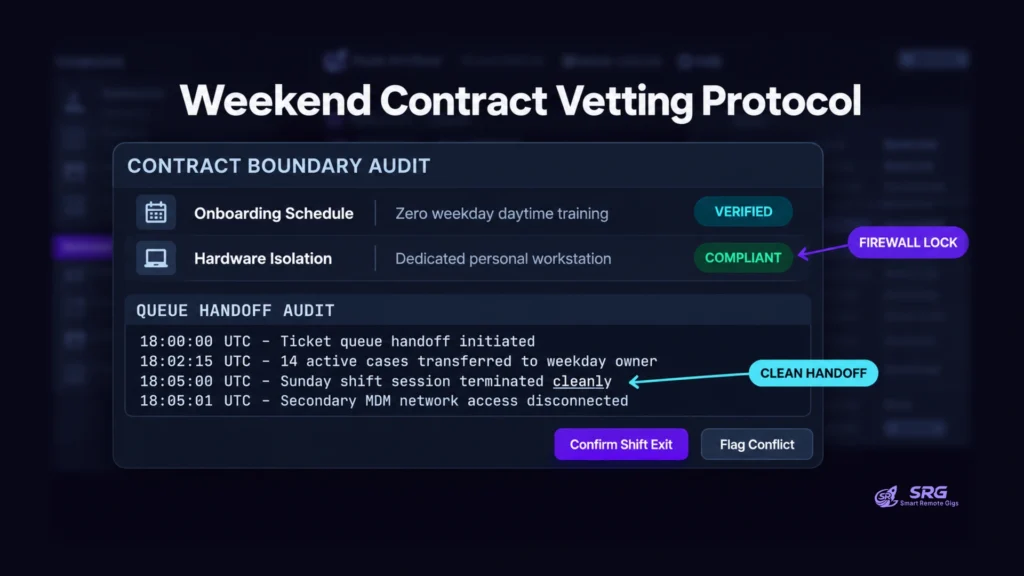
A posting labeled “weekend” is not always weekend-only. The checks below are done before signing anything.
The Weekday Onboarding Trap
In the SRG sample of 18 weekend remote postings, 7 (38.9%) required synchronous weekday daytime onboarding, with wording such as “Must be available Monday–Friday 9 AM–5 PM for initial 2-week training.” For a full-time employee, that is a direct conflict. Before accepting an offer, confirm in writing:
- Whether any training, orientation, or certification occurs on weekdays.
- Whether recorded or asynchronous onboarding alternatives exist.
- The date the first weekend shift begins, and whether it depends on completing weekday sessions.
The Async SLA Audit
For queue-based roles, the service-level agreement (SLA) defines the real schedule. Review ticket response-time targets, escalation rules, and any expectation of monitoring Slack or email between Monday and Friday. An SLA that implies daytime weekday responsiveness turns a weekend role into a second job.
Time Zone Handoff Protocols
Weekend shifts usually begin and end with a handoff to a team in another time zone. Define in writing the handoff time for Friday evening and Sunday night, and confirm that tickets still open at shift end are transferred, not carried into Monday morning.
PRO TIP: The “Hidden Standup” Screening Script
During the interview, ask: “Is there any recurring meeting, standup, training session, or check-in that happens Monday through Friday, even briefly? And if a ticket is still open at the end of my Sunday shift, who owns it on Monday morning?”
Then request the answer in the offer letter or contract. A vague answer such as “we’re pretty flexible” is not a confirmation.
Red Flag Taxonomy
- Misclassification signals. A posting that demands fixed weekend hours and company-directed scripts but labels the role “1099” may be misclassified. Under IRS common-law rules, a payer who controls what is done and how it is done typically has an employee, not a contractor. Read the IRS employee versus contractor guidance in Publication 15-A.
- Commission-only “jobs.” Unpaid until a sale closes, with no base rate.
- Data-entry phishing. Requests for bank details, an ID scan, or an upfront “equipment” or “training” fee before any paid work.
- Payment-forwarding schemes. Any role that involves receiving money or checks and sending part of it elsewhere.
5. Moonlighting Compliance: Tax Liabilities and Legal Guardrails
This section covers federal tax and moonlighting boundaries only. It is general information, not legal or tax advice, and state tax rules vary.
W-2 Part-Time vs. 1099 Independent Contractor
Fixed weekend shift coverage is predominantly W-2 hourly employment. In the SRG sample, 11 of 18 postings (61.1%) were W-2 hourly, 5 (27.8%) were 1099, and 2 (11.1%) were unspecified or contract-to-hire. The W-2 roles involved fixed shifts, mandatory queue coverage, and supervisor monitoring.
The 1099 roles were task-based, such as asynchronous queue clearing, moderation, or transcription. With a 1099 agreement, the work should be structured as an outcome-based retainer rather than hourly shift attendance.
The 15.3% SECA Tax Model
A 1099 contractor owes self-employment (SECA) tax of 15.3%, made up of 12.4% Social Security and 2.9% Medicare. It is assessed on 92.35% of net profit, so the effective burden is about 14.13% of gross contracting income before income tax. See the IRS Schedule SE self-employment tax guidance.
Worked example (customer service, $15,874.56 gross, no expenses):
- Taxable net earnings: $15,874.56 × 0.9235 = $14,660.16
- Full SECA tax: $14,660.16 × 15.3% ≈ $2,243.00
The High-Earner Social Security Exemption
The Social Security wage base is $184,500 for 2026. A moonlighter whose primary W-2 wages meet or exceed that cap owes no 12.4% Social Security portion on 1099 earnings. Only the 2.9% Medicare portion applies, an effective rate of about 2.68% of gross.
On the same example, that is about $425.14, which is $1,817.86 less than the full SECA tax. Medicare has no wage cap, and an Additional Medicare Tax can apply at higher total income. See IRS Publication 15-A employer guidance.
Quarterly Estimates vs. Form W-4 Step 4(c)
There are two ways to pay the tax on secondary income:
- Quarterly estimated payments. Remit vouchers using IRS quarterly estimated tax vouchers on Form 1040-ES. To avoid an underpayment penalty, payments generally must total at least the smaller of 90% of the current year’s tax or 100% of the prior year’s tax. The prior-year threshold rises to 110% if prior-year adjusted gross income exceeded $150,000 ($75,000 if married filing separately). See IRS Publication 17 safe harbor rules.
- Extra withholding at the primary job. Using Step 4(c) on the W-4, an employee can ask the primary employer to withhold an additional dollar amount each pay period. Many moonlighters use this to cover secondary-income tax and avoid quarterly filings. See IRS Form W-4 extra withholding instructions.
Equipment & Enterprise MDM Isolation
As covered in Section 1, primary-employer laptops, VPNs, and enterprise cloud accounts are off-limits for weekend work. Device-management endpoint logging can surface unauthorized secondary activity, and IP assignment clauses can reach work created on employer systems.
BOTTOM LINE: The 1099 Tax Reserve Rule
Reserve 25–30% of gross 1099 revenue for federal and state liabilities, and set it aside as income arrives.
6. Where to Discover Verified Weekend Remote Roles
6.1 Platform Taxonomy Realities
Major remote job boards do not offer a dedicated “Weekend-Only” filter checkbox. Their categories are typically Full-Time, Part-Time, Contract, and function-based groupings. Weekend schedules appear in the job description text, so searches have to be built with keywords.
Two examples of boards that follow this pattern are the We Work Remotely customer support board and the Remote.co customer service directory. On We Work Remotely, a free-text search for “weekend” inside the Customer Support category surfaces Saturday/Sunday coverage and off-peak triage roles.
6.2 Reproducible Boolean Search Syntax
Standard query:
("weekend" OR "Saturday" OR "Sunday") AND ("remote" OR "work from home") AND ("part-time" OR "contract")
Exclusionary query:
"weekend shift" AND "remote" NOT ("Monday" OR "Tuesday" OR "Wednesday" OR "Thursday" OR "Friday")
Some aggregators ignore the NOT operator, so shift requirements in each description still need a manual read. Searches that do not pair “weekend” with a role category, such as “customer support,” return mixed weekday and irregular gig listings.
To log secondary job applications and track shift availability across your weekend operational window, download our free application toolkit below.

Download the free part-time remote career bundle: 4 vetted templates for tracking applications, async schedules, and interviews.
6.3 The Public Alternative: SRG’s Native Job Exchange
SmartRemoteGigs’ free remote job exchange lists curated remote and flexible roles without a subscription. Roles from any source can then be screened using the Section 4 checks.
7. The Weekend Execution SOP: Sustaining Output Without Burnout
Saturday/Sunday energy management.
- Alternate focused work blocks with deliberate rest intervals away from screens.
- Set a hard cap on non-work screen time between blocks.
- Keep the 16 hours inside two blocks or four windows. Adding hours erodes the recovery that Monday depends on.
The Sunday Evening Shutdown Protocol.
- Stop all contracting work by 6:00 PM Sunday.
- Close weekend accounts and queues, complete the handoff, and log out.
- Leave the evening for a clean transition into Monday.
The Monday Morning Firewall.
- Weekend ticket emergencies do not carry into business hours. Confirm in advance who owns open items on Monday.
- No weekend-role notifications on devices or accounts used for the primary job.
The Verdict: Sustaining Secondary Remote Income
Weekend remote work pays off when three conditions hold: a verified role with no hidden weekday obligations, a tax plan in place before the first paycheck, and a hard boundary around the primary job. The 16-hour window is a ceiling, not a target, and the Sunday 6:00 PM shutdown and Monday firewall protect the income that matters most, the full-time one.
Documentation-based guide. Reviewed against 12 official vendor sources as of November 2026. SRG did not independently test this setup.
For recovery strategies, see the guide to avoiding weekend shift burnout and managing dual-employment recovery. For weekday schedules, see the guide to standard weekday part-time hourly workflows. To start applying, browse verified roles on the SmartRemoteGigs job exchange.

Never Miss a New Remote Job
Remote job alertsGet notified about new remote jobs and access practical freelance tools from your phone.