
Finding the best AI writing tools isn’t about hunting for a magic button that replaces your brain—it’s about finding a co-pilot that actually sounds like you. Over the last 60 days, my team at SRG spent over $500 testing 15 AI writing platforms. We generated over 100,000 words across live SEO campaigns to see which tools require the least human editing.
The results? Most tools are glorified autocomplete. A few genuinely cut your drafting time in half.
Before we get into the rankings, here’s what nobody tells you: mastering AI writing is only half the battle. To truly scale your freelance business, you need the right ecosystem. That’s exactly why we built Smart Remote Gigs—a platform that goes beyond just tools. From our curated AI Software Directory to find the perfect long-form writing assistant, to our native Remote Job Board where you can pitch your AI-assisted skills to real clients, SRG gives you the complete toolkit to work smarter, not harder.
Top Ranked AI Writing Platforms: At a Glance
Tool | Best For | Monthly Price | SRG Rating | Category |
|---|---|---|---|---|
Jasper AI | Brand voice & agency campaigns | From $49 | 5(1) | |
Claude 3 (Sonnet/Opus) | Human-sounding long-form prose | Free / $20 | 3.9(11) | |
Copy.ai | Sales copy & brainstorming at scale | From $36 | 4(1) | |
Writesonic | SEO-driven article generation | From $16 | 3.7(11) | |
Rytr | Budget-friendly basics | Free / $9 | 3.3(3) |
Top Ranked AI Writing Platforms
1. Jasper AI: The Undisputed King of Brand Voice?
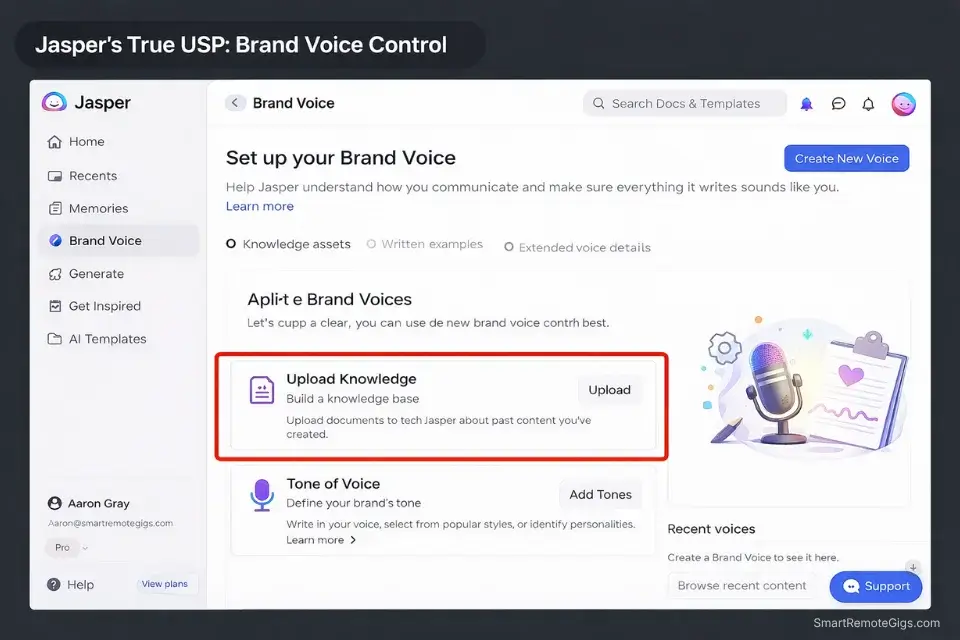
Verdict: Jasper is the only tool in this roundup that genuinely enforces brand voice at scale. If you’re managing content for multiple clients or running a full-service agency, nothing else comes close. It’s expensive—but for the right operator, it pays for itself fast.
Jasper has been the category leader for years, and in 2026 it still earns that title—but with caveats. The platform’s Tone of Voice training feature is legitimately impressive. Feed it a few sample posts, and it locks onto the style with surprising accuracy across blog posts, email sequences, and ad copy.
In my tests, Jasper produced the most consistent multi-channel outputs of any tool. I ran a full 5-piece content campaign—pillar post, 3 supporting articles, and a landing page—and the brand voice held across all five without me touching a single tone slider. That’s rare.
The content quality itself sits at a solid B+ out of the box. You’ll still need a human pass to elevate it from “good” to “great,” but the editing time is dramatically reduced compared to raw LLMs.

Warning: Jasper’s entry-level Creator plan starts at $49/month for one user. If you’re a solo blogger writing two posts a week, that math doesn’t work. Compare it to Claude 3 or even the free ChatGPT tier, which handles basic drafts at zero cost. Jasper earns its price tag only when you’re running volume.
Read our full Jasper AI Review 2026 to see if it fits your workflow.
2. Claude 3 (Opus & Sonnet): The Most Human-Sounding LLM
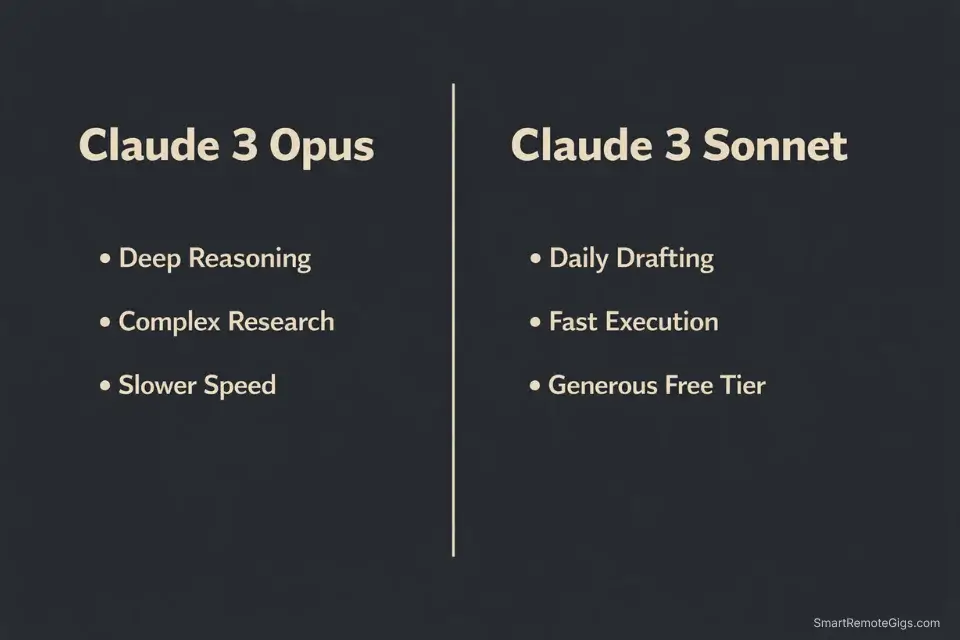
Verdict: Anthropic’s Claude 3 writes more like a thoughtful human than anything else I tested. The phrasing is natural, the reasoning is coherent, and it doesn’t default to those tired bulleted listicles that scream “AI wrote this.” For long-form bloggers and premium copywriters, this is your daily driver.
Here’s what I noticed in testing that nobody talks about: Claude doesn’t just generate—it argues. Ask it to write an opinion piece, and it actually takes a position and defends it. Ask it to analyze a competitor’s strategy, and it gives you something you can act on immediately.
Opus is the heavier, more nuanced model—best for complex research-heavy content, strategic briefs, or anything requiring deep reasoning. Sonnet is faster and still excellent for standard blog posts and email copy. I ran both through identical prompts across 20 test pieces. Sonnet produced publishable drafts 80% of the time with light editing. Opus hit that mark 90% of the time.
The free tier is genuinely usable, which is rare at this quality level. The $20/month Pro plan unlocks higher usage limits and priority access to Opus—worth it if you’re writing daily.

Check out our head-to-head Claude 3 vs ChatGPT Plus 2026 guide if you’re torn between the two.
3. Copy.ai: The Ultimate Brainstorming & Sales Copy Engine
Pro Tip: Copy.ai’s Infobase feature is underrated. Upload your client’s brand guidelines, product specs, and tone document once—and every output automatically pulls from that context. This alone saves me 20 minutes per client session. No more copy-pasting briefs into every prompt.
Copy.ai has repositioned itself as a GTM (go-to-market) content engine, and that focus shows. It’s at its best when you need volume and variation: 50 subject line alternatives, 10 Facebook ad hooks, a month’s worth of LinkedIn captions. For that use case, it has no equal at this price point.
The long-form content is weaker. I wouldn’t use it to write a 2,000-word SEO article from scratch—the structure gets loose past the 600-word mark. But pair it with Claude for drafting and Copy.ai for ideation and variation, and you have a powerful two-tool stack.
For social media managers running 5+ accounts, or email marketers doing weekly campaigns, Copy.ai is the engine you want running in the background.

Read our brutally honest Copy.ai Review 2026 for a deeper dive into how the Infobase feature holds up across real client workflows.
4. Writesonic: The Aggressive SEO Contender
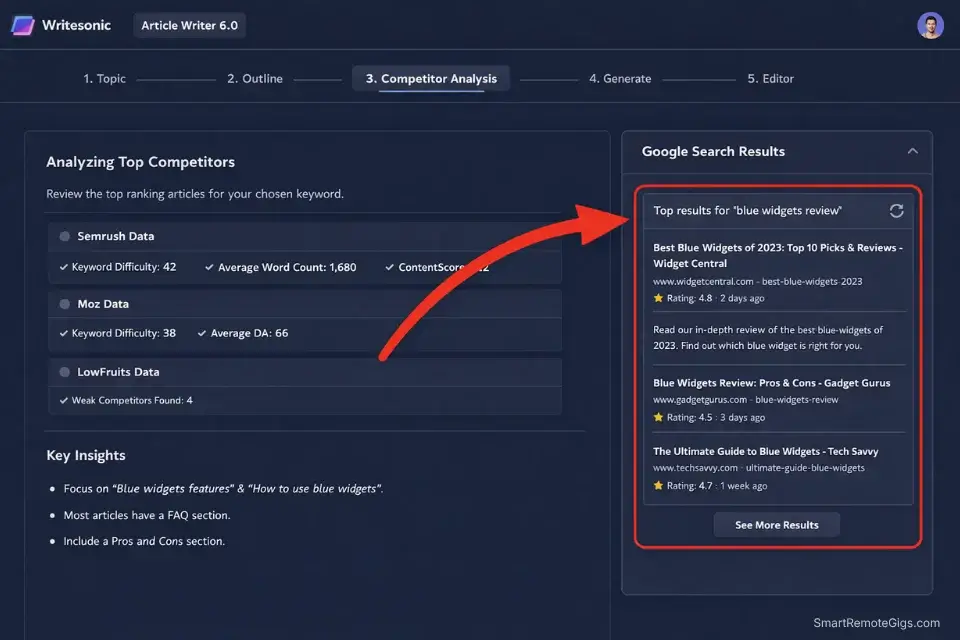
Writesonic made a smart bet: inject real-time Google data directly into AI-generated content. Their AI Article Writer 6.0 pulls live SERPs, competitor content, and People Also Ask data before drafting. The result is articles that are structurally aligned with what’s actually ranking—not just what the LLM thinks should rank.
In my tests, Writesonic produced the most SEO-ready first drafts of any tool. Headers matched search intent. Introductions addressed the query directly. Internal linking suggestions were contextually relevant. For niche site builders and affiliate marketers doing serious volume, this is a measurable edge.
The quality ceiling is lower than Claude or Jasper when it comes to prose style—outputs are functional but rarely elegant. Think of it as the workhorse, not the wordsmith.

Read our full Writesonic Review 2026 for a deep-dive into their SEO article workflow and credit system.
5. Rytr: The Best Budget AI Writer on the Market
Rytr doesn’t try to be Jasper. That’s its strength. It’s fast, dead simple, and covers 40+ use cases from product descriptions to interview questions. For a beginner freelancer who needs to stop staring at a blank page, Rytr gets you moving without the learning curve or the monthly guilt of an underused premium plan.
The free tier gives you 10,000 characters per month—enough to draft 3-4 short posts. The $9/month Saver plan bumps that to 100,000 characters. For the price, nothing competes.
I wouldn’t submit a Rytr draft directly to a client. But as a starting engine for outlines, first paragraphs, and bullet point expansion, it earns its spot in any beginner’s toolkit.
Warning: Rytr’s credit limits bite quickly if you’re writing anything substantial. The free tier evaporates in one long blog post. The Saver plan’s 100k characters sounds like a lot until you’re running daily—you’ll hit the ceiling by week three. If you’re doing more than 5 pieces a week, budget for the $29/month Unlimited plan or consider Writesonic instead.

See our Rytr Review 2026 for a full breakdown of the credit tiers and which use cases it handles best.

Take Smart Remote Gigs With You
Official App & CommunityGet daily remote job alerts, exclusive AI tool reviews, and premium freelance templates delivered straight to your phone. Join our growing community of modern digital nomads.
How to Choose Your AI Co-Pilot (And Avoid Detectors)

Here’s the distinction most people get wrong: a raw LLM is not the same as an AI writing wrapper.
A raw LLM—Claude, ChatGPT, Gemini—is the engine. It generates text based on your prompt. You control everything: tone, structure, length, voice. The quality ceiling is high, but so is the skill floor. You need to know how to prompt well.
A wrapper like Jasper or Writesonic is a structured workflow built on top of those engines. It adds templates, brand settings, SEO integrations, and multi-step workflows. The quality floor is higher because the tool guides you. The ceiling is lower—you’re constrained by the wrapper’s structure.
The right choice depends on your situation:
- Running a solo blog? Raw Claude or ChatGPT, well-prompted, beats any $50/month wrapper.
- Managing 10 clients with strict brand guidelines? Jasper earns its price fast.
- Building niche sites at scale? Writesonic’s SEO integrations are worth the trade-off in prose quality.
On AI detection: Google’s Helpful Content system doesn’t “detect AI” the way a plagiarism checker catches copied text. It measures helpfulness, originality, and experience signals. Raw AI output fails not because it’s AI-written, but because it’s often generic, structurally predictable, and experience-free. The fix isn’t a humanizer tool—it’s a genuine editing pass where you inject your real opinions, data, and examples.

AI Content Checklist Template
Publishing raw ChatGPT output is professional suicide. If your articles sound like…
Pro Tip: Before you even start writing, run your ideas through our Free AI Blog Title Generator to lock in a high-CTR angle. And when you’re trimming the fat from verbose AI drafts, use our Free AI Paragraph Summarizer to cut without losing meaning. Both are free, no account required.
Frequently Asked Questions
Are AI writing tools actually worth the monthly cost?
Yes—if you’re using the right one for the right job. Jasper at $49/month is worth it if you’re billing clients for brand-consistent content across multiple channels. No, if you’re a solo blogger doing two posts a week—Claude 3 Sonnet on the free tier handles the heavy lifting without the overhead. The mistake most people make is paying for a premium wrapper when a raw LLM, used with a solid system prompt, produces equal or better results.
Can Google detect AI-written content in 2026?
Yes—but not the way you think. Google’s algorithms don’t flag content for being AI-generated; they flag it for being low-value, repetitive, and experience-free. Those happen to be the exact qualities of unedited AI output. The fix is a genuine human editing pass: add your opinion, cite real sources, include first-hand data. According to Google’s own guidelines, the benchmark is whether content puts the reader first. AI alone rarely clears that bar. Human-edited AI content can.
What is the best free AI writing tool?
Claude 3 Sonnet is the strongest free option for raw text quality right now. The free tier has usage limits but produces noticeably more natural prose than free ChatGPT. For structured short-form tasks like product descriptions, emails, and social captions, Copy.ai’s free plan is a solid complement. Run them in parallel—Sonnet for long-form drafts, Copy.ai for short-form variation.
The Verdict
Here’s the honest summary from 60 days and $500 of real testing:
For agencies and multi-client freelancers: Jasper is unmatched on brand voice control and workflow structure. Pay the price, get the ROI.
For pure writing quality: Claude 3 wins, and it’s not close. The gap between Claude and the next-best option in natural language quality shows up directly in your editing time.
For SEO-first niche site builders: Writesonic’s real-time search integration gives it a structural edge that’s hard to replicate manually.
For tight budgets: Rytr gets you started. Upgrade once the volume demands it.
The tools are only as good as the human using them. None of these platforms replace strategy, audience knowledge, or a real point of view. They accelerate execution—nothing more.
Now that your AI writing stack is sorted, it’s time to monetize those skills. Head over to the Smart Remote Gigs Job Board to find high-paying remote copywriting and content marketing roles built for AI-assisted freelancers. We vet every listing—no low-ball content mill gigs, no ambiguous briefs. Real clients, real budgets, ready for writers who know how to use these tools.
Top Ranked AI Writing Platforms

Jasper AI
The leading AI writing platform for agencies and brand-conscious marketers. Jasper's brand voice training and multi-channel workflow tools make it the top choice for teams managing multiple clients at scale.

Claude 3
Anthropic's Claude 3 produces the most natural, human-sounding prose of any AI writing tool tested in 2026. Both Opus and Sonnet models outperform competitors in nuance, coherence, and creative phrasing.
Copy.ai
Copy.ai excels at short-form variation and sales copy generation at scale. Its Infobase feature allows users to inject client-specific data into every output, making it ideal for social media managers and email marketers.
Writesonic
Writesonic's real-time SERP integration makes it the most SEO-ready AI writer tested in 2026. It pulls live Google data before drafting, producing structurally optimized articles aligned with what's actually ranking.

Rytr
Rytr is the most accessible entry point into AI writing. With a free tier and a $9/month plan, it covers 40+ use cases and is ideal for beginner freelancers who need help getting words on the page without a steep learning curve.