Most templates fail because they talk about you. These templates work because they talk about them.
Here’s the Silence that haunts freelancers: you send 50 carefully crafted emails using templates you found online. You check your inbox obsessively. Days pass. Nothing. Not even a “no thanks.”
Why? Because you sound like a bot.
Everyone uses the same templates from the same blog posts. “I’m a [Title] with [X] years of experience offering [Generic Services].” Hiring managers see this 47 times per week. It’s white noise.
The templates in this guide work because they follow a simple principle: they solve a specific problem for a specific person before asking for anything.
These are the exact scripts that have closed $5K+ deals for me and dozens of freelancers I’ve coached. Not theory. Not guesses. Proven frameworks with real results.
But here’s the catch: you must customize them. Copy-paste without research gets you marked as spam. Read on.
📨 Template Selector
Template Type | Best For… | Est. Reply Rate |
|---|---|---|
The “Video Audit” | SMMs / Designers | ⭐⭐⭐⭐⭐ (Highest) |
The “Typo Fix” | Proofreaders / Developers | ⭐⭐⭐⭐ |
The “Case Study” | VAs / Marketers | ⭐⭐⭐ |
The “Question” | Consultants | ⭐⭐⭐ |
The “Breakup” | Follow-Up | ⭐⭐⭐⭐ (Last Resort) |
How to use this guide:
- Pick the template that matches your service
- Read the “Why It Works” section to understand the psychology
- Fill in ALL the [bracketed personalization fields]
- Send to 5-10 qualified prospects
- Track open/reply rates
- Iterate based on results
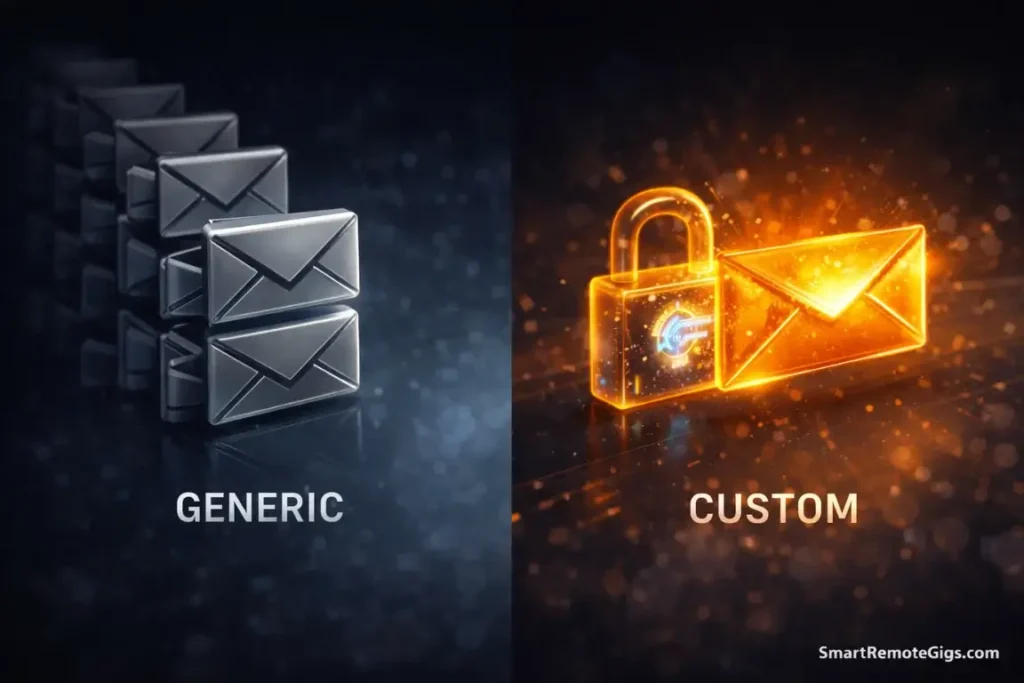
The Golden Rule: Personalization > Templates
Templates are training wheels. They give you structure. But the magic happens in the customization.
The personalization checklist:
Before sending ANY email from these templates, verify:
✅ You’ve researched this company for at least 5 minutes
✅ You’ve identified a specific, observable problem they have
✅ You can explain why YOU specifically can help THEM specifically
✅ You’ve replaced EVERY [bracketed field] with actual information
✅ You’ve checked their name spelling (getting this wrong = instant delete)
✅ You’ve run it through Grammarly for typos
Warning: If you don’t change the [Bracketed Text], you will be marked as spam. Gmail and Outlook can detect template patterns. If 100 people send the same email with only the name changed, you all get flagged. Personalization isn’t optional—it’s survival.
What “personalization” actually means:
❌ Changing their name
✅ Referencing something specific about their business that required research
❌ “I love your company”
✅ “I noticed your Q3 product launch got 500K views on TikTok but your Instagram engagement dropped 40%—curious why the disconnect”
The goal: make it impossible for them to think this email was sent to 50 other people.
Template 1: The “Video Audit” (Best for Social Media Managers)
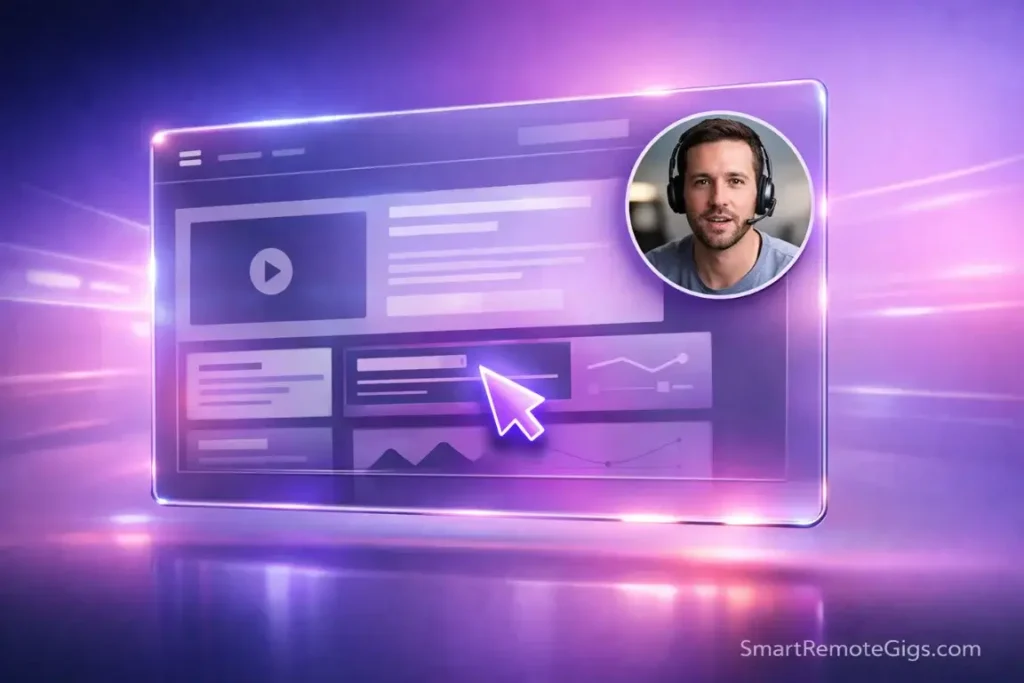
Why this works: You’re giving away $200-500 worth of consulting for free. Reciprocity is one of the most powerful psychological triggers—people feel compelled to respond when you’ve given them value first.
When to use it: When you can quickly identify 3-5 fixable problems with their social media presence.
Effort required: 20-30 minutes (research 10 min, record video 10 min, write email 10 min)
Expected reply rate: 25-35% (highest of all templates)
Subject Line:
Quick audit: [Company Name]’s Instagram
Body:
Hi [First Name],
I came across [Company Name] while researching [Industry] brands in [Location/Niche]. [Specific compliment about their product/service/content—must be genuine].
I noticed [Specific observation—e.g., “your Instagram hasn’t posted in 6 weeks” or “your Reels are getting 10x less engagement than your static posts”]. I work with [Industry] brands on short-form video strategy, so this caught my attention.
I recorded a quick 2-minute video walking through [3 specific things you noticed] and some ideas that might help. No strings attached—just wanted to share: [Loom link]
If you ever want to chat about social strategy for [Company Name], I’m around.
Best,
[Your Name]
[Portfolio Link]
[LinkedIn]
Customization fields you MUST change:
[First Name]→ Their actual first name (check LinkedIn, About page)[Company Name]→ Exact company name (capitalize correctly)[Industry]→ Their specific industry (e.g., “sustainable fashion” not “fashion”)[Location/Niche]→ Where they operate or their specific niche[Specific compliment]→ Something genuine (their product design, a recent campaign, a blog post you actually read)[Specific observation]→ The problem you identified (must be accurate and observable)[Loom link]→ Your actual video audit (record this BEFORE sending the email)
What to include in the Loom video:
- 0:00-0:15 – Introduction: “Hi [Name], I’m [Your Name]. I put together this quick audit for [Company]…”
- 0:15-1:00 – Problem 1: Show their social media, point out the issue, explain why it matters
- 1:00-1:30 – Problem 2: Another specific issue with visual examples
- 1:30-2:00 – Quick wins: “Here’s what I’d do first…” (give 2-3 actionable suggestions)
- 2:00-2:15 – Soft close: “Hope this is helpful. If you want to chat about strategy, my email is below.”
Why this template crushes:
- Effort signals expertise – Most people won’t spend 30 minutes on a prospect. You just did.
- Video is personal – They see your face, hear your voice. You’re human, not a bot.
- You’ve proven value – They can judge your skills by watching the video, not reading claims.
- No pressure – You’re not asking for work, just sharing ideas.
Before sending this, make sure your portfolio is ready to handle traffic. See our guide on Build an SMM Portfolio from Scratch for exactly what to showcase.
Real example that closed a $3.5K/month client:
Subject: Quick Instagram audit, Sarah
Hi Sarah,
I came across Bloom & Co while researching sustainable home goods brands in Portland. Your product photography is stunning—especially the recent launch campaign for the ceramic collection.
I noticed your Instagram Reels are getting about 2K views while your static posts average 8K impressions, which is unusual (typically video performs 3-5x better). As someone who helps home goods brands with short-form video, this caught my attention.
I recorded a 2-minute video walking through what might be causing the disconnect and a few ideas that could help: [loom.com/share/xyz]
No strings attached—just wanted to share since I was already analyzing it for research.
If you ever want to chat about social strategy for Bloom & Co, I’m around!
Best,
Marcus
[portfolio link]
[linkedin.com/in/marcus]
Result: Reply within 3 hours. Call scheduled. Hired within a week.
Template 2: The “Typo Fix” (Best for Proofreaders/Devs)
Why this works: You’re solving an immediate, embarrassing problem they didn’t know they had. This positions you as detail-oriented and helpful, not salesy.
When to use it: When you find a genuine error (typo, broken link, outdated info, accessibility issue) on their website or blog.
Effort required: 15 minutes (find error, verify it’s real, write email)
Expected reply rate: 20-30%
Subject Line:
Quick heads up about [Company Name]’s [Location of Error]
Body:
Hi [First Name],
I was reading your [blog post/about page/product page] on [Topic] and noticed [Specific error—typo, broken link, outdated information].
[Screenshot or description of the error]
Figured you’d want to know! These things happen when you’re publishing consistently.
I’m a [Your Role] who specializes in [Your Specialty]. If you ever need help with [proofreading/editing/QA], happy to chat. Either way, wanted to give you a heads up.
Best,
[Your Name]
[Portfolio]
Customization fields:
[First Name]→ Decision-maker’s name (find on About/Team page)[Company Name]→ Exact company name[Location of Error]→ Where you found it (“blog post” / “homepage” / “careers page”)[Topic]→ What the content was about[Specific error]→ Exactly what’s wrong (be specific: “there’s a typo in paragraph 3: ‘publci’ should be ‘public'”)[Screenshot or description]→ Either attach screenshot or quote the sentence with error highlighted[Your Role]→ Proofreader, Editor, Developer, QA Specialist[Your Specialty]→ Your niche (technical documentation, marketing copy, web accessibility)
What makes a good “error” to point out:
✅ Typo in a prominent location (homepage, about page)
✅ Broken link on a high-traffic page
✅ Factually outdated information (“We were founded in 2019” but it’s now 2026)
✅ Accessibility issue (missing alt text on images, poor color contrast)
✅ Inconsistent branding (logo spelled two different ways)
❌ Nitpicky grammar preferences (serial comma debates)
❌ Stylistic choices you disagree with
❌ Things that are subjective, not objectively wrong
The psychology:
People feel grateful when you help them avoid embarrassment. A typo on their homepage has been seen by thousands of visitors. You just saved them from looking unprofessional. They owe you.
See how to find these leads systematically in Freelance Cold Emailing: The Ultimate Guide—the prospecting section covers exactly where to hunt for these opportunities.
Real example:
Subject: Quick typo on Acme Corp’s About page
Hi Jennifer,
I was reading Acme Corp’s About page (learning about your approach to sustainable packaging) and noticed a small typo in the founder’s bio section:
“Jennifer has lead the company since 2020” → should be “led” (past tense)
Figured you’d want to fix it before too many people see it!
I’m a proofreader who specializes in marketing copy and website content. If you ever need an extra set of eyes on content before it goes live, happy to chat.
Either way, keep up the great work on sustainability!
Best,
Rachel
[portfolio link]
Result: Reply in 4 hours: “Thank you!! Fixed. Are you available for ongoing work?”
Template 3: The “Case Study” (Best for Virtual Assistants)
Why this works: Social proof. You’re not saying “I’m great”—you’re showing “I helped someone exactly like you solve exactly this problem.”
When to use it: When you have a previous client or portfolio project in a similar industry.
Effort required: 10-15 minutes (identify similar client, write email)
Expected reply rate: 15-25%
Subject Line:
How I helped [Similar Company] with [Specific Result]
Body:
Hi [First Name],
I recently helped [Company/Industry Similar to Theirs] [Specific result—e.g., “save 15 hours per week on admin work” / “organize 6 months of backlogged emails” / “streamline their client onboarding process”].
I noticed [Company Name] is [Observation about their situation—e.g., “growing quickly based on your recent job postings” / “managing a lot of moving parts based on your LinkedIn activity”]. I specialize in helping [Industry] companies at this stage with [Your Service].
Here’s a quick summary of what I did for [Previous Client]:
[Specific task/result]
[Specific task/result]
[Specific task/result]
Would you be open to a 15-minute call to see if something similar might help [Company Name]? No pressure—just want to share what worked for a business in your space.
Best,
[Your Name]
[Portfolio]
[Case study link if you have one]
Customization fields:
[First Name]→ Their name[Similar Company]→ A previous client (if you can name them) or “a tech startup” (if confidential)[Specific result]→ Measurable outcome (hours saved, revenue increased, processes improved)[Company Name]→ Their company[Observation]→ Evidence you researched them (recent LinkedIn post, job listings, news coverage)[Industry]→ Their specific industry[Your Service]→ What you do (admin support, email management, project coordination)[Previous Client]→ The company or “a similar business” if confidential[Specific task/result](3x) → Concrete deliverables with numbers
Making your case study credible:
Even if you don’t have paid clients yet, you can reference:
- Spec work you did (see the portfolio guide)
- Pro bono work for nonprofits
- Work you did “for a friend’s business”
- Your own business/side project
Just be honest about the context: “I helped a friend’s real estate business organize their CRM, which cut their follow-up time by 40%.”
Don’t have a case study yet? Build one using the Start a Virtual Assistant Business guide—Week 1 covers creating your first client proof even without paying clients.
Real example:
Subject: How I helped a wellness coach save 12 hours/week
Hi Marcus,
I recently helped a wellness coach in Denver cut their weekly admin time from 15 hours to 3 hours by setting up automated systems for client scheduling, email responses, and content planning.
I noticed you’re growing quickly (congrats on the podcast launch!) and figured you might be dealing with similar operational overwhelm. I specialize in helping coaches at your stage with backend systems so they can focus on clients, not admin.
Here’s what I did for the previous client:
Set up Calendly + Zoom automation (eliminated back-and-forth scheduling)
Created email templates and canned responses (cut response time by 60%)
Built a Notion content calendar (organized 3 months of social media in advance)
Would you be open to a quick 15-minute call to see if something similar might help? No pressure—just want to share what worked for a coach in your situation.
Best,
Alicia
[portfolio]
Result: “Yes! When are you free?” Closed $1,800/month retainer within a week.
Template 4: The “Curiosity Question” (Best for Writers)
Why this works: You’re starting a conversation, not making a pitch. People love talking about their content and ideas. This positions you as peer/collaborator, not vendor.
When to use it: When they publish content (blog, newsletter, podcast, YouTube) and you have a genuine insight or question.
Effort required: 20 minutes (read/watch their content, formulate smart question)
Expected reply rate: 15-20%
Subject Line:
Loved your [Post/Article/Episode] on [Topic]—quick question
Body:
Hi [First Name],
I just read your [article/post/newsletter] on [Specific Topic] and loved [Specific thing you genuinely appreciated—quote a line or insight].
It got me thinking: [Thoughtful question or observation related to their content. Shows you engaged deeply, not just skimmed].
I ask because I’m a [Your Role] who works with [Industry] companies on [Your Specialty]. I’ve seen [Related trend or insight] and I’m curious how you think about [Specific angle].
Would love to hear your thoughts if you have a minute. And if you’re ever looking for help with [Content type you provide], I’d be happy to contribute to [Company Name]’s content.
Best,
[Your Name]
[Portfolio/Writing Samples]
Customization fields:
[First Name]→ Their name[Post/Article/Episode]→ Specific piece of content (include title)[Specific Topic]→ What it was about[Specific thing you appreciated]→ A quote, insight, or perspective that resonated[Thoughtful question]→ Something that shows you read deeply and thought critically[Your Role]→ Content writer, Copywriter, Technical writer[Industry]→ Their industry[Your Specialty]→ Your niche (SaaS content, healthcare writing, B2B thought leadership)[Related trend]→ Something relevant you’ve observed[Content type]→ What you provide (blog posts, case studies, newsletters)[Company Name]→ Their company
What makes a question “thoughtful”:
❌ “Have you considered doing X?” (presumptuous)
✅ “I’m curious how you balance X with Y—I’ve struggled with that tension in my work”
❌ “Great post!” (lazy)
✅ “Your point about [Specific Thing] challenged my assumption that [Thing]. How did you arrive at that conclusion?”
The goal: make them think, “This person actually read it and engaged intellectually.”
Real example:
Subject: Loved your post on async communication—question about scale
Hi David,
I just read your article on “Why Async-First Fails at 50+ Employees” and this line hit hard: “Real-time collaboration isn’t a bug, it’s a feature once you reach product-market fit.”
It got me thinking: at what team size have you seen companies successfully maintain async culture? I’m a B2B SaaS writer working with scaling startups, and I’ve seen some maintain it at 75-100 people, but usually with very specific tooling (Loom, Notion, strict documentation culture).
Curious if you think the 50-person threshold is hard, or if it’s more about workflow design than headcount.
I ask because I help SaaS companies document these kinds of operational philosophies for recruiting/onboarding content. If [Company Name] ever wants to publish more on your remote work philosophy, I’d love to contribute.
Best,
Kevin
[portfolio link]
Result: Long reply discussing his thoughts. Three emails later: “Actually, we do need help with our company blog. Can we talk?”
Template 5: The “Magic Breakup” (The Final Follow-Up)

Why this works: Loss aversion. People hate leaving loops open. The “I’m walking away” email triggers urgency and often gets responses from people who’ve been passively ignoring you.
When to use it: After 3 unanswered emails over 2 weeks. This is your final attempt before removing them from your list.
Effort required: 5 minutes
Expected reply rate: 15-25% (often higher than your initial email)
Subject Line:
Re: [Your Original Subject Line]
Body:
Hi [First Name],
I’ll stop bothering you after this! 😊
I know your inbox is probably buried (mine certainly is). Just wanted to check one last time if you’d be interested in [Brief reminder of your offer—e.g., “chatting about social strategy for [Company]” / “help with [Specific Task]”].
If not, totally understand—I’ll close the loop and take you off my follow-up list.
Either way, wishing you success with [Company Name] / [Recent thing they’re working on]!
Best,
[Your Name]
P.S. If timing is just off right now, feel free to reach out down the road—always happy to chat.
Customization fields:
[First Name]→ Their name[Your Original Subject Line]→ Copy from your first email to maintain thread[Brief reminder]→ One sentence about your offer[Company Name]→ Their company[Recent thing]→ Product launch, hiring announcement, anything that shows you’re still paying attention
The psychology:
- Scarcity: “This is your last chance” creates urgency
- Permission to decline: Reduces pressure, makes them more likely to engage
- Friendly tone: The emoji and casual language feels human, not corporate
- Exit offer: “reach out down the road” gives them an easy way to re-engage later without feeling bad
Pro Tip: This email gets the most replies because people hate closing loops. They’ve seen your name 3 times. You’ve been respectful about follow-ups. Many were planning to respond but kept forgetting. This is the nudge that finally gets them to act.
Common responses to this email:
“Sorry, been slammed!” → Great! Now you have an opening. Reply: “Totally understand. Would next week work for a quick call?”
“Not right now, but let’s stay in touch” → Add them to 90-day follow-up list. Reply: “Sounds good! I’ll check back in a few months.”
“Actually, yes, let’s chat” → You just closed a deal that was dead. Reply immediately with your calendar link.
Silence → They’re truly not interested. Remove from list and move on.
Real example:
Subject: Re: Quick thought on Acme’s Instagram
Hi Sarah,
I’ll stop bothering you after this! 😊
I know your inbox is probably buried (mine too). Just wanted to check one last time if you’d be interested in chatting about social strategy for Acme—specifically those Reel ideas I sent over.
If not, totally understand—I’ll close the loop and stop filling up your inbox.
Either way, congrats on the recent product launch! Saw the campaign on LinkedIn—beautifully done.
Best,
Marcus
P.S. If timing is just off right now, feel free to reach out later. Always happy to chat.
Result: Reply within 2 hours: “Marcus! So sorry, this fell through the cracks. Yes, let’s absolutely talk. This week?”
Frequently Asked Questions
Should I attach my resume?
No. Attaching files to cold emails triggers spam filters and feels formal/corporate. Instead, include a link to your portfolio, LinkedIn, or personal website in your email signature. Let them click if they’re interested. If they ask for your resume during a call, send it then—but lead with your work examples, not credentials.
How long should a cold email be?
Target: 75-150 words (about 30-45 seconds to read). Shorter than this feels abrupt. Longer than this gets skimmed or deleted. Use this structure: personalized opening (2 sentences) + value proposition (2-3 sentences) + low-friction CTA (1 sentence). White space matters—break into short paragraphs. Dense blocks of text don’t get read.
Can I use AI to write cold emails?
Yes, but carefully. AI (ChatGPT, Claude, etc.) can help with structure and phrasing, but it can’t do research. Use AI to improve your templates, but YOU must customize them with specific details about each prospect. AI-generated emails without personalization get 2-5% reply rates. Human-researched emails get 15-30% reply rates. The difference is worth the effort.
Conclusion: Customize or Die
Templates are a starting point, not a finish line.
The template gives you structure—the psychology, the flow, the CTA. But research gives you credibility.
The freelancers who succeed with cold email:
- Spend 5-10 minutes researching each prospect before writing
- Reference specific, observable details about the company
- Offer value before asking for anything
- Follow up 3-4 times with added value each time
- Track metrics and iterate based on results
The freelancers who fail:
- Copy-paste templates and change only the name
- Send to 100 unqualified prospects
- Lead with their credentials instead of the prospect’s problem
- Give up after one unanswered email
- Never test or improve their approach
The difference between $2K/month and $8K/month isn’t talent—it’s disciplined outbound execution.
Your action plan for today:
- Pick ONE template that matches your service
- Identify 5 qualified prospects who fit your ideal client profile
- Spend 5 minutes researching each one
- Customize the template with specific details
- Send all 5 emails before you overthink it
- Set reminders to follow up in 3 days
That’s it. No fancy tools. No expensive software. Just research, personalization, and consistent execution.
Pick one template. Send 5 customized emails today. Track your results. Iterate. Repeat.
The clients are waiting. You just have to reach out.