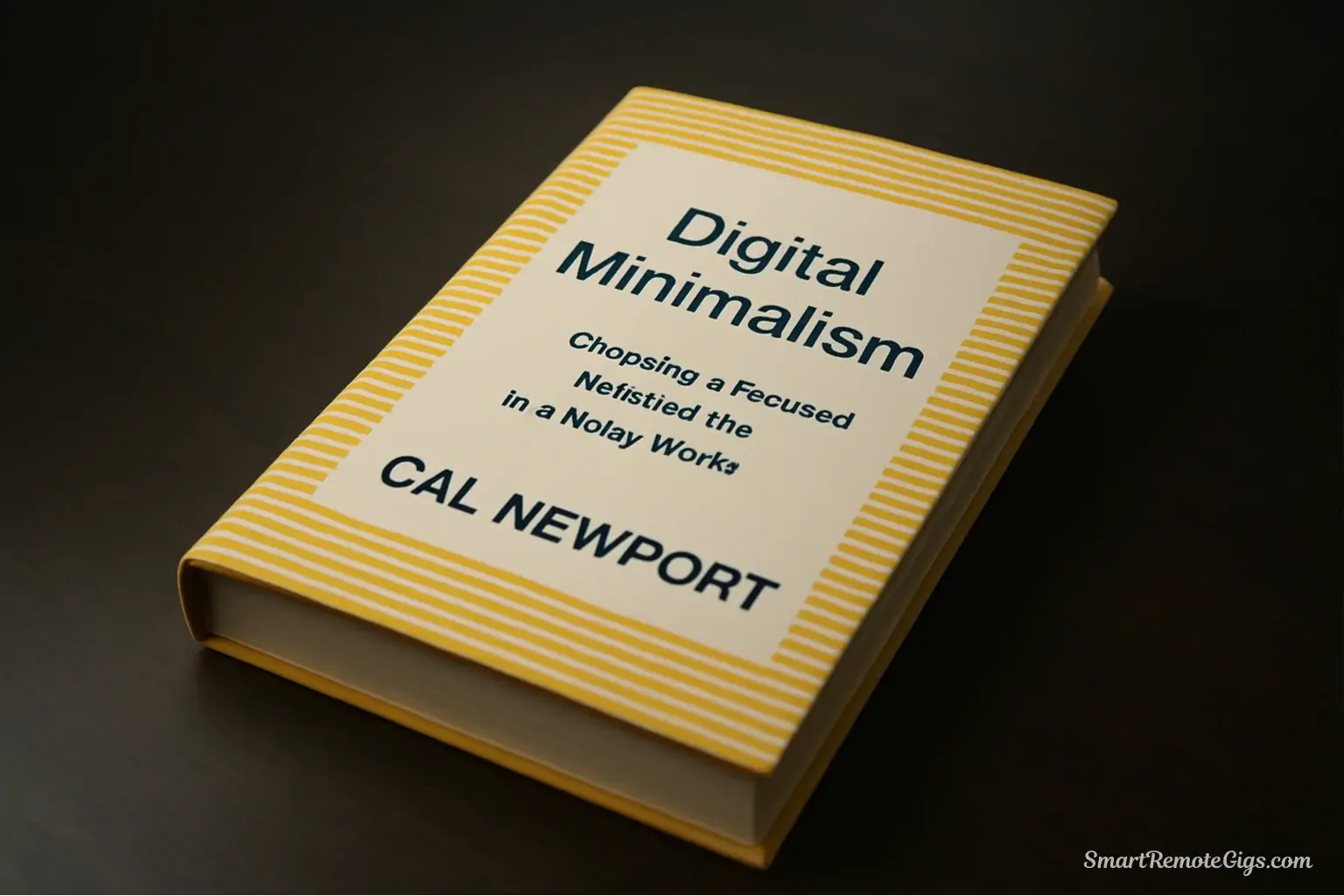
Cal Newport didn’t just write another self-help book about spending less time on your phone. With “Digital Minimalism: Choosing a Focused Life in a Noisy World,” he introduced a complete philosophy for living intentionally in the age of digital distraction. Newport, a computer science professor at Georgetown University and author of the bestselling “Deep Work,” has become the definitive authority on reclaiming your attention from technology.
The book’s central argument is radical but necessary: our relationship with technology is fundamentally broken, and small tweaks won’t fix it. Downloading a screen time tracking app or moving social media to a folder won’t solve a problem that’s architectural. The platforms are designed by the world’s best behavioral psychologists to be addictive. Fighting that with willpower alone is like trying to bail out a sinking ship with a teaspoon.
Newport argues that we need a complete philosophy—a comprehensive set of principles and practices that helps us use technology in a way that serves our values rather than undermines them. This digital minimalism book summary distills the most powerful concepts from Newport’s work, giving you the essential framework without the full 300-page read (though the full book is absolutely worth your time).
The Foundation: Why We Need a Philosophy, Not Just “Hacks”
Before diving into the three key ideas, it’s crucial to understand why Newport believes traditional productivity advice fails when applied to technology.
We’re living in what Newport calls the “Attention Economy.” Tech companies don’t make money from you buying their products—they make money from capturing and monetizing your attention. Every feature, notification, and algorithm is optimized not for your wellbeing, but for engagement—keeping you on the platform as long as possible so they can serve more ads or collect more data.
The statistics are staggering: the average person checks their phone 96 times per day (once every 10 minutes while awake). We’re not weak. We’re responding to billions of dollars of research into behavioral psychology and habit formation. The infinite scroll, the pull-to-refresh mechanic, the red notification badges—these weren’t accidents. They were engineered to exploit our psychological vulnerabilities.
This is why simple “life hacks” don’t work. Turning off notifications helps, but it doesn’t address the underlying compulsion. Using grayscale mode makes your phone less appealing, but it doesn’t give you a framework for deciding what technology should be in your life in the first place.
Newport’s solution is digital minimalism: “a philosophy of technology use in which you focus your online time on a small number of carefully selected and optimized activities that strongly support things you value, and then happily miss out on everything else.”
This isn’t about rejecting technology. It’s about being highly selective and intentional about which technologies you allow into your life, then optimizing how you use them to extract maximum value while minimizing the costs to your attention and autonomy.
Key Idea #1: The Digital Declutter is a Full Reset, Not a Tweak
The centerpiece of Newport’s book—and the digital minimalism main points that matter most—is the 30-day Digital Declutter. This isn’t a suggestion or optional warm-up exercise. Newport considers it the non-negotiable starting point for anyone serious about changing their relationship with technology.

The process is deceptively simple:
- Take a 30-day break from all optional technologies in your life (social media, news sites, video streaming, games, etc.)
- During this break, actively rediscover high-quality activities and interests
- At the end of 30 days, reintroduce only the technologies that pass a strict test: “Does this offer a massive benefit to something I deeply value?”
- For technologies that make it back in, establish strict “operating procedures” about when and how you’ll use them
Why a full reset rather than gradual reduction?
Newport argues that addiction creates a warped cost-benefit analysis. When you’re constantly using Instagram, you overestimate its benefits (staying connected, creative inspiration) and underestimate its costs (fragmented attention, comparison anxiety, stolen time). You can’t accurately evaluate something while you’re still under its influence.
The 30-day break serves multiple purposes:
- It breaks the habit loop: After 30 days, you’re no longer automatically reaching for your phone or opening tabs to check social media. The compulsion fades.
- It reveals true value: When you reintroduce technologies after 30 days, you clearly see which ones you actually missed and which ones you didn’t need at all. Most people are shocked to discover they don’t miss 70-80% of what they gave up.
- It creates space for alternatives: When you remove digital distractions, you’re forced to fill the time with something else. This is where you rediscover activities that provide genuine satisfaction rather than just filling time.
- It provides emotional detachment: Stepping away for 30 days gives you the psychological distance to make rational decisions about technology rather than emotional ones based on FOMO or anxiety.
Newport emphasizes that this isn’t a “digital detox” (a temporary break before returning to old habits). It’s a permanent restructuring of your digital life based on explicit values. The declutter is the foundation that makes everything else possible.
For a detailed, day-by-day guide to implementing this process, see our comprehensive article: How to Perform a Digital Declutter: The Complete 30-Day Checklist.
Key Idea #2: The Importance of Solitude and High-Quality Leisure
Newport dedicates significant attention to two interconnected concepts that are casualties of our always-connected lives: solitude and high-quality leisure.

The Solitude Deprivation Crisis
Newport defines solitude not as physical isolation, but as “freedom from input from other minds.” This means time when you’re alone with your own thoughts, not consuming content created by others—no podcasts, no social media, no texts, no articles. Just you and your mind.
He argues that humans have never, in history, experienced “solitude deprivation” at the scale we’re experiencing now. Previous generations naturally had hours of solitude daily—during commutes, while doing chores, in moments of waiting. Today, any moment of potential boredom is immediately filled with our phones.
The consequences are severe:
- Loss of self-understanding: We can’t process our experiences and form our own opinions when we’re constantly consuming others’ thoughts
- Reduced ability to solve problems: Many of life’s biggest decisions require sustained contemplation that’s impossible when you’re constantly distracted
- Decreased empathy and emotional regulation: Newport cites research showing that solitude is essential for developing empathy and managing difficult emotions
- Creative stagnation: Original ideas emerge from boredom and mind-wandering, not from consuming content
Newport’s solution is simple but challenging: build regular solitude into your life. This might mean:
- Taking walks without headphones or podcasts
- Leaving your phone behind during errands
- Driving in silence rather than with entertainment
- Sitting quietly for 10 minutes each morning before checking devices
High-Quality Leisure vs. Low-Quality Distraction
The second half of this key idea addresses what you do with the time you reclaim from digital distractions. Newport makes a crucial distinction:
Low-quality leisure: Passive, easy, requires no skill, produces nothing, often digital (scrolling social media, watching random YouTube videos, playing addictive mobile games)
High-quality leisure: Active, requires skill, produces something tangible, often physical (woodworking, playing an instrument, team sports, cooking elaborate meals, fixing things, creating art)
Newport draws on Aristotle’s concept of “leisure” as activities pursued for their own sake that contribute to human flourishing. The philosopher would be horrified by what we now call “leisure”—sitting passively consuming whatever content algorithms serve us.
The book argues that humans are wired to find satisfaction in:
- Craft: Using our hands to create physical objects
- Skill development: The satisfaction of getting better at something challenging
- Physical activity: Movement and exertion
- Face-to-face connection: Real-time interaction with other humans
Newport found that people who successfully maintain digital minimalism long-term share a common trait: they’ve filled their recovered time with genuinely satisfying activities, not just replaced one digital distraction with another.
This is why the Digital Declutter includes an active phase of rediscovering high-quality activities. If you just eliminate digital distractions without replacing them with better alternatives, you’ll eventually drift back to your old habits out of boredom.
⏱️ Need to Focus?
Our free Smart Gig Finder app includes a built-in Pomodoro timer to help you master deep work. Download it now.

Key Idea #3: Adopt a “Minimalist Technology Screen”
After completing the Digital Declutter, you face the crucial question: which technologies should come back into your life? Newport provides a rigorous framework he calls the “Minimalist Technology Screen.”

The Core Question
For each technology you’re considering reintroducing, ask:
“Does this technology offer a massive benefit to something I deeply value?”
This phrasing is deliberate and crucial. Notice what it’s NOT asking:
- ❌ “Does this technology offer any benefit?” (Too low a bar—everything offers some benefit)
- ❌ “Is this technology useful?” (Usefulness isn’t enough—it must serve your values)
- ❌ “Do other people use this?” (Other people’s choices are irrelevant to your values)
The filter requires three things:
1. Massive benefit (not marginal)
The benefit must be substantial and significant. “It’s kind of nice to see what my high school classmates are up to” doesn’t qualify. “This tool directly enables my career as a photographer by connecting me with clients and showcasing my work” does qualify.
Newport argues that we chronically overestimate the benefits of optional technologies. Instagram might provide some value for staying connected with friends, but is it massive? Or could you achieve better connection through other means (texts, calls, in-person hangouts)?
2. Something you deeply value
This requires doing the hard work of defining your core values. Not surface-level values like “staying informed” or “being social,” but your deepest priorities: meaningful relationships with specific people, creative expression in a particular medium, contribution to your community, physical health, spiritual growth, mastery of a craft.
Most optional technologies serve vague, surface-level values that dissolve under scrutiny. Do you deeply value “knowing what’s trending” or “staying updated on celebrity news”? Probably not.
3. Optimized for value extraction
Even technologies that pass the first two criteria require optimization—specific rules about when and how you’ll use them to maximize value while minimizing harm.
For example, if Instagram legitimately supports your photography business (massive benefit to something you value), you still need operating procedures:
- Desktop only, not on phone (prevents impulsive checking)
- Only for posting your work and responding to clients (no browsing feed)
- 20 minutes on Saturday mornings only (strict time boundaries)
- Turn off all notifications except direct messages from verified clients
The Minimalist Technology Principles
Newport supplements the core screening question with three principles:
Principle 1: Clutter is Costly
Every technology you use has costs beyond time spent directly using it. There’s the mental overhead of remembering passwords, the context-switching cost of notifications, the decision fatigue of managing multiple platforms. These hidden costs add up to a significant cognitive burden.
Digital minimalists keep only essential technologies precisely because clutter—even digital clutter—imposes real costs on your attention and mental energy.
Principle 2: Optimization is Important
Once you’ve decided a technology provides value, optimize ruthlessly for that value. Don’t just use it in the default way the platform wants you to use it. Customize, constrain, and configure it to serve your goals while preventing exploitation of your attention.
Principle 3: Intentionality is Satisfying
Perhaps most importantly, Newport argues that using technology on your own terms—with clear intentions and boundaries—is deeply satisfying in a way that passive consumption never is. The sense of agency and control you gain from curating your digital life carefully provides its own reward.
For example, you can rigorously apply this filter to your social media use by performing a mindful social media cleanse.
Who Should Read This Book?
The full “Digital Minimalism” book is essential reading for:
- Anyone who feels controlled by their devices rather than in control of them
- Parents concerned about their children’s relationship with technology (Newport includes a section on raising kids in the digital age)
- Knowledge workers whose careers require deep focus but who struggle with digital distraction
- People experiencing anxiety, depression, or loneliness that seems connected to social media use
- Anyone who’s tried to “cut back” on screen time and failed repeatedly
The book provides both the intellectual framework (why digital minimalism matters) and the practical process (how to implement it). Newport backs his arguments with research from psychology, philosophy, and sociology, making the case that this isn’t just a personal preference but a necessary response to a technological environment designed to exploit human vulnerabilities.
Where to get it: You can find “Digital Minimalism” on Amazon or request it from your local library. For more about Newport’s work, visit his blog, which regularly explores themes of focus, productivity, and intentional technology use.
Conclusion: Putting the Philosophy into Practice
This Cal Newport digital minimalism summary covers the essential framework, but the book’s real power comes from how thoroughly Newport develops each concept with research, case studies, and philosophical arguments. If you’re serious about changing your relationship with technology, the full book is worth the investment.
The core lessons from digital minimalism are:
- Small changes aren’t enough: You need a complete philosophy and a full reset (the 30-day Digital Declutter) to break free from addictive technologies
- Solitude and high-quality leisure are non-negotiable: Humans need time alone with their thoughts and activities that provide genuine satisfaction, not just distraction
- Be ruthlessly selective: Only allow technologies that provide massive benefits to things you deeply value, and optimize how you use them
Newport provides the “why”—the intellectual and philosophical foundation for digital minimalism. But philosophy alone doesn’t change habits. You need practical implementation.
That’s where our guides come in. To see how we apply this philosophy with step-by-step instructions, detailed checklists, and day-by-day guidance, read our Ultimate Guide to Digital Minimalism. There you’ll find the complete practical framework for implementing Newport’s ideas in your own life.
The book gives you the conviction that change is necessary and possible. Our guides give you the exact roadmap to make it happen.
Digital minimalism isn’t about deprivation or becoming a Luddite. It’s about designing your technological life so intentionally that you wonder how you ever lived any other way. Newport’s book shows you why that matters. Now it’s time to make it real.
Start with understanding the philosophy. Then move to action. Your focused life is waiting.