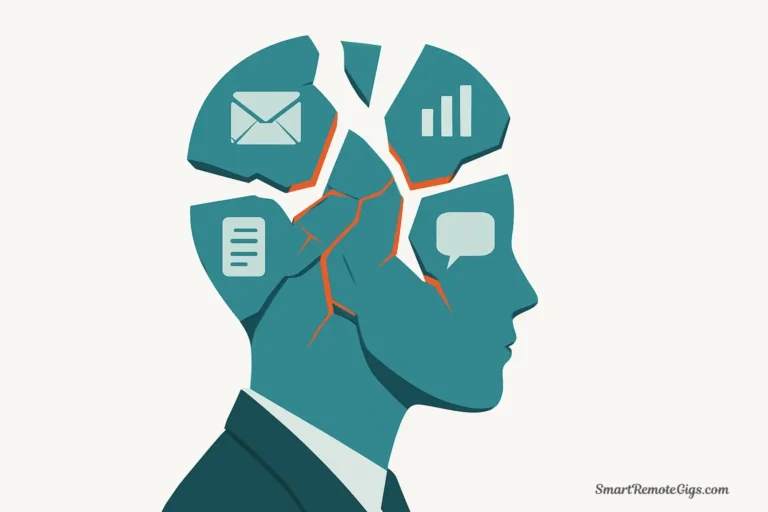
The “Cold Start” Problem. In a remote environment, the hardest part of the day isn’t the work itself—it’s the start. You spend 45 minutes “preparing” to work (cleaning the desk, checking email, making a second coffee) because the friction of entering “Deep Work” mode feels too high.
I used to rely on “feeling ready” to write. Some days I felt it at 10 AM; other days, not until 4 PM. My income was held hostage by my mood. I needed a way to force the “flow state” switch, regardless of how tired I felt.
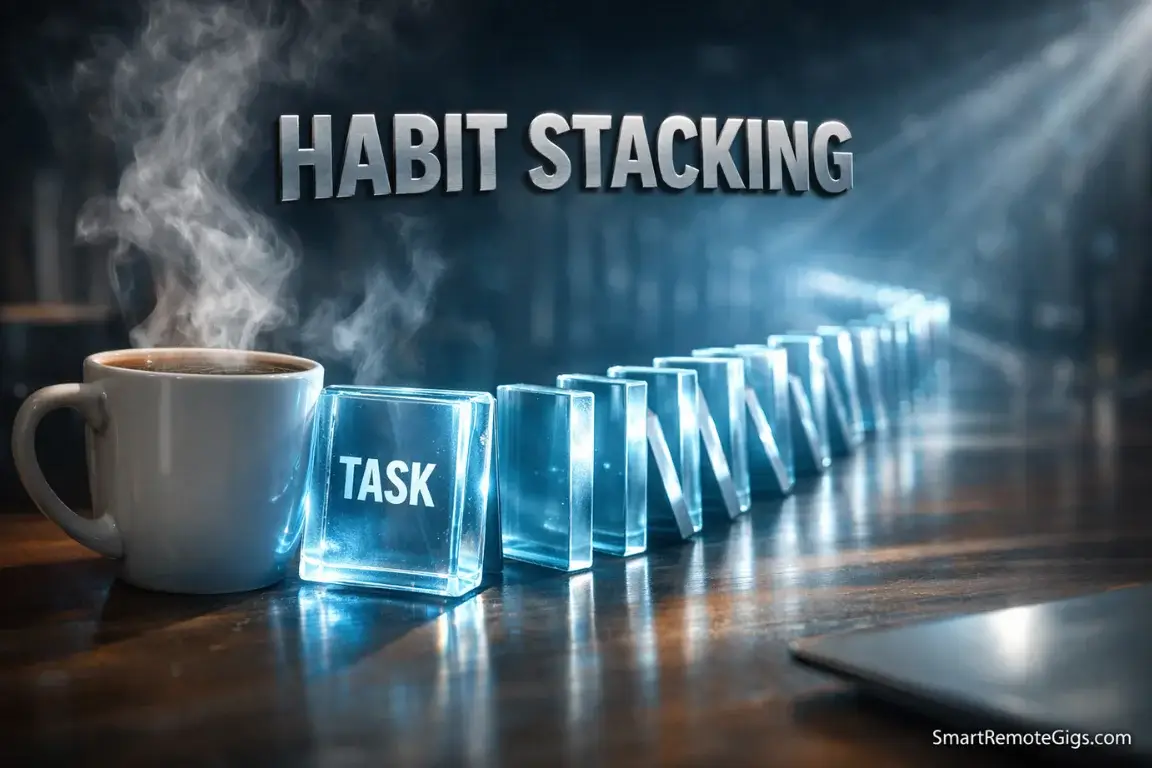
We will apply BJ Fogg’s “Tiny Habits” and James Clear’s “Stacking” logic to create a Neural Chain Reaction. You won’t have to “decide” to work; your morning coffee will simply trigger your productivity.
⚡ The Stacking Formula
The Code: After I [CURRENT HABIT], I will [NEW HABIT].
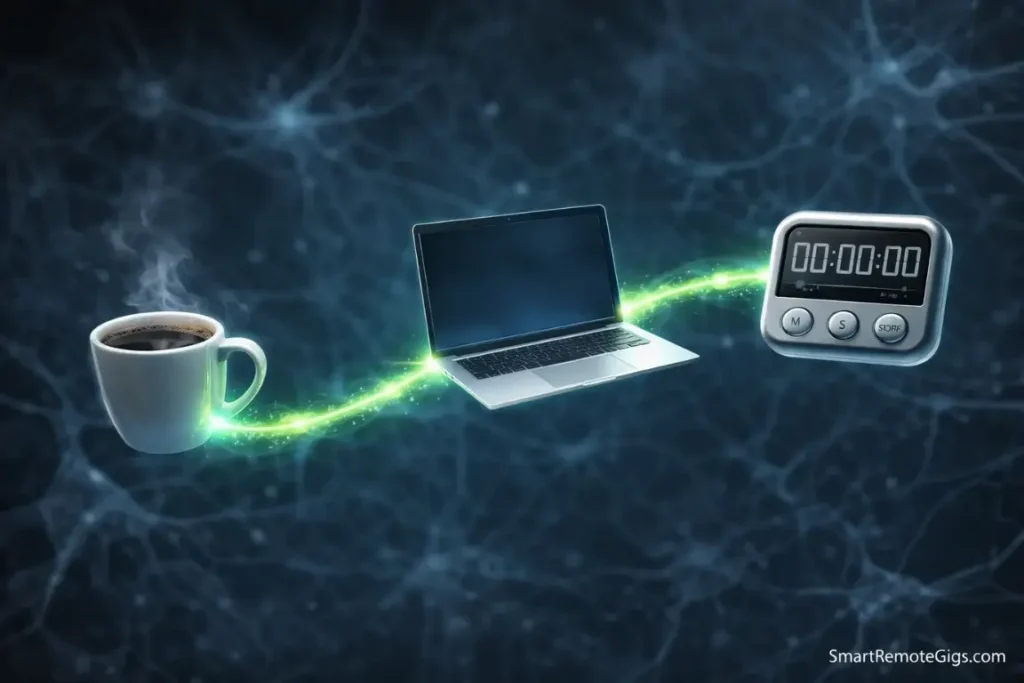
The Remote Example: “After I [Pour my coffee], I will [Open my ‘Deep Work’ Browser Profile].”
Why It Works: It piggybacks off established neural pathways, removing the need for willpower.
Why “Motivation” is a Trap for Remote Workers
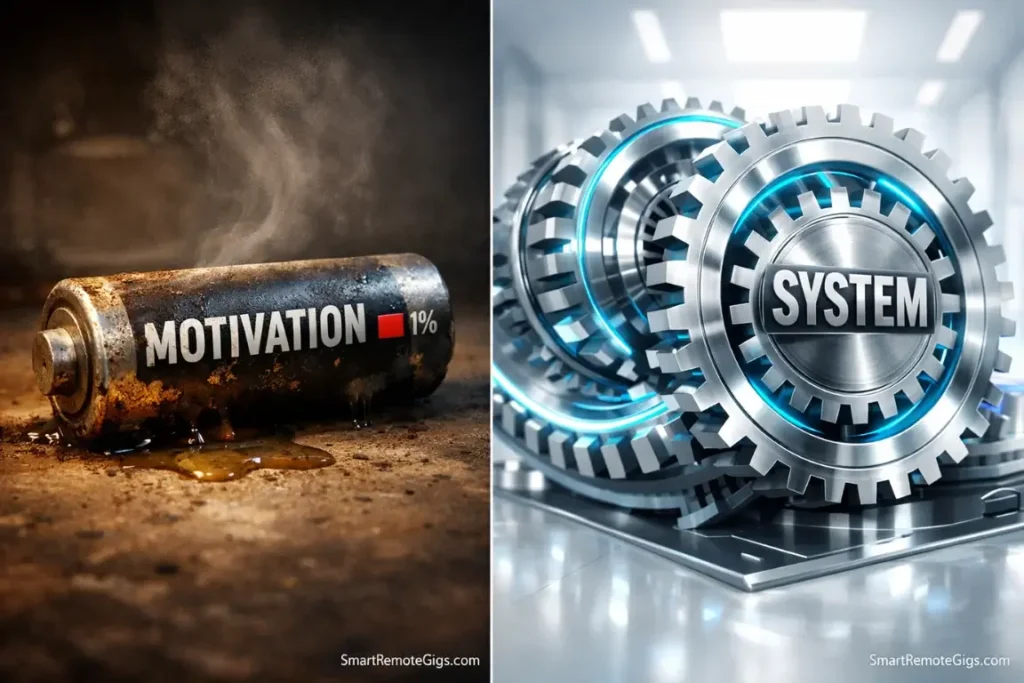
Motivation is a battery. Sometimes it’s charged. Most of the time, it’s not.
If you build your productivity system around motivation, you’re building on sand. One bad night of sleep, one stressful email, one rainy morning—and the whole system collapses.
Remote workers can’t afford this volatility.
You don’t have a boss standing over you. You don’t have coworkers creating social pressure. You’re alone. And if you wait for motivation to show up, you’ll wait all day.
The solution isn’t to “find” more motivation. It’s to eliminate the need for motivation entirely.
The Diderot Effect: How one action triggers the next (and why checking Slack first triggers a spiral of distraction)
In the 18th century, French philosopher Denis Diderot received a beautiful scarlet robe as a gift. He loved it. But suddenly, his old furniture looked shabby next to the robe. So he replaced his furniture. Then the rug looked cheap. Then the paintings looked outdated.
One robe triggered a cascade of purchases.
This is the Diderot Effect: one action naturally leads to the next.
Your brain works the same way.
If you start your morning by opening Slack, what happens next? You see a message. You reply. Someone replies back. You check another channel. You see a notification. You click. Before you know it, 45 minutes have passed and you haven’t started your actual work.
Slack → Email → Twitter → More Slack → “Where did the morning go?”
This isn’t a discipline problem. It’s a design problem.
The first action in your morning determines the entire trajectory of your day.
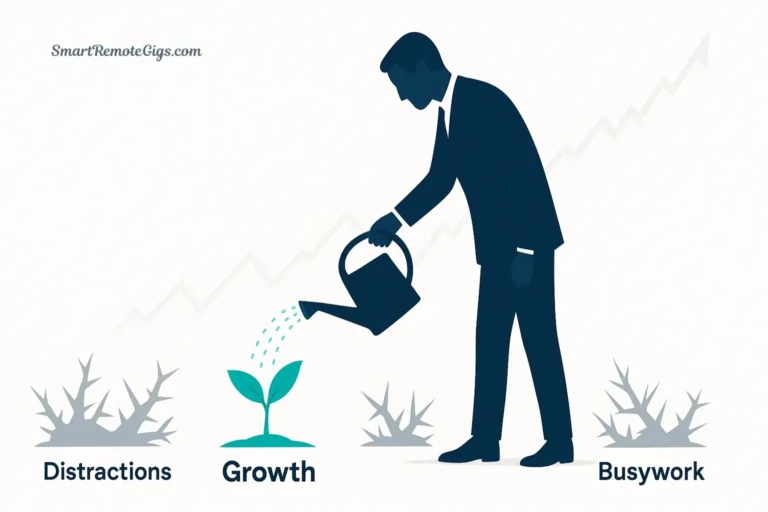
If you start with distraction, distraction compounds.
If you start with deep work, deep work compounds.
The stack is everything.
Synaptic Pruning: Your brain is lazy. If you don’t give it a specific cue, it defaults to the path of least resistance (Netflix/Instagram)
Your brain is incredibly efficient. Too efficient.
Through a process called synaptic pruning, your brain strengthens the neural pathways you use frequently and eliminates the ones you don’t.
If you check Instagram every morning, the “wake up → check Instagram” pathway becomes a highway.
If you never do deep work first thing, the “wake up → deep work” pathway becomes overgrown.
Here’s the brutal truth: your brain will always default to the strongest pathway.
If you don’t design a specific cue for deep work, your brain will choose the easier option. Every. Single. Time.
Netflix is easier than writing.
Instagram is easier than coding.
Email is easier than strategy work.
You don’t have a willpower problem. You have a pathway problem.
Warning: Never stack a high-friction habit (Deep Work) on top of a variable habit (Checking Email). Email is a roulette wheel; it destroys the stack before it starts.
Designing Your “Login Sequence” (The Digital Stack)
The “Login Sequence” is the series of actions that takes you from “sitting down” to “fully immersed in deep work.”
Most people don’t have a sequence. They sit down and… improvise.
“Should I check email first? Maybe Slack? Let me make coffee first. Actually, let me clean my desk. Oh, I should review my goals. Wait, did I respond to that client?”
This is decision fatigue. And it kills momentum before you even start.
The Login Sequence eliminates decisions. You follow the same path every time. The brain loves this.
The Anchor: Identifying a habit you already do without thinking (e.g., sitting in your chair, unlocking your laptop)
The foundation of habit stacking is the anchor habit.
This is something you already do automatically, without thinking. It’s so ingrained that you do it even on your worst days.
Examples of anchor habits:
- Sitting in your work chair
- Opening your laptop
- Pouring your first coffee
- Plugging in your laptop charger
The anchor must be:
- Automatic (you never skip it)
- Specific (not vague like “morning time”)
- Tied to a location (physical cues are stronger than time-based cues)
Once you identify your anchor, you stack your new habit immediately after.
Bad Example: “In the morning, I will do deep work.”
(Too vague. “Morning” could mean 7 AM or 11 AM.)
Good Example: “After I sit in my work chair, I will open my Deep Work browser profile.”
(Specific. The physical act of sitting triggers the next action.)
The Tiny Execution: The new habit must take less than 2 minutes
Here’s where most people fail: they stack too big.
Bad Stack: “After I open my laptop, I will write for 4 hours.”
This is setting yourself up for failure. Writing for 4 hours is a marathon, not a habit. Your brain will resist.
Good Stack: “After I open my laptop, I will start the Pomodoro Timer.”
Starting a timer takes 5 seconds. Your brain doesn’t resist. And once the timer is running, you’ll naturally start working because the timer creates urgency.
The new habit should be so small that it’s almost embarrassing.
Not “write an entire blog post.” Just “open the document.”
Not “complete the client project.” Just “review yesterday’s progress.”
Not “code for 3 hours.” Just “open VS Code and review the last function.”
The 2-minute version is just the entry point. Once you start, momentum takes over.
The Pomodoro timer is the perfect low-friction trigger to initiate the sequence.
Stacking the Environment (Physical Cues)
Digital stacking is powerful. But physical stacking is even stronger.
Your environment is a collection of cues. Every object in your workspace is either pulling you toward productive behavior or pulling you away from it.
The “Mise-en-place” Rule: Chefs prep their station before cooking. You must prep your desk before sleeping
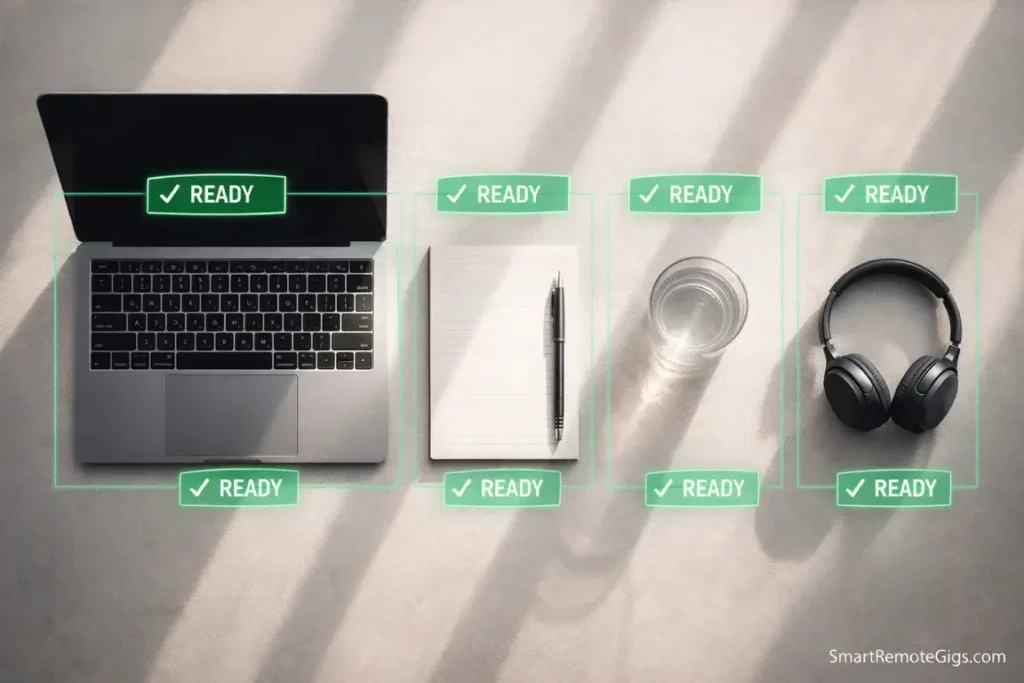
Walk into any professional kitchen and you’ll see mise-en-place—everything in its place.
Before the chef cooks a single dish, the station is prepped. Knives are sharp. Ingredients are measured. Tools are within reach.
Why? Because in the middle of service, there’s no time to hunt for a spatula or chop an onion. The flow must be uninterrupted.
Your workday is the same.
If you sit down in the morning and have to:
- Find your notebook
- Clear yesterday’s coffee mug
- Untangle your headphone cord
- Figure out where you saved that document
…you’ve already lost. The friction is too high. Your brain will choose the easier path (scrolling Twitter).
The solution: Prep your desk the night before.
Use your Shutdown Ritual to set the anchor for tomorrow morning’s stack.
Before you close your laptop tonight:
- Clear the desk completely
- Place tomorrow’s notebook and pen in the exact spot you’ll need them
- Plug in your laptop so it’s fully charged
- Queue up the first task in your task manager
When you sit down tomorrow, the desk is ready. The friction is gone. The stack flows.
Hardware Triggers: Using physical objects to gatekeep digital actions
Physical objects can be powerful cues for mental states.
Example: Noise-canceling headphones = Deep Work Mode
I have a rule: I only put on my noise-canceling headphones when I’m entering “Code Mode.” Not for Slack. Not for email. Only for deep work.
Now, the act of putting on the headphones triggers my brain: “We’re doing serious work now.”
Other examples:
- Standing desk raised = Writing mode
- Second monitor turned on = Design mode
- Notebook open = Strategy mode
The object becomes the cue. And cues automate behavior.
Advanced Stacking: The Morning Chain
Once you’ve mastered single stacks, you can chain multiple habits together into a sequence.
This is where the magic happens.
Sequencing the First 60 Minutes
Here’s a sample Morning Chain designed to move you from “asleep” to “deep work” with zero decision-making:
Step 1: Wake Up → Drink Water
(The anchor: your alarm goes off. The stack: drink 16 oz of water before touching your phone.)
Step 2: Drink Water → Stretch
(After you finish the water, do 5 minutes of stretching. Not optional. The water is the cue.)
Step 3: Stretch → Review Daily Goals
(After stretching, sit at your desk and open your task list. Review today’s Top 3 tasks.)
Step 4: Review Goals → Open Laptop
(After reviewing goals, open your laptop and start the first Pomodoro timer.)
Notice the structure:
Each action is small (under 2 minutes).
Each action is triggered by the completion of the previous action.
There are no gaps where you could “check Instagram real quick.”
The chain is unbreakable.
Pro Tip: If the chain breaks, don’t try to restart from the middle. Go back to the previous link (e.g., go drink water again) to reset the neural pathway.
Why Your Stacks Fail (Troubleshooting)
Most habit stacks fail for predictable reasons. Let’s fix them.
The Cue Was Too Vague
Bad Cue: “When I take a break, I will go for a walk.”
“When I take a break” is vague. Breaks don’t happen at specific times. You’ll forget.
Good Cue: “When I stand up from my chair after a Pomodoro session, I will walk to the kitchen for water.”
The physical act of standing is the cue. It’s specific. It’s impossible to miss.
The fix: Make your cues physical and obvious.
Not “in the afternoon.”
Use: “When I close my laptop for lunch.”
Not “when I’m stressed.”
Use: “When I notice my shoulders are tense.”
Not “before bed.”
Use: “After I brush my teeth.”
The Reward Was Missing
Habits need rewards to stick. This is how the brain’s dopamine-driven reward system works.
If you complete a habit stack and nothing good happens, your brain won’t prioritize it.
The fix: Celebrate immediately.
After you complete your Morning Chain, do something that feels good:
- Play your favorite song
- Check off a box on your habit tracker (visual dopamine hit)
- Say out loud: “I did it”
This sounds silly. It works.
Comparative Analysis
The Random Morning | The Stacked Morning |
|---|---|
Relies on feeling “energetic” | Relies on the previous action |
High decision fatigue (What should I do first?) | Zero decision fatigue (The sequence is set) |
Inconsistent output (Some days great, some days lost) | Predictable results (Same input = same output) |
Motivation-dependent | System-dependent |
“I’ll start when I feel ready” | “I start because the cue happened” |
45 minutes of ‘prep’ before real work | Immediate transition to deep work |
The difference is night and day.
Random mornings produce random results.
Stacked mornings produce compounding results.
The Verdict
You don’t rise to the level of your goals; you fall to the level of your systems. Habit Stacking is the code that programs your system. Stop thinking, start stacking.

Motivation is overrated. Systems are underrated.
The remote worker who relies on motivation will have good weeks and bad weeks, dictated by mood and energy.
The remote worker who builds habit stacks will have consistent weeks, dictated by nothing but the sequence.
Build the stack. Trust the stack. Let the stack carry you.
You’ve built the engine (Habits). Now, let’s clear the road. Read our guide on Friction Design to ensure your digital workspace doesn’t derail your new stacks.