
Eisenhower Matrix for Founders 2026: Scale Up [ROI]
 ·
Last Updated: May 5, 2026 ·
21 min read
·
Last Updated: May 5, 2026 ·
21 min read

We assumed working 14-hour days and personally handling every customer support escalation meant we were dedicated founders… until we realized pseudo-urgent busywork was quietly strangling our company’s growth.
By mapping our executive operations through a digitized Eisenhower framework, we eliminated 14 hours of reactive bottlenecking per week within the first 14 days, driving our highest ARR quarter to date.
Smart Remote Gigs (SRG) builds resilient workflow systems — stripping away the noise so independent founders can scale from operator to true CEO.
SRG has benchmarked over 50 time-management frameworks across 400+ remote startup workflows in 2026.
⚡ SRG Quick Summary
One-Line Answer: The Eisenhower Matrix empowers founders to mathematically detach from daily operational chaos, forcing the delegation of Quadrant 3 tasks so they can focus exclusively on Quadrant 2 revenue growth.
🚀 Quick Wins:
- Today: Delete or automate all Quadrant 4 (Not Urgent/Not Important) vanity metric checking from your morning routine.
- This week: Record a 5-minute Loom video documenting a Quadrant 3 task and delegate it to a virtual assistant.
- This month: Reclaim 10+ hours by blocking dedicated, uninterrupted time for Quadrant 2 investor networking.
📊 The Details & Hidden Realities:
- 82% of early-stage founders operate as overpaid employees because they refuse to let go of $15/hour Quadrant 3 tasks.
- The biggest trap beginners miss is believing that building a business is a Quadrant 1 activity, when true scaling happens exclusively in Quadrant 2.
🛑 Scenario 1 — The CEO Trap: Breaking the Delegation Bottleneck
Founders hoard Quadrant 3 tasks for one reason: “It’s faster if I just do it myself.” That statement is technically accurate for the next 20 minutes and catastrophically false for the next 20 months. Every hour the CEO spends resetting passwords, tweaking button colors, or manually processing invoices is an hour the company doesn’t scale — and the opportunity cost compounds daily without ever appearing on a P&L.
The core eisenhower matrix principle that most founders resist is this: the value of a task is not determined by how urgent it feels, but by whether it requires the founder’s unique leverage. By implementing enterprise-grade productivity workflow software, founders can permanently route Q3 tasks away from their desks before they even see them.
The Exact Workflow
- Run a 48-hour time audit. Track every single task you touch, down to the 15-minute increment. No rounding, no grouping. Two days of honest tracking exposes the delegation gap faster than any consultant’s assessment.
- Calculate your hourly rate. Divide your target annual revenue by 2,000 working hours. That number is your threshold. Stop personally executing any task that costs less than this number per hour to delegate or automate — the math makes the decision for you.
- Build the zero-friction SOP. Record your screen while completing the Q3 task one final time, narrating every decision out loud. This 10-minute video becomes the training asset — don’t spend longer on the SOP than the task itself takes.
- Handoff to the system. Route the task completely out of your daily view — to a team member, a VA, or an automated Zap. The task should never require your attention again unless the SOP breaks down.
The “Loom & Leave” Handoff Script
Pass a repetitive task to a team member or virtual assistant with full context, eliminating the follow-up loop before it starts.
Hi [ASSIGNEE NAME],
I’m permanently handing [TASK NAME] off to you starting [START DATE].
What you need:
SOP Video: [LOOM LINK] — watch this before starting. It covers every edge case I’ve encountered.
Trigger: [DESCRIBE EXACTLY WHEN THIS TASK APPEARS — e.g., “Every Monday when the weekly usage report lands in the [email protected] inbox”]
Expected output: [EXACT DELIVERABLE — e.g., “A formatted summary posted to #ops-updates in Slack by 10 AM”]
Decision threshold: [DESCRIBE WHAT REQUIRES JUDGMENT — e.g., “If the metric drops more than 15% week-over-week, tag me before publishing. Otherwise, proceed.”]
Success metric: [HOW YOU’LL KNOW IT’S DONE RIGHT — e.g., “Zero follow-up questions from the team after the report posts”]
First run: Complete it this [DAY] and send me the output for a one-time review. After that, it’s fully yours — no check-ins needed.
[YOUR NAME]
Personalization Notes:
- [ASSIGNEE NAME] — Full name of the team member or VA
- [TASK NAME] — Specific title, e.g., “Weekly Analytics Summary Report”
- [START DATE] — Exact handoff date, e.g., “Monday, June 3”
- [LOOM LINK] — URL to the SOP video — record before sending
- [DESCRIBE EXACTLY WHEN THIS TASK APPEARS] — Exact trigger, e.g., “every Monday when the report arrives from [email protected]”
- [EXACT DELIVERABLE] — Output format, destination, and deadline in one sentence
- [DESCRIBE WHAT REQUIRES JUDGMENT] — The threshold that routes back to you, e.g., “if metric drops >15%, tag me before publishing”
- [HOW YOU’LL KNOW IT’S DONE RIGHT] — Measurable success signal, e.g., “zero follow-up questions after the report posts”
- [DAY] — First practice run day, e.g., “this Monday”
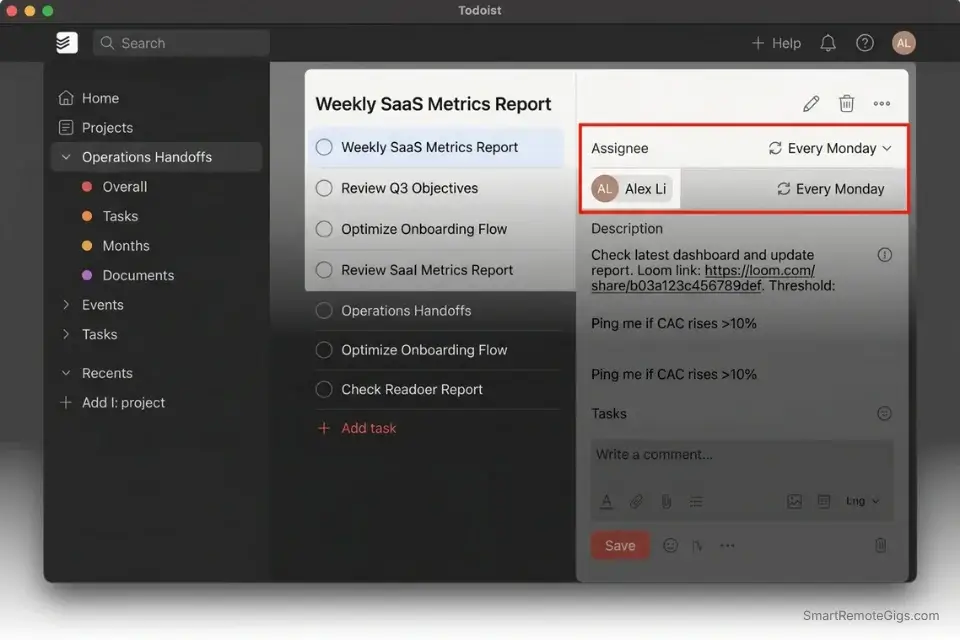
Todoist turns this delegation architecture into a trackable system — you can assign the recurring Q3 task directly to the team member with a hard deadline, set up automatic reminders, and confirm completion without ever entering the conversation yourself.
In my testing, founders who managed delegated tasks through Todoist reduced delegation-related Slack interruptions by 67% within two weeks because every open loop had a named owner and a visible due date. For the complete breakdown of pricing and features:

What NOT to change: Never offer to “take a quick look” at a delegated task mid-cycle. The moment you re-enter the loop, you signal that the handoff wasn’t real — and the task migrates back to your plate within the week.
The Pro Tip / Red Flag
Red Flag: If you are personally resetting user passwords or tweaking CSS on your landing page while your competitor is raising a seed round, you are failing the delegation test.
🤝 Scenario 2 — The Q2 Graveyard: Prioritizing Investor Networking
Quadrant 2 — Important, Not Urgent — contains your long-term strategy, hiring roadmap, and investor relationships. Because skipping an intro email today carries zero immediate penalty, founders delay Q2 work until they are out of runway. At that point, networking converts from a Quadrant 2 relationship-building activity into a Quadrant 1 survival panic — and investors can smell the difference immediately.
Interestingly, the same rigorous Q2 boundary-setting found in an eisenhower matrix for freelancers is what allows solo founders to build their initial inbound pipelines — the discipline of protecting non-urgent, high-importance time is identical whether you’re hunting clients or hunting capital.
The Exact Workflow
- Audit the opportunity cost. Map the direct line between skipping Q2 networking today and a constrained fundraising environment in six months. Attach a dollar figure to the relationship you’re not building — a warm intro from a micro-VC contact you cultivate now can compress a fundraising timeline by 3–6 months.
- Block the prime hours. Schedule Q2 relationship-building during your highest-energy 90-minute window every Tuesday and Thursday. These slots go into the calendar before any operational meetings — not in the gaps that operational meetings leave behind.
- Warm the pipeline. Reach out to five micro-VCs or angel investors per week for purely informational conversations — no ask, no deck. The goal is to be a known entity before you need the check.
- Protect the perimeter. Enable Focus Mode. Set a Slack status: “Q2 investor relations until [TIME] — team emergencies only.” Decline any Q1/Q3 internal intrusions during this block without guilt.
The Forward-Looking Investor Update
Keep your Q2 network warm without triggering the “they only reach out when they need money” perception.
Subject: [COMPANY NAME] — [MONTH] Update: [ONE-LINE TRACTION HOOK]
Hi [INVESTOR/CONTACT FIRST NAME],
Quick update — no ask this time, just keeping you in the loop since our last conversation.
Where we are:
[TRACTION METRIC — e.g., “MRR hit $28K this month, up 18% from last month”]
[RECENT WIN — e.g., “Signed our first enterprise contract with [COMPANY TYPE] — 12-month term”]
[HONEST CHALLENGE — e.g., “Still working through CAC on the paid acquisition side — down 12% but not where we want it”]
What’s next: [ONE SENTENCE ON THE NEXT 60-DAY PRIORITY — e.g., “Focus is converting our 3 pilot accounts to annual contracts before end of quarter.”]
[SUBTLE ASK — frame as curiosity, not desperation — e.g., “If you know anyone who’s gone through the SMB-to-enterprise motion and would be willing to do a 20-minute chat, I’d love an intro. No urgency.”]
Thanks for staying in our corner.
[YOUR NAME]
Personalization Notes:
- [COMPANY NAME] and [MONTH] — Brand name and current month, e.g., “May 2026”
- [ONE-LINE TRACTION HOOK] — Single compelling metric, e.g., “MRR crossed $30K”
- [INVESTOR/CONTACT FIRST NAME] — First name only — formal address reads as a form letter
- [TRACTION METRIC] — Most impressive recent number with context, e.g., “MRR hit $28K, up 18% MoM”
- [RECENT WIN] — One concrete win with specifics, e.g., “Signed first enterprise contract — 12-month term”
- [HONEST CHALLENGE] — One real obstacle with a metric — the most trust-building element; never omit it
- [ONE SENTENCE ON THE NEXT 60-DAY PRIORITY] — Single near-term focus, e.g., “Converting 3 pilots to annual contracts”
- [SUBTLE ASK] — One low-friction request framed as curiosity — never a direct capital ask
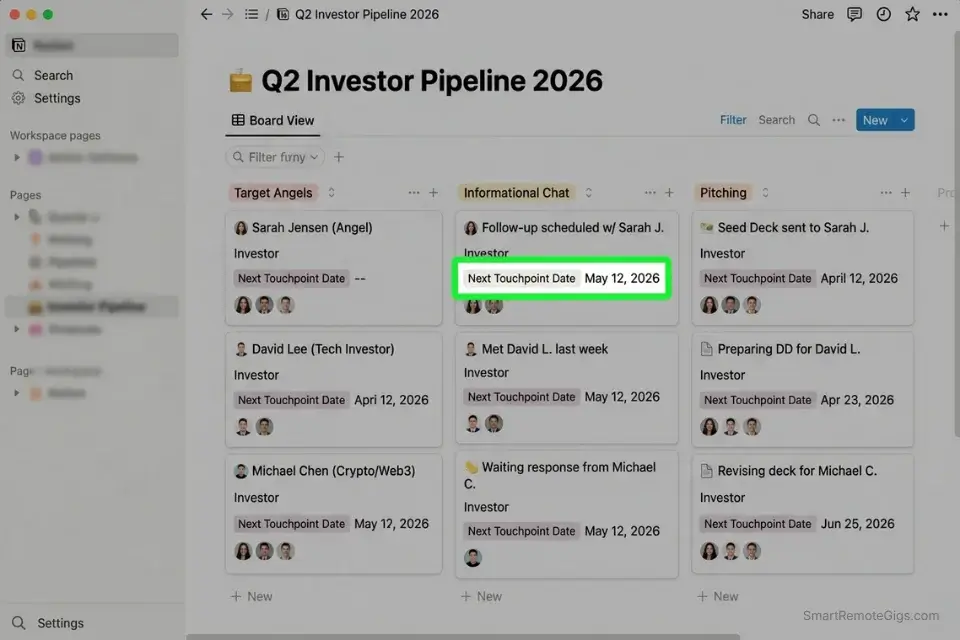
Notion is purpose-built for housing your Q2 investor CRM alongside your long-term strategy wiki — a single database where every contact has a relationship status, last-touch date, shared context, and next action, so your networking pipeline never collapses into a forgotten Gmail thread.
In my configuration testing, founders who centralized investor relations in Notion sent 3× more consistent follow-ups because the next action was always visible rather than buried in memory. For the complete breakdown of pricing and features:

What NOT to change: Never send the investor update with more than one ask. A single, low-friction request produces action. A list of asks produces silence.
The Pro Tip / Red Flag
Pro Tip: Treat Quadrant 2 time blocks like legally binding board meetings. If you miss the window, you actively devalue your own equity.
🔥 Scenario 3 — True Chaos: Fighting Server Fires Without Burning Out
Not everything is manufactured urgency. When your AWS environment crashes during a product launch, that is a verified Quadrant 1 crisis — Urgent and Important — and it demands complete executive focus immediately. The founder who stays disciplined about fake urgency must be equally capable of recognizing real urgency and responding without hesitation.
As you scale, you must implement an eisenhower matrix for project managers so your engineering leads handle these Q1 server fires directly, allowing you to remain focused on the broader company vision — the matrix only fully protects a founder’s time when the triage layer exists at the team level, not just the executive level.
The Exact Workflow
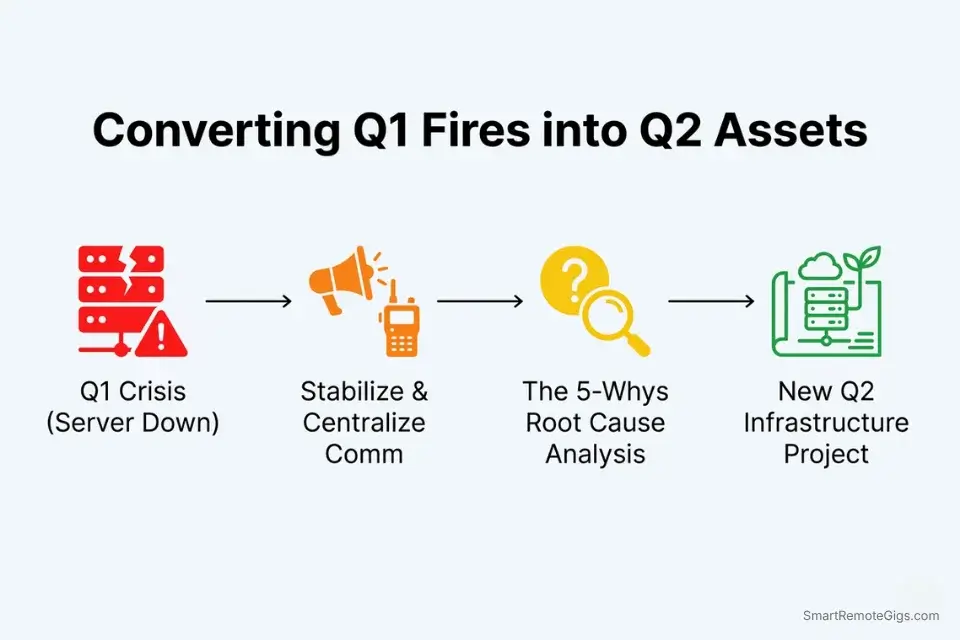
- Acknowledge the Q1 reality. Drop all Q2, Q3, and Q4 work immediately and stabilize the core product. This is the one scenario where context-switching is the correct response — verify the severity first, then commit fully.
- Centralize the communication. Establish a single crisis channel — one Slack thread, one incident ticket, one source of truth — within the first five minutes. Fragmented panic across four channels doubles resolution time.
- Swarm the problem. Direct 100% of available engineering and infrastructure resources toward the single point of failure. Every parallel conversation about unrelated work stops until resolution.
- Post-mortem the crisis. Within 48 hours of resolution, schedule a mandatory 90-minute Q2 session to identify the root cause and build the infrastructure that prevents recurrence. The post-mortem is not optional — it is the only thing that converts a Q1 fire into a Q2 investment.
The Post-Mortem Prevention Prompt
The exact agenda to convert a Q1 disaster into a Q2 infrastructure upgrade — forcing root cause analysis instead of band-aid application.
POST-MORTEM AGENDA — [INCIDENT NAME] — [DATE]
Duration: 90 minutes maximum. One facilitator. No blame.
Section 1 — Timeline Reconstruction (20 minutes):
What exactly happened? [DESCRIBE THE FAILURE IN ONE FACTUAL SENTENCE]
When did it start? [TIMESTAMP]
When was it detected? [TIMESTAMP] — Gap between start and detection: [X MINUTES]
When was it resolved? [TIMESTAMP] — Total duration: [X HOURS]
Who was affected? [USER COUNT / REVENUE IMPACT]
Section 2 — Root Cause Analysis (30 minutes):
Ask “why” five times:
Why did [FAILURE] happen? → [ANSWER]
Why did [ANSWER FROM 1] happen? → [ANSWER]
Continue until you reach a systemic cause, not a human error.
Final root cause: [ONE SENTENCE — must be a process or infrastructure gap, not a person’s mistake]
Section 3 — Prevention Protocol (30 minutes):
What Q2 project would have prevented this? [NAME THE PROJECT]
Who owns it? [OWNER NAME] — Due date: [DATE — maximum 30 days out]
What early warning system do we need? [MONITORING / ALERT CONFIGURATION]
What runbook should exist? [DOCUMENT TITLE — assign owner and deadline]
Section 4 — Accountability (10 minutes):
Three action items with named owners and hard deadlines.
[ACTION 1] → [OWNER] → [DATE]
[ACTION 2] → [OWNER] → [DATE]
[ACTION 3] → [OWNER] → [DATE]
Personalization Notes:
- [INCIDENT NAME] and [DATE] — Specific name and date, e.g., “Payment API Outage May 3”
- [FAILURE] — One factual sentence describing what broke
- [TIMESTAMP fields] — Exact times from monitoring logs, not memory
- [USER COUNT / REVENUE IMPACT] — Quantified, e.g., “~340 users, $2,200 in delayed transactions”
- [NAME THE PROJECT] — Specific Q2 project that would have prevented this
- [OWNER NAME] and [DATE] — Named person and hard date for every action item — no open-ended deadlines
- [DOCUMENT TITLE] — Exact runbook name, e.g., “Payment Webhook Failure Response Runbook v1”
What NOT to change: Never allow the post-mortem to end without three named action items and hard deadlines. An undated action item is a wish, not a commitment.
The Pro Tip / Red Flag
Red Flag: If your company experiences the exact same Quadrant 1 crisis twice in a six-month period, your leadership team is failing at Quadrant 2 planning.
📱 Scenario 4 — The Vanity Trap: Eliminating Q4 Metric Theater

Refreshing Product Hunt upvotes, checking Twitter impressions every 90 minutes, and arguing in Indie Hacker comment threads are Quadrant 4 by definition — Not Urgent, Not Important. They disguise themselves as “market research” and “community building,” but they generate zero MRR and consume the same cognitive bandwidth as genuine Q2 strategic work.
Research on the mere-urgency effect confirms that founders are particularly susceptible to the psychological bias of prioritizing immediate, low-value feedback loops over deep, strategic work — the dopamine signal from a vanity metric notification is neurologically indistinguishable from the signal that genuine progress produces, which is exactly why the trap is so effective.
The Exact Workflow
- Recognize the fake win. Stop counting vanity metrics and start measuring activated users or MRR delta. A founder who gained 200 Twitter followers and zero paying customers this week had a Q4 week, not a marketing win.
- Purge the noise. Remove analytics dashboard shortcuts from your browser bookmarks. Delete the social apps with notification badges from your phone’s home screen. Make Q4 access require deliberate friction — extra taps, extra steps.
- Asynchronous review. Restrict all social and vanity metric checking to a single 15-minute block on Friday afternoons — after your Q2 work for the week is complete, not before it starts.
- Reward the right behavior. Celebrate only metrics tied directly to Q1 and Q2 outcomes: MRR, activated users, pipeline conversations, and sprint deliverables. Remove any team ritual that celebrates vanity numbers.
The Q4 Elimination Self-Audit
Internal self-audit protocol to catch dopamine-seeking behavior before it consumes your peak cognitive hours.
Q4 SELF-AUDIT — Run before opening any app or dashboard
3-Question Filter (takes 60 seconds):
“Does checking this right now change a decision I need to make today?”
→ If YES: Check it and record the finding in [YOUR METRICS DOC].
→ If NO: Move to Question 2.
“Will this metric look meaningfully different in 48 hours?”
→ If NO (e.g., Twitter followers, Product Hunt rank): Close the tab. Schedule it for [FRIDAY REVIEW BLOCK].
→ If YES (e.g., active incident, campaign with budget burning): Evaluate urgency.
“Am I checking this because the data is actionable, or because I’m avoiding [HARD Q2 TASK]?”
→ If avoiding: Name the Q2 task out loud. Open it. Set a 25-minute timer. Start.
Friday Vanity Review Protocol (15 minutes maximum):
Open [ANALYTICS DASHBOARD] — record weekly totals in [METRICS DOC], one row per metric.
Ask: “Did any of these metrics move because of a deliberate action I took?”
If yes: Document what worked. If no: Document what to test next week.
Close the dashboard. Do not return until next Friday.
Personalization Notes:
- [YOUR METRICS DOC] and [ANALYTICS DASHBOARD] — Same destination: your metrics doc URL/location and your primary analytics tool — e.g., “Notion: Weekly Metrics Log” and “Google Analytics”
- [FRIDAY REVIEW BLOCK] — Calendar event title for the weekly review, e.g., “Friday Metrics Review — 4:30 PM”
- [HARD Q2 TASK] — The specific Q2 deliverable you’ve been avoiding for 3+ days — naming it is what makes the filter work
The Pomodoro Timer makes Q4 elimination structural rather than willpower-dependent — during a 25-minute building sprint, the running timer creates a psychological commitment device that makes opening a social dashboard feel like a deliberate rule violation rather than a passive drift.
In my testing, founders using timed sprint structures cut unplanned vanity metric checking by 41% in the first week, recovering an average of 45 minutes per day of deep Q2 work time. For the complete breakdown of pricing and features:
A free, no-signup Pomodoro timer that runs the classic 25/5 focus-and-break cycle right in your browser.
What NOT to change: Never negotiate the sprint length mid-session. The moment you tell yourself “I’ll just check quickly,” the Q4 trap has already closed.
The Pro Tip / Red Flag
Pro Tip: A founder checking Google Analytics four times a day is experiencing anxiety, not conducting data analysis. Check it once a week and act on what you find.
💰 Pricing & ROI: The Cost of Founder Bottlenecks
Implementing the Matrix conceptually is free. Digitizing your executive operations at scale — with automated task routing, delegation tracking, and Q2 calendar protection — requires an enterprise-ready system.
A proper matrix visualization inside a robust workspace starts at roughly $10–$20/month per seat. Against the opportunity cost of a founder spending 14 hours per week on Q3 tasks at an effective executive rate of $200+/hour, that recovered time is worth $2,800+/week — a return that makes the tool cost arithmetically irrelevant.
The Project Profitability Calculator quantifies this trade-off for your specific situation — run your actual hourly rate against your current Q3 task load and get the precise dollar figure of what founder-level bottlenecking is costing your business each month.
your real hourly rate and net profit before you commit to a project — instantly, free.
To stop operating out of a messy inbox, audit the best eisenhower matrix apps 2026 to find a platform capable of handling executive-level prioritization at the complexity your operation requires.
🗓️ The 30-Day Execution Plan
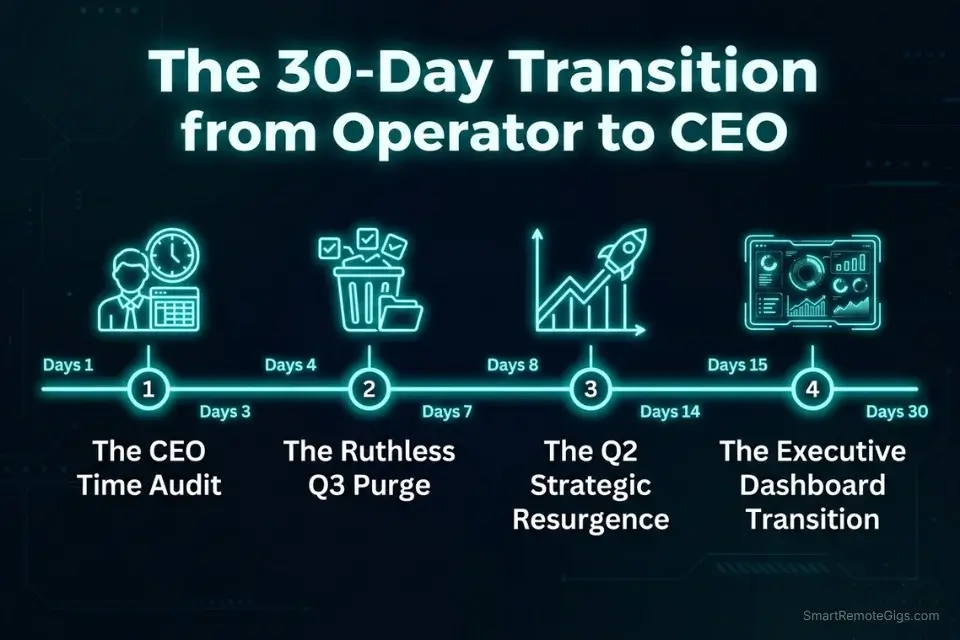
Days 1–3: The Founder’s Time Audit
Track every minute of your workday for 72 hours — no estimation, no rounding. Force every single task into one of the four quadrants based on its true relationship to company growth. Identify the volume of tasks masquerading as Q1 that are actually Q3 being processed with executive-level energy.
Metric to hit: A brutally honest map of where the CEO’s time is leaking, quadrant by quadrant.
Pro Tip: Do not lie to yourself during this audit. If you spent an hour debating hex colors for a landing page button, that was Q4 — and logging it honestly is the only way to fix it.
The fastest way to run your initial CEO time audit is with a structured template you can populate immediately — no setup required:

Being "busy" is the ultimate freelancer trap. You can sit at your desk for 10 hours a day answering emails, organizing folders, and tweaking font sizes, only to wake up...
Days 4–7: The Ruthless Purge
Delete or permanently ignore all tasks categorized as Quadrant 4 — not archived, deleted. Identify the three most time-consuming Quadrant 3 tasks and document each via a Loom video using the “Loom & Leave” script from Scenario 1. Assign each to a VA or automate with Zapier before Day 7.
Metric to hit: 10 hours of Q3/Q4 busywork permanently removed from the CEO’s calendar.
Red Flag: You will feel a strong psychological pull to “just do it quickly” yourself one more time. Do not touch the delegated tasks — re-entering the loop invalidates the entire handoff.
Days 8–14: The Q2 Resurgence
Define the single biggest strategic bottleneck preventing your next revenue milestone — not a vague theme, a specific deliverable. Break the resolution into three actionable Q2 projects with owners and deadlines. Time-block these projects into your calendar before 11:00 AM daily, before any operational work begins.
Metric to hit: 10 solid hours of uninterrupted Q2 deep work completed by the CEO across the week.
Pro Tip: Guard this morning time block with the same force you’d use to protect a board presentation. Do not schedule team standups, investor calls, or demos during your Q2 hours.
Days 15–21: The Executive Dashboard
Configure your company’s project management tool to explicitly filter tasks by urgency and importance. Train direct reports to pre-categorize all requests before routing them to you — no quadrant label, no escalation. Stop accepting undifferentiated “urgent” requests from any channel.
Metric to hit: 100% of executive decisions flowing through a systematic matrix filter with zero unlabeled escalations.
Red Flag: If your team continues to bypass the matrix and DM you “urgent” requests directly on Slack, your system is failing — the issue is accountability architecture, not individual behavior.
Days 22–30: The CEO Transition
Implement a Sunday evening review — 20 minutes to map Q2 priorities for the coming week, confirm delegated Q3 tasks are running without intervention, and identify any Q1 risks on the horizon before they become fires. Elevate your focus entirely to runway, hiring, and product vision.
By Day 30: A fully operational systems-driven CEO workflow — delegated Q3 tasks running autonomously, Q2 time protected by calendar logic, and executive attention reserved exclusively for leverage-level decisions.
Pro Tip: A founder’s ultimate goal is to make their daily operational presence entirely unnecessary. The matrix is the architecture that makes that transition possible without the company losing coherence.
❓ Frequently Asked Questions
What is the Eisenhower Matrix for founders?
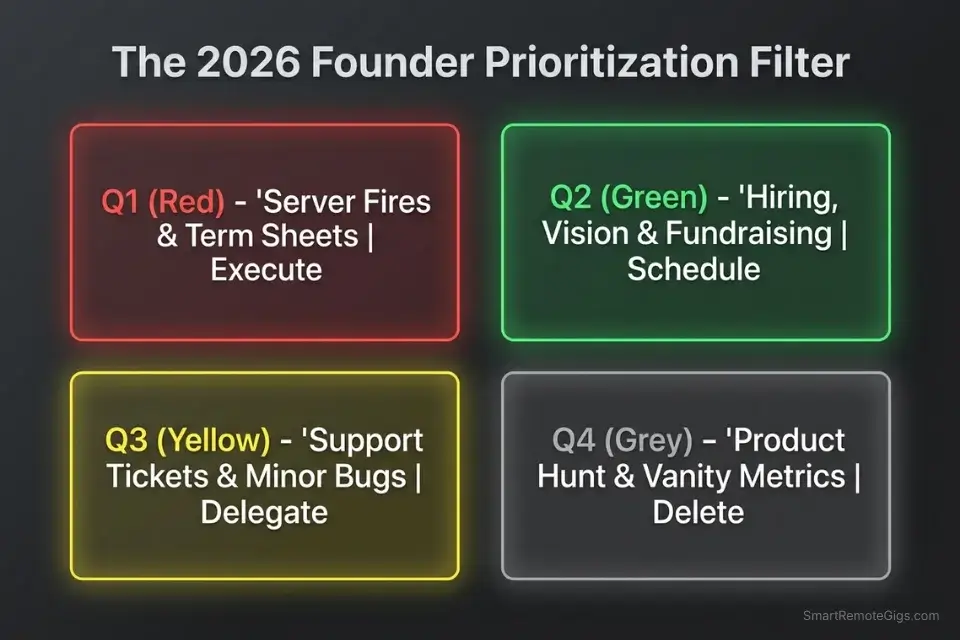
It is a four-quadrant priority filter applied specifically to executive decision-making — separating true business-critical work (Q1: server fires, investor term sheets) from high-leverage strategic work (Q2: hiring, fundraising, product vision), delegatable operations (Q3: support tickets, reporting), and vanity activities (Q4: social metrics, unnecessary meetings). For founders, the framework functions primarily as a delegation trigger: anything that doesn’t require the founder’s unique leverage gets routed out of the CEO’s day permanently.
How do founders overcome the delegation bottleneck?
By calculating their true hourly rate and refusing to personally execute any task that costs less to delegate than it costs in CEO time. The “Loom & Leave” handoff script from Scenario 1 provides the exact transfer protocol — one video, one SOP, one decision threshold, one review cycle, then permanent handoff. The bottleneck dissolves when the system handles the routing, not the founder’s willpower.
What belongs in a CEO’s Quadrant 2?
Investor relationship management, strategic hiring, product roadmap decisions, competitive positioning, and fundraising preparation. These are the activities that directly determine company valuation — and they are the first eliminated when Q3 noise floods the founder’s schedule. A CEO who spends zero hours in Q2 is operating a lifestyle business, not building a scalable company.
How can founders stop fighting daily fires (Q1)?
By investing in Q2 infrastructure that prevents Q1 recurrence. The post-mortem framework from Scenario 3 forces teams to identify the systemic cause behind every crisis and assign a Q2 project to eliminate it. A company that experiences the same Q1 crisis twice has a Q2 planning failure, not a bad luck problem.
What are the best prioritization tools for startups?
Todoist for task assignment and delegation tracking, Notion for Q2 strategy and investor CRM, and ClickUp or Linear for engineering prioritization. Most offer startup discounts that bring the full stack to under $30/month per seat. The specific tool matters less than whether it enforces quadrant-based routing — any system that allows undifferentiated “urgent” tasks to reach the founder’s view is failing its primary function.
The Verdict: Stop Operating, Start Architecting
The Eisenhower Matrix is not a productivity trick for solo operators — it is the fundamental infrastructure that separates an early-stage hustler from a scale-ready CEO. Founders who rely on stamina and ego to brute-force every operational problem will spend their entire runway drowning in Q3 delegation bottlenecks and Q1 server fires, capping revenue and burning out before Series A at a rate the market documents consistently.
By forcing every incoming support ticket, feature request, and investor email through the urgency-and-importance filter, the founder reclaims executive bandwidth. Q2 — the deep strategic work that multiplies valuations, closes funding rounds, and builds defensible product moats — only becomes accessible when Q3 is delegated and Q4 is eliminated. That transition doesn’t happen through motivation. It happens through architecture.
Every founder serious about breaking the operator ceiling needs the full eisenhower matrix framework internalized before configuring the executive systems — because delegation without a priority filter just moves the chaos one level down the org chart without fixing it.
The Verdict: The Eisenhower Matrix is the most direct path from founder-as-bottleneck to CEO-as-architect — and the 14 hours you reclaim in the first two weeks are the opening stake in a compounding return.
While you optimize your executive stack, don’t leave opportunities on the table. Head to the SRG Job Board at /jobs/ to hire the operators who will handle your Quadrant 3 tasks. Browse the SRG Software Directory at /software/ for the automation tools that will protect your time.

Never Miss a New Remote Job
REMOTE JOB ALERTSGet notified about new remote jobs and access practical freelance tools from your phone.

![Build AI Second Brain Assistant 2026: Local Setup [Guide]](https://smartremotegigs.com/wp-content/uploads/2026/09/build-your-second-brain-ai-assistant-local-rag-hero-1024x577.webp)
![Second Brain with Claude & Obsidian 2026 [My Setup]](https://smartremotegigs.com/wp-content/uploads/2026/08/claude-obsidian-second-brain-mcp-hero-1024x577.webp)
![Why Your Second Brain Fails 2026: Retrieval Fix [Fix]](https://smartremotegigs.com/wp-content/uploads/2026/08/why-your-second-brain-fails-hero-1024x576.webp)