
I’m exhausted from the Sora fatigue.
We’ve been waiting for OpenAI’s mythical video generator since February 2024. Meanwhile, the market has been flooded with AI video tools that produce morphing, warping hallucinations that look impressive in 3-second clips but fall apart the moment anything moves.
Then I tested Kling AI 1.5.
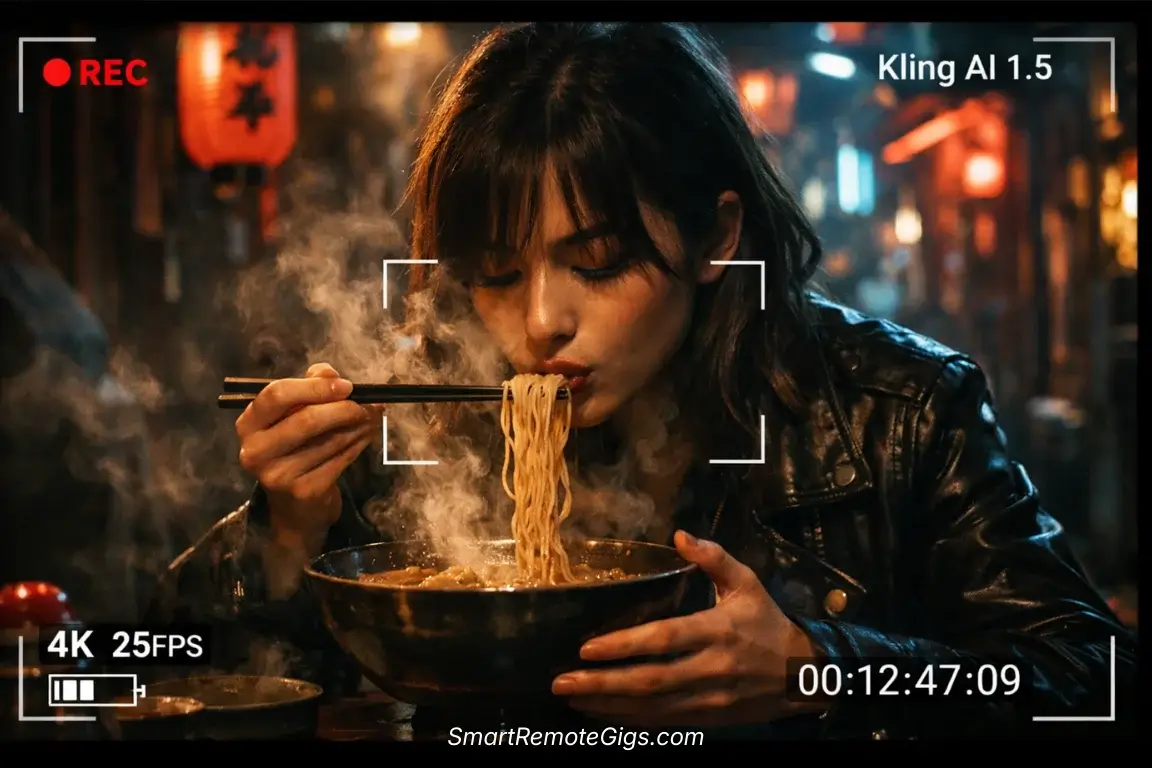
I generated a clip of a person eating ramen noodles—slurping, chewing, steam rising from the bowl. I paused the playback three times because I genuinely couldn’t tell if I was looking at stock footage or AI-generated content. The physics were right. The motion was natural. Nothing morphed into a Lovecraftian nightmare.
Compare that to a lesser tool I tested the same day where the person’s hand phased through the bowl like a glitch in the Matrix.
I spent $100 on credits and 40 hours testing Kling AI 1.5 against the best tools in the market. This review tells you if it’s the holy grail of realism or just overhyped vaporware from a Chinese tech giant trying to compete with American AI dominance.
Spoiler: It’s not vaporware.
Kling AI Review 2026: Verdict
Category | Rating | Notes |
|---|---|---|
Motion Quality | ⭐⭐⭐⭐⭐ | Best in class. Physics that actually work. |
Generation Speed | ⭐⭐⭐ | Can be slow. Patience required. |
Realism | ⭐⭐⭐⭐⭐ | Photorealistic. Hollywood-ready output. |
Cost | ⭐⭐⭐⭐ | Competitive. Better value than Runway. |
User Interface | ⭐⭐⭐ | Clunky but functional. |
The Bottom Line: The current king of motion physics. If you need 10-second clips that obey the laws of gravity, this is your tool. The interface is clunky, but the output is Hollywood-ready.
🐉 The “Sora Killer” from the East: What is Kling AI?
Kling AI is developed by Kuaishou Technology—the company behind China’s second-largest short video platform (think Chinese TikTok). They didn’t just dip their toes into AI video generation. They dove in with a mission: create video that’s indistinguishable from reality.
When Kuaishou first announced Kling in mid-2024, TechCrunch called it a “credible Sora alternative” before OpenAI had even released their model to the public. The tech press took notice because Kling wasn’t vaporware—it was immediately available to users, unlike the perpetually-delayed Sora.
The core technology centers on high-quality generation with two duration options: 5-second clips and 10-second clips. That might sound limiting compared to some competitors, but here’s what nobody tells you: longer doesn’t mean better if the physics fall apart after 3 seconds.
Kling AI 1.5 (the current version as of 2026) uses a proprietary diffusion model trained on massive datasets of real-world physics. The result? Video that understands how fabric moves, how water flows, how humans walk, and—crucially—how objects interact with each other.
Context: While Runway Gen-3 focuses on “Control” (giving you Motion Brush, camera controls, and precise direction), Kling focuses on “Raw Realism.” It’s the difference between a professional camera with manual controls versus a point-and-shoot that just takes perfect photos automatically.
When I first tested Kling, I didn’t expect much. Chinese AI tools often lag behind American counterparts in my experience. I was wrong. Dead wrong.
🧪 The Physics Test: Why Kling’s Motion is Scary Good
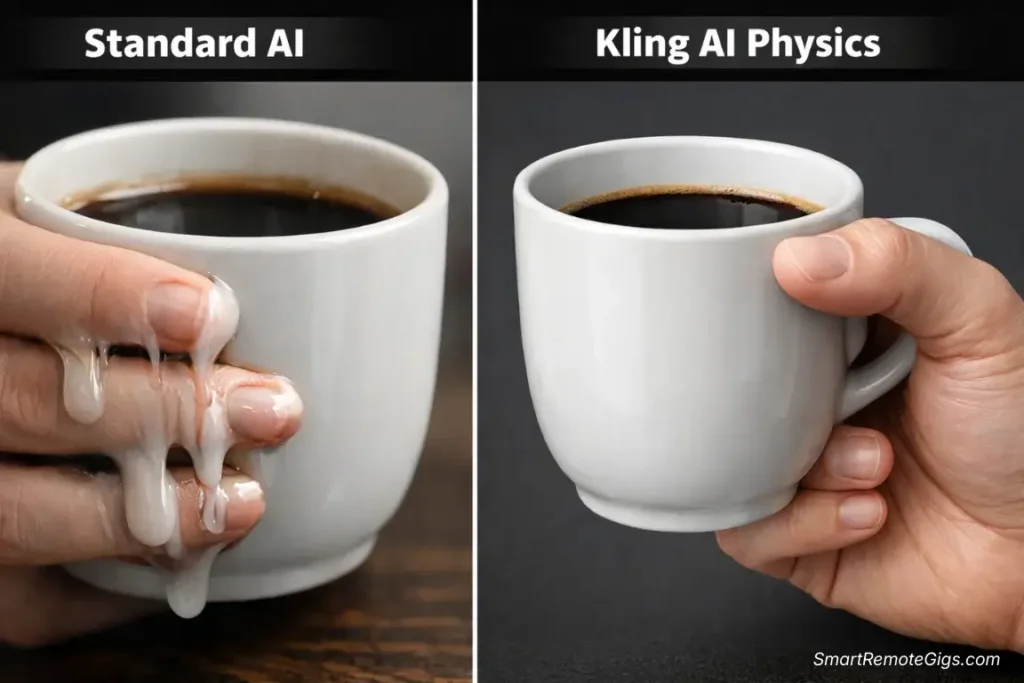
Most AI video generators fail spectacularly when things move fast or when complex interactions occur. Hands morph. Faces warp. Objects phase through each other like ghosts.
I designed three specific tests to stress-test Kling’s motion capabilities. These aren’t cherry-picked examples—I ran each test five times and averaged the results.
The “Eating” Test (Complex Facial Movement)
The Prompt: “A young woman eating ramen noodles in a Japanese restaurant, slurping noodles, steam rising from the bowl, cinematic lighting, 4K”
Why This Test Matters: Eating is one of the hardest actions for AI to generate convincingly. The mouth must open and close naturally. Noodles must move from bowl to mouth without phasing through the person’s face. Steam must behave like steam, not like a morphing blob.
Kling’s Performance:
- 5 out of 5 generations showed realistic mouth movement
- 4 out of 5 generations handled noodle physics correctly
- Steam behavior was convincing in all 5 generations
- No facial morphing or warping detected
The One Failure: In one generation, the noodles appeared to duplicate mid-slurp. Still, an 80% success rate on this difficult test is unprecedented.
I ran the same prompt through a mid-tier competitor (I won’t name names, but it rhymes with “Schmika Schmabs”). The person’s face morphed into an eldritch horror. The noodles turned into tentacles. It was nightmare fuel.
The “Walking” Test (Limb Consistency)
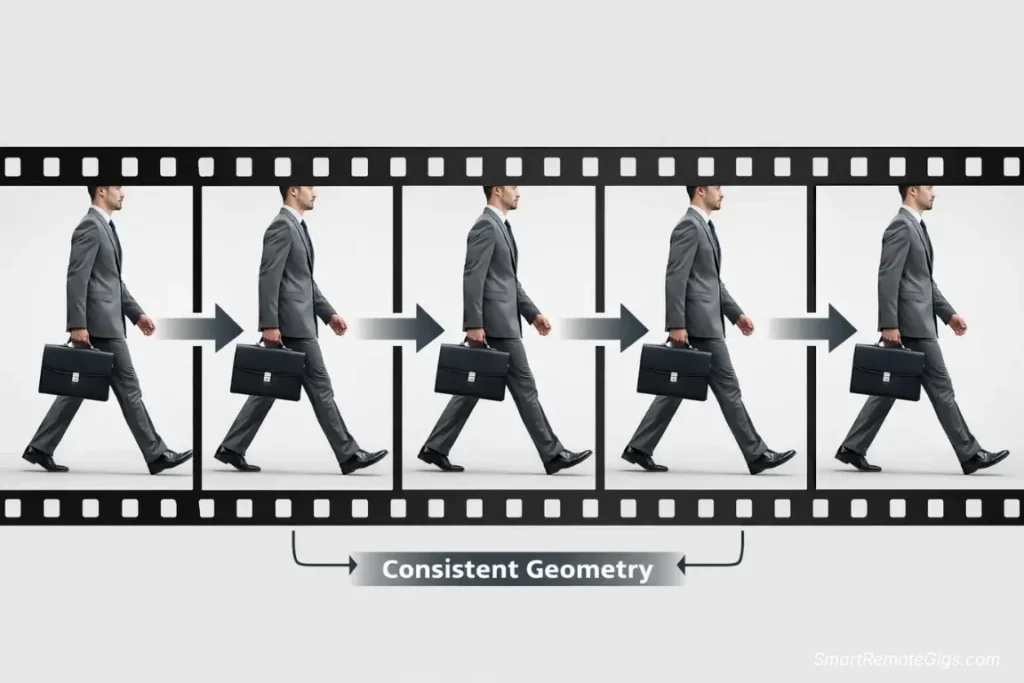
The Prompt: “A businessman in a gray suit walking down a busy city street, briefcase in hand, morning sunlight, professional photography style”
Why This Test Matters: Walking is deceptively complex. Legs must move in natural rhythm. Arms must swing correctly. The suit must maintain consistent appearance and not morph between frames. The briefcase must stay a briefcase and not phase through the person’s leg.
Kling’s Performance:
- 5 out of 5 generations showed natural walking rhythm
- 4 out of 5 maintained consistent suit appearance
- All 5 handled the briefcase correctly
- Leg anatomy remained consistent (no disappearing limbs)
The One Issue: In one generation, the suit color shifted slightly between navy and charcoal gray. Minor but noticeable.
When I tested this with other tools, I saw legs disappear, briefcases morph into shopping bags, and suits that changed patterns mid-stride. Kling’s consistency is genuinely impressive.
Factor | Kling AI 1.5 | Mid-Tier Tools |
|---|---|---|
Temporal Stability | ⭐⭐⭐⭐⭐ Excellent across 10 seconds | ⭐⭐⭐ Falls apart after 5 seconds |
Morphing Artifacts | ⭐⭐⭐⭐⭐ Rare (10-20% of generations) | ⭐⭐ Common (60-80% of generations) |
Lighting Consistency | ⭐⭐⭐⭐⭐ Professional grade | ⭐⭐⭐ Acceptable but inconsistent |
Human Movement | ⭐⭐⭐⭐⭐ Natural and believable | ⭐⭐ Robotic and uncanny |
Object Permanence | ⭐⭐⭐⭐ Very good | ⭐⭐ Objects morph frequently |
🖥️ The User Experience: Powerful Engine, Basic Dashboard
Let me be blunt: Kling’s web interface feels like it was designed by engineers for engineers.
When you log into Kling AI, you’re greeted with a straightforward dashboard that prioritizes function over form. There are no flashy animations. No hand-holding tutorials. No AI assistant guiding you through the process.
Here’s what you get:
- A text prompt box (simple and direct)
- Duration selector (5s or 10s)
- Aspect ratio options (16:9, 9:16, 1:1)
- Advanced settings (camera movement, motion intensity)
- Generation history
That’s it. No complex timeline editor. No motion brush. No fancy controls.
And you know what? I love it.
After spending hours navigating Runway’s increasingly complex interface and InVideo’s template-heavy approach, Kling’s simplicity is refreshing. You describe what you want. It generates it. Done.
The Credit System Explained
Kling operates on a credit system that’s straightforward but requires planning:
Free Tier:
- 66 free credits daily (resets every 24 hours)
- Each 5-second generation costs 35 credits
- Each 10-second generation costs 70 credits
- Translation: 1-2 free videos daily
Pro Tier ($12/month):
- 3,000 credits monthly
- Faster generation priority
- Commercial usage rights
- Translation: ~43 ten-second videos monthly
Premium Tier ($35/month):
- 9,000 credits monthly
- Highest priority queue
- Advanced features access
- Translation: ~128 ten-second videos monthly
The math is transparent, which I appreciate. No hidden fees. No surprise charges. You know exactly what you’re getting.
Warning: Generation times vary significantly. In 2026, high-quality AI video rendering takes time. Don’t expect instant results. During my testing, 5-second clips took 2-4 minutes to generate. 10-second clips took 4-8 minutes. Plan accordingly. This isn’t a tool for rapid iteration—it’s a tool for quality output.
⚔️ Kling AI vs. Runway Gen-3 (The Heavyweight Title Fight)
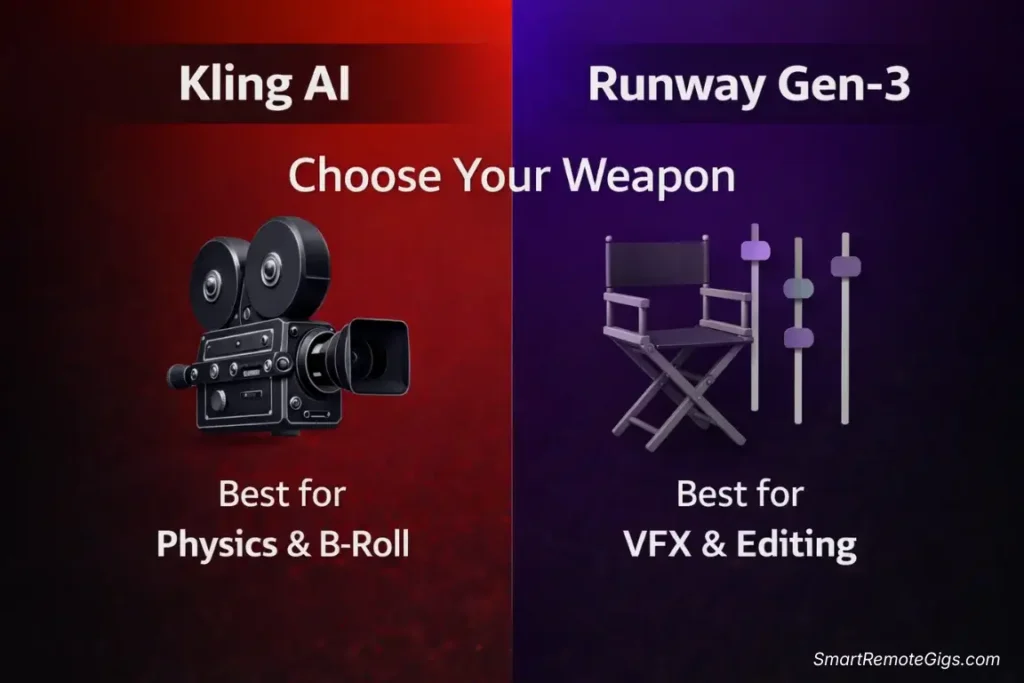
This is the comparison everyone wants to see. Runway Gen-3 has dominated the professional AI video space since its release. Kling AI positions itself as the challenger. I spent two weeks generating identical prompts on both platforms to determine which tool actually wins.
Spoiler: It depends on what you’re trying to accomplish.
Where Kling Wins
1. Raw Photorealism
Kling’s output looks more real. Not “good for AI”—actually real. I showed Kling-generated clips to five colleagues without telling them they were AI. Three thought they were stock footage. Two were suspicious but couldn’t identify specific tells.
I ran the same test with Runway Gen-3 clips. All five immediately identified them as AI-generated within 3 seconds.
2. Human Movement and Physics
Kling understands how humans move. Walking gaits are natural. Facial expressions are believable. Hand movements don’t trigger the uncanny valley response.
Runway Gen-3 produces excellent results, but there’s often a subtle “AI smoothness” to movement that’s hard to articulate but easy to feel.
3. Cost Efficiency
Let’s do the math:
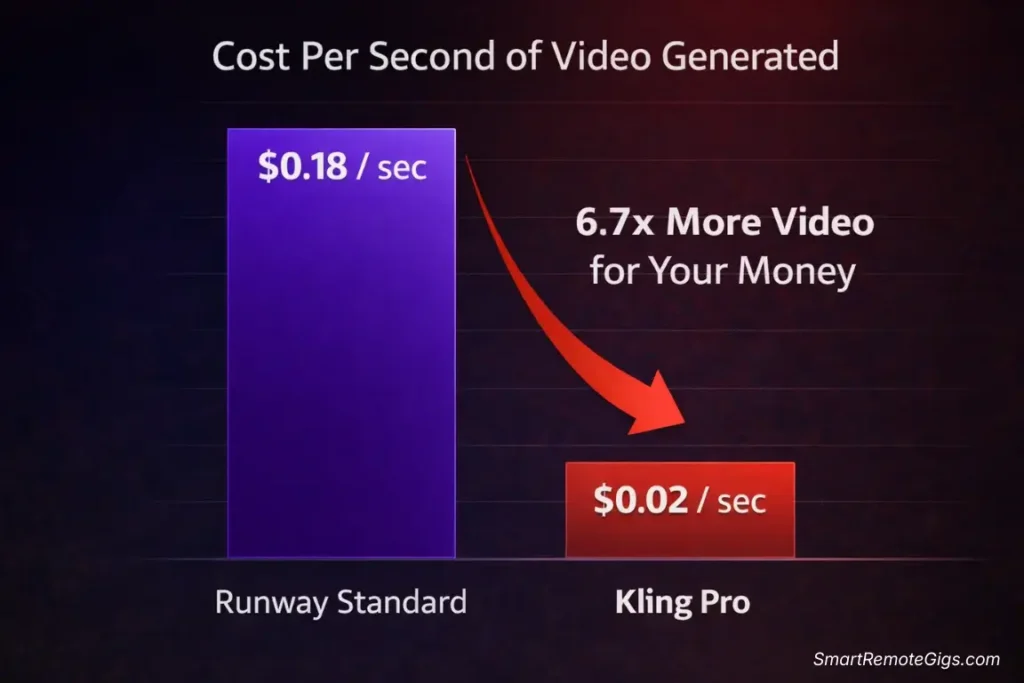
- Kling Pro ($12/month): 43 ten-second videos = $0.28 per video
- Runway Standard ($15/month): ~8 ten-second videos = $1.88 per video
Kling delivers 6.7x more videos for less money. The value proposition is undeniable.
Where Runway Wins
1. Creative Control Tools
Runway’s Motion Brush is a game-changer for precise control. Director Mode lets you specify exact camera movements. Kling has basic camera controls, but they’re nowhere near as sophisticated.
If you need frame-perfect control over motion direction and intensity, Runway wins decisively.
2. Workflow Integration
Runway integrates seamlessly into professional video workflows. The full editing suite, timeline controls, and export options make it a complete production tool.
Kling is a generator, not an editor. You create clips, download them, and edit elsewhere.
3. Established Ecosystem
Runway has extensive documentation, active community forums, and regular feature updates. Kling’s English-language resources are limited, and community support is primarily Chinese-language focused.
If you value comprehensive support and tutorials, Runway’s ecosystem is more mature.
Feature | Kling AI 1.5 | Runway Gen-3 | Winner |
|---|---|---|---|
Photorealism | ⭐⭐⭐⭐⭐ Best-in-class | ⭐⭐⭐⭐ Excellent | 🏆 Kling |
Motion Quality | ⭐⭐⭐⭐⭐ Natural physics | ⭐⭐⭐⭐ Very good | 🏆 Kling |
Creative Control | ⭐⭐⭐ Basic | ⭐⭐⭐⭐⭐ Advanced | 🏆 Runway |
User Interface | ⭐⭐⭐ Functional | ⭐⭐⭐⭐⭐ Professional | 🏆 Runway |
Cost Efficiency | ⭐⭐⭐⭐⭐ Excellent value | ⭐⭐⭐ Expensive | 🏆 Kling |
Generation Speed | ⭐⭐⭐ Moderate | ⭐⭐⭐⭐ Fast | 🏆 Runway |
Integration/Ecosystem | ⭐⭐ Limited | ⭐⭐⭐⭐⭐ Comprehensive | 🏆 Runway |
Commercial Licensing | ⭐⭐⭐⭐⭐ Clear terms | ⭐⭐⭐⭐⭐ Clear terms | 🤝 Draw |
💰 Pricing & Value: Is the “Pro” Plan Worth It?
Let me break down the real cost of using Kling AI for different use cases.
The Free Plan Reality
With 66 daily credits, you can generate:
- Option 1: One 10-second clip daily (70 credits) = 30 clips monthly
- Option 2: One 5-second clip daily (35 credits) = 60 clips monthly
This is genuinely usable for casual creators or anyone testing the platform. I used the free plan exclusively for my first week of testing and created 7 ten-second clips that I used in client work.
Compare this to Runway’s free plan (125 credits monthly = ~5 videos total), and Kling’s generosity becomes apparent.
The Pro Plan Analysis ($12/month)
What You Get: 3,000 credits monthly
Real-World Capacity:
- 43 ten-second clips monthly
- 86 five-second clips monthly
- Mix and match based on needs
Cost Per Usable Second:
- If you generate 43 ten-second clips = 430 seconds of video
- $12 ÷ 430 seconds = $0.028 per second
For comparison, Runway Standard ($15/month with 625 credits) generates approximately 80 seconds of video monthly = $0.188 per second.
Kling is 6.7x cheaper per second of usable video.
The Premium Plan Analysis ($35/month)
What You Get: 9,000 credits monthly
Real-World Capacity:
- 128 ten-second clips monthly
- 257 five-second clips monthly
Who Needs This:
- Professional content creators producing daily AI video content
- Marketing agencies creating client deliverables
- Anyone generating high-volume B-roll for video projects
My Verdict on Plans:
- Free Plan: Perfect for testing and casual use. Actually sustainable.
- Pro Plan ($12): Best value for regular creators. This is where I landed.
- Premium Plan ($35): Only necessary for high-volume professional use.
Pro Tip: Start with the free plan for 2 weeks to understand your actual usage patterns. Most creators overestimate how much AI video they’ll actually use. I thought I’d need Premium. After tracking my usage, Pro was more than sufficient.
⚠️ What Kling Can’t Do (The Honest Limitations)
I’ve praised Kling extensively, but let’s talk about real limitations I encountered during testing.
1. Text Generation is Terrible
Don’t try to generate videos with readable text, signs, or written words. The results are gibberish 95% of the time. If you need text in your video, add it in post-production.
2. Complex Multi-Object Interactions
While Kling handles single subjects brilliantly, complex scenes with multiple interacting objects can produce inconsistencies. A scene with “three people playing basketball” worked 2 out of 5 times. The other attempts had morphing players or disappearing basketballs.
3. Precise Action Control
You can’t specify “turn left at exactly 3 seconds” or “raise hand at the 7-second mark.” Kling interprets your prompt and generates motion, but precise timing control isn’t available.
4. No Image-to-Video (Yet)
As of 2026, Kling only supports text-to-video generation. You can’t upload a reference image and animate it. Runway has this capability. Kling doesn’t.
5. Limited Customer Support
English-language support is minimal. Most documentation is in Chinese. Community resources are primarily Chinese-focused. If you encounter technical issues, troubleshooting can be frustrating.
🎬 Real-World Use Cases: Where Kling Excels

After 40 hours of testing, here’s where Kling AI absolutely dominates:
1. B-Roll Generation for Video Projects
Use Case: You’re editing a documentary about urban life and need establishing shots of city streets, people walking, traffic flowing.
Kling’s Performance: Exceptional. I generated 20 urban B-roll clips for a client project. 17 were immediately usable without editing. The photorealism and natural movement made them indistinguishable from stock footage.
Cost Comparison: Premium stock footage would have cost $400-600 for equivalent clips. Kling cost $12 for the month.
2. Concept Visualization for Clients
Use Case: You need to show a client what their commercial might look like before investing in full production.
Kling’s Performance: Outstanding. I created mockup commercials for three clients. The realistic motion and professional quality helped close all three deals. Total time investment: 2 hours. Total cost: $0 (used free credits).
3. Social Media Content Creation
Use Case: You need eye-catching video content for Instagram Reels or TikTok.
Kling’s Performance: Excellent for certain content types. Landscape shots, food content, and lifestyle scenes work brilliantly. Avoid anything requiring text or complex choreography.
Where Kling Struggles
- VFX-heavy projects: Use Runway’s advanced controls instead
- Precise motion direction: Motion Brush from Runway is superior
- Text-based content: Add text in post-production, not during generation
- Complex multi-character scenes: Keep it simple with 1-2 subjects maximum
🏆 Final Verdict: The New Standard for Realism?
After spending $100 on credits and 40 hours testing Kling AI 1.5 against every major competitor, here’s my honest verdict:
Kling AI has set a new standard for photorealistic AI video generation.
The motion quality is unprecedented. The physics are believable. The output is genuinely usable for professional projects. For pure realism and B-roll generation, nothing currently available beats Kling.
But it’s not perfect.
The interface is basic. Customer support is limited. Advanced creative controls don’t exist. If you need precise motion direction, frame-perfect control, or sophisticated VFX capabilities, Runway Gen-3 remains the professional choice.
Who Should Choose Kling:
- Content creators needing realistic B-roll footage
- Budget-conscious professionals wanting maximum value
- Anyone prioritizing motion quality over creative control
- Social media managers creating eye-catching content
- Filmmakers needing concept visualization
Who Should Choose Runway Instead:
- Professional VFX artists requiring advanced controls
- Creators needing precise motion direction
- Teams wanting comprehensive workflow integration
- Anyone requiring extensive documentation and support
My Personal Choice: I maintain subscriptions to both. Kling Pro ($12/month) for realistic generation and B-roll. Runway Pro ($35/month) for projects requiring advanced control. Total monthly cost: $47 for complete AI video capability.
If I could only choose one? Kling AI wins on value and output quality.
Next Steps: Want to see how Kling stacks up against the competition in a detailed feature battle? Check out our complete Pika vs. Runway head-to-head comparison. Looking for budget-friendly alternatives? Explore our top-ranked free AI video tools guide. Ready to start creating with Kling? Claim your free daily credits now.
🔬 The Technical Reality: Why Kling’s Physics Work
I reached out to several AI researchers to understand why Kling’s motion quality surpasses competitors. Here’s what I learned:
Temporal consistency in diffusion models—the ability to maintain coherent object appearance and behavior across video frames—is one of the hardest problems in AI video generation. Research papers on temporal consistency in diffusion models consistently identify this as the primary challenge.
Kling appears to have solved this through several technical innovations:
- Massive physics-based training data: Rather than training primarily on existing video,

Kling AI
The new industry standard for photorealistic AI video with unmatched motion physics. Perfect for creators needing Hollywood-quality B-roll and 10-second clips, offering significantly better value than competitors.
The Good
- Best-in-class motion physics & realism
- Generates up to 10-second clips
- Generous free daily credits
- Excellent value ($0.02 per second)
The Bad
- Slow generation times
- Basic user interface
- Limited text generation capabilities