
The “Silence of the Slack.” In an office, you see people working, and they see you. At home, the silence breeds paranoia. “Am I doing enough?” “Do they think I’m slacking?” This leads to performance theater—staying green on Slack rather than doing deep work.
I used to reply to emails at 7 AM just to “prove” I was awake. I wasn’t being productive; I was insecure. I was acting like a terrified employee, not a trusted professional.
We will dismantle Remote Imposter Syndrome not with affirmations, but with evidence. You will learn how to cast “votes” for your new identity as a high-performance remote leader.
⚡ The Mindset Shift Matrix
Old Identity (The Victim): “I hope I don’t get caught not working.”
→ Result: Anxiety & Burnout.
New Identity (The CEO): “I deliver results, not hours.”
→ Result: Confidence & Autonomy.
The Tactic: Small wins (e.g., The Shutdown Ritual) prove the new identity is real.
Why Remote Work Triggers Your Inner Fraud
Remote work didn’t invent imposter syndrome. But it created the perfect breeding ground for it.
The Lack of Visual Validation: Why your brain panics when there is no boss walking past your desk
In a traditional office, validation is ambient.
Your boss walks past your desk and sees you typing. Your coworker asks you a question, proving you’re present. You attend a meeting and contribute, solidifying your status as “someone who works here.”
These micro-validations happen dozens of times a day. They’re invisible, but they’re powerful. They tell your brain: “You belong here. You’re doing your job.”
Remote work eliminated all of that.
Now, you work in silence. Nobody sees you typing. Nobody walks past your desk. Nobody witnesses your effort.
Your brain, wired for social validation, starts to panic.
“If nobody sees me working, am I actually working?”
“If I don’t respond to Slack within 30 seconds, will they think I’m slacking?”
“If I’m not in the office, how do I prove I’m valuable?”
This anxiety isn’t a character flaw. It’s a predictable response to the removal of social proof.
The problem is how most remote workers respond to this anxiety: performance theater.
Performance Theater vs. Deep Work: The toxic habit of “looking busy” digitally (mouse jigglers, instant replies)

Performance theater is the art of looking productive without being productive.
It’s replying to emails instantly to prove you’re “online.” It’s keeping Slack green even when you’re eating lunch. It’s buying a mouse jiggler to fake activity on your computer. It’s scheduling emails to send at 6 AM to show you’re an “early riser.”
None of this is work. It’s insecurity disguised as hustle.
The irony? Performance theater destroys the very thing that makes remote work valuable: deep work.
You can’t do deep work when you’re constantly checking Slack. You can’t think deeply when you’re paranoid about your status icon. You can’t create anything meaningful when you’re optimizing for visibility instead of impact.
Warning: If you build habits based on fear of being fired, you will burn out in 6 months. You need habits based on pride in your craft.
The shift from performance theater to deep work isn’t about working harder. It’s about changing your identity.
The Onion Model: Why “Goals” Fail Remote Workers
Most productivity advice focuses on goals. “Set a revenue target.” “Land three clients this month.” “Launch the product by Q2.”
Goals are fine. But they’re not enough.
Here’s why: You can achieve a goal and still feel like a fraud.
You can land a $10k client and still wonder if you deserve it. You can get promoted and still feel like you tricked them. You can hit your revenue target and still check Slack at midnight out of anxiety.
Goals change your circumstances. They don’t change your identity.
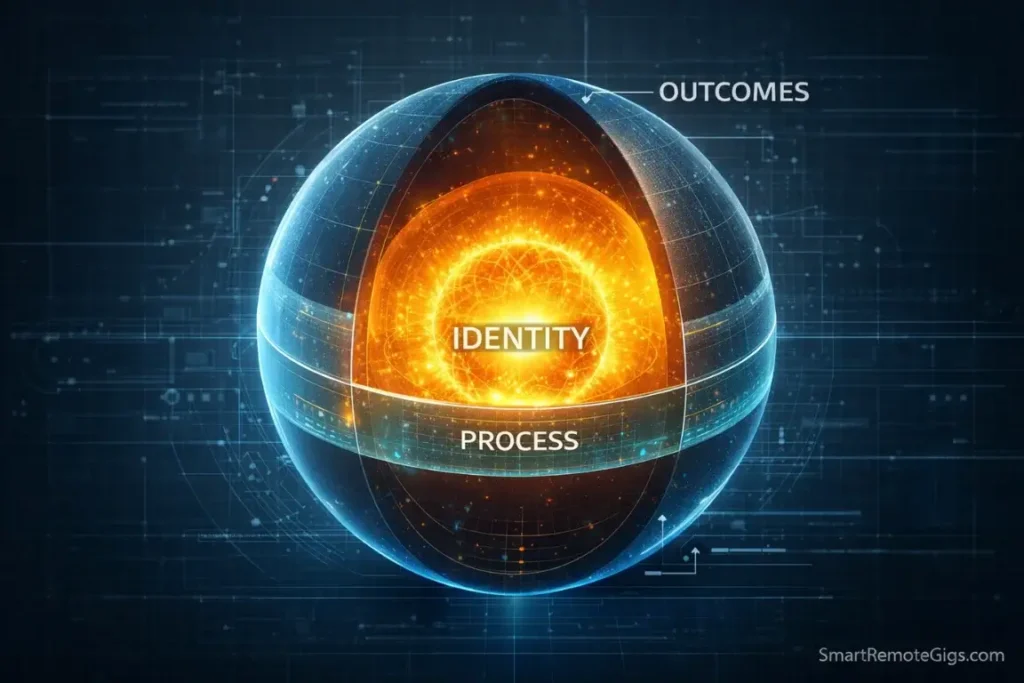
Outcomes vs. Processes vs. Identity: Explaining James Clear’s model
James Clear’s Atomic Habits breaks behavior change into three layers, like an onion:
Layer 1: Outcomes (What you want to achieve)
Example: “I want to earn $100k as a remote worker.”
Layer 2: Processes (What you do to get there)
Example: “I will send 10 cold emails every morning.”
Layer 3: Identity (Who you believe you are)
Example: “I am a professional who delivers high-value work.”
Most people focus on Layer 1 (outcomes). Some focus on Layer 2 (processes). Almost nobody focuses on Layer 3 (identity).
But Layer 3 is where lasting change happens.
When you change your identity, your behaviors change automatically. You don’t need willpower to “act professional” because you are professional. You don’t need discipline to do deep work because deep work is what “people like you” do.
This is the difference between forcing a habit and embodying a habit.
You Can’t “Hack” Discipline: Why buying a planner doesn’t work if you still view yourself as a procrastinator
I see this all the time.
Someone buys a $50 productivity planner. They set it up perfectly. They write down their goals. They design their ideal week.
Two weeks later, the planner sits on a shelf, unused.
What happened?
The planner didn’t fail. The identity did.
If you see yourself as “someone who procrastinates,” no planner will fix that. The planner might work for a few days, powered by novelty and motivation. But the moment motivation fades, you’ll default to your identity.
And your identity says: “I’m a procrastinator.”
You don’t need a new planner. You need a new identity.
The “CEO of One” Mindset (The Target Identity)
Here’s the identity shift that changes everything:
Stop acting like a remote employee. Start acting like the CEO of a one-person company.
A CEO doesn’t need a boss to tell them what to do. A CEO doesn’t need validation from Slack. A CEO doesn’t work from the couch in pajamas.
A CEO builds infrastructure. A CEO protects their time. A CEO delivers results.
This isn’t about ego. It’s about responsibility.
When you’re an employee, your job is to follow instructions. When you’re a CEO, your job is to design the system.
Owning Your Infrastructure: A CEO doesn’t work on the couch in pajamas. A CEO builds a dedicated HQ
The first vote for your new identity is physical.
A CEO wouldn’t run a business from a couch. Why are you?
You don’t need a fancy home office with French doors and exposed brick. But you do need a dedicated workspace that signals: “This is where serious work happens.”
When you invest in your workspace—a proper desk, a good chair, a second monitor—you’re not just buying furniture. You’re casting a vote for the identity of someone who takes their work seriously.
This is why your physical setup matters—it’s the first vote for your identity as a pro.
Every time you sit at your “work desk” instead of your couch, you reinforce the identity: “I am a professional with standards.”
Managing Your Own Attention: A CEO guards their time fiercely
The second vote for your new identity is mental.
A CEO’s most valuable asset isn’t money. It’s attention.
CEOs don’t scroll Twitter for 45 minutes before starting work. CEOs don’t leave 23 browser tabs open. CEOs don’t let every Slack notification interrupt deep work.
CEOs design systems that protect their attention.
This means:
- Closing Slack during deep work hours
- Batch-processing email instead of checking it constantly
- Using website blockers to eliminate distractions
- Saying “no” to low-value meetings
If you want to embody the CEO identity, you need to treat your attention like the scarce resource it is.
Adopt a Digital Minimalist approach to protect your mental assets from the noise.
How to “Cast Votes” for Your New Identity

Identity change isn’t a lightning bolt. It’s an election.
Every action you take is a vote for the type of person you want to become.
Do the action once? That’s one vote. Not enough to win the election.
Do the action every day for 30 days? That’s 30 votes. Your brain starts to believe: “This is who I am.”
Small Wins = Big Proof: You don’t need a $10k month to feel successful. You need to wake up at 7 AM three days in a row. Every action is a vote
Here’s what most people get wrong about identity change:
They think they need a big win to prove the new identity is real.
“Once I land the $10k client, I’ll feel like a pro.”
“Once I hit six figures, I’ll stop feeling like a fraud.”
“Once I get promoted, I’ll believe I deserve to be here.”
This is backwards.
You don’t need a $10k client to feel like a pro. You need to act like a pro consistently, and the $10k client becomes inevitable.
Small wins are the proof.
Waking up at 7 AM three days in a row? That’s proof you’re disciplined.
Closing your laptop at 6 PM every day this week? That’s proof you respect boundaries.
Sending five cold emails every morning? That’s proof you’re serious about growth.
These aren’t “just” habits. They’re votes. And when you accumulate enough votes, your identity changes.
You stop trying to be disciplined. You are disciplined.
The Power of ‘No’: The ultimate sign of a pro is the ability to decline low-value meetings
Amateurs say yes to everything. Pros say no to almost everything.
When you’re insecure, you say yes because you’re afraid of being seen as “difficult” or “uncommitted.”
When you’re confident, you say no because you know your time is valuable.
Saying no is a vote for the identity of someone who:
- Knows their priorities
- Respects their time
- Values deep work over shallow work
The first time you decline a meeting that doesn’t align with your goals, you’ll feel guilty.
Do it anyway.
By the 10th time, it will feel normal.
By the 20th time, it will feel empowering.
Pro Tip: Every time you close your laptop intentionally at 5 PM, you cast a vote for the identity of someone who respects their own boundaries.
Use the Shutdown Ritual to formalize this daily vote.
Comparing Mental Models
The Employee Mindset | The Intrapreneur Mindset |
|---|---|
Waits for instructions | Proposes solutions |
Hides mistakes | Owns and fixes errors |
Values hours worked | Values output delivered |
Seeks approval constantly | Seeks feedback strategically |
Optimizes for “looking busy” | Optimizes for impact |
Checks Slack every 5 minutes | Batch-checks Slack at set times |
Works from couch in pajamas | Builds a dedicated workspace |
Replies to emails at 7 AM to prove availability | Replies during work hours because that’s the system |
The employee mindset is driven by fear. The intrapreneur mindset is driven by ownership.
You don’t need permission to make the shift. You just need to start voting.
Fake It Till You Make It? (The Trap)
You’ve probably heard the advice: “Fake it till you make it.”
It sounds empowering. But it’s a trap.
Why “faking it” breeds more imposter syndrome
When you “fake it,” you’re lying to yourself.
You’re pretending to be confident when you’re terrified. You’re acting professional while feeling like a fraud. You’re performing competence while drowning in self-doubt.
And every time you “fake it,” your brain keeps a record:
“I faked being confident in that meeting.”
“I pretended to know what I was doing on that project.”
“I acted like I had it together, but I was panicking inside.”
Over time, these records pile up. And your brain concludes: “I’m a fraud. I’m just good at faking.”
This is why “fake it till you make it” often increases imposter syndrome instead of curing it.
“Practice It Until You Become It”: The subtle but crucial difference
Here’s the better version: “Practice it until you become it.”
The difference is honesty.
You’re not pretending to be confident. You’re practicing confidence.
You’re not faking discipline. You’re building discipline, one action at a time.
You’re not performing competence. You’re accumulating competence through deliberate practice.
This mindset removes the guilt. You’re not a fraud. You’re a beginner who’s getting better.
And every action you take—every vote you cast—is evidence that you’re becoming the person you want to be.
The Verdict
Imposter syndrome thrives in the dark. It dies when exposed to the light of consistent action. You don’t “think” your way into a new mindset; you “act” your way there.

The remote worker who feels like a fraud every day is the same person as the remote worker who feels like a CEO. The only difference is the number of votes cast.
You don’t need a personality transplant. You don’t need to “believe in yourself” more. You just need to act like the person you want to become, consistently, until your brain catches up.
The votes don’t lie.
Your mindset is ready. Now, let’s remove the friction that slows you down. Read our guide on Friction Design to optimize your digital workspace for your new identity.