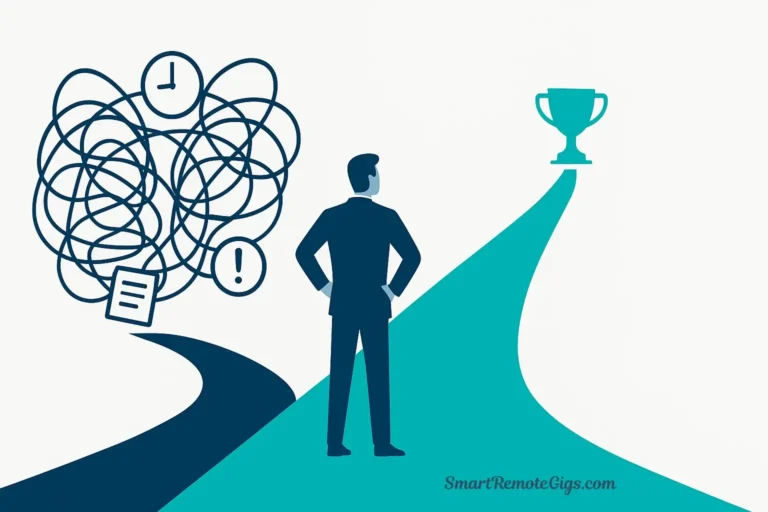

The “Ghost Notification” Syndrome. You close your laptop physically, but your brain is still processing Slack messages, worrying about tomorrow’s deadline, and guilt-tripping you for not doing “one more thing.” In an office, the commute is the off-switch. At home, the switch is broken.
For months, my “shutdown” was just moving my laptop from the desk to the couch. I wasn’t working, but I wasn’t resting. I was in the “Grey Zone”—too tired to be productive, too stressed to relax.
The shutdown ritual is the fourth law of behavior change in our Atomic Habits for Remote Work guide—”Make It Satisfying.” Without a satisfying end to your workday, your brain never gets the reward signal that work is complete. This article will show you exactly how to build that ritual in four concrete phases.
⚡ The Shutdown Cheat Sheet
Step 1: Capture — Dump all open loops into a trusted system.
Step 2: Plan — Define the top 3 priorities for tomorrow.
Step 3: Reset — Clear browser tabs and physical desk.
Step 4: Trigger — Say the “Termination Phrase” aloud.
Why You Can’t Relax (The Science of “Open Loops”)
Let’s start with the uncomfortable truth: your inability to relax at night isn’t a personality flaw. It’s a predictable psychological phenomenon.
The Zeigarnik Effect: Explaining why unfinished tasks dominate your attention span

In the 1920s, Russian psychologist Bluma Zeigarnik noticed something odd: waiters could remember complex orders perfectly while customers were still eating, but the moment the bill was paid, they forgot everything.
The pattern was clear. The brain obsesses over incomplete tasks and releases them the moment they’re resolved.
This is the Zeigarnik Effect, and it’s destroying your evenings.
When you close your laptop at 6 PM with 14 unread Slack messages, 3 half-written emails, and a client proposal “almost done,” your brain doesn’t rest. It loops. It replays. It runs simulations of what you should have said in that meeting. It calculates whether you can finish the proposal before tomorrow’s deadline.
The work isn’t happening, but the mental work never stops.
You’re not lazy. You’re not uncommitted. You’re just carrying open loops.
The Commute Void: Recognizing that we lost the physical boundary and must replace it with a psychological one
The traditional workday had a built-in shutdown sequence: the commute.
You’d pack your bag, walk to your car, sit in traffic for 30 minutes, and by the time you pulled into your driveway, work-you had dissolved into home-you. The physical distance created psychological distance.
Remote work eliminated that buffer.
Now, “leaving work” means walking from the desk to the couch—a journey of 12 feet. There’s no decompression chamber. No ritual. No transition.
Your brain doesn’t know the workday is over, so it assumes it isn’t.
Warning: If you don’t shut down intentionally, your brain assumes you are “on call.” This low-grade anxiety is the primary driver of remote burnout.
Without a shutdown ritual, you’re living in a constant state of work-readiness. You check your phone during dinner. You refresh Slack before bed. You wake up at 3 AM remembering that email you forgot to send.
The commute void must be filled with something. If you don’t design the ritual, your brain will default to the Grey Zone.
Phase 1: The Capture (Close the Mental Tabs)
The first phase of the shutdown ritual is about getting everything out of your head and into a system you trust.
The Brain Dump: Writing down every uncompleted task so your brain can stop holding onto it
Here’s the rule: Your brain is for having ideas, not storing them.
At 6 PM (or whenever your workday ends), open a blank document or your task manager and write down every single thing that’s still rattling around in your skull.
Not the big projects. Not just the urgent stuff. Everything.
- “Reply to Sarah’s email about the Q4 budget”
- “Check if the invoice was sent”
- “Research CRM tools for the client pitch”
- “Follow up with John—haven’t heard back in 3 days”
- “Fix the typo on the website homepage”
- “Schedule the team sync for next week”
Don’t organize it. Don’t prioritize it. Don’t solve anything. Just capture.
This is the Brain Dump, and it’s the single most powerful step in the shutdown ritual.
The moment you write something down, your brain stops holding onto it. The Zeigarnik Effect releases its grip. The loop closes.
Pro Tip: Don’t solve the problems now. Just capture them. Your brain trusts the list.
If you want to take this further, apply Digital Minimalism principles to clear your inbox to zero (or near zero) before closing. An empty inbox is a psychological reset. Even if you can’t get to inbox zero, batch your email responses and move everything else into folders or task lists.
The goal of Phase 1 is simple: zero open loops in your head.
When you finish the Brain Dump, you should feel lighter. If you don’t, keep writing. There’s more.
Phase 2: The Setup (Be Kind to “Future You”)
The second phase is about preparing for tomorrow so that “Future You” doesn’t start the day with decision fatigue.
The Ivy Lee Method: Selecting exactly 3 tasks for tomorrow morning
In 1918, productivity consultant Ivy Lee gave Charles Schwab (the steel magnate, not the brokerage) a simple strategy:
At the end of each day, write down the six most important things you need to accomplish tomorrow. Then, rank them in order of importance. When you start work tomorrow, focus only on the first task until it’s complete. Then move to the second.
We’re using a simplified version: the Top 3 Rule.
Look at your Brain Dump from Phase 1 and ask yourself: “If I could only accomplish three things tomorrow, which three would move the needle the most?”
Not 10 things. Not “whatever comes up.” Three.
Write them down in this format:
Tomorrow’s Top 3:
- [Task]
- [Task]
- [Task]
This is the last decision you make today. Tomorrow morning, you don’t choose what to work on. You already chose. You just execute.
Eliminating Decision Fatigue: Why deciding what to do tomorrow morning is a recipe for procrastination
Decision fatigue is real. Every decision you make—what to wear, what to eat, what to work on—depletes a finite cognitive resource.
When you wake up and open your laptop without a plan, you face the most dangerous question in remote work: “What should I work on first?”
That question is a trap.
You’ll scroll through Slack. Check email. Browse your task list. Debate whether to start the big project or knock out a few small tasks first. Before you know it, 30 minutes have passed and you’re still in decision mode.
The Top 3 Rule eliminates this.
Tomorrow morning, you open your task list, see the first task, and start. No debate. No scrolling. No “just checking email real quick.”
This is a classic application of the “Make it Easy” law from our Atomic Habits guide. By deciding tonight, you remove friction from tomorrow.
Future You will thank you.
Phase 3: The Environment Reset (Closing the Factory)
The third phase is about resetting your physical and digital workspace so that tomorrow starts clean.
Browser Tab Bankruptcy: The rule of closing ALL tabs (no “saving for later”)
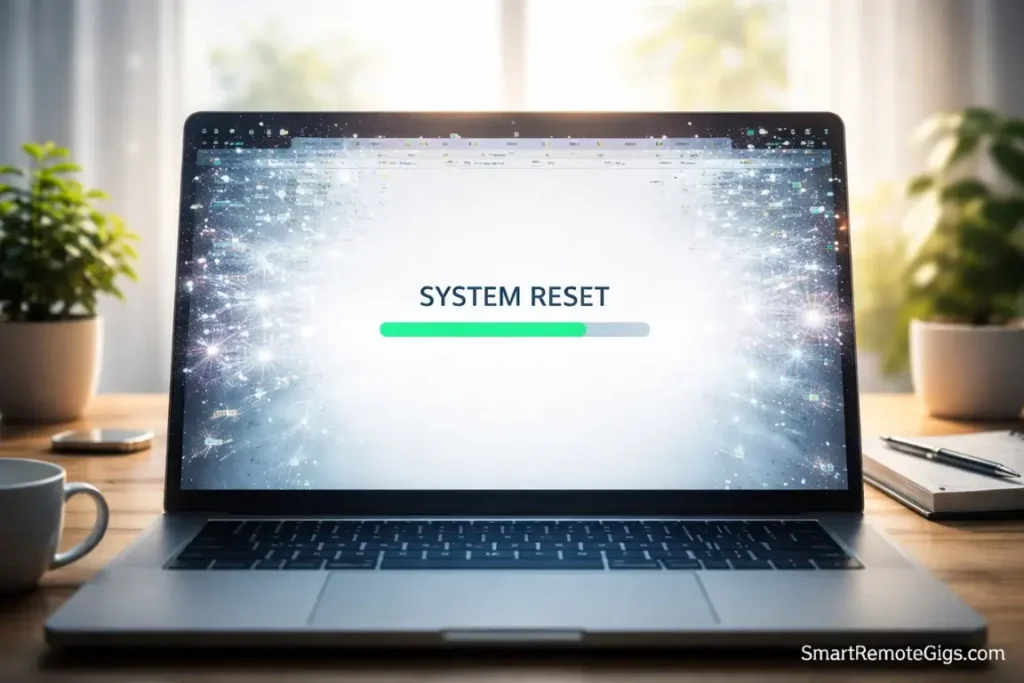
Here’s a radical idea: Close every single browser tab at the end of the day.
Not “most tabs.” Not “the ones you’re done with.” All of them.
I know what you’re thinking: “But what about the article I was halfway through? What about the GitHub issue I was reviewing? What about the 17 tabs I need for tomorrow?”
Here’s the truth: If it’s important, it’s already in your task list from Phase 1. If it’s not in your task list, it wasn’t important.
Tabs are open loops. Every tab is a little voice in your brain saying, “Don’t forget about me.” When you leave 23 tabs open overnight, you’re asking your brain to remember 23 things.
Your brain can’t do that. So it stresses.
Close them all. Declare tab bankruptcy. Start fresh tomorrow.
If you genuinely need something tomorrow, add it to your Top 3 list with a note: “Continue reading X article” or “Review Y document.” Then close the tab.
The rule is absolute. Zero tabs. Zero exceptions.
Reset to Neutral: Clearing the physical desk so tomorrow starts with a clean slate
Your physical workspace matters just as much as your digital one.
At the end of the day, spend 2 minutes resetting your desk to “neutral.”
- Put away notebooks, pens, and papers.
- Move coffee mugs to the kitchen.
- Clear any clutter that accumulated during the day.
- If you use a physical inbox, file everything or add it to your task list.
The goal is simple: When you sit down tomorrow morning, your desk should look like a professional workspace, not a crime scene.
This isn’t about aesthetics. It’s about psychology.
A cluttered desk signals chaos. A clean desk signals control. When you start the day in a clean environment, your brain believes work is manageable. When you start in chaos, your brain believes work is overwhelming.
Reset to neutral. Be kind to Future You.
The Amateur Exit vs. The Pro Exit
The Amateur Exit | The Pro Exit |
|---|---|
Leaves laptop open on couch “in case something urgent comes up” | Closes laptop, puts it in a drawer or designated spot out of sight |
Keeps Slack open on phone “just to stay updated” | Turns off work notifications or puts phone in Do Not Disturb mode |
Leaves 23 browser tabs open “to continue tomorrow” | Closes all tabs, trusts task list to remember what matters |
Desk covered with papers, half-empty coffee mugs, random notes | Desk completely cleared, reset to neutral, ready for tomorrow |
No transition between work and home—just stops typing | Runs a deliberate shutdown ritual with clear beginning and end |
Mentally carries work into dinner, TV time, and bedtime | Feels genuinely “off the clock” within 15 minutes of closing laptop |
Phase 4: The Termination Trigger

The fourth and final phase is about creating a psychological anchor that tells your brain: “Work is over. You can let go now.”
The Physical Anchor: A specific action that signals the end (e.g., changing clothes, a specific playlist, a walk)
Your brain loves rituals. Rituals create predictability, and predictability creates safety.
You need a Termination Trigger—a specific, repeatable action that signals the end of the workday.
Here are examples:
- Change your clothes. If you worked in a t-shirt and jeans, change into loungewear. Even if your “work clothes” are already casual, the act of changing signals a shift.
- Play a specific song or playlist. Choose one song that becomes your “work is done” anthem. Play it at the end of every workday. Pavlov’s dogs salivated at the sound of a bell. You can train your brain to relax at the sound of a song.
- Take a 10-minute walk. This is the closest thing to recreating the commute. Leave your house (or apartment, or room), walk around the block, and return. The physical movement creates separation.
- Make a specific drink. Some people brew a cup of tea. Others pour a glass of wine. The ritual matters more than the beverage.
The key is consistency. Whatever you choose, do it every single day at the same time.
Your brain will learn: “This action means work is over.”
The Cal Newport Phrase: Saying “Shutdown Complete” out loud to finalize the mental state
This is the final step, and it’s non-negotiable.
At the end of your shutdown ritual—after you’ve captured, planned, reset, and triggered—say these two words out loud:
“Shutdown complete.”
Not in your head. Out loud.
This phrase comes from productivity expert Cal Newport, and it’s deceptively powerful.
Saying it out loud forces your brain to acknowledge the end. It’s a declaration. A commitment. A contract with yourself.
The first time you do this, it will feel silly. Do it anyway.
By the 10th time, it will feel automatic.
By the 30th time, it will feel essential.
Just like the Pomodoro timer signals a break, this phrase signals the “Big Break” until tomorrow.
When you say “Shutdown complete,” you’re not just closing your laptop. You’re closing the mental loops. You’re granting yourself permission to stop.
And that’s the whole point.
Troubleshooting Your Shutdown
“What if my boss emails at 6 PM?”
This is the most common objection to the shutdown ritual, and it’s rooted in fear.
Here’s the truth: Your boss emailing at 6 PM doesn’t mean you need to respond at 6 PM.
Unless you work in a true 24/7 emergency environment (ER doctor, on-call engineer, etc.), most “urgent” emails can wait until tomorrow morning.
The key is setting expectations.
If your company culture expects instant responses, you need to have a conversation about boundaries. Here’s a script:
“I’m working on being more focused during the day so I can deliver better results. Part of that is having a clear end to my workday. I’ll be checking email until 6 PM and then again first thing in the morning. If something is truly urgent, feel free to call or text me.”
Most managers will respect this. The ones who don’t are revealing a dysfunction in the organization, not a flaw in your shutdown ritual.
Your availability is a boundary you set, not a boundary they set.
If you’re afraid to set this boundary, ask yourself: “What’s the worst that could happen?”
In most cases, the answer is: “Nothing.” Your boss might be mildly annoyed. But they’ll survive. And so will you.
“What if I didn’t finish everything?”
Welcome to the human condition.
There will always be more work. Always. The inbox will never be empty for long. The project list will never shrink to zero.
You are not failing because you didn’t finish everything. You’re succeeding because you’re choosing to be a whole human being instead of a work machine.
The shutdown ritual isn’t about finishing everything. It’s about closing the day with intention instead of exhaustion.
Here’s the mindset shift:
“I didn’t finish everything” → “I finished today’s work. Tomorrow’s work will be there tomorrow.”
The work is infinite. Your time is finite. The shutdown ritual is how you honor that reality.
The Verdict
A shutdown ritual is not about ending work; it’s about beginning your life. Without it, you are just an employee sleeping in your office. With it, you are a professional with boundaries.

The Grey Zone is optional. The always-on anxiety is optional. The guilt about “not doing one more thing” is optional.
What’s not optional is the ritual itself.
If you want to be present for your family, your hobbies, your sanity—you need a shutdown ritual. Not someday. Today.
Build it. Protect it. Honor it.
Your evenings depend on it.
You’ve mastered the end of the day. Now, let’s fix the beginning. Read our guide on Atomic Morning Routines to start as strong as you finish.