Freelance Value Ladder 2026: Double LTV [My Method]
 ·
Last Updated: May 29, 2026
·
Last Updated: May 29, 2026

Pitching a $5,000 core service to a cold lead usually gets you ghosted or dragged into a pricing debate.
One $199 paid discovery audit converted 80% of cold leads into $4,000 full-execution contracts in 14 days.
Here is the exact value ladder method — the tier-by-tier architecture to naturally ascend clients to your highest-ticket offers.
Smart Remote Gigs (SRG) maps the psychological buying triggers that turn skeptical prospects into premium buyers.
SRG has reverse-engineered the service ascension funnels of the top 50 independent consultants in 2026.
⚡ SRG Quick Summary:
One-Line Answer: A freelance value ladder is a structured sequence of service offerings that increases in price and value, designed to build trust with low-risk entry offers before pitching expensive core execution.
🚀 Quick Wins:
- Carve out a $199–$499 diagnostic audit from your existing core service — pull the discovery phase and package it standalone (Today)
- Map out the exact transition script from Audit to Execution using the bridge template in Scenario 2 (This Week)
- Launch a high-ticket VIP Day invitation to your top 5 past legacy clients using the script in Scenario 4 (This Month)
📊 The Details & Hidden Realities:
- 90% of pricing objections vanish when a client has already paid you for a small, successful diagnostic step
- The biggest red flag beginners miss is overdelivering on the entry-level tier — effectively solving the problem and cannibalizing their core offer
🔍 Scenario 1 — The Skeptical Lead: The Entry-Level Audit
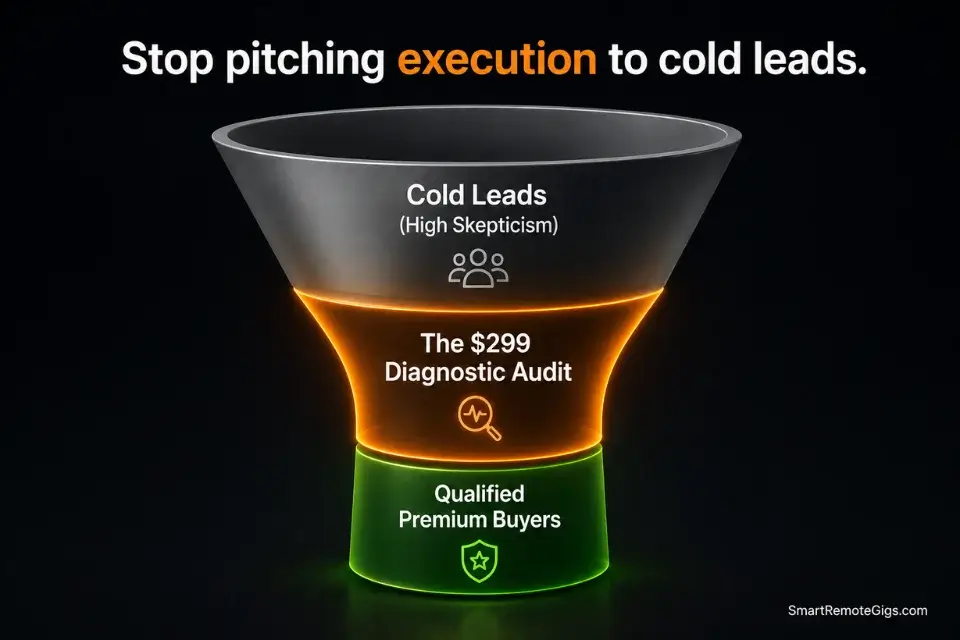
Cold leads do not trust you yet. That is not an objection — it is physics. Pitching a full-scale build to someone who just met you is a mathematical coin toss. You need to lower the barrier to entry with a low-cost, high-value diagnostic step that proves your competence before you ask them to commit real money.
The entry-level audit is not a watered-down version of your service. It is a scalpel — precise, fast, and designed to surface exactly the pain points your core offer fixes.
To make this tier profitable and scalable, you must fundamentally productize freelance services so the audit takes you less than 45 minutes to execute — otherwise a $299 audit at 3 hours of work is a $100/hr ceiling you have built for yourself.
The Exact Playbook
- Extract the discovery phase from your existing core service. Every service has a research and diagnosis stage. That stage — stripped of execution — is your audit product. Define the exact output: a Loom recording, a PDF report, a prioritized action list. One output. Hard format. No scope creep.
- Price the audit to filter, not to profit. The $199–$499 range is not about revenue. It is about qualifying intent. A prospect who will not spend $299 to diagnose a problem they claim to have is not a serious buyer. The price screens out time-wasters before they consume your calendar.
- Deliver asynchronously within 48 hours. No live calls for entry-tier audits. Record a Loom, write the report, send the link. Speed signals competence. A 48-hour turnaround on a $299 diagnostic makes your $4,000 core offer feel like a bargain by comparison.
- End every audit with a single prescribed next step. The final section of your audit output is always the same: “Here is what I found. Here is what it is costing you. Here is the one move that fixes it — and that move is what my core execution offer covers.” One recommendation. One direction. No menu of options.
- Apply the audit fee as a credit toward the core project. Tell the prospect upfront: “If we move to full execution, this $299 is credited toward your invoice.” This single line removes the psychological cost of the audit purchase and makes the ascension feel like a sunk-cost advantage rather than a second spend.
The Paid Teardown Pitch Script
Use this to redirect “free pick-your-brain” requests into a paid diagnostic engagement.
Subject: A faster way to get your answer — [AUDIT_PRODUCT_NAME]
Hi [PROSPECT_FIRST_NAME],
Happy to dig into this with you. Before we book a call, I want to make sure we are solving the right problem and not just the visible one.
I run a [AUDIT_PRODUCT_NAME]: a [AUDIT_DELIVERY_FORMAT, e.g., “48-hour async Loom + PDF report”] where I [AUDIT_OUTCOME, e.g., “identify your top 3 conversion bottlenecks and rank them by revenue impact”].
Investment: $[AUDIT_PRICE].
If we move to a full [CORE_SERVICE_NAME] engagement afterward, this fee is credited in full toward your project invoice.
To book: [CHECKOUT_OR_BOOKING_LINK]
Once you complete the short intake form, I will have your [AUDIT_DELIVERY_FORMAT] to you within [TURNAROUND_HOURS] hours.
[YOUR_NAME]
[YOUR_TITLE]- [PROSPECT_FIRST_NAME] — First name only. Mirror their energy — formal if they are formal, direct if they are direct.
- [AUDIT_PRODUCT_NAME] — The name of your packaged audit. “Growth Audit,” “Copy Teardown,” “Tech Stack Review.” One noun phrase.
- [AUDIT_DELIVERY_FORMAT] — The exact format of the deliverable: “48-hour async Loom + PDF” or “written report delivered via Google Doc.” Hard and specific.
- [AUDIT_OUTCOME] — The single diagnostic output in one sentence. What do they receive that they did not have before?
- [AUDIT_PRICE] — $199–$299 for lighter audits; $399–$499 for deep-domain specialists with documented results.
- [CORE_SERVICE_NAME] — The name of your full execution offer. Use it here to plant the ascension path in their mind before they even book.
- [CHECKOUT_OR_BOOKING_LINK] — A direct payment or booking link. No “reply and we will figure it out.” Remove all friction.
- [TURNAROUND_HOURS] — 24 or 48 hours. Never “a few days.” Speed is part of the product at this tier.
- [YOUR_TITLE] — Your niche-specific title, not a generic label. “E-commerce Growth Strategist” not “Freelancer.”
The SRG Freelance Hourly Rate Calculator runs your audit price against your real delivery time — including intake review, recording, and report writing — so you know your actual effective rate before you lock in the price.
For the complete breakdown of pricing and features:

Most freelancers guess their rate. This free calculator helps you set yours with precision — built around your actual monthly expenses, desired profit, and billable hours so you never undercharge again.
The Pro Tip / Red Flag
Pro Tip: Frame the audit cost as a credit upfront — in the pitch email, on the checkout page, and in the intake confirmation. “If we decide to move forward with the full build, I will credit this $299 audit fee toward your final project invoice.” It makes the “yes” to the audit a no-brainer, and it pre-sells the core offer before the audit is even delivered.
🏗️ Scenario 2 — The Buy-In: The Core Execution Offer
The audit has done its job. The prospect has paid you, received value, and now knows exactly what is broken. They are primed. The objection is no longer “who are you?” — it is “when can we start?”
Your job in this scenario is not to pitch. It is to prescribe.
Do not treat the post-audit conversation as a new sales conversation. The audit findings are the proposal. You are connecting the diagnosis to the cure.
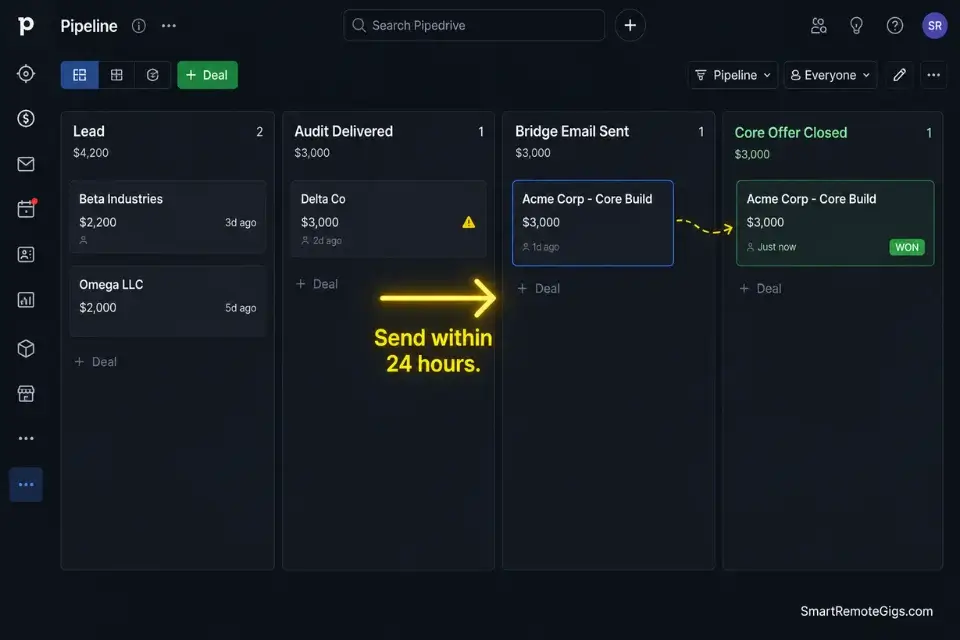
If you delay sending the formal freelance proposal by more than 24 hours after delivering the audit, the client’s urgency will plummet and the deal will go cold — the window of peak motivation closes fast.
The Exact Playbook
- Send the bridge email within 24 hours of audit delivery. Not 48. Not “later this week.” The moment the audit lands in their inbox, your follow-up is already scheduled. Urgency is real only when you honor it operationally.
- Open with one specific finding from their audit. Not a generic “I hope you found the audit valuable.” Reference a specific number or gap you uncovered: “Your cart abandonment rate is 74%. Industry standard for your category is 58%. That 16-point gap is worth approximately $X/month in recovered revenue.” Specificity is the bridge.
- Present the core offer as the prescribed solution, not a menu. One offer. One price. One outcome. “The fix for what I found is my [CORE_OFFER_NAME]. Here is exactly what it covers and what it produces.” Menus create decision fatigue; prescriptions create momentum.
- Anchor the investment against the cost of inaction. “The gap I identified is costing you approximately $[MONTHLY_LOSS] per month. My project fee is $[PROJECT_FEE]. That is a [PAYBACK_PERIOD]-month payback at current bleed rate.” This is not manipulation — it is math. Let the numbers do the persuasion.
- Include a hard decision window. “I have one execution slot opening on [START_DATE]. This proposal is valid through [EXPIRY_DATE].” Capacity is not manufactured urgency — it is a real constraint. Treat it as one.
The Bridge-to-Execution Script
Use this to convert a completed audit directly into a core execution contract.
Subject: Your [AUDIT_PRODUCT_NAME] findings — and the next move
Hi [CLIENT_FIRST_NAME],
Based on your [AUDIT_PRODUCT_NAME], here is the single highest-leverage finding:
[SPECIFIC_AUDIT_FINDING — one sentence, one number, one gap identified]
This is costing you approximately $[ESTIMATED_MONTHLY_LOSS]/month at current trajectory.
The fix is [CORE_OFFER_NAME].
WHAT IT COVERS:
[CORE_DELIVERABLE_1]
[CORE_DELIVERABLE_2]
[CORE_DELIVERABLE_3]
WHAT YOU GET AT THE END:
[ONE_SENTENCE_OUTCOME — the single measurable result the client has after the engagement]
Investment: $[PROJECT_FEE] (your $[AUDIT_PRICE] audit fee is credited in full).
Timeline: [PROJECT_DURATION, e.g., “14 days from kickoff”].
Start date: [PROPOSED_START_DATE].
This slot closes on [PROPOSAL_EXPIRY_DATE].
To confirm: [AGREEMENT_LINK_OR_REPLY_INSTRUCTION]
[YOUR_NAME]- [AUDIT_PRODUCT_NAME] — Match exactly to the audit name they purchased. Consistency anchors the conversation.
- [CLIENT_FIRST_NAME] — First name. This is a warm prospect at peak trust — match that energy.
- [SPECIFIC_AUDIT_FINDING] — One sentence. One number. One gap. “Your email open rate is 11% against a 27% category benchmark” is a finding. “Several areas need improvement” is not.
- [ESTIMATED_MONTHLY_LOSS] — A calculated or conservatively estimated number. Show your math in a follow-up if they ask. Do not leave this blank.
- [CORE_OFFER_NAME] — The exact name of your execution package. Not “my services” — the specific named offer.
- [CORE_DELIVERABLE_1/2/3] — Three specific, scoped deliverables. Vague deliverables invite scope creep from day one.
- [ONE_SENTENCE_OUTCOME] — The measurable end state: “A fully launched email nurture sequence generating automated revenue from your existing list.”
- [PROJECT_FEE] — Net of the audit credit. Show the credit applied: “$4,000 minus your $299 audit credit = $3,701 due.”
- [PROPOSAL_EXPIRY_DATE] — Hard date, 5–7 business days from send. Honor it. If they miss it, quote the new timeline honestly.
The Pro Tip / Red Flag
Red Flag: Never provide the execution roadmap inside the audit. The audit highlights the what and the why. Your core execution offer is the how. The moment you explain how to fix it in the audit, you have given away the product you were about to sell for $4,000.
🔄 Scenario 3 — The Retention Engine: The Continuity Offer
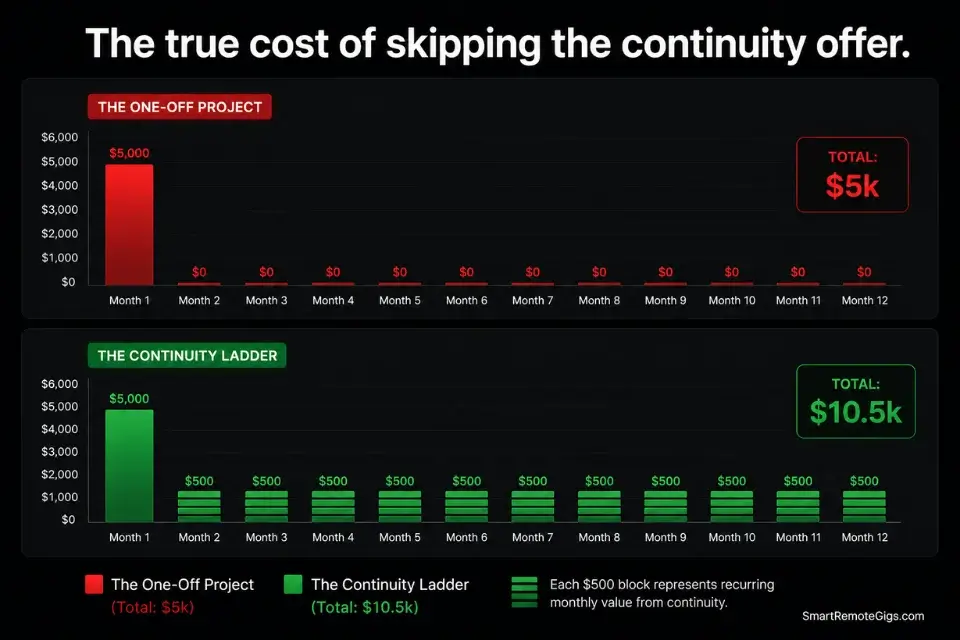
Project completion is not the end of the client relationship. It is the beginning of the highest-margin phase. The client now trusts you, knows how you work, and has seen results. The cost of acquiring this level of trust with a new client is 6–10x higher than retaining the one sitting in front of you.
The continuity offer converts a one-time project fee into a monthly baseline that compounds. Without structuring tight freelance retainer packages, your continuity offer will devolve into you doing endless unpaid favors for legacy clients who “just have a quick question.”
Top-tier operators use automated client management tools to silently track maintenance tasks and auto-bill these continuity retainers on the first of every month — zero manual invoicing, zero chasing.
The Exact Playbook
- Plant the continuity seed at project kickoff. In your kickoff call or onboarding email, mention Phase 2 explicitly: “We build and launch in Phase 1. Phase 2 is where we protect and optimize what we built.” The client hears “continuity” as a planned next step, not an upsell, when it is introduced before the project starts.
- Define the continuity scope before the project ends. Do not scramble to write a maintenance proposal on delivery day. Have the one-pager ready two weeks before handoff. The scope: exactly which tasks are covered monthly, what the response SLA is, and what triggers out-of-scope billing.
- Price the retainer at 10–20% of the core build cost per month. A $5,000 website build supports a $500–$1,000/month maintenance retainer. A $3,000 email system supports a $300–$600/month optimization retainer. The math is simple — use it as your anchor in the pitch.
- Send the continuity pitch with the final project delivery. One email: here is your completed project, and here is how we protect it going forward. The client is at peak satisfaction at the moment of delivery. That is your highest-conversion window. Do not let it close.
- Enforce a strict scope ceiling from day one. The continuity offer covers defined, recurring tasks — not “whatever comes up.” Every request outside the defined scope is quoted separately before work begins. State this in the contract and repeat it in the onboarding email.
The Ongoing Support Upsell Script
Use this to convert a completed project client into a monthly continuity retainer.
Subject: [PROJECT_NAME] is live — keeping it that way
Hi [CLIENT_FIRST_NAME],
[PROJECT_NAME] is complete and live. [ONE_SENTENCE_RESULT, e.g., “Your automation sequences are active and your onboarding flow is running.”]
Here is what happens to [ASSET_TYPE, e.g., “systems like this”] without ongoing attention: [SPECIFIC_DECAY_RISK, e.g., “plugin conflicts accumulate, performance degrades, and conversion rates quietly erode over 60–90 days”].
I offer a [RETAINER_TIER_NAME] for clients after a successful build.
WHAT IS COVERED MONTHLY:
[MAINTENANCE_TASK_1]
[MAINTENANCE_TASK_2]
[MAINTENANCE_TASK_3]
Monthly [REPORT_TYPE, e.g., “performance summary”] delivered by [REPORT_DELIVERY_DAY, e.g., “the 5th”]
WHAT IS NOT COVERED:
New builds, redesigns, or feature additions (quoted separately)
Any task outside the list above
Investment: $[MONTHLY_RETAINER_RATE]/month, billed on the 1st.
Cancel with [NOTICE_PERIOD, e.g., “30 days”] written notice.
Ready to add this to your close-out package?
[YOUR_NAME]- [PROJECT_NAME] — The exact project name from the contract. Consistency across all communications signals professionalism.
- [CLIENT_FIRST_NAME] — First name. Peak-trust moment — match the warmth of the relationship.
- [ONE_SENTENCE_RESULT] — State the concrete delivery outcome. “Your funnel is live” not “the project is done.”
- [ASSET_TYPE] — The category of what you built: “websites,” “email systems,” “automation sequences,” “content pipelines.”
- [SPECIFIC_DECAY_RISK] — The real thing that breaks without maintenance. Make it specific to their asset. Vague risk does not convert.
- [RETAINER_TIER_NAME] — Name the tier for the client: “Care Plan,” “Protection Plan,” “Growth Retainer.” Not “maintenance retainer.”
- [MAINTENANCE_TASK_1/2/3] — Only tasks you have timed and documented. No open-ended language.
- [REPORT_TYPE / REPORT_DELIVERY_DAY] — The monthly proof-of-value document. A specific delivery date creates accountability.
- [MONTHLY_RETAINER_RATE] — 10–20% of your core build fee. Calculate this before you write the email.
- [NOTICE_PERIOD] — 30 days written notice is the field-tested standard.
The Pro Tip / Red Flag
Pro Tip: Pitch the continuity offer during the project kickoff, not just at the end. Establish early that you build in Phase 1, and you optimize and protect in Phase 2. By delivery day, the retainer feels like a scheduled next step — not a surprise upsell that triggers buyer resistance.
👑 Scenario 4 — The Capacity Hack: The Premium VIP Day
You will eventually hit a ceiling on core execution projects. There are only so many $4,000 builds you can run at once before your calendar is full and your growth stalls. The VIP Day solves this by selling something your core project cannot: speed. A client who needs results in one day — not two weeks — will pay a premium for that compression.
The VIP Day is not a discounted version of your core offer. It is a different product entirely. The deliverable is hyper-accelerated execution; the price reflects the intensity and the opportunity cost of blocking out your entire day.
Executing a VIP Day requires flawless intake forms connected to workflow automation software so every asset is collected and organized before the 8-hour clock begins — one missing file on VIP Day morning costs you 90 minutes of your billable window.
The Exact Playbook
- Define the exact output deliverable of your VIP Day. Not “a full day of work.” A specific end state: “a fully written and formatted email welcome sequence, ready to upload,” or “a complete homepage copy rewrite, delivered as a Google Doc.” The client buys the output, not your time.
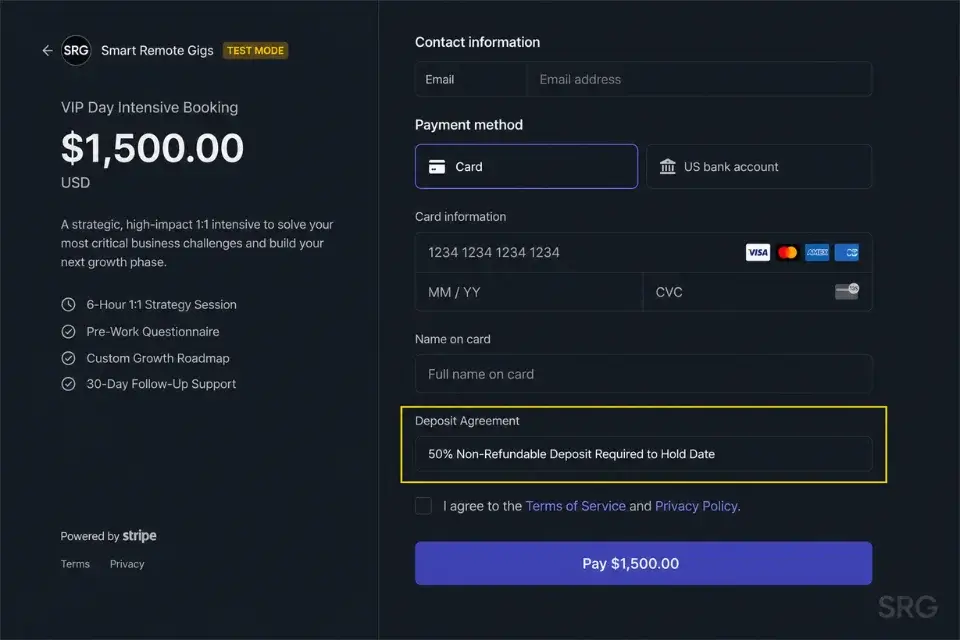
- Set a hard pre-requisite intake window. All assets — brand guidelines, logins, briefs, reference materials — must be submitted via intake form at least [INTAKE_DEADLINE_DAYS] days before the VIP Day date. No assets by the deadline means the day is rescheduled, not refunded. State this in the booking agreement.
- Price at a minimum of $1,500 for entry-level VIP Days; $3,000–$5,000+ for senior expertise. The premium is the speed, not the output volume. A $1,500 VIP Day for 8 hours of focused execution is $187/hr effective rate at minimum — and you are removing the client’s 2-week wait time, which has real business value to the right buyer.
- Limit availability to 2–3 VIP Days per month maximum. Scarcity is real when you enforce it. Blocking your full calendar for one client is a legitimate capacity constraint. Two or three slots per month at $2,000–$3,000 each adds $4,000–$9,000 in monthly revenue that requires zero new client acquisition.
- Require a non-refundable 50% deposit to hold the date. The deposit is the filter. Clients who pay to hold a date show up prepared. Clients who do not pay in advance cancel on short notice and waste your blocked day.
The “Done-In-A-Day” Invitation Script
Use this exclusive pitch to invite high-value leads or past clients to book a premium intensive.
Subject: One day. [VIP_DAY_OUTCOME, e.g., “Your entire email sequence, done.”]
Hi [PROSPECT_OR_CLIENT_FIRST_NAME],
I have [NUMBER_OF_SLOTS, e.g., “one”] VIP Day slot available in [AVAILABILITY_MONTH].
A VIP Day is a focused, single-day intensive where we complete [VIP_DAY_DELIVERABLE] — start to finish — in one session.
WHAT YOU GET:
[VIP_DELIVERABLE_1]
[VIP_DELIVERABLE_2]
[VIP_DELIVERABLE_3]
Final delivery by [END_OF_DAY_TIME, e.g., “6:00 PM”] on the booked date
WHAT IS REQUIRED FROM YOU (BEFORE WE START):
All assets submitted via intake form by [INTAKE_DEADLINE, e.g., “72 hours before the VIP Day”]
[SPECIFIC_ASSET_1, e.g., “Brand guidelines and tone of voice document”]
[SPECIFIC_ASSET_2, e.g., “Completed intake questionnaire”]
Investment: $[VIP_DAY_RATE] total.
To hold your date: 50% deposit ($[DEPOSIT_AMOUNT]) due at booking.
Remaining 50% ($[BALANCE_AMOUNT]) due 48 hours before the VIP Day.
Important: If required assets are not submitted by the intake deadline, the VIP Day is rescheduled. Deposits are non-refundable.
To book: [BOOKING_LINK]
[YOUR_NAME]
[YOUR_TITLE]- [VIP_DAY_OUTCOME] — The subject line result in 5 words or fewer. Make it concrete: “Your sales page, written.” Not “We get a lot done.”
- [PROSPECT_OR_CLIENT_FIRST_NAME] — First name. This pitch works for both cold high-value leads and warm past clients.
- [NUMBER_OF_SLOTS] — Be honest. If you have one slot, say one. Fake scarcity collapses when the client checks back in two weeks and the slot is still open.
- [AVAILABILITY_MONTH] — The calendar month, not “soon.” “One slot in June” creates real urgency.
- [VIP_DAY_DELIVERABLE] — The specific output in one clause: “your complete 6-email welcome sequence” not “content work.”
- [VIP_DELIVERABLE_1/2/3] — Three specific line items that make up the day’s output. No ambiguity.
- [END_OF_DAY_TIME] — A hard delivery time on the day. Creates a professional container and sets expectations.
- [INTAKE_DEADLINE] — Minimum 72 hours before. 5 business days is even better for complex deliverables.
- [SPECIFIC_ASSET_1/2] — List the exact files or documents you need. “Brand guidelines” is specific. “Any materials you have” is not.
- [VIP_DAY_RATE / DEPOSIT_AMOUNT / BALANCE_AMOUNT] — Show the math explicitly: total, 50% deposit, 50% balance. Transparency on payment structure reduces friction.
- [BOOKING_LINK] — A direct payment or scheduling link. No “reply and we will figure out the logistics.”
The Pro Tip / Red Flag
Red Flag: Do not offer VIP Days to highly disorganized clients. If they cannot deliver their assets asynchronously before the start date, the intensive will collapse — and you will spend your blocked day chasing files instead of building. Screen for operational readiness before you sell the date.
💵 Pricing & ROI: The Math Behind the Ascension
Your ladder should mathematically qualify prospects so your time is always protected. Here is how the tiers break down in the field.
The entry-level audit runs $199–$499. At 45 minutes of delivery time, that is a $265–$665 effective hourly rate — and it pre-sells the core offer. The core execution offer sits between $2,500 and $10,000+ depending on niche, complexity, and documented impact. Price it on the outcome, not the hours.
The continuity retainer averages 10–20% of the core build cost per month — a $5,000 build supports a $500–$1,000/month retainer that compounds over 12 months into $6,000–$12,000 in additional LTV from a single client. The VIP Day starts at $1,500 for entry-level specialists and scales to $3,000–$5,000+ for senior domain expertise with compressed delivery.
According to SBA guidance for independent business operators, structured service tiers with clearly defined scope and value benchmarks at each level position solo operators to retain clients longer and command premium pricing — a principle that maps directly to the ascension model above.
Structuring your services this way is the most systematic method to rapidly raise freelance rates without having to justify your hourly value to anyone — the ladder justifies itself through the logical progression of trust and results. Find the automation tools to run every tier efficiently in the SRG Software Directory.
The math across all four tiers: one client who enters at $299 audit, converts to a $4,000 core project, signs a $600/month retainer for 12 months, and books one $2,000 VIP Day in month 8 is worth $13,499 in lifetime value. From a single $299 entry point.
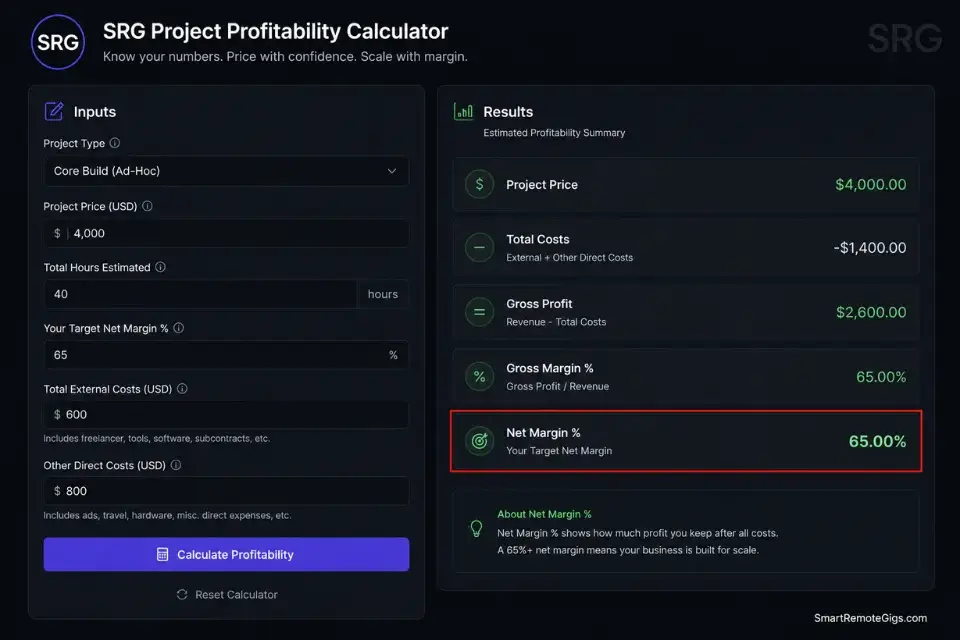
The SRG Project Profitability Calculator runs your margin across every tier — audit, execution, retainer, and VIP Day — and shows you which rung of the ladder is your highest net profit per hour so you can prioritize accordingly.
For the complete breakdown of pricing and features:

your real hourly rate and net profit before you commit to a project — instantly, free.
🗓️ The 30-Day Ladder Execution Plan
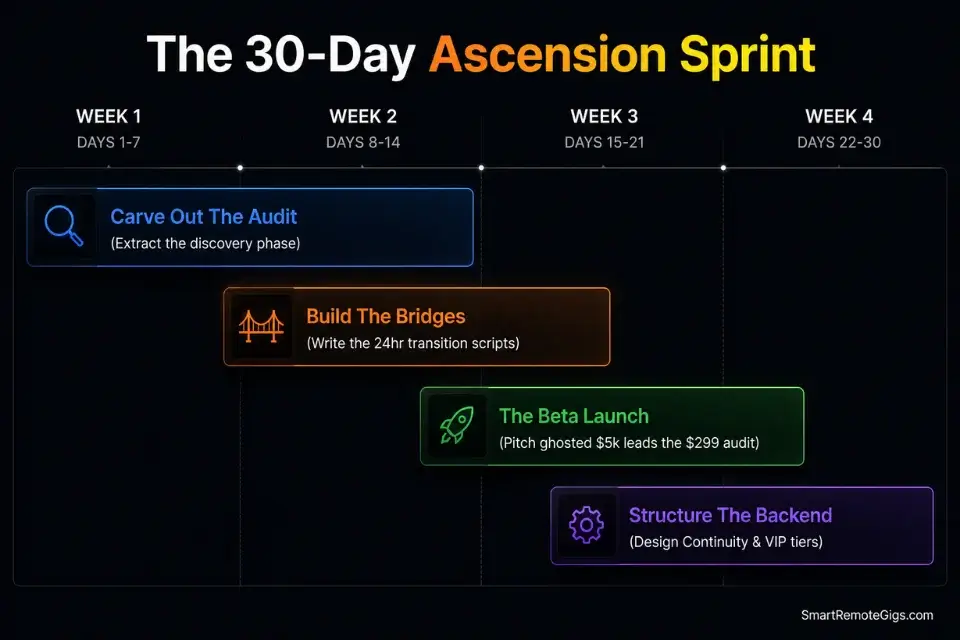
Days 1–3: Carve Out the Audit
- Map your existing core service end-to-end and identify the research and diagnosis phase.
- Extract that phase and package it as a standalone $199–$499 deliverable with a hard format: one Loom recording, one PDF report, one prioritized action list.
- Write the constraints before you launch: 48-hour delivery, async only, no live calls, no execution included.
Pro Tip: Never run live calls for an entry-level audit. Deliver it asynchronously via a Loom recording and written report. Live calls at this tier destroy your margin and set a “available anytime” expectation before the relationship has even started.
Days 4–7: Build the Bridges
- Write the transition email from audit delivery to core offer using the Bridge-to-Execution script in Scenario 2.
- Establish the “Audit Fee Credit” policy in writing — add it to your checkout page, your intake confirmation, and your delivery email.
- Build your checkout link for the audit tier. It should be a single page: the outcome, the format, the price, the buy button.
Red Flag: If your entry offer requires a proposal to be reviewed and signed before purchase, it is too complex. The audit should be buyable in under 90 seconds. Checkout page only — no back-and-forth.
Days 8–14: The Beta Launch
- Pull 5 prospects who ghosted your previous $5,000+ proposals in the last 6 months.
- Send them the Paid Teardown Pitch Script from Scenario 1 — the $299 entry point reopens conversations that the $5,000 pitch closed.
- Fulfill the first audits asynchronously within 48 hours of intake form completion.
Days 15–21: The Core Upsell
- Deliver the completed audits to the beta group and start the 24-hour bridge email clock immediately.
- Execute the Bridge-to-Execution script from Scenario 2 within 24 hours of each audit delivery.
- Target at least one core execution contract confirmed before Day 21.
Days 22–30: Structuring the Backend
- Design your continuity retainer offer for the moment each core project completes — scope, price, and cancellation terms all written before the project starts.
- Map the limits of your Premium VIP Day: the exact deliverable, the intake deadline, the deposit structure, and the maximum slots per month.
- Build the booking page and automate the intake form trigger on deposit payment.
By Day 30, you will have a fully functional ascension model that converts cold traffic predictably, protects your time with hard scope ceilings, and maximizes client lifetime value from every single entry-point buyer.
❓ Frequently Asked Questions
What is a value ladder for freelancers?
Yes — and it is one of the highest-leverage structural changes you can make to your business. A freelance value ladder is a tiered sequence of service offerings that ascends in price and value: an entry-level audit to establish trust, a core execution offer as the main revenue engine, a continuity retainer for recurring income, and a premium VIP Day for time-compressed, high-ticket delivery. Each rung builds psychological readiness for the next.
How do you build a freelance value ladder?
It depends on your existing service, but the sequence is always the same. Start by extracting your discovery phase into a standalone paid audit at $199–$499. Package your core deliverable as a fixed-scope execution offer at $2,500–$10,000+. Design a continuity retainer at 10–20% of the core build cost per month. Then create a VIP Day at $1,500–$5,000+ for speed-premium buyers. Four tiers. One logical progression.
What is a paid discovery phase?
Yes — it is a productized diagnostic service where the client pays you to identify and prioritize their problems before any execution begins. The output is a specific document, recording, or report — not a strategy call, not a free consultation. The paid discovery phase filters serious buyers from time-wasters and pre-sells your core offer by surfacing the exact gaps your execution service fixes.
How do you transition a client from audit to execution?
It depends on timing, but the rule is universal: send the bridge email within 24 hours of audit delivery. Reference one specific finding with a number attached. Present your core offer as the prescribed solution to that finding. Apply the audit fee as a credit toward the project invoice. Include a hard proposal expiry date. Every hour you wait after delivery, the client’s urgency drops and competing priorities fill the gap.
What is the difference between a core offer and a VIP day?
It depends on what the client is buying. A core offer delivers a defined scope of work over a standard project timeline — typically 1–4 weeks. A VIP Day delivers a specific, compressed output in a single intensive session — typically 6–8 hours. The core offer is for clients who want a full build. The VIP Day is for clients who need results by tomorrow and will pay a premium for the speed.
How do I price my freelance service tiers?
It depends on your niche and track record, but the framework is consistent. Entry audit: $199–$499, priced to filter not to profit. Core execution: $2,500–$10,000+, priced on the outcome value not your hours. Continuity retainer: 10–20% of core build cost per month. VIP Day: minimum $1,500, scaling to $5,000+ for senior expertise. Run every tier through the Project Profitability Calculator before you publish the price.
The Verdict: Architect the Journey, Don’t Just Sell the Destination
Most freelancers sell one thing at one price to anyone who will listen. They get a yes, they deliver the work, and then they start the whole acquisition cycle over from scratch. The value ladder ends that cycle. It converts a single transaction into a multi-stage relationship where every successful delivery becomes the entry point for the next offer up the stack.
This model is not for everyone. If your work is inherently one-off — brand identity, a single launch campaign, a one-time audit — the continuity and VIP tiers are harder to architect. But if there is any ongoing component to the problems you solve, any maintenance required after the build, or any premium buyer in your market who values speed over process, you have at least two rungs of a ladder available to you right now.
The freelancers who build ladders stop competing on price. They stop getting ghosted on $5,000 proposals. They stop starting every month at zero. The foundation underneath every rung is a standardized, repeatable delivery system — which is why the first structural move is always to productize freelance services before you build the ladder on top of them. They have a system that qualifies, converts, and retains — automatically — because the structure of the offer itself does the selling.
The Verdict: A freelancer with a value ladder closes more, earns more per client, and works fewer hours than one without — because the ladder does the persuasion, and the entry offer filters out everyone who was never going to buy anyway.
While you build your income ascension systems, don’t leave money on the table. Head to the SRG Job Board at /jobs/ for remote clients seeking structured operational expertise. Browse the SRG Software Directory at /software/ for the automation tools required to fulfill your value ladder seamlessly.

Never Miss a New Remote Job
REMOTE JOB ALERTSGet notified about new remote jobs and access practical freelance tools from your phone.

![How to Find Client Email Addresses: B2B Method [Guide]](https://smartremotegigs.com/wp-content/uploads/2026/10/how-to-find-client-email-addresses-hero-1024x577.webp)