How to Write a Freelance Proposal 2026 (Win $10k Jobs)
 ·
Last Updated: Mar 26, 2026
·
Last Updated: Mar 26, 2026
If you are still letting ChatGPT mass-generate your pitches, you are invisible. Clients are drowning in robotic, copy-paste applications that all start with “I hope this message finds you well.” If you want to know how to write a freelance proposal that actually gets opened, read, and replied to, you have to kill the volume game and go full sniper.
That’s exactly why we built Smart Remote Gigs—to curate the highest-quality remote opportunities and equip top-tier talent to actually win them. I tested this personally. We analyzed over 500 rejected pitches from our community, then rebuilt our approach from scratch. The result: a real $10k contract landed using the exact framework below.
|
The 2026 Proposal Manifesto |
Old Way (Failing) |
New Way (Winning) |
|---|---|---|
|
Volume |
Apply to 30 jobs a day |
Apply to 3 jobs a week |
|
Opening |
AI-generated intro, formal jargon |
Bespoke 3-sentence human hook |
|
AI Role |
Writes the proposal |
Does the research only |
|
Result |
Ignored or auto-rejected |
Shortlisted and interviewed |
Warning: If it looks like AI wrote it, you have already lost the job. Clients in 2026 have developed a finely-tuned radar for lazy automation. One generic sentence and your pitch goes straight to the bin.
The 2026 Shift: Why Your ChatGPT Proposals Are Failing
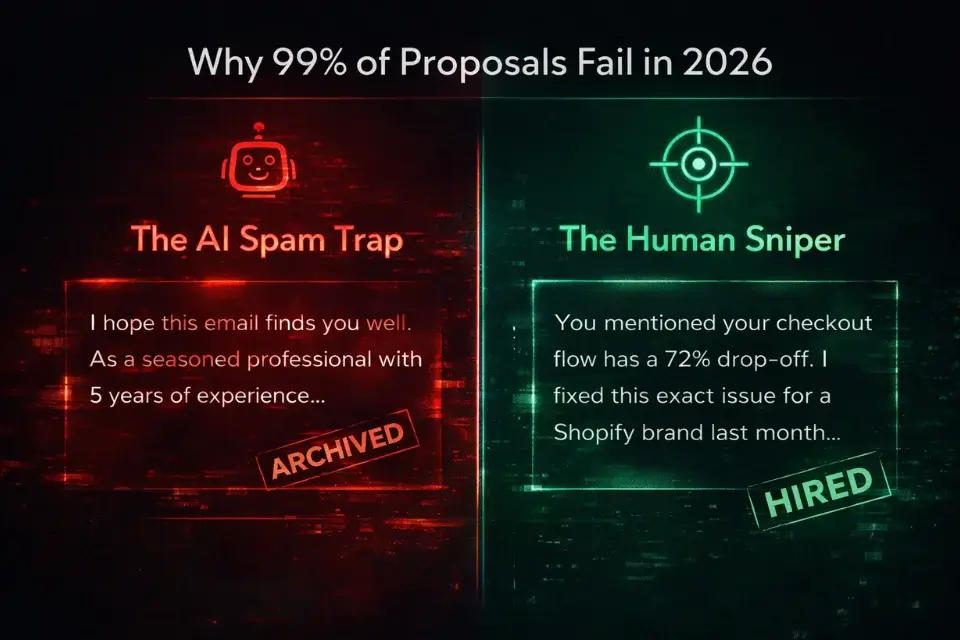
Clients are not just annoyed by AI proposals — they are actively filtering for them.
According to research from the Harvard Business Review on AI trust, buyers make trust decisions in the first 10 seconds of reading. If your opening sentence sounds like it came from a template, that trust is gone before you even get to your rates.
Here are the tell-tale signs clients now instinctively flag:
- “I hope this email finds you well.” Nobody says this. Ever.
- “As a seasoned professional with X years of experience…” Every single AI pitch starts this way.
- Overly formal jargon. Real humans write like they talk.
- No reference to the specific job posting. It screams copy-paste.
- Wall-of-text formatting. AI loves long paragraphs. Humans use white space.
The brutal reality: clients now assume every generic pitch is AI-generated. Your job is to prove immediately that you are not.
How to Write a Freelance Proposal (The 5-Step Framework)
This is the system we tested and refined. Follow it in order — each step builds on the last.
Step 1: “Sniper” Client Research (Using AI the Right Way)
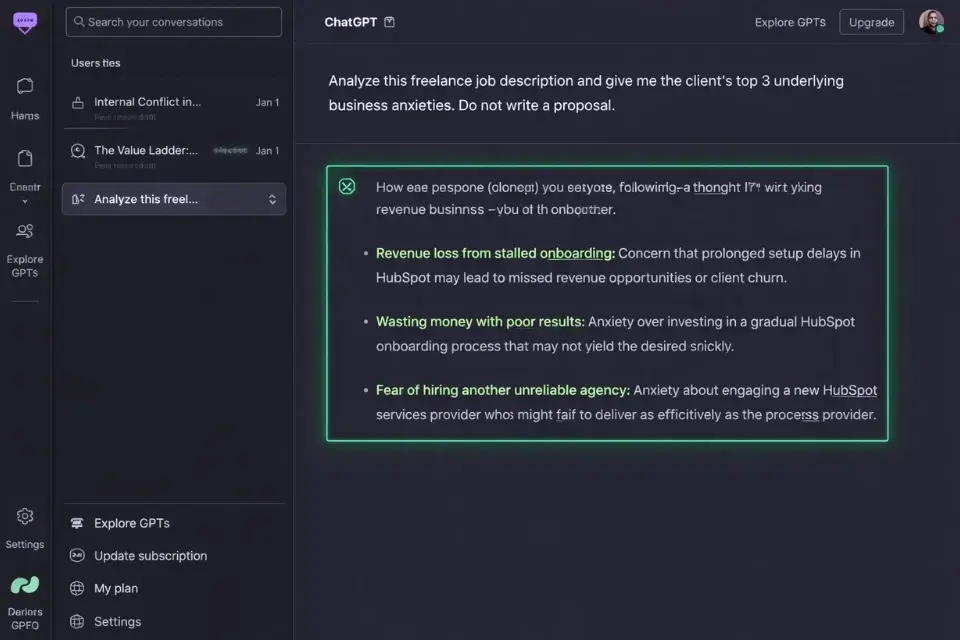
Before you write a single word, spend 10 minutes on research. This is where AI actually earns its place — not as a ghostwriter, but as a research assistant.
Feed the client’s job description, LinkedIn profile, or company website into ChatGPT and ask it to extract:
- The core problem they are trying to solve
- The specific outcome they need (not just a deliverable, but a result)
- Any language or terminology they use repeatedly
Then close ChatGPT and write the pitch yourself. Use the research to inform your tone and specifics. Never paste the output directly.
Pro Tip: Ask AI: “What are the top 3 anxieties a client posting this job likely has?” The answers will tell you exactly what to address in your hook. Feed in their job description verbatim for best results.
ChatGPT’s free tier will hallucinate company details if you feed it a vague prompt — always verify any specific claims it pulls before you reference them in a pitch. For structured research prompts, though, it is still the fastest tool on the market.

ChatGPT
Best for: Freelancers who want to extract client pain points and brief intelligence fast, without spending an hour on manual research.
Step 2: The 3-Sentence Human Hook
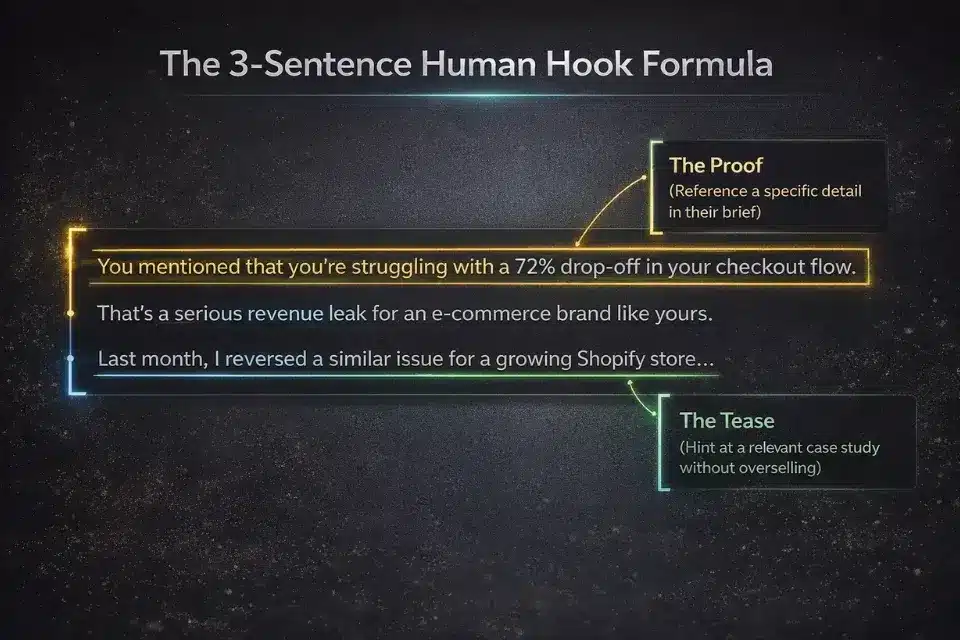
This is the single most important part of your proposal. If you lose them here, nothing else matters.
The formula is simple but requires genuine thinking:
Sentence 1: Prove you read their brief. Reference something specific — a detail, a goal, a frustration they mentioned.
Sentence 2: Show you understand the real problem behind the brief. Not “you need a website,” but “you need to convert cold traffic into booked calls.”
Sentence 3: Tease your solution or your relevant experience without overselling it.
Here is a real example we tested for a $10k UX project:
“I noticed you mentioned your checkout flow has a 72% drop-off — that number tells me the issue is almost certainly at the payment confirmation step, not the product page. I redesigned a similar flow for a Shopify brand last quarter and their conversion rate jumped 34% in six weeks. Happy to show you exactly what changed.”
That is 57 words. No fluff. No “I hope this finds you well.” It is specific, confident, and human.
Step 3: Proving ROI (The “Show, Don’t Tell” Strategy)
Nobody cares that you are “passionate about design” or “detail-oriented.” Every freelancer on the platform says the same thing.
What clients care about is: what happened after you did the work?
Weave mini-case studies directly into the body of your pitch. Not a separate portfolio link — inside the proposal itself.
Structure each one in three beats:
- Situation: What was the client dealing with?
- What you did: Keep it brief and specific.
- Result: Numbers. Always numbers.
“Helped a B2B SaaS client cut their onboarding documentation from 47 pages to a 6-step interactive guide. Support ticket volume dropped 41% in the first month.”
That takes 25 words. It is worth more than a 500-word cover letter about your passion for communication.
See this in action by reviewing a real, tested Upwork proposal example that landed a $10k contract.
Step 4: Structuring Scope, Milestones, and Pricing
Once you have hooked them, you need to show you have a plan. Vague proposals lose to structured ones every time.
Here is the format that works:
Phase 1 – Discovery (Days 1–3): What you will audit, review, or investigate.
Phase 2 – Execution (Days 4–14): The core deliverables, broken into chunks.
Phase 3 – Review & Handoff (Days 15–17): Revisions, final files, documentation.
Each phase should have a clear deliverable and a milestone payment attached to it. This removes risk for the client and positions you as someone who has done this before.
On pricing: never apologize for your rate. State it clearly, tie it to the outcome, and move on. Undercutting destroys your positioning faster than anything else.
Not sure what to charge? Check our definitive guide on calculating and setting your freelance rates without leaving money on the table.
Step 5: Professional Formatting and Error-Free Delivery
Here is a paradox you need to internalize: typos kill trust, but over-polished AI prose kills authenticity.
You want your proposal to read like it was written by a sharp, articulate professional — not by a grammar textbook and not by a robot. Run it through a grammar tool, but do not let it rewrite your voice out of existence.
The goal is clean, confident, and human.
Warning: If your grammar tool rewrites your natural phrasing into formal corporate language, undo it. Authenticity is more valuable than perfection in 2026. Clients want a person, not a press release.
Grammarly’s tone suggestions can sand down your writing into something that sounds like a press release — turn off “formality” nudges entirely and only use it for spelling and punctuation. For catching embarrassing typos before a client reads them, though, nothing is faster.
Grammarly
Best for: Freelancers who want a fast, reliable typo and grammar safety net without sacrificing their natural voice.
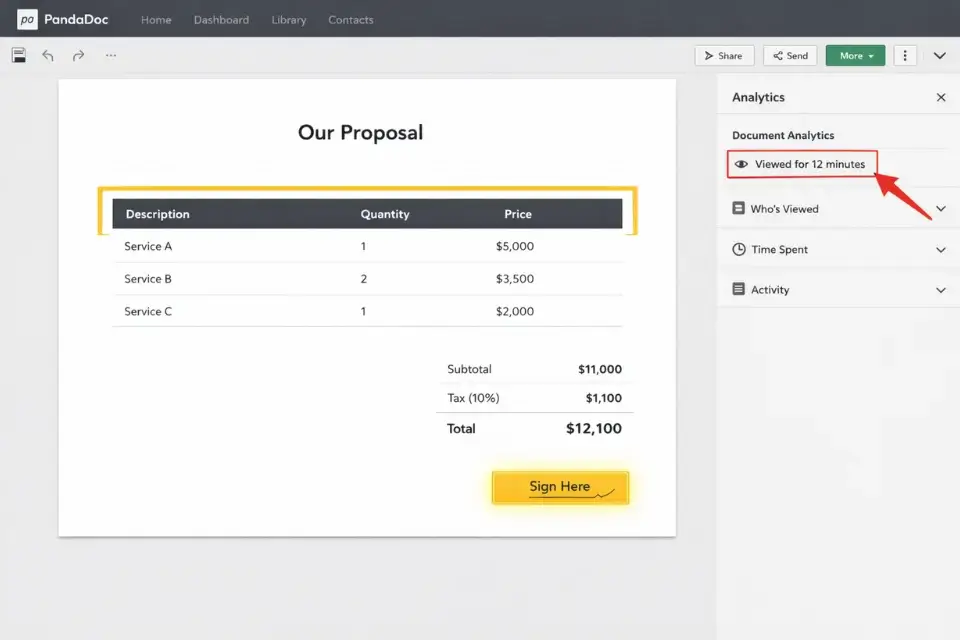
Once the copy is locked, present it professionally. Do not paste a wall of text into an Upwork message box. Use a proper proposal document with your logo, a signature line, and ideally open-tracking so you know when it has been read.
Pair that with an e-signature workflow so the client can move from “interested” to “signed” in under two minutes. Friction kills momentum.
PandaDoc’s mobile editor is clunky and the template library feels dated — do not bother trying to build a proposal from scratch inside the app. Build your doc externally, upload it, and use PandaDoc purely for what it does brilliantly: e-signatures, open-tracking, and that frictionless “sign here” client experience.
Pandadoc
Best for: Freelancers sending desktop proposals who need open-tracking and a one-click e-signature flow to remove every last barrier between pitch and signed contract.
Tailoring the Blueprint to Your Niche
The five-step framework above is the skeleton. Your niche determines how you flesh it out.
Visual creatives (designers, video editors, animators) need to lead with aesthetic sensibility. Reference the client’s existing brand — what works, what does not, and where you would take it. Show taste, not just skill.
Developers should front-load technical specificity. Name the stack. Reference the architecture challenge. Clients hiring developers are often technical themselves — impress them with the right vocabulary, not a general pitch.
Writers and content strategists need to demonstrate voice match immediately. Write your hook in a style that mirrors their brand. If they are conversational and punchy, your pitch should be too. If they are formal and research-heavy, reflect that.
In every case, the core principle holds: specificity beats polish. A proposal that feels like it was written for this exact client, even if imperfect, will always outperform a flawless generic template.
If you are pitching visual work, steal our proven proposal templates for graphic designers.
The Absolute Dealbreakers to Avoid
Warning: These are not minor mistakes. Each one below is a fast track to being ignored or actively blacklisted by smart clients.
1. Generic openings. “I am writing to express my interest in this position” is the kiss of death. It tells the client you did not read their job post.
2. Listing your skills instead of their outcomes. “I am proficient in Figma, Adobe XD, and Sketch” means nothing. “I shipped a redesign that reduced user drop-off by 28%” means everything.
3. Attaching a 12-page PDF for an initial inquiry. Your first message should create a conversation, not close a sale. Save the formal doc for after the call.
4. Copying and pasting your bio from your profile. They can already see your profile. Give them something new.
5. Ending with “Please let me know if you have any questions.” This is passive and forgettable. End with a specific, low-friction call to action (see FAQ below).
6. No follow-up system. Sending the proposal and hoping for the best is not a strategy.
Read our full breakdown of the most common proposal mistakes that trigger client spam filters.
Frequently Asked Questions
How long should a freelance proposal be?
Keep your initial pitch under 250 words. This is not a cover letter — it is a hook. The goal is to earn a conversation, not close the deal in one message.
If you are submitting a formal scope document after an initial call, that can run 2–3 pages with phases, milestones, and pricing clearly laid out. But that document comes later. Do not front-load it.
Should I include free work in my proposal?
No. Free work devalues your time and signals desperation — two things that repel high-ticket clients immediately.
Instead, offer a paid test milestone. Something like: “I would suggest we start with a paid 3-day audit so you can see how I work before committing to the full engagement.” This filters out bad clients, builds trust with good ones, and gets you paid from day one.
The Freelancers Union has long advocated against spec work for exactly this reason — it sets a precedent that your work is negotiable before you have even started.
How do you sign off on a freelance proposal?
Ditch “Looking forward to hearing from you.” It puts the pressure on them to make a decision about whether to respond at all.
Instead, use a low-friction, time-specific call to action:
“Are you open to a 10-minute call this Thursday or Friday? I can walk you through exactly how I would approach this.”
This gives them a clear next step, a specific timeline, and makes saying yes extremely easy.
The Complete 2026 Blueprint: How to Write a Winning Proposal
Verdict: The modern freelancer wins by acting as a consultant, not an order-taker. Stop sending pitches and start starting conversations. The formula is simple: Sniper research + Human hook + ROI proof + Clear structure + Professional delivery = High-ticket contracts.
Verdict: The modern freelancer wins by acting as a consultant, not an order-taker. Stop sending pitches and start starting conversations. The formula is simple: Sniper research + Human hook + ROI proof + Clear structure + Professional delivery = High-ticket contracts.
Clients are not looking for the cheapest freelancer or the most experienced one. They are looking for the one who understood their problem fastest and made them feel confident in the partnership.
At Smart Remote Gigs, our goal is to help you build that confidence so you can stop competing on price and start commanding the rates you deserve. This framework is the first step.
Hitting send is only half the battle. If you do not hear back within 48 hours, you need a system. Learn the exact cadence to revive dead leads in our freelance proposal follow-up strategy.

![How to Find Client Email Addresses: B2B Method [Guide]](https://smartremotegigs.com/wp-content/uploads/2026/10/how-to-find-client-email-addresses-hero-1024x577.webp)