
Atomic Habits for Remote Work: Build Systems That Stick
 ·
Last Updated: January 24, 2026 ·
16 min read
·
Last Updated: January 24, 2026 ·
16 min read
I spent my first year of remote work “waiting for motivation” to strike. It never did.
I found myself replying to emails at 9 PM not because I was dedicated, but because I procrastinated until 4 PM. It wasn’t a discipline problem; it was a design problem.
The home office is a beautiful lie. We imagine ourselves at a pristine desk, crushing tasks with monk-like focus. The reality? You’re in sweatpants at 2 PM, toggling between a Google Doc and Twitter, convincing yourself that “research” counts as work.
This is the WFH Drift—where you are half-working all day and fully resting never.
The fix isn’t more willpower. It’s environmental design. James Clear’s Atomic Habits gives us the blueprint, but most advice is written for office workers. We need the remote version.
Let me show you how to build a system where productivity is inevitable.
⚡ The Atomic WFH Protocol
|
The Law |
The Remote Tactic |
The Result |
|---|---|---|
|
Make It Obvious |
The “Work-Only” Browser Profile |
Eliminates “Tab Drifting” instantly |
|
Make It Attractive |
Podcast + Admin Work bundling |
Turns boring tasks into rewards |
|
Make It Easy |
The 2-Minute Slack Rule |
Zero mental backlog by 5 PM |
|
Make It Satisfying |
The Shutdown Ritual |
Prevents work from bleeding into night |
Why Your Home Office Is Sabotaging You (The Invisible Hand)
Your kitchen table isn’t neutral. Your couch isn’t neutral. Every surface in your home has already been claimed by a habit.
The couch = Netflix. The bed = sleep (or scrolling). The kitchen = snacking.
When you try to work from these places, you’re fighting the ghost of every habit you’ve ever built there. You will lose.
In a traditional office, the environment does the heavy lifting. The building itself says: “This is where work happens.” The commute acts as a psychological buffer between home-you and work-you.
At home, you have none of that. You are 100% reliant on internal discipline, which is a battery that drains fast.
Research backs this up. Studies on context-dependent memory show that our brains encode habits to specific locations. When you work from the same spot where you relax, you’re creating what psychologists call context interference—your brain literally can’t tell the difference between work mode and rest mode.
Systems vs. Goals: Why aiming for “$10k months” fails without a “Cold Email at 9 AM” system
Let me be blunt: Goals are useless without systems.
Every freelancer wants to hit $10k months. That’s the goal. But what’s the system?
Here’s what I mean:
|
Goal (What You Want) |
System (What You Do Daily) |
|---|---|
|
Land a $5k client |
Send 5 cold emails every morning at 9 AM |
|
Finish course by end of month |
Complete 1 module before checking Slack |
|
“Be more productive” |
Close all tabs at 11 AM, work in 90-min blocks |
|
Stop working late |
Hard stop at 6 PM with Shutdown Ritual |
The goal is the destination. The system is the vehicle. If you only focus on the destination, you’re standing on the side of the road hoping a car shows up.
Warning: Motivation is a battery. In an office, peer pressure saves you when the battery dies. At home, you are alone. If you rely on the battery, you will burn out.
Law 1: Make It Obvious (Design Your Cues)
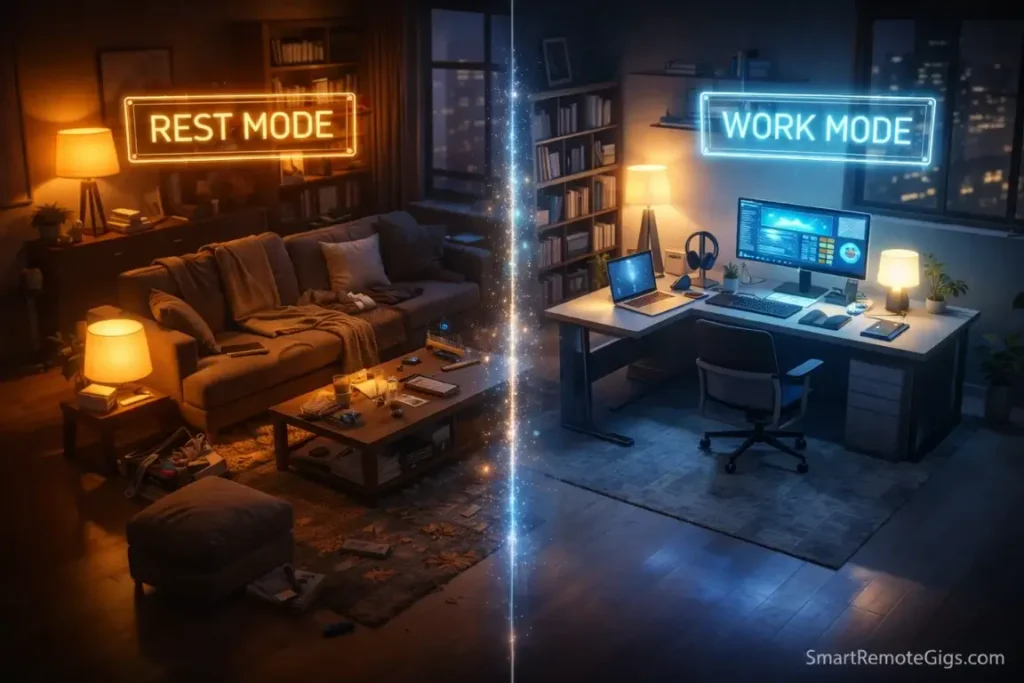
The first law is about making the cues of good habits impossible to ignore.
In an office, the cues are built-in. You see your coworkers working. You hear the hum of productivity. You walk past the conference room and remember you have a meeting.
At home? You see the unmade bed. You hear the laundry buzzing. You walk past the fridge.
You need to manufacture the cues.
The Environment is the First Habit: Separating “Living Space” from “Working Space” even in a studio apartment
I don’t care if you live in a studio apartment. You need a designated work zone.
This doesn’t mean you need a home office with French doors. It means you need one specific spot that only means work.
Here’s what I did in my 400-square-foot apartment:
- I bought a cheap folding desk that I only unfolded during work hours.
- When it was folded, work was over. When it was open, work was happening.
- I never, ever sat at that desk to watch YouTube or browse Reddit.
The desk became the cue. When I sat there, my brain knew: “We’re working now.”
If you want to go deeper on this, check out the specific ergonomic gear that signals ‘work mode’ to your brain.
The key is context dependency. Your brain is a pattern-matching machine. If you work from your bed, your bed will stop being a place of rest. If you eat lunch at your desk, your desk will stop being a place of focus.
One location, one behavior. That’s the rule.
Implementation Intentions: Writing down exactly when and where you will check Slack
Here’s a sentence that will change your remote work life:
“At [TIME], in [LOCATION], I will [ACTION].”
This is called an Implementation Intention, and it’s the antidote to the WFH Drift. Research on implementation intentions shows that people who use this formula are 2-3x more likely to follow through on habits than those who rely on vague goals.
Don’t say: “I’ll check Slack when I get a chance.”
Say: “At 9:00 AM, at my desk, I will check Slack for 15 minutes.”
The specificity removes the decision fatigue. You don’t have to wonder when to start. You already decided.
Here are the Implementation Intentions I use:
- “At 8:30 AM, at my kitchen table, I will drink coffee and review my calendar.”
- “At 9:00 AM, at my desk, I will open Asana and choose my Top 3 tasks.”
- “At 12:30 PM, in the kitchen, I will eat lunch with my phone in another room.”
- “At 6:00 PM, at my desk, I will run my Shutdown Ritual.”
Notice the pattern: Time + Location + Action.
Your brain loves clarity. Give it clarity.
Pro Tip: Habit Stacking the Start: “After I [Pour Coffee], I will [Open Asana].” Do not open email first. Email is reactive. Asana is proactive. Stack the proactive habit onto the coffee cue, and you will never start the day in defense mode again.
Want to master this technique? Read our deep dive on Habit Stacking for Deep Work to learn how to start before you feel ready.
Law 2: Make It Attractive (Temptation Bundling)
The second law is about pairing what you need to do with what you want to do.
This is called Temptation Bundling, and it’s the secret weapon for boring remote work tasks.
The “Admin & Audio” Rule: Only allowing yourself to listen to your favorite True Crime podcast while doing expense reports or data entry
I hate admin work. Invoicing, expense reports, filing receipts—it’s all soul-crushing.
So I made a rule: I can only listen to my favorite podcast while doing admin tasks.
Now, when I have a backlog of receipts to file, I actually look forward to it because it means I get to catch up on the latest episode of Serial.
This is Temptation Bundling in action. You take a habit you need to do (admin work) and pair it with a habit you want to do (podcast listening).
Here are other examples:
- Only listen to audiobooks while doing laundry or cleaning.
- Only watch YouTube cooking videos while prepping meals.
- Only scroll Instagram while on the treadmill.
The key is exclusivity. If you listen to podcasts all the time, the bundle loses its power. You need to create artificial scarcity.
The Community Effect: Joining digital co-working spaces to mimic the “tribe”
Humans are tribal. We do what the people around us do.
In an office, the tribe is working. So you work.
At home, there is no tribe. Just you and the existential dread.
The solution? Manufacture a tribe.
I joined a digital co-working space called Focusmate. It pairs you with a stranger over video for a 50-minute work session. You both say what you’re working on, mute yourselves, and work in parallel.
It sounds ridiculous. It works beautifully.
Knowing that someone is watching me work (even silently) activates the same social pressure that made offices productive. I can’t slack off. I’m accountable.
Other options:
- Discord co-working servers (free, less structure)
- Flow Club (group co-working sessions with a facilitator)
- In-person co-working spaces (if you need the full sensory experience)
The tribe makes the habit attractive. Use the tribe.
Law 3: Make It Easy (Reduce Friction)

The third law is about removing every possible obstacle between you and the habit.
Remote work is full of friction. Every decision is a speed bump. Every notification is a detour.
Your job is to pave the highway.
To understand the science behind why friction matters so much, explore our guide on Friction Design: Engineering Your Digital Workspace for Zero Resistance. It breaks down exactly how to architect your entire digital environment for maximum productivity.
The 2-Minute Rule for Async Comms: If a Slack reply takes <2 minutes, do it now. If >2, task it. Stop the mental backlog
Here’s the remote work killer: the mental backlog.
You see a Slack message. It requires a thoughtful response. You think, “I’ll get to that later.”
But “later” never comes. Instead, the message sits in your brain, consuming RAM. By the end of the day, you have 47 unresolved tasks rattling around in your skull.
This phenomenon has a name: the Zeigarnik Effect. Research on the Zeigarnik Effect explains how our brains obsessively loop on incomplete tasks, draining mental energy even when we’re not actively working on them.
The fix is the 2-Minute Rule:
If a task takes less than 2 minutes, do it immediately. If it takes more than 2 minutes, add it to your task list and close the tab.
This rule eliminates the backlog. You’re either acting on the message or you’re parking it in a trusted system (like Asana or Todoist). You’re never holding it in your head.
Here’s what this looks like in practice:
- Slack message asking for a Zoom link? Send it now (30 seconds).
- Slack message asking for feedback on a draft? Add to Asana: “Review draft by EOD” (10 seconds).
- Email asking for a call? Reply with Calendly link (1 minute).
The mental peace this creates is insane. You stop carrying the weight of unfinished tasks.
Standardize the Start: Using a “Start Up Ritual” to lower the barrier to entry
The hardest part of any task is starting.
So make starting automatic.
I have a Start Up Ritual that I do every single morning at 9:00 AM:
- Open my “Work-Only” browser profile (no personal tabs, no YouTube, no Twitter).
- Open Asana and review my Top 3 tasks for the day.
- Open a blank Google Doc titled “Daily Log” and write one sentence about what I’m working on.
- Start a 90-minute Pomodoro timer.
The entire ritual takes 3 minutes. But it eliminates decision fatigue. I don’t have to think about what to do first. I just follow the script.
If you want to go deeper on this, use the Pomodoro Technique to overcome the initial resistance of starting.
The ritual becomes a psychological cue. When I complete it, my brain knows: “We’re in work mode now.”
High Friction vs. Low Friction Setup
|
High Friction (What Most People Do) |
Low Friction (What You Should Do) |
|---|---|
|
Open browser, see 47 tabs from yesterday |
Close all tabs every night, start fresh |
|
Phone on desk, buzzing every 5 minutes |
Phone in kitchen, on Do Not Disturb |
|
Laptop cluttered with random files |
Desktop 100% clean, only active project visible |
|
Email notifications turned on |
Email closed until 4 PM, batch replies once daily |
|
Slack open all day, constant interruptions |
Slack closed during deep work, check at set times |
Every bit of friction you remove is a vote for the good habit. Every bit of friction you add to bad habits is a vote against them.
Design the path of least resistance.
Law 4: Make It Satisfying (The Reward)

The fourth law is about making the habit feel good immediately.
Humans are wired for instant gratification. If a habit doesn’t deliver a dopamine hit right now, we won’t repeat it.
The problem with remote work is that the rewards are distant. You send a cold email today. You might land a client in 3 months. Your brain doesn’t care about 3 months from now.
You need to manufacture immediate rewards.
The Shutdown Ritual: Why “closing the laptop” isn’t enough. You need a psychological full-stop to prevent work seeping into the evening
Here’s the brutal truth about remote work: the workday never ends unless you end it.
There’s no commute. There’s no office building you leave. There’s just… your laptop, sitting there, glowing, whispering, “Just check Slack one more time.”
You need a Shutdown Ritual.
Here’s mine, performed every day at 6:00 PM:
- Close all browser tabs and quit the browser.
- Open my task manager and write down tomorrow’s Top 3 tasks.
- Close my laptop and put it in a drawer (out of sight).
- Say out loud: “Work is done.”
- Change into non-work clothes (even if I was already in sweatpants).
The ritual creates a psychological boundary. When I complete it, my brain knows: “We’re off the clock now.”
Without this ritual, work bleeds into the evening. You’re never fully working, but you’re never fully resting. You’re stuck in the Gray Zone.
The ritual gives you permission to stop.
For a complete step-by-step system to close your workday with zero mental residue, read The Remote Shutdown Ritual: How to Actually Stop Working at 6 PM.
Visual Progress Tracking: Using a paper habit tracker or digital streak counter (Seinfeld Strategy)
The Seinfeld Strategy, also known as “Don’t Break the Chain”, is simple: Don’t break the chain.
Jerry Seinfeld’s advice for becoming a better comedian was to write jokes every single day and mark an X on a calendar. After a few days, you have a chain. Your only job is to not break the chain.
I use this for my remote work habits.
I have a printed habit tracker on my desk with these habits:
- ✅ Started work by 9 AM
- ✅ Completed Top 3 tasks
- ✅ Ran Shutdown Ritual by 6 PM
Every day I complete a habit, I put an X in the box. Seeing the chain of X’s is incredibly satisfying. My brain gets a dopamine hit every time I mark that box.
The visual progress is the reward. It makes the habit satisfying immediately, even if the long-term payoff is months away.
You can do this with:
The medium doesn’t matter. The visibility does.
The Inversion: How to Break Bad Digital Habits
The 4 Laws work in reverse too.
To break a bad habit:
- Make it invisible
- Make it unattractive
- Make it difficult
- Make it unsatisfying
Let’s apply this to the biggest remote work vice: mindless scrolling.
Make It Invisible: The nuclear option for social media blockers and phone storage
Out of sight, out of mind.
I deleted Instagram, Twitter, and TikTok from my phone. Not “logged out.” Not “in a folder.” Deleted.
If I want to check Twitter, I have to:
- Open the App Store
- Re-download the app
- Wait for it to install
- Log in
- Scroll
By the time I get to step 3, I’ve usually realized this is a waste of time and I stop.
The friction kills the impulse.
For desktop distractions, I use:
- Freedom (blocks websites on a schedule)
- Cold Turkey (nuclear option, literally impossible to bypass)
- LeechBlock (Firefox extension, highly customizable)
I also keep my phone in the kitchen during work hours. If it’s not in the room, I can’t pick it up.
If you want a deeper system for this, check out our deep dive into Digital Minimalism for removing digital noise.
Make It Difficult: Logging out of every account daily so you have to type passwords manually
Here’s a weird trick that works: Log out of everything at the end of each day.
YouTube, Reddit, Twitter, even Gmail—log out of all of it.
The next time you want to check, you have to manually type your password. This 10-second delay is often enough to make you think, “Is this really worth it?”
Most of the time, it’s not.
The friction creates a pause, and in that pause, you can make a conscious decision instead of running on autopilot.
Identity-Based Habits: The “Remote CEO” Mindset
Here’s the final piece: You don’t rise to the level of your goals. You fall to the level of your identity.
If you see yourself as “a freelancer who is disorganized,” you will be disorganized. If you see yourself as “the type of person who creates order,” you will create order.
This is identity-based habit change, and it’s the deepest lever you can pull.
Shifting from “I’m a freelancer who is disorganized” to “I am the type of person who creates order”
Every action you take is a vote for the type of person you want to become.
If you struggle with feeling like you’re “not a real professional” while working from home, read our deep dive on Identity-Based Habits: Overcoming Remote Imposter Syndrome to rewire how you see yourself as a legitimate remote professional.
When you complete your Shutdown Ritual, you’re casting a vote for: “I am the type of person who respects boundaries.”
When you send your 5 cold emails at 9 AM, you’re casting a vote for: “I am the type of person who does hard things early.”
When you put your phone in the kitchen, you’re casting a vote for: “I am the type of person who controls their attention.”
The goal isn’t to have discipline. The goal is to become a disciplined person.
Small distinction. Massive difference.
I started calling myself the CEO of my remote business—even though I’m a solo freelancer. CEOs don’t procrastinate until 4 PM. CEOs don’t skip the Shutdown Ritual. CEOs design systems that work whether they “feel like it” or not.
The identity shift changes everything.
The Verdict
Verdict: Remote work freedom is a double-edged sword. To handle the freedom, you need the discipline of a machine. Atomic Habits isn’t just a book; it’s the operating system for the solo worker. You don’t need more motivation. You need better systems. Build the cues, remove the friction, manufacture the rewards, and repeat until the system runs itself. That’s how you win at remote work.

Now that your environment is set, you need the right tools to automate the rest. Check out our Curated List of AI Productivity Tools to handle the heavy lifting.

![Build AI Second Brain Assistant 2026: Local Setup [Guide]](https://smartremotegigs.com/wp-content/uploads/2026/09/build-your-second-brain-ai-assistant-local-rag-hero-1024x577.webp)
![Second Brain with Claude & Obsidian 2026 [My Setup]](https://smartremotegigs.com/wp-content/uploads/2026/08/claude-obsidian-second-brain-mcp-hero-1024x577.webp)
![Why Your Second Brain Fails 2026: Retrieval Fix [Fix]](https://smartremotegigs.com/wp-content/uploads/2026/08/why-your-second-brain-fails-hero-1024x576.webp)