
Cold Email Follow-Up Strategy: The No-Nag Guide (2026)
 ·
Last Updated: January 30, 2026 ·
13 min read
·
Last Updated: January 30, 2026 ·
13 min read
I looked at my CRM. 4 of my last 5 clients didn’t reply to my first email. They replied to the 3rd or 4th.
Here’s the Silence that kills most freelance businesses: you send a perfectly crafted cold email. You check your inbox obsessively. Nothing. Day 2: Nothing. Day 3: Still nothing.
You assume they hated it. You assume they think you’re annoying. You assume they’re not interested.
You’re wrong on all three counts.
The truth? They probably never even saw your email. It got buried under 47 other messages, 3 Slack notifications, 2 Zoom meetings, and a minor crisis with their biggest client.
The statistic everyone ignores: 70% of sales close after the 3rd+ email, not the first. Most freelancers send one email, get no response, and give up. They’re leaving 70% of potential revenue on the table out of fear of being “annoying.”
This guide teaches you the exact follow-up strategy that wins clients without destroying relationships—the timing, the psychology, the specific words to use, and the hard line where persistence becomes harassment.
📅 The “No-Nag” Schedule
|
Touchpoint |
Timing |
The Goal |
Value Add |
|---|---|---|---|
|
Email 1 |
Day 0 |
The Pitch |
The Offer |
|
Email 2 |
Day 3 |
The Bump |
“Just in case…” |
|
Email 3 |
Day 10 |
The Value |
“Saw this article…” |
|
Email 4 |
Day 17 |
The Breakup |
“Closing the file” |
The pattern: Increase time between follow-ups and increase value in each one. Never just “check in.”
Why You Feel Annoying (And Why You’re Not)
Let’s kill the mental block that stops most people from following up.
Your internal monologue:
- “They saw my email and chose not to reply—I should respect that”
- “If I email again, they’ll think I’m desperate”
- “I don’t want to be that annoying salesperson”
- “They probably hate me now”
The reality:
- They get 150+ emails per day and yours got lost
- They meant to reply but forgot (happens constantly)
- They were interested but got distracted by something urgent
- They don’t even remember seeing your first email
The data from my inbox archaeology project:
I analyzed my last 50 client acquisitions:
- 8% replied to the first email
- 23% replied to the second email
- 31% replied to the third email
- 22% replied to the fourth email (the breakup)
- 16% never replied but became clients 3-6 months later through different channels
Translation: 92% of my clients required follow-up. If I’d stopped after one email, I would have made 8% of the money I actually made.
Psychology Shift: You are not begging for attention. You are offering a business solution to a business problem. Following up isn’t desperate—it’s professional persistence. CEOs follow up on deals. Sales teams follow up on leads. You’re doing business, not bothering people.
The reframe:
Don’t think: “I’m annoying them”
Think: “I’m making it easy for them to say yes by staying visible”
Don’t think: “They’re ignoring me”
Think: “They’re busy and I need to re-surface at the right time”
Don’t think: “I’m being pushy”
Think: “I’m being helpful by reminding them of a valuable opportunity”
The “Zero-Nag” Rule: Never Just “Check In”
The #1 mistake freelancers make: the empty follow-up.
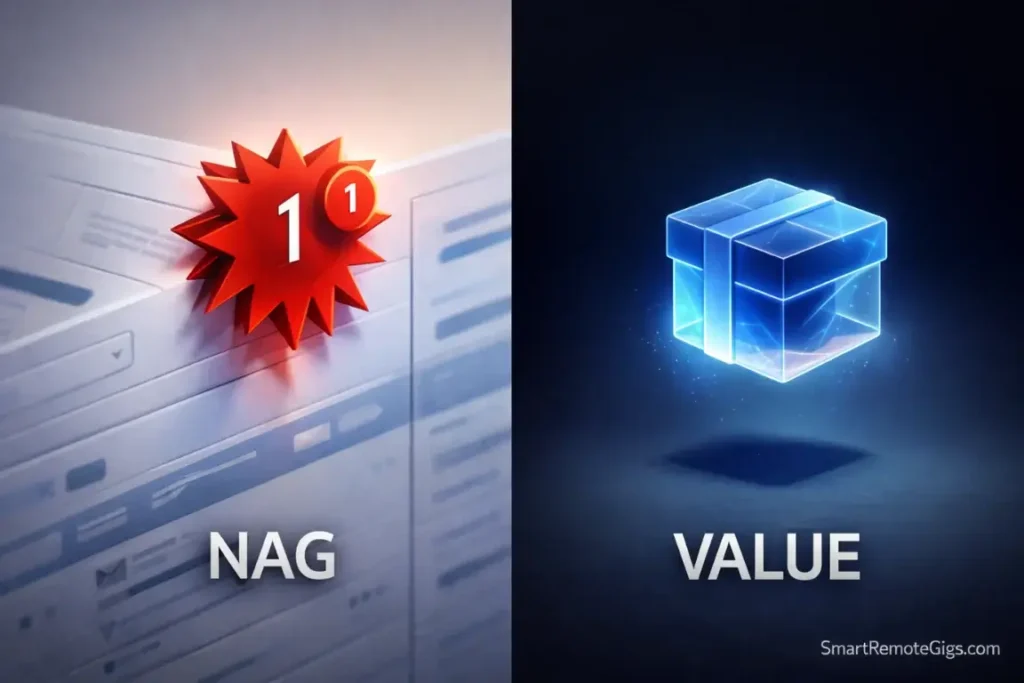
Examples of worthless follow-ups:
❌ “Just checking in to see if you saw my last email”
❌ “Following up on my previous message”
❌ “Did you get a chance to review my email?”
❌ “Wanted to bump this to the top of your inbox”
❌ “Circling back on this”
Why these fail:
They’re transparent excuses to get your attention. They add zero value. They’re about YOUR need (you want a response), not THEIR benefit.
The Zero-Nag Rule: Every follow-up must contain new value—information, insight, resource, or perspective they didn’t have in the previous email.
Value-add follow-up examples:
✅ “Saw this article about [Their Industry] and thought of you: [link]”
✅ “Noticed [Competitor] just launched [Campaign]—here’s what they’re doing well”
✅ “Quick idea for [Their Company] based on something I saw this week”
✅ “Found a case study similar to your situation: [link]”
✅ “Just published a guide on [Relevant Topic]—thought it might be useful”
The structure:
Paragraph 1: The value (article, insight, resource)
Paragraph 2: How it relates to them specifically
Paragraph 3: Soft reminder of your original offer
Paragraph 4: Easy out or easy yes
Example:
Subject: Article for CloudMetrics
Body:
Hi Sarah,
Saw this Harvard Business Review article on Series A companies’ biggest marketing mistakes ([link]) and immediately thought of our conversation about CloudMetrics’ social presence.
The section on “underfunding brand building while overspending on performance marketing” felt particularly relevant given your board’s questions about social strategy.
Still happy to chat if you want to explore that LinkedIn growth plan I mentioned. Either way, hope the article is useful.
Best,
Marcus
Why this works:
- Leads with value (the article), not with “me me me”
- Shows continued thinking about their problem
- Reminds them of the original offer without being pushy
- Gives them an out (“either way, hope it’s useful”)
Use the specific follow-up scripts from our 5 Freelance Cold Email Templates—Template 5 is entirely dedicated to follow-up psychology.
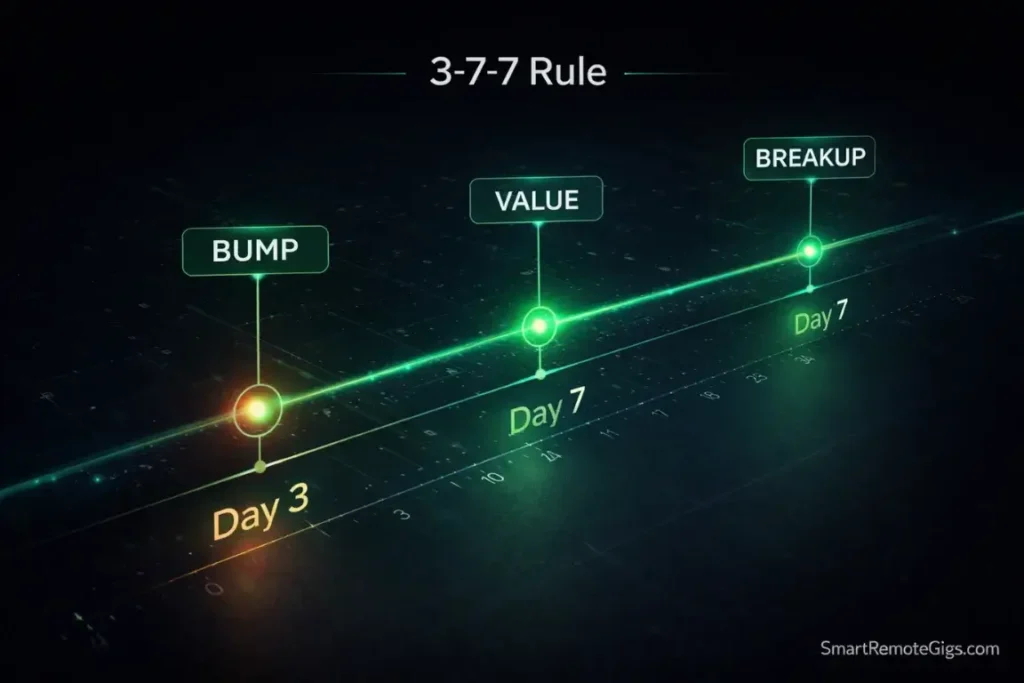
The 3-7-7 Cadence (The Golden Ratio)
This is the timing that maximizes replies without triggering “spam” feelings.
Email 1: Day 0 – The Pitch
Your initial outreach. Personalized, value-focused, clear CTA.
Example:
Subject: Question about Acme’s Instagram
Body:
Hi Sarah,
Noticed Acme’s Instagram has 15K followers but recent posts are getting <100 likes. For a brand your size with this much quality content, that’s a solvable problem.
I specialize in helping DTC brands fix engagement issues through short-form video strategy. Recently helped a similar brand increase engagement from 0.8% to 4.2% in 60 days.
Would you be open to a quick call this week to discuss what might work for Acme?
Here’s my calendar: [link]
Best,
Marcus
[Portfolio link]
Send time: Tuesday-Thursday, 9-11 AM in their timezone
Email 2: Day 3 – The Bump
The “just in case it got buried” follow-up. Short, non-pushy, assumes technical error not rejection.
Example:
Subject: Re: Question about Acme’s Instagram
Body:
Hi Sarah,
Just bumping this to the top of your inbox in case it got buried—I know how chaotic inboxes get.
Still happy to share those engagement ideas for Acme if you’re interested.
Best,
Marcus
Length: 2-3 sentences max
Send time: Same time of day as Email 1 (3 days later)
Why Day 3:
- Too soon (Day 1-2) = desperate
- Too late (Day 5+) = they’ve completely forgotten the context
- Day 3 = “gentle reminder” sweet spot
Email 3: Day 10 – The Value Add
This is where most conversions happen. You’re adding new information that reignites interest.
Example:
Subject: Re: Question about Acme’s Instagram
Body:
Hi Sarah,
Haven’t heard back so I’m assuming this isn’t a priority right now—no worries!
Before I close the loop, I recorded a quick 2-minute Loom video walking through 3 specific content ideas I think would boost Acme’s engagement: [Loom link]
No strings attached—just wanted to share since I was thinking about your brand this week.
If you ever want to chat about strategy, I’m around.
Best,
Marcus
Why this works:
- Acknowledges the silence without being passive-aggressive
- Delivers massive value (you recorded a video specifically for them)
- Removes pressure (“no strings attached”)
- Reopens the door (“if you ever want to chat”)
The Loom video content:
- 0:00-0:20: “Hi Sarah, I created this quick audit for Acme…”
- 0:20-1:30: Show 3 specific content ideas with examples
- 1:30-2:00: “Hope this is useful. My email is below if you want to discuss.”
Why Day 10 (not Day 7):
Gives them a full week to respond to Email 2. The gap between Email 2 and Email 3 should be longer than Email 1 to Email 2. Pattern: 3 days, then 7 days, then 7 days.
Email 4: Day 17 – The Breakup
The “I’m walking away” email. Creates scarcity and urgency through loss aversion.
Example:
Subject: Re: Question about Acme’s Instagram
Body:
Hi Sarah,
I’ll stop bothering you after this! 😊
Just wanted to check one last time if you’d be interested in chatting about engagement strategy for Acme. If not, totally understand—I’ll close the loop and take you off my follow-up list.
Either way, wishing you success with the brand!
Best,
Marcus
P.S. If timing is just off right now, feel free to reach out down the road. Always happy to chat.
Why this works:
- Loss aversion: “Last chance” triggers urgency
- Permission to decline: Reduces pressure paradoxically increases response rate
- Friendly tone: Emoji and casual language feel human
- Exit offer: P.S. gives them guilt-free way to re-engage later
The data: Breakup emails get 15-25% reply rates—often higher than any previous email—because they force a decision.
Why Day 17:
One week after Email 3. This is your final attempt before moving on. Total campaign: 17 days, 4 emails.
Track this exact timeline easily using the automated tools in 7 Best Cold Email Tools for Freelancers—platforms like Instantly and Lemlist handle the scheduling automatically.
The “Omni-Channel” Nudge (Advanced)
Email isn’t the only touchpoint. Smart freelancers use LinkedIn to stay visible without flooding inboxes.
The strategy:
Day 0: Send Email 1
Day 1: View their LinkedIn profile (they get a notification you viewed)
Day 3: Send Email 2
Day 6: Like or comment on one of their recent LinkedIn posts
Day 10: Send Email 3
Day 13: View their LinkedIn profile again
Day 17: Send Email 4
Why this works:
You’re creating multiple micro-touches that keep you top-of-mind without sending 8 emails. Each LinkedIn interaction puts your face in front of them without being intrusive.
The psychology:
When they finally open your email on Day 17, they think: “Marcus… why does that name sound familiar? Oh right, I’ve been seeing him on LinkedIn.”
Recognition breeds trust. Even passive exposure (profile views, post likes) makes you less of a stranger.
The execution:
LinkedIn profile views:
- Don’t hide your identity (let them see you viewed)
- Don’t view their profile 10 times (stalker vibes)
- View once after Email 1, once before Email 4
LinkedIn post engagement:
- Find a recent post (within last 5 days)
- Leave a thoughtful comment (not “Great post!”)
- Reference something specific they said
- Don’t mention your services—pure engagement
Example LinkedIn comment:
Their post: “Just closed our Series A! Excited for this next chapter.”
Your comment: “Congrats Sarah! Series A is a huge milestone. The Harvard Business Review stat about 60% of Series A companies underfunding brand during hypergrowth feels especially relevant now. Excited to see where you take CloudMetrics.”
What you’ve done:
- Celebrated their win (likable)
- Added value (HBR stat)
- Shown industry knowledge
- Stayed relevant to your pitch (brand/marketing)
- Didn’t pitch (maintained social norms)
Pitching for social media work? Engage authentically with their brand’s content before following up—see exactly how in Land a Remote Social Media Job in 4 Weeks.
When to Stop (The Hard Line)
The rule: After 4 emails over 17 days, stop.
Why:
4 emails = professional persistence
5+ emails = annoying
8+ emails = harassment
Warning: Sending 8 emails isn’t persistence. It’s harassment. You’re not “staying top of mind”—you’re training them to delete your emails on sight.
The stopping checklist:
After Email 4 (Day 17), ask:
✅ Did they open any of my emails? (Check with Streak/Instantly)
✅ Did they engage on LinkedIn?
✅ Did they visit my website/portfolio?
If all three are “no”:
They’re not interested. Move on. Add them to a 90-day “check back” list if you want, but stop active outreach.
If any are “yes” but still no reply:
They’re aware of you but timing is off. Send one final email on Day 90 with fresh context:
Subject: Checking back in, Sarah
Body:
Hi Sarah,
It’s been about 3 months since I last reached out about Acme’s Instagram strategy.
Figured I’d check back in case timing is different now.
[New relevant observation about their company or industry]
If you’re still not ready, no problem—just wanted to surface once more.
Best,
Marcus
If they reply at any point:
Great! Respond within 2 hours, move to a call, close the deal. The follow-up worked.
If they reply with “not interested”:
Perfect. Thank them for the clarity, offer to stay in touch, and remove from list. Clarity is a gift.
If they ghost after Email 4:
Archive the thread. They’re a “no” until proven otherwise. Focus on new prospects.
What about calling them?
Short answer: Only if you’re in a call-heavy industry (recruiting, high-ticket B2B sales).
For freelancers: Email and LinkedIn usually work better. Cold calls feel more intrusive than cold emails. Exception: if you’ve emailed 4 times, they’ve opened multiple times but not replied, a call can break the stalemate.
The call script:
“Hi Sarah, this is Marcus—I’ve emailed a few times about social strategy for Acme. I know you’re probably slammed, so I thought I’d just call quickly rather than fill up your inbox. Is now a terrible time, or do you have 2 minutes?”
50/50 whether they’ll appreciate the directness or find it annoying. Read the room based on industry and seniority.
Frequently Asked Questions
How many times should I follow up?
4 emails over 17 days. Day 0 (pitch), Day 3 (bump), Day 10 (value), Day 17 (breakup). After that, stop active outreach unless they engage. You can add them to a 90-day “nurture” list for one final check-in, but the aggressive sequence ends at 4 emails. More than 4 in 2-3 weeks = harassment.
What time of day is best for follow-ups?
Send at the same time as your original email (ideally 9-11 AM in their timezone). Why? Pattern recognition. If they remember seeing something from you “around 10 AM Tuesday,” sending at the same time helps with recall.
Avoid early mornings (buried under overnight emails), lunch hours (away from desk), and late afternoons (checking out mentally). Tuesday-Thursday mornings are the sweet spot.
Should I call them after emailing?
Only in specific situations: (1) You’re in a call-heavy industry (recruiting, enterprise sales), (2) They’ve opened your emails 3+ times but not replied (signals interest but indecision), (3) It’s a very high-value prospect worth the risk. For most freelancers, stick to email + LinkedIn.
Cold calls feel more intrusive and have lower success rates unless you’re in a sales culture. If you do call, acknowledge the emails first: “I’ve sent a few emails but figured a quick call might be easier…”
Conclusion: Persistence Pays Rent
The money isn’t in the first email. It’s in the follow-up.
The math that changed my business:
Old approach:
- Send 50 perfect cold emails
- Get 5-8 replies (10-16% reply rate)
- Close 1-2 clients
- Wonder why it’s not working faster
New approach:
- Send 50 perfect cold emails
- Follow up 4x on each using 3-7-7 cadence
- Get 18-25 replies (36-50% reply rate)
- Close 4-6 clients
- Make 3x more money from same initial effort
The difference: 200% increase in replies and revenue from the same 50 prospects—just by following up systematically.
Most freelancers are sitting on thousands of dollars in potential revenue that died in their “Sent” folder because they were too afraid to follow up.
The truth:
Your prospects aren’t annoyed by your follow-ups. They don’t even remember your first email. They’re busy, distracted, and overwhelmed. Your job is to resurface at the right moment with the right value.
Persistence isn’t annoying when it’s helpful. Persistence is only annoying when you’re just saying “pay attention to me” with no value.
Every follow-up should make them think: “Oh, this person is still thinking about my problem and offering solutions. That’s actually helpful.”
Go to your “Sent” folder right now. Find 3 people who didn’t reply to your cold email in the last 7-14 days. Open this guide. Send Email #2 or Email #3 using the exact scripts above.
Do it before you close this tab.
One of those three will reply. That reply will turn into a call. That call will turn into a client. That client will pay for 6 months of groceries.
Persistence pays rent. Follow up.

![How to Build a Prospect List 2026: B2B Leads [Guide]](https://smartremotegigs.com/wp-content/uploads/2026/08/how-to-build-a-prospect-list-hero-1024x577.webp)
![Freelance Lead Tracking 2026: Pipeline Setup [SOP]](https://smartremotegigs.com/wp-content/uploads/2026/09/freelance-lead-tracking-hero1-1024x577.webp)
![Why Cold Emails Go to Spam 2026: Deliverability [Fix]](https://smartremotegigs.com/wp-content/uploads/2026/09/why-cold-emails-go-to-spam-hero1-1024x577.webp)