Common Proposal Mistakes 2026: Stop AI Spam (Fixed)
 ·
Last Updated: Mar 26, 2026
·
Last Updated: Mar 26, 2026
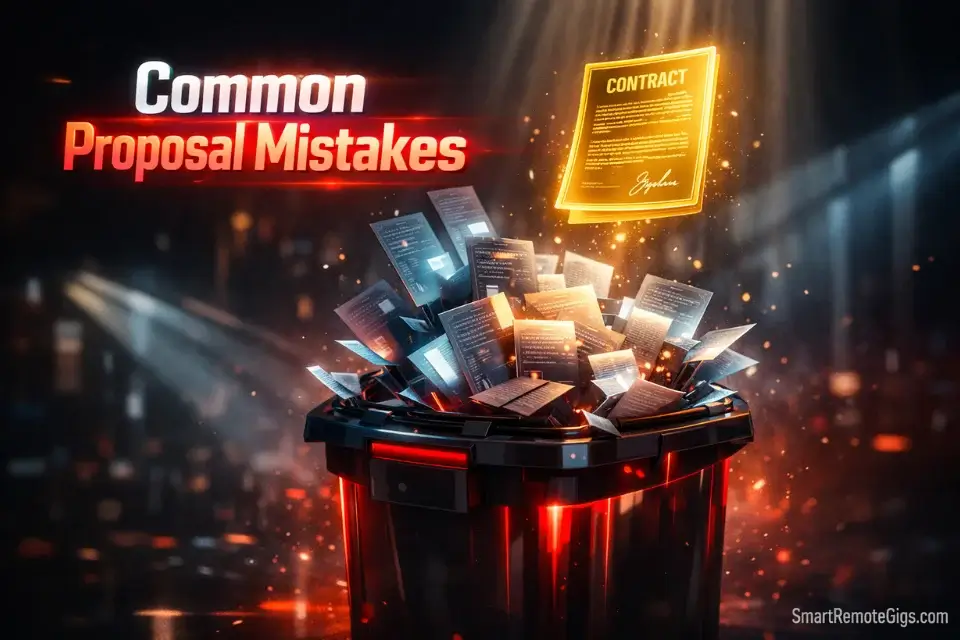
If you are sending dozens of pitches a week and hearing absolute silence, you are not alone. You are likely making the same common proposal mistakes that 90% of freelancers make. In 2026, clients can spot an AI-generated template from a mile away — meaning volume-based pitching is completely dead.
When we built Smart Remote Gigs, we wanted to know exactly why highly skilled talent was being ignored. So, we audited over 200 rejected freelance proposals from our community to find the exact patterns and phrases that get pitches instantly archived by high-paying clients. Here are the 7 mistakes destroying your conversion rate, and the exact fixes for each.
The 2026 Proposal Red Flags
|
The Fatal Flaw |
Mass-applying to jobs using unchanged, AI-generated text |
|
The “Me, Me, Me” Trap |
Spending 80% of the proposal talking about your background instead of the client’s problem |
|
The Formatting Crime |
Sending a wall of unbroken text that clients bounce off in under 3 seconds |
|
The Takeaway |
If you do not prove you are a human who read their brief within the first 3 sentences, you lose the job |
The “AI Fatigue” Epidemic: Why Clients Delete Unread
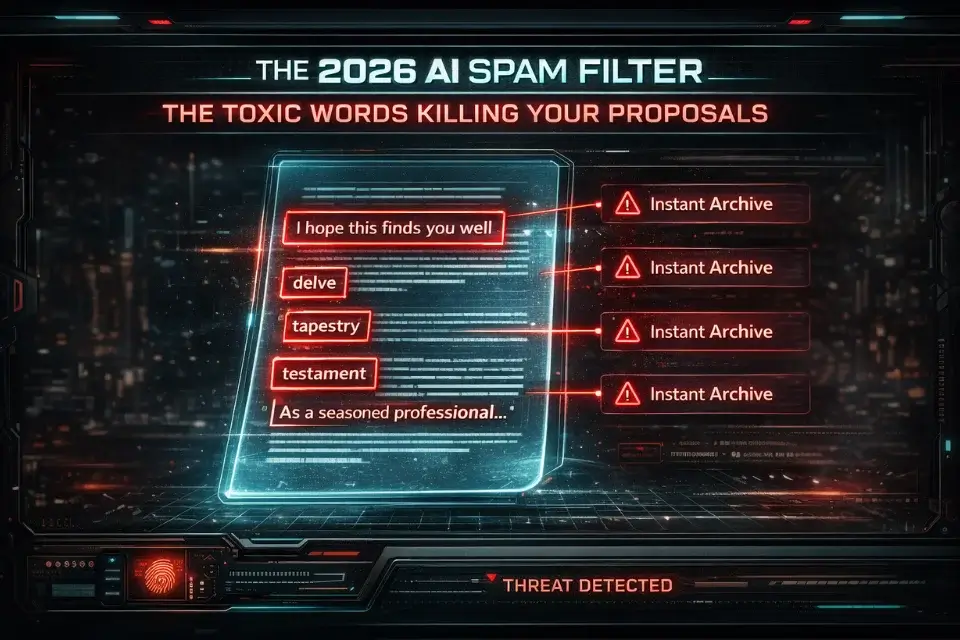
The volume of AI-generated proposals on every major freelance platform has reached a breaking point. Clients posting on Upwork, Toptal, or LinkedIn are no longer wading through pitches — they are pattern-matching for reasons to delete.
Warning: Clients in 2026 have developed a sixth sense for ChatGPT output. Phrases like “I hope this finds you well,” “I would love to bring my passion to this role,” “delve,” “tapestry,” or “I am confident I can deliver exceptional results” are now immediate grounds for rejection. These words and phrases appear in AI-generated proposals at such a high rate that they have become automatic red flags — regardless of how strong the rest of your pitch is.
The average high-paying client on a platform like Upwork receives 40–80 proposals within the first 24 hours of posting. Research from Upwork’s own freelancer resources confirms that clients make their shortlist decisions in the preview pane — often without clicking through to read the full text.
You have two sentences to prove you are human. Most freelancers waste both.
7 Common Proposal Mistakes That Are Costing You Clients
Mistake #1: The Copy-Paste ChatGPT Template
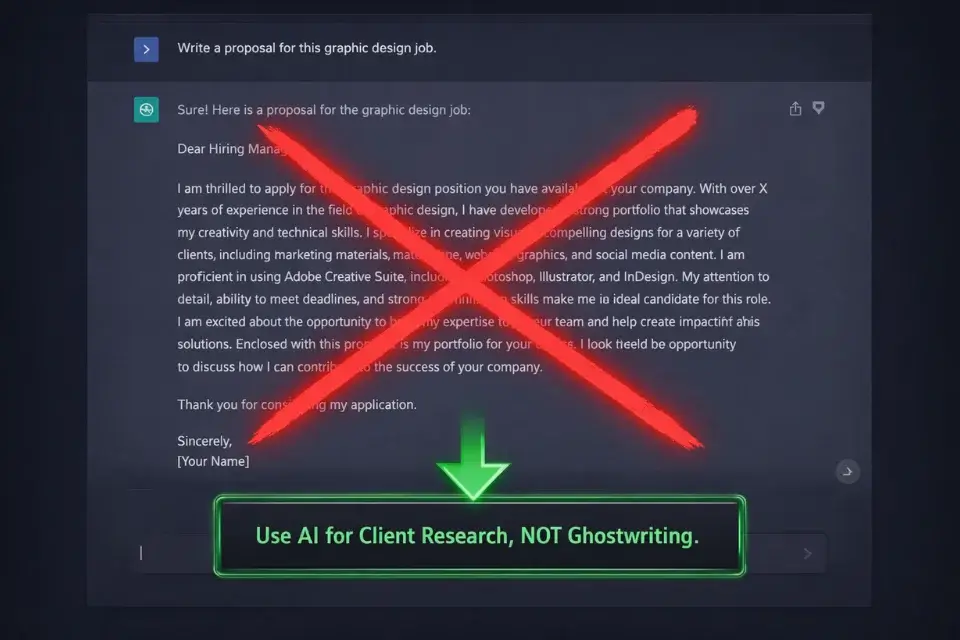
This is the single most common reason proposals get archived unread. Freelancers paste their job description into ChatGPT, ask it to “write a compelling proposal,” and send the output verbatim. The result is a pitch that is grammatically perfect and completely invisible.
The problem is not using AI. The problem is letting AI write your introduction.
ChatGPT defaults to formal, generically enthusiastic language that applies to any job, for any client, in any industry. It cannot reference the specific detail in the job post that caught your attention. It cannot replicate the exact phrase the client used that signalled their real frustration. It does not know what distinguishes this job from the 30 others you applied to this week.
The Fix: Use AI strictly as a research tool. Feed it the job description and ask it to identify the client’s core pain points, hidden anxieties, and the outcome they actually care about. Then close the tab and write the proposal yourself — using those insights to make every sentence specific.
ChatGPT’s free tier will occasionally surface generic or surface-level insights when given a vague prompt — always push back with follow-up questions and verify its output against what you actually read in the job post. It is a research accelerator, not a ghostwriter.

ChatGPT
Best for: Freelancers who want to extract client intelligence and pain-point analysis from a job description before writing a single word of their own pitch.
Mistake #2: The “Self-Centered” Introduction
Read your last three proposals back to yourself. Count how many sentences start with “I.”
If the answer is more than two in the first paragraph, you are falling into the self-centered trap. Your background, your years of experience, your passion for the craft — none of it matters to a client who does not yet believe you understand their problem.
The Fix: Flip the ratio entirely. The first 80% of your proposal should be about their business problem, their specific challenge, and the outcome they are trying to reach. The final 20% is where you briefly establish why you are the right person to deliver it.
A client reading your proposal should think: “This person gets exactly what I am dealing with” before they think “This person is impressive.” The first feeling earns the interview. The second feeling closes the contract — but only if the first one happens.
Mistake #3: Text-Wall Formatting (Zero Whitespace)
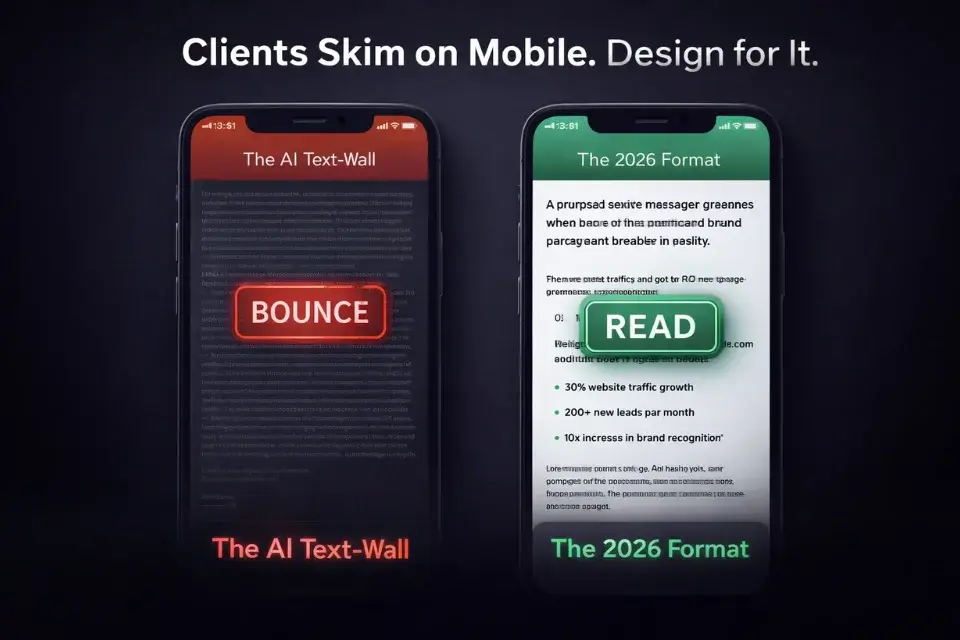
Clients are reviewing proposals on mobile, between meetings, often while managing multiple open jobs simultaneously. A dense, unbroken block of text signals three things immediately: this was written for a computer, not a human; this freelancer does not think about user experience; and this will take effort to read.
None of those signals help you win the job.
The Fix: Write in short paragraphs — two to three lines maximum. Use line breaks between every distinct thought. If you are referencing a list of deliverables or phases, break them out visually rather than burying them in a sentence.
White space is not padding — it is a design decision that signals clarity and professionalism. The clients paying the highest rates are often the most time-poor. Respecting their attention in the format of your pitch proves you will respect it in the engagement itself.
See the perfect visual format applied to design-specific proposals in our proven proposal templates for graphic designers.
Mistake #4: The Pricing “Guessing Game”
Clients who receive a proposal with vague, ambiguous pricing — “rates vary depending on scope” or “happy to discuss budget on a call” — experience a specific type of anxiety. They do not know if you are affordable, if you are in the same ballpark as their budget, or whether the conversation will be a waste of time.
That anxiety does not lead to a reply. It leads to moving on to the next proposal where the pricing is clear.
The Fix: State your rate or range directly in the proposal. If the scope is genuinely variable, give a realistic starting point. Clients are not shocked by high rates — they are shocked by surprises late in the conversation. Transparency on pricing is a trust signal, not a risk.
Never apologise for your rate. State it, frame it against the outcome it delivers, and move on. If a client cannot afford you, finding out in the proposal saves everyone time. If they can, your confidence in your pricing reassures them they are not dealing with someone who will negotiate themselves into a corner mid-project.
Learn how to correctly price your scope before you send the proposal in our core guide on how to set freelance rates.
Mistake #5: Sending Generic Portfolio Links
“Please see my full portfolio at [homepage link]” is the portfolio equivalent of handing someone a library card and asking them to find a specific book themselves.
High-paying clients do not have time to browse. They want to see evidence that you have solved their specific type of problem before — and they want to see it immediately, without effort.
The Fix: Never link to your homepage or a general portfolio page in the initial proposal. Instead, curate two to three hyper-relevant case studies and reference them directly in the body of the proposal itself.
Each case study needs three beats: the client’s situation, what you did, and the measurable result. Link to the full write-up only if it adds depth — the summary in the proposal should stand on its own.
“I redesigned the checkout flow for a DTC skincare brand last quarter. Add-to-cart rate increased 31% within 60 days of launch.” That is 24 words. It is worth more than a link to 30 uncontextualised portfolio pieces.
Mistake #6: Ignoring the Core Business Objective (ROI)
Clients do not post jobs because they want deliverables. They post jobs because they have a business problem that a deliverable might solve.
Nobody wakes up wanting “a new website.” They want more bookings, more leads, or less time spent explaining their business to every new prospect. Nobody wants “a new logo.” They want to stop losing deals to competitors who look more established.
When your proposal focuses on what you will produce instead of what the client will gain, you are speaking a different language from the one they are listening in.
Pro Tip: Before writing a single line of your proposal, ask yourself: “What business metric does this client care about most?” Is it revenue, lead volume, conversion rate, cost savings, or time efficiency? Build your entire pitch around that metric — use it in the hook, reference it in your case study, and tie your pricing directly to the ROI it produces. Clients who see their own goals reflected in your proposal do not shop around.
The Fix: Map every deliverable to a business outcome. Instead of “I will build you a 5-page website,” write: “I will build a site architecture designed specifically to convert first-time visitors into booked consultations — the same structure I used for a law firm last year that increased their inquiry rate by 44%.”
Same deliverable. Completely different conversation.
Mistake #7: Sloppy Typos and Broken Links
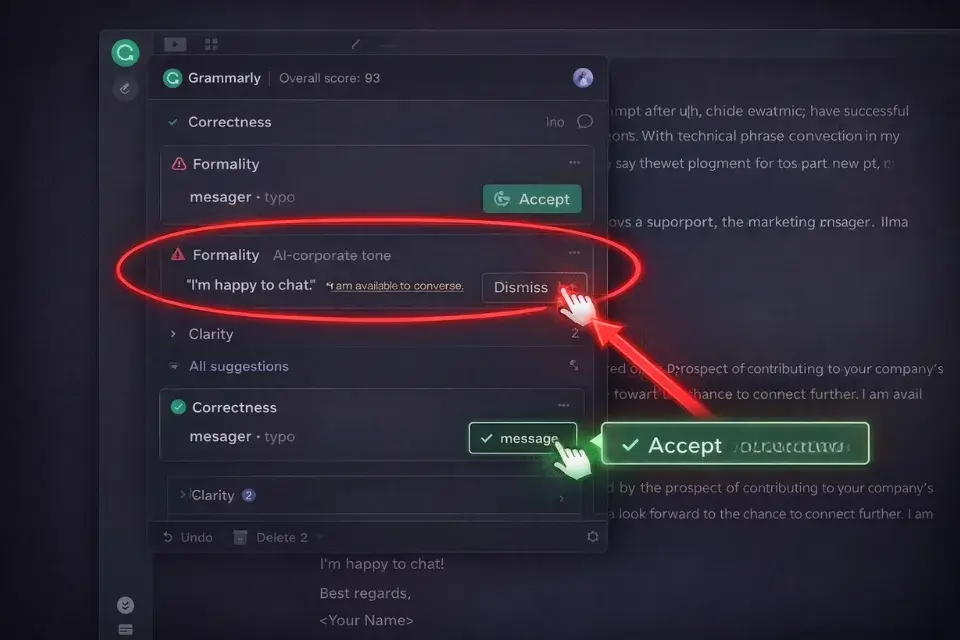
Nothing destroys the credibility of a proposal faster than claiming “meticulous attention to detail” in a sentence with a typo in it. And yet — in our audit of 200+ rejected proposals — broken or dead portfolio links appeared in over a third of them.
Clients click those links. When they hit a 404 or a page that has not been updated since 2022, the proposal is over.
The Fix: Before sending any proposal, run it through a grammar tool and manually click every single link. Not once — every time. Portfolio pages move. Case study URLs change. That link you included six months ago may be dead today.
On the grammar tool question: use one, but do not surrender your voice to it. The goal is to catch embarrassing errors, not to homogenise your writing into corporate formality. If the tool suggests replacing a natural phrase with something that sounds like a press release, ignore it.
Grammarly’s tone and formality suggestions have a tendency to flatten casual, confident language into something that reads like a boilerplate corporate email — turn those features off and use it exclusively for spelling, punctuation, and grammar flags. For catching the kind of embarrassing errors that quietly kill proposals, it remains the fastest option available.
Grammarly
Best for: Freelancers who want a reliable last-pass safety net for typos and grammar errors before a proposal goes out, without losing the natural voice that makes the pitch feel human.
The “Anti-Spam” Fix: Rebuilding Your Pitch
Here is every mistake mapped against its fix in a single reference:
|
Element |
❌ The Mistake-Ridden AI Pitch |
✅ The Human-Optimized Pitch |
|---|---|---|
|
Opening Line |
“I hope this message finds you well. I am very excited to apply for this opportunity.” |
Directly references a specific detail, frustration, or goal from the job post |
|
Focus Ratio |
80% about the freelancer’s background and skills |
80% about the client’s problem and desired outcome |
|
Formatting |
Dense paragraph blocks, no white space, reads like a cover letter |
Short paragraphs, clear visual breathing room, mobile-readable |
|
Pricing |
“Rates are flexible depending on the scope — happy to discuss.” |
Clear starting rate or range stated directly, tied to the outcome it produces |
|
Portfolio |
“Please visit my portfolio at [homepage link] to view my work.” |
2–3 curated case studies embedded directly in the proposal with measurable results |
|
Value Framing |
“I will deliver a 5-page website with responsive design and SEO optimization.” |
“I will build a site structured to convert first-time visitors into booked calls — the same approach that increased inquiry rate 44% for a previous client.” |
|
QA |
Sent immediately after writing, links unchecked, no grammar pass |
Grammar-checked, every link clicked manually, re-read aloud before sending |
|
CTA |
“Please let me know if you have any questions. Looking forward to hearing from you.” |
“Open to a 15-minute call this week to see if there’s a fit? No deck, no pitch — just a conversation.” |
Ready to rebuild your pitch from the ground up using a proven framework? Start with our master guide on writing a winning freelance proposal.
Frequently Asked Questions
Why do clients ignore my freelance proposals?
The most common reason in 2026 is a complete lack of personalisation. When a proposal could have been sent to any of the 200 other jobs posted that day — and the client can sense that — there is no reason for them to respond.
Personalisation is not mentioning the client’s name. It is referencing the specific detail in their job post that tells them you actually read it. It is naming the business outcome they are trying to reach, not the deliverable they asked for. It is proving within the first three sentences that this pitch was written for them specifically, and no one else.
If your proposals are being ignored, audit the last five you sent. Ask honestly: could this exact text have been sent to a completely different job? If the answer is yes, you have found your problem.
How do I know if my proposal sounds like AI?
Run this test: read the opening paragraph aloud. If it sounds like something you would never actually say in a conversation — overly formal, enthusiastic in a generic way, full of words like “leverage,” “synergies,” “delve,” or “I am passionate about delivering exceptional results” — it sounds like AI.
A human-sounding proposal is specific, slightly imperfect in its phrasing, and references something concrete about the client’s situation. It uses the vocabulary of someone who works in the industry, not the vocabulary of someone trying to impress a hiring manager at a Fortune 500 company.
If you are unsure, paste it into GPTZero or Originality.ai — the same tools clients are increasingly using to filter submissions. If it flags as AI-generated, rewrite the opening from scratch in your own voice before sending.
Should I follow up if my proposal is ignored?
Yes — once, and with genuine value attached.
Most high-paying clients are not ignoring you because they are uninterested. They are overwhelmed, distracted, or managing five other open jobs simultaneously. A well-timed follow-up that adds something new — a relevant observation, a quick question about the project, or a brief update on your availability — can resurrect a pitch that got buried.
Wait 4–5 business days after the initial proposal. Keep the follow-up to three sentences maximum. Do not ask “just checking in” — that adds zero value and signals neediness. Ask a specific, intelligent question about the project that proves you are still thinking about their problem.
One follow-up is professional. Two or more without a response crosses into territory that damages your reputation on platforms where clients can leave feedback.
The Complete 2026 Blueprint: How to Write a Winning Proposal
Verdict: Stopping the spam stops the bleeding. The freelancers consistently winning high-ticket contracts in 2026 are not the ones sending 50 proposals a week — they are sending 5, each of which took 20 minutes of real research and was written specifically for that client and no one else.
Shift from volume to precision, and your win rate will not just improve — it will compound. At Smart Remote Gigs, we believe your skills shouldn’t be hidden behind a bad pitch. Fix these errors, reclaim your human voice, and start landing the clients you actually deserve.
Now that you have fixed your initial pitch, what happens when the client gets busy and forgets to reply? Master the art of the bump with our final guide on effective freelance proposal follow-up strategies.
![How to Find Client Email Addresses: B2B Method [Guide]](https://smartremotegigs.com/wp-content/uploads/2026/10/how-to-find-client-email-addresses-hero-1024x577.webp)