
7 Remote Jobs No Degree Required 2026: The Real Hiring Data
 ·
Last Updated: September 13, 2026 ·
13 min read
·
Last Updated: September 13, 2026 ·
13 min read 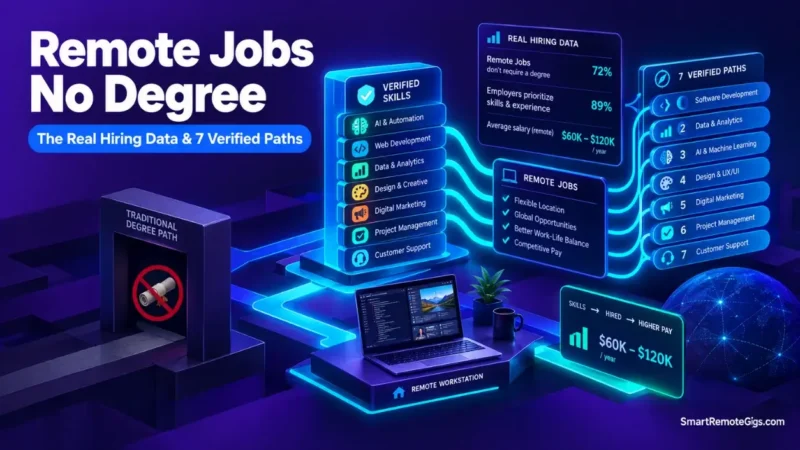
We assumed dropping the “Bachelor’s Degree Required” line from a job posting meant companies were actually hiring more people without degrees — until Harvard Business School and Burning Glass Institute research made clear that policy and practice are two very different things. If you’re searching for remote jobs no degree listings can actually get you hired for, the honest answer starts with the data below, not the job-posting language.
Pairing a free or low-cost industry certification with a real portfolio piece closes that gap far more reliably than a rewritten job posting does — it’s the one lever that consistently shows up across the seven careers that don’t need degrees covered below.
Smart Remote Gigs (SRG) builds this guide by cross-referencing job-posting data, employer certification programs, and independently reported hiring-outcome research — not by repeating the “no-degree” narrative that most listicles pass along uncritically.
SRG verifies certification pricing and hiring statistics against primary sources at time of publication, not marketing copy from the certification providers themselves.
SRG Quick Summary
One-Line Answer: Getting hired for a remote job without a degree in 2026 means picking one of a handful of skills-first career paths, earning the specific entry certification that substitutes for a degree in that field, building one portfolio piece that proves you can do the work, and restructuring your resume to lead with credentials — while treating “degree not required” postings as an opening, not a guarantee, since real hiring has moved far slower than job-posting language suggests.
🚀 Quick Wins:
- Today (20 Mins): Pick one of the 7 role paths below and start its free (or near-free) entry certification — HubSpot Sales/CRM, uTest Academy, or Google’s Digital Marketing/PM cert.
- This Week: Restructure your resume so a “Certifications & Relevant Training” section sits above your work history, in the spot “Education” usually occupies.
- This Month: Build one portfolio piece that demonstrates the core skill for your chosen role, then apply to five postings — including ones that still list “degree preferred.”
📊 The Details & Hidden Realities:
- Companies that publicly dropped degree requirements saw actual non-degree hiring rise by well under one percentage point in most studies — the job posting changed faster than the hiring did.
- Certification pricing shifts without warning: Google Career Certificates rose from $39/mo to $49/mo in 2024, and CompTIA A+ now runs $506–$548 total for both required exams, higher than the ~$500 figure still circulating in older guides.
🎯 The Skills-First Career Map: 7 Remote Jobs No Degree Required
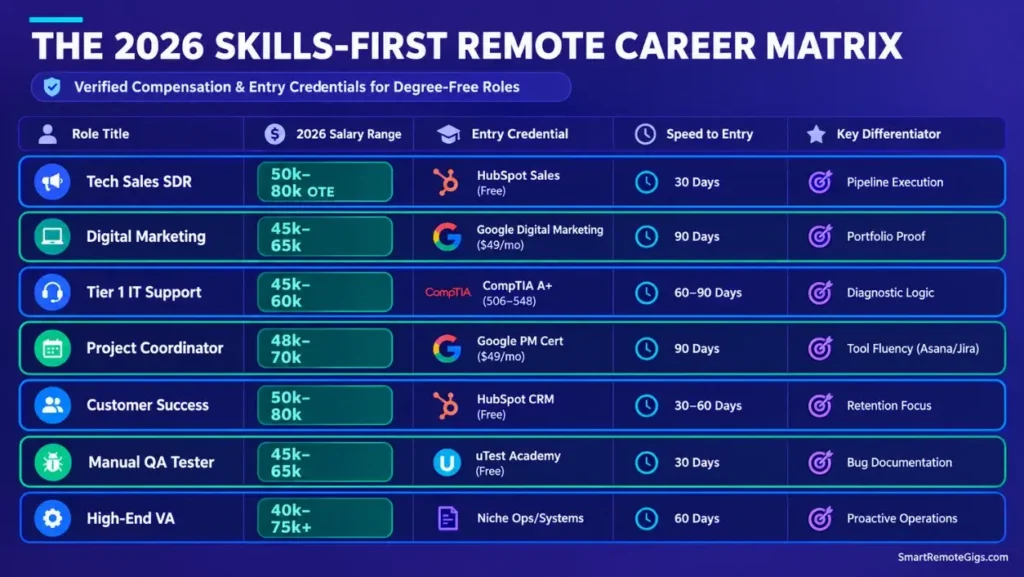
| 💰 Best Pay | Sales Development Rep — $50k–$80k OTE, commission-driven ceiling |
| 🚀 Fastest Entry | Customer Success Rep — $50k–$80k, hired on empathy and tool fluency |
| 📈 Best Career Path | Project Coordinator — Google PM Cert gets you in; results get you to $90k+ |
| 💻 Tech Entry | Manual QA Tester — $45k–$65k, no coding required at entry level |
| 🎨 Creative | Digital Marketing Specialist — $45k–$65k, Google cert + portfolio gets you in |
[Evidence Source: role/salary ranges reflect commonly reported job-board ranges (Indeed, Glassdoor, LinkedIn) as of 2026 — not a single benchmarked study] [Confidence Level: Medium]
The “Paper Ceiling” Is Cracking — Slower Than the Headlines Suggest
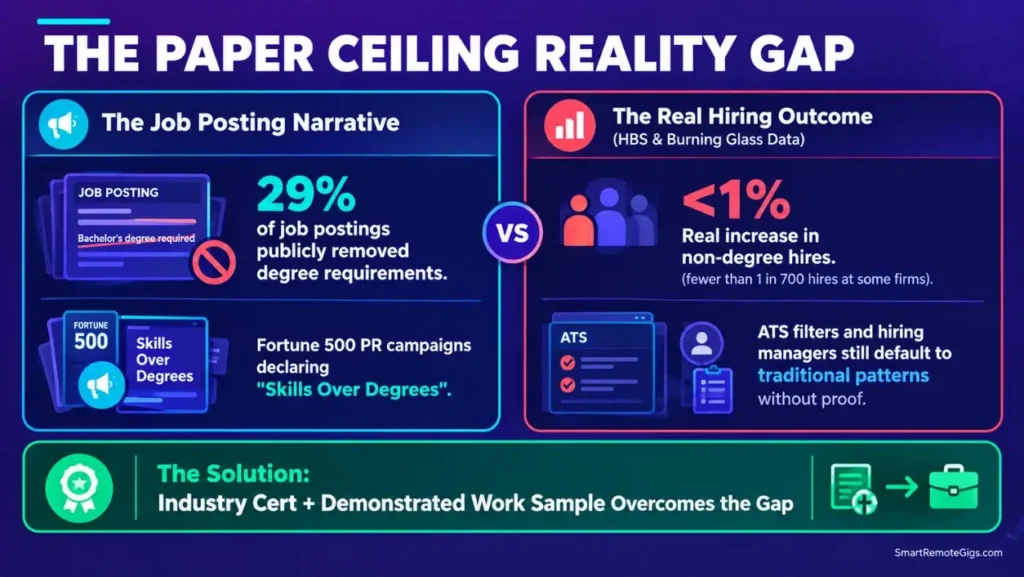
LinkedIn’s own hiring data shows the share of paid job postings that don’t require a professional degree rose from 21% in 2019 to 29% in 2022. [Evidence Source: LinkedIn Talent Blog, “More Jobs Don’t Require College Degrees” / HR Dive coverage, 2022–2023] [Confidence Level: High]
In 2022, companies including Google, IBM, and Accenture publicly dropped degree requirements from large portions of their job postings — a clear signal that more jobs don’t need degree credentials than hiring templates suggest — with IBM alone reporting roughly half of its U.S. roles no longer required a four-year degree, a shift researchers linked to a tight labor market and disappointing performance from degree-filtered hires.
[Evidence Source: Harvard Business Review / Burning Glass Institute job-posting analysis, 2017–2020; CNBC, April 2022] [Confidence Level: High]
Here’s the part most “no-degree” articles skip: dropping the requirement from a job posting and actually hiring more people without degrees are two different things. A Harvard Business School / Burning Glass Institute study — and separate 2025 research from TestGorilla — found that at companies that publicly removed degree requirements, the real increase in non-degree hires was well under one percentage point in most cases. Some sources describe it as fewer than 1 in 700 new hires.
[Evidence Source: Harvard Business School / Burning Glass Institute research, as reported 2024–2026; TestGorilla State of Skills-Based Hiring 2025] [Confidence Level: Medium — multiple independent sources converge on the same directional finding, exact figures vary slightly by source]
That doesn’t mean the seven paths below are a mirage. It means the honest framing is: the door has opened wider, especially at startups, scale-ups, and remote-first companies — but you’re still the exception in most applicant pools, and a certification plus a real work sample does more to close that gap than a rewritten job posting ever will.
#1 — Sales Development Representative (Tech Sales)
💰 Salary Potential: $50k–$80k OTE (On-Target Earnings) [Confidence Level: Medium — job-board range, not a single wage study]
Sales is one of the more meritocratic functions in most companies. Pipeline numbers are visible; degrees aren’t part of the quota conversation. Tech sales specifically — SaaS, cybersecurity, cloud — requires you to understand a product well enough to have a credible conversation with a buyer, not to have built it yourself.
What the role actually involves:
- Prospecting through cold email, LinkedIn outreach, and inbound lead follow-up
- Qualifying leads using BANT or MEDDIC frameworks
- Booking demo calls for Account Executives who handle closing
- Logging every interaction in Salesforce or HubSpot to maintain pipeline accuracy
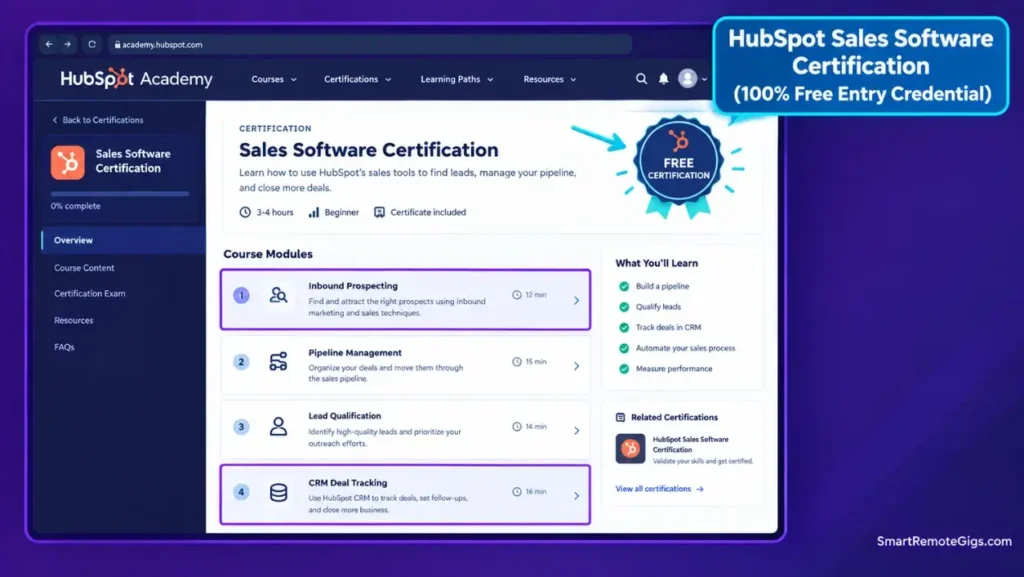
The entry credential: HubSpot Sales Software Certification — free, self-paced, covers CRM pipeline management and outreach fundamentals. Pair it with a Salesforce Trailhead Associate path (also free).
The honest challenge: SDR work carries a high rejection rate — expect “no” on the large majority of cold outreach. The people who last combine resilience with genuine curiosity about the buyer’s problem, not just their own quota. If that’s you, the realistic ceiling from this starting point is $150k–$200k+ within five years as an Account Executive or sales leader.
#2 — Digital Marketing Specialist
💰 Salary Potential: $45k–$65k (in-house); $50–$80/hr (agency/freelance)
Marketing platforms and algorithms shift faster than any curriculum can track. A Digital Marketing Specialist manages the execution layer — paid social, email, landing-page optimization, performance tracking, and channel content.
What the role actually involves:
- Campaign setup in Meta Ads Manager, Google Ads, or LinkedIn Ads
- Email execution in HubSpot, Klaviyo, or Mailchimp
- SEO fundamentals: keyword research, on-page optimization, content briefing
- Analytics: GA4, attribution reporting, A/B test interpretation
- Content production and scheduling across social platforms
The entry credential: Google Digital Marketing & E-commerce Certificate on Coursera — $49/month (Coursera raised this from $39/month in early 2024), typically completed in 3–6 months. Pair it with HubSpot’s free Inbound Marketing certification for a strategy-plus-execution stack.
The portfolio move: Build a mock 30-day campaign for a fictional brand — a brief, three ad variations, an email sequence, and a tracking template. That’s your interview evidence. For the full path, see our guide to free marketing certifications.
#3 — Tier 1 Tech Support (The IT Backdoor)
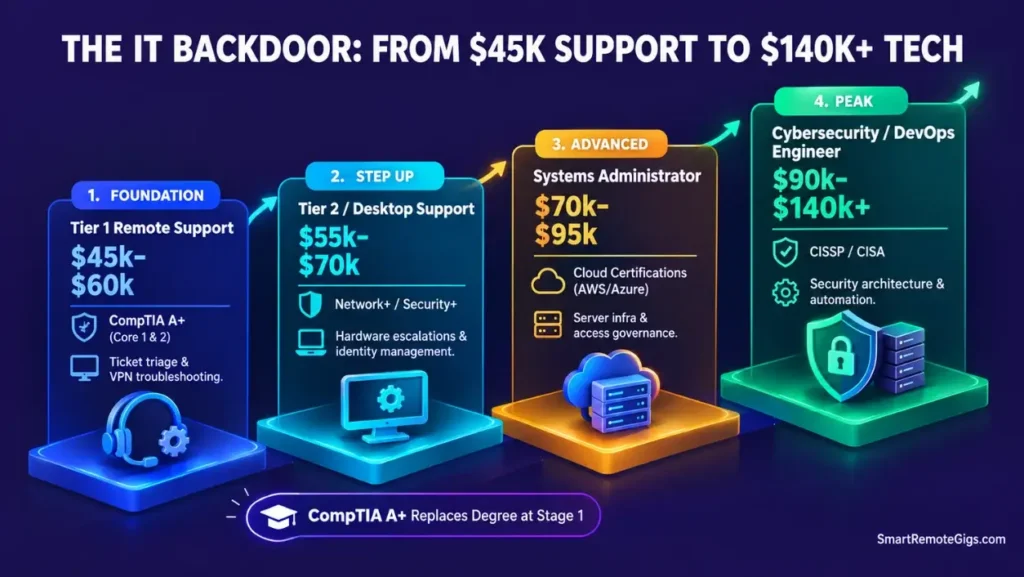
💰 Salary Potential: $45k–$60k (Tier 1); $70k–$100k+ (Tier 2/SysAdmin/Security)
Tier 1 Support doesn’t require coding or a CS degree. It requires patience, systematic troubleshooting, and the ability to explain technical concepts without condescension.
The CompTIA A+ certification is the industry-standard substitute for a degree in this role — vendor-neutral and widely listed as a qualification in Tier 1 postings.
What the role actually involves:
- First-line response to hardware, software, and connectivity issues via ticket, chat, or phone
- Password resets, account unlocks, software installs, VPN troubleshooting
- Documenting interactions for Tier 2 escalation
- Following escalation protocols for complex issues
Career trajectory: Tier 1 ($45k) → Tier 2/Desktop Support ($55k–$70k) → SysAdmin ($70k–$95k) → DevOps or Cybersecurity ($90k–$140k). Many employers fund certification advancement after your probationary period.
The entry credential: CompTIA A+ requires two exams — Core 1 and Core 2 — at roughly $253–$274 each ($506–$548 total) as of 2026, prices CompTIA can adjust without much notice. Professor Messer’s free course is a solid prep path. For the complete 90-day plan, see our guide to getting into IT support without a degree.
#4 — Project Coordinator
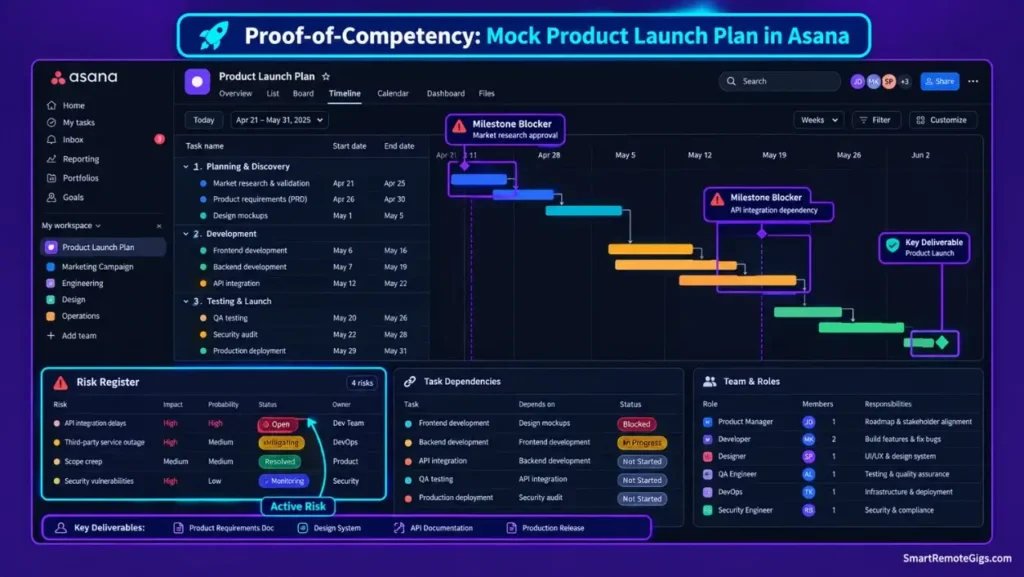
💰 Salary Potential: $48k–$70k; Senior Project Manager: $90k–$130k
Project Coordinators keep distributed work moving — timelines, deliverables, standups, documentation. The core competency is organizational discipline, not technical knowledge, which is exactly why this role rewards process-minded people without a formal PM background.
What the role actually involves:
- Maintaining timelines and milestones in Asana, Jira, or Monday.com
- Running team syncs and documenting decisions, blockers, action items
- Managing stakeholder communication and expectation alignment
- Tracking budget actuals against forecasts for senior reporting
The entry credential: Google Project Management Certificate on Coursera — $49/month, roughly 6 months at 10 hrs/week, covering Agile, Scrum, and stakeholder management.
The portfolio move: Build a documented project plan for a fictional launch — timeline, stakeholder map, risk register, communication schedule.
#5 — Customer Success Manager (CSM)
💰 Salary Potential: $50k–$80k; Senior CSM: $90k–$120k
A CSM makes sure customers who’ve already bought a product actually use it, get value from it, and renew. Hiring managers weight empathy and communication quality heavily — competencies built in any customer-facing role, not a classroom.
What the role actually involves:
- Onboarding new customers and driving initial product adoption
- Running business reviews with account stakeholders
- Identifying at-risk accounts and executing retention playbooks
- Surfacing customer feedback to the product team
The entry path: CSM roles at SaaS companies frequently hire from retail management, hospitality operations, and high-volume customer service — the muscle for managing complex customer relationships under pressure transfers directly.
The credential stack: HubSpot’s free CRM certification, plus a cover letter that explicitly maps your customer-management experience to the retention outcome the role is hired for.
#6 — Manual QA Tester
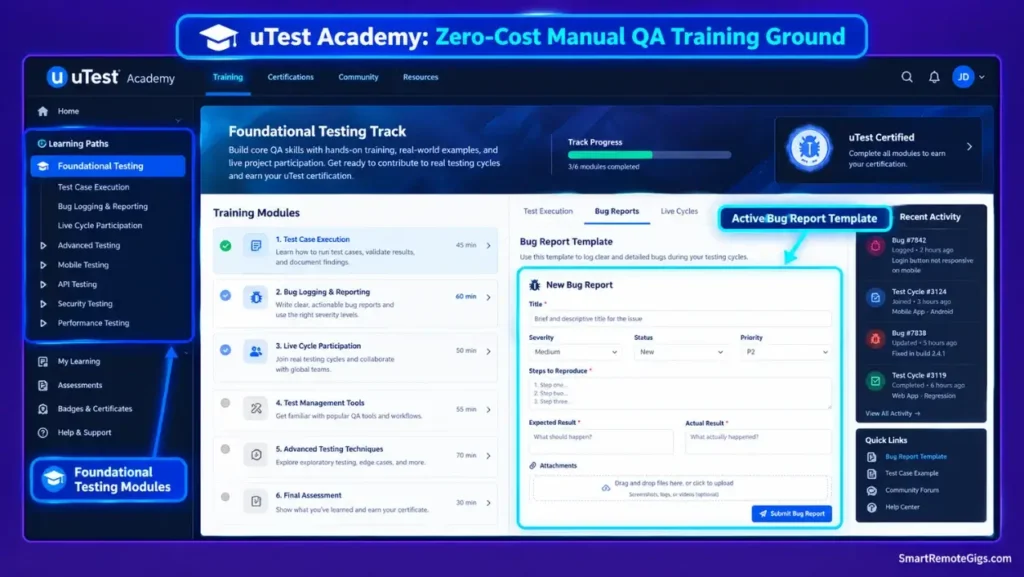
💰 Salary Potential: $45k–$65k; Automation QA: $80k–$110k
QA testing is one of the most accessible tech-adjacent roles for someone with zero coding experience, and one of the clearer paths into software engineering for people who want to get there. The job is fundamentally attention to detail, structured thinking, and clear technical writing.
What the role actually involves:
- Executing test plans against new features and bug fixes
- Writing clear, reproducible bug reports in Jira or similar tools
- Verifying that reported bugs are resolved in new builds
- Participating in sprint planning to understand incoming feature scope
The honest path forward: manual QA is a strong entry point, not a final destination for most people. Automation QA — writing scripts to run tests automatically — requires learning Python or JavaScript basics, roughly a 3–6 month investment that meaningfully raises the salary range.
The entry credential: uTest Academy offers free training for testers entering the freelance QA market — confirmed still active as of 2026. The ISTQB Foundation Level certification is the formal credential recognized by enterprise employers; confirm current pricing directly with ISTQB, as we couldn’t independently verify an exact 2026 figure.
#7 — High-End Virtual Assistant
💰 Salary Potential: $40k–$75k; Specialist VA: $80k–$120k
The VA role has the broadest ceiling variance on this list, and it’s the one most people underestimate. Executive-level VAs at the specialist tier function as de facto Chiefs of Staff — managing operations, vendor relationships, and scheduling for founders and executives who pay for organizational value that’s hard to replace.
The path from generalist VA to specialist VA runs through niche expertise — legal, medical, executive, or startup-ops focused. The entry point is accessible; the ceiling is set by how deep you go in one lane.
What differentiates a high-earning VA:
- Proactive rather than reactive — anticipating needs, not waiting for instructions
- Systems-builder rather than task-completer — repeatable processes, not one-offs
- Technology-fluent — Notion, Asana, HubSpot, Calendly, and whatever the client’s stack requires
- Business-literate — understanding why each task matters to the client’s goals
The full strategic path is covered in our guide to becoming a six-figure VA. If you’re earlier in the search — including roles that don’t require prior experience at all — see our remote jobs with no experience guide and our full list of entry-level remote jobs.
Strategy: How to Bypass the Degree Filter
The degree filter lives in two places: the ATS scanning your resume, and the hiring manager forming an impression in the first six seconds.
On your resume: replace the “Education” section’s placement with a “Certifications & Relevant Training” section, positioned where education usually sits — above your work history, below your summary. The degree line doesn’t disappear; it moves to the bottom, as supporting context rather than the primary qualifier.
While my background is non-traditional, I’ve invested in [SPECIFIC_CERTIFICATION] and built [SPECIFIC_PORTFOLIO_PIECE] that demonstrates the competencies this role requires.In your portfolio: a demonstrated work sample removes the hypothetical. A hiring manager looking at real output can’t use “no degree” as a disqualifier without evaluating what’s actually in front of them. For the full framework, see our guide to building a portfolio from scratch.
Paste your resume and instantly find out which remote-work keywords you have — and which ones are costing you interviews. Built for job seekers targeting remote roles in a competitive market.
Known Limitations
A few things worth saying plainly:
- Job postings dropping degree requirements has outpaced actual hiring behavior — see the data above. Treat a “degree not required” posting as an opening, not a guarantee.
- Salary ranges throughout this guide are drawn from general job-board patterns, not a single benchmarked wage study — expect real offers to vary by region, company stage, and negotiation.
- Large, compliance-heavy employers (regulated industries, government contractors, most Fortune 500s) are far more likely to enforce degree requirements through formal background checks than startups or remote-first companies.
- Certification pricing changes — we’ve noted current 2026 figures where we could verify them, but confirm exact pricing directly with the certifying body before budgeting.
Frequently Asked Questions
Can I lie about having a degree?
Never — and not just for ethical reasons. Background checks at companies that run them verify educational credentials directly with the institution. A lie about a degree is grounds for termination and, in some cases, fraud claims. List your certifications first, lead with your portfolio, and address the gap proactively in your cover letter — that gets interviews. Lying gets you fired.
Do remote companies actually check for degrees?
It depends on company type. Large enterprises, regulated industries, and government contractors typically run formal education verification. Startups and small businesses in the sub-100-employee range rarely check formally — they evaluate on interview performance and portfolio quality. Remote-first companies tend to skew certification-and-skills-forward.
Is a Google Career Certificate enough to get hired?
On its own, no. The certificate gets you past the ATS filter and onto the “worth reading” pile. What gets you the interview is the portfolio project that proves you can apply what you certified in. You need both the credential and the evidence.
The Verdict: Skills Beat Degrees — But You Still Have to Prove It
Verdict:
The degree requirement is loosening — but slower, and less than headline stats suggest. Job postings have moved faster than actual hiring practice. That gap is exactly why the certification-plus-portfolio combination matters: it’s the difference between being technically eligible for a “no-degree” posting and actually standing out in a stack of applicants where the hiring manager still leans on familiar signals. Build the proof. Apply anyway, even when the posting says “degree preferred.” The interview is where you close.
Your action items:
- Pick one of the seven paths above that matches your natural strengths
- Start the entry certification this week — most are free or under $50/month
- Build one portfolio piece that demonstrates the core skill for that role
- Update your resume using the certification-first structure from our formatting guide
- Apply to five roles in your chosen category — including some that list “degree preferred” — and browse open roles on our remote jobs board
The paper ceiling is real, but it’s thinner than it used to be — and it mostly stops the people who never test it.





![AI Content Writer Jobs: [My 2026 Survival Playbook]](https://smartremotegigs.com/wp-content/uploads/2026/04/ai-content-writer-jobs-survival-playbook-1024x577.webp)
![Remote Copywriting Jobs 2026: [High-Ticket Method]](https://smartremotegigs.com/wp-content/uploads/2026/04/remote-copywriting-jobs-high-ticket-method-guide-1024x577.webp)
![Remote Technical Writing Jobs: [The $80K/Yr Guide]](https://smartremotegigs.com/wp-content/uploads/2026/04/remote-technical-writing-jobs-hero.webp)