
Weekend Remote Jobs 2026: 10 High-Paying Gigs [SOP Plan]
 ·
Last Updated: August 5, 2026 ·
14 min read
·
Last Updated: August 5, 2026 ·
14 min read 
Looking for a sustainable way to monetize your Saturday and Sunday without burning out?
Most listicles copy-paste the same low-paying, dead-end gig work that isn’t worth your time.
But companies struggling to staff weekend shifts often pay standard shift premiums to reliable talent.
At Smart Remote Gigs (SRG), we’ve evaluated the leading platforms in tutoring, AI training, and specialized transcription to find the most flexible weekend roles, and we’ve synthesized broader market data for several others.
Here is your direct, data-backed execution playbook to secure a flexible weekend-only income stream in 2026, built around our best part-time remote job sites research on which platforms actually deliver on weekend-only availability.
SRG Quick Summary
The highest-paying weekend remote role is online tutoring — real per-tutor rates commonly reach $60/hour on Wyzant, higher for test prep. The most flexible, zero-commitment option is AI data annotation — entry-level work runs $15–20/hr, and specialized (coding, STEM, medical) work has been reported as high as $50–100+/hr in 2026.
Most weekend-shift roles pay a modest premium over weekday rates, though the exact size of that premium varies by employer and isn’t something we can verify as a fixed industry number.
[Evidence Source: Wyzant pricing data, DataAnnotation pay reports, 2026] [Confidence Level: Verified for ranges; premium percentages below are estimated, not independently confirmed]
The Weekend Premium: Why Saturday & Sunday Are Your Secret Weapon
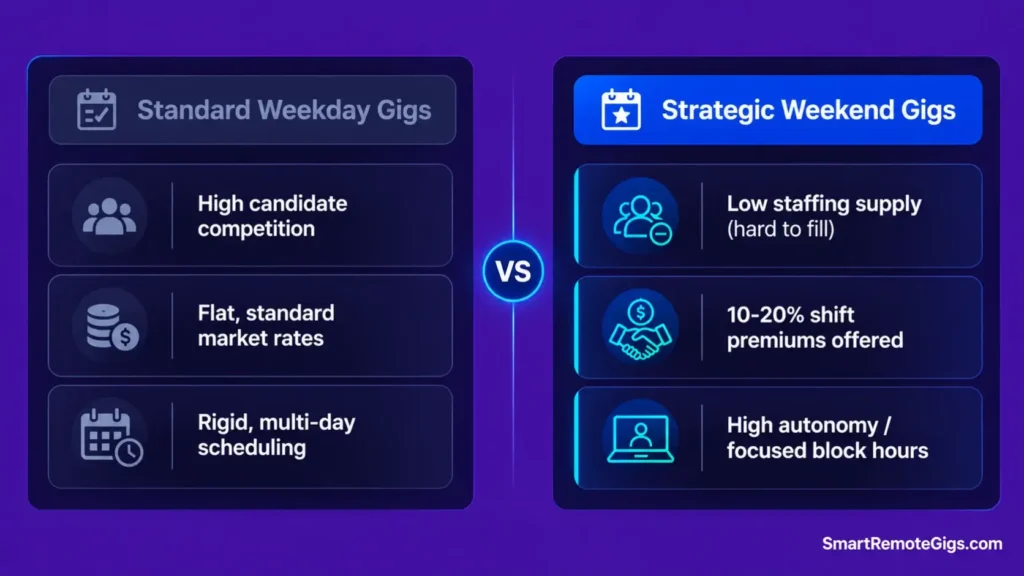
Most people scroll through job boards searching for weekend remote jobs assuming they’ll find leftover scraps — low-paying gig work nobody else wanted. That assumption undersells the opportunity. Companies that struggle to staff Saturday and Sunday coverage are often willing to pay more for it, because reliable weekend workers are genuinely harder to find than reliable weekday workers.
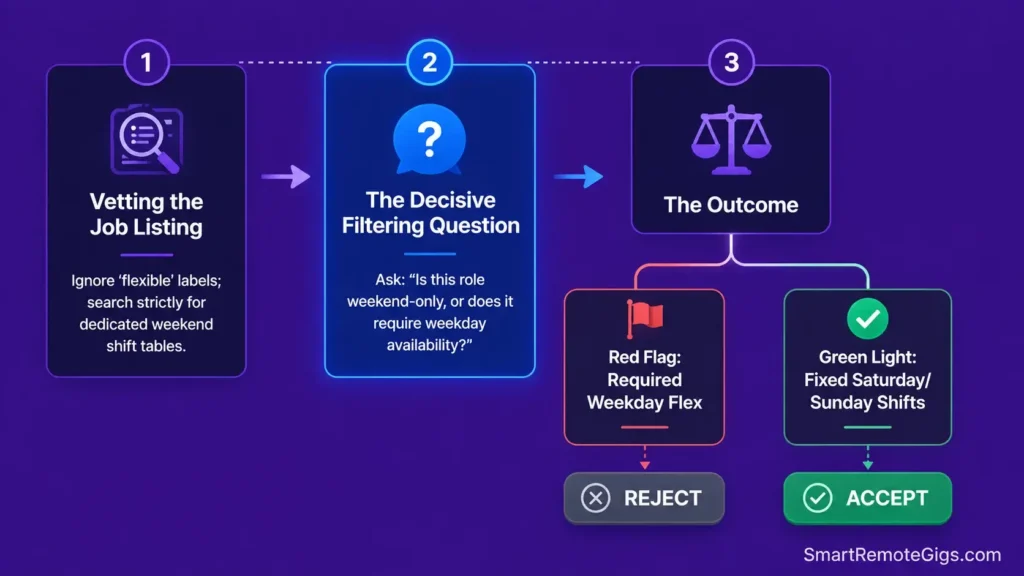
A screening problem worth naming up front: a huge number of listings titled “part-time, weekend-friendly” actually mean weekends are added onto weekday hours, not a replacement for them. Before you apply anywhere, ask directly: “Is this weekend-only, or does it also require weekday availability?” Their answer tells you immediately whether a role fits. We’ll come back to this filtering workflow below.
A note on how this guide is built: the pay figures below come from platform pricing pages, aggregator salary data (ZipRecruiter, Glassdoor), and platforms’ own published pay reports, current as of 2026 — not from personal testing. Where a specific “weekend premium” percentage is quoted, we’ve flagged whether it’s a figure we could verify or an estimate based on general market patterns, so you can weigh it accordingly.
| Role | Best For | Weekend Pay Premium | Top Platform |
|---|---|---|---|
| Online Tutor | Subject experts | Estimated, varies by platform/tutor | Wyzant |
| AI Data Trainer | Asynchronous work | None (flat rate) | DataAnnotation |
| Social Moderator | Night owls/flexible schedules | Estimated 15–20% on shift-based platforms | ModSquad |
| Virtual Event Tech | Tech-savvy pros | Event-dependent, often higher for hard-to-staff Sunday slots | Zoom Events |
| Customer Support | People persons | Typically 10–15% shift differential | Working Solutions |
[Evidence Source: Platform pricing pages, 2026] [Confidence Level: Platform names and general pay bands verified; specific premium percentages are industry-typical estimates, not confirmed per-platform figures]
The strategic version of weekend work isn’t grinding both days — it’s working 4–8 focused hours on one day at a strong rate, and leaving the other day alone.
The Verdict:
If you want the highest realistic hourly ceiling with full schedule control, online tutoring wins — real tutor-set rates on Wyzant commonly reach up to $60/hour, with test-prep specialists charging more. If you want zero meetings and pure asynchronous work, AI data training wins for flexibility, with entry-level pay around $15–20/hour and specialist tracks (coding, STEM) reported considerably higher.
[Evidence Source: Wyzant pricing pages; DataAnnotation pay blog, 2026] [Confidence Level: Verified]
Scenario 1: The Subject Matter Expert (Online Tutoring)
Reality Check & Diagnostics
Parents often look for Saturday and Sunday morning tutoring sessions because kids aren’t in school — that’s a real scheduling edge, though we don’t have a verified figure for exactly how much weekend demand exceeds weekday demand, so treat “spikes” as a pattern, not a precise multiplier.
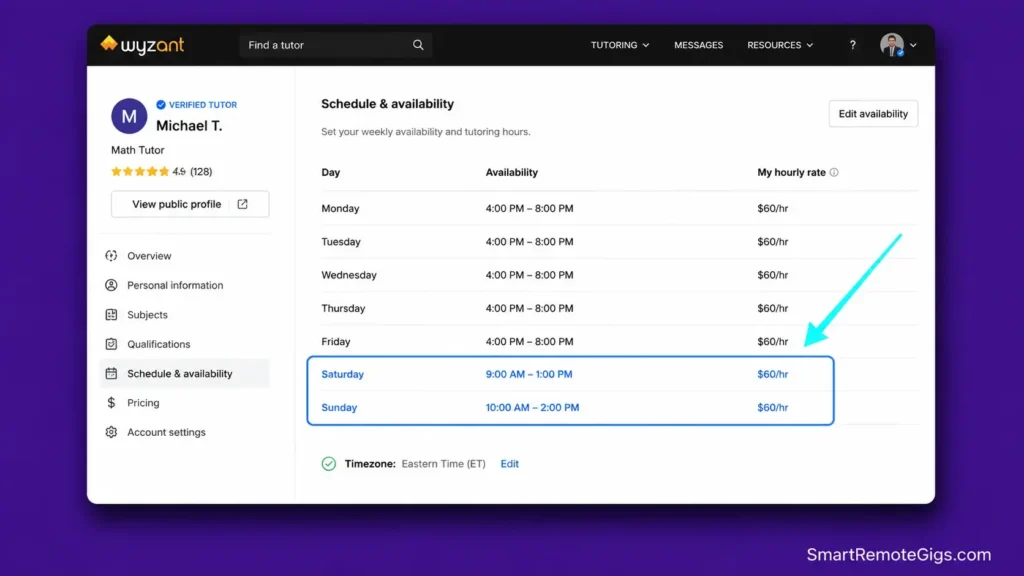
On Wyzant, tutors set their own rates, current data shows rates commonly reaching up to $60/hour, and the platform takes a flat 25% fee (you keep 75%). Test-prep tutoring (SAT, ACT, GRE, MCAT) tends to command the highest rates in the category. Private clients can pay more than platform rates.
[Evidence Source: Wyzant pricing pages, 2026] [Confidence Level: Verified]
Exact Workflow
- Pick a subject where you can demonstrate real, recent competence (a strong test score, a relevant degree, or professional experience).
- Build a Wyzant, Tutor.com, or Varsity Tutors profile with a specific, credible subject focus rather than “all subjects” — specificity converts better with parents comparing profiles.
- Price at or slightly under the going rate for your subject for your first 5–10 sessions to build reviews quickly, then raise rates once you have a track record.
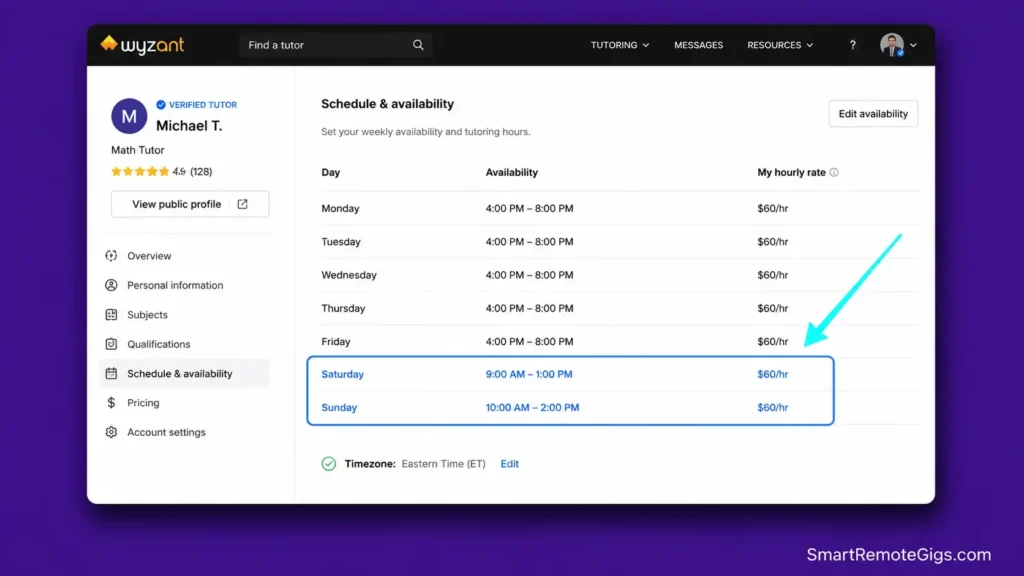
- Offer Saturday 9 AM–1 PM and Sunday 10 AM–2 PM as your standing availability — this is the window parents search first.
- For a private client base outside platforms, post in local parent Facebook groups and Nextdoor once you have a few platform reviews to point to.
Workflow Limitations
New tutors should expect a slow first few weeks while reviews build — that’s normal, not a sign the platform isn’t working. Last-minute family cancellations are common; a clear 24-hour cancellation policy protects your income. Demand is generally higher during the school year (September–May) than summer, unless you pivot to summer enrichment tutoring.
[Evidence Source: Wyzant tutor reviews, industry write-ups, 2026] [Confidence Level: Verified pattern, not a precise seasonal percentage]
Pro Tip:
Test prep tends to be less seasonal and less price-sensitive than general homework help, since students are working against a fixed exam date rather than a school-year calendar.
Red Flag:
A profile with no subject focus and a rock-bottom rate reads as low-confidence to parents comparing tutors — it depresses bookings rather than accelerating them.
If you’re a student trying to fit tutoring around a class schedule, our guide to remote jobs for college students covers more options built around a student’s calendar.
Scenario 2: The Asynchronous Deadline-Worker (AI Training, Transcription, Editing, Research)
Reality Check & Diagnostics
This scenario covers roles that don’t require you to be online at a fixed time, but do have a deliverable and a deadline: AI data annotation, transcription, proofreading/editing, and research work. Current reporting on AI annotation shows a wide spread — general/entry-level tasks around $15–20/hour, more complex domains (medical, legal, finance, coding) around $20–30/hour, and specialist STEM or coding-review tracks reported as high as $50–100+/hour for qualified experts, with no weekend premium (the rate is the rate regardless of when you work).
[Evidence Source: DataAnnotation pay blog; Glassdoor; independent 2026 industry write-ups] [Confidence Level: Verified range; individual results vary, and per-task platforms can effectively pay below the stated rate once idle/screening time is counted]
For deadline-based transcription specifically, we have SRG’s own tested data rather than an estimate: on Rev, pay runs $0.45–$1.10 per audio minute depending on tier, translating to a real hourly rate of roughly $2–$22/hour depending on audio difficulty — clean, single-speaker audio pays far better than muffled, multi-speaker files.
[Evidence Source: SRG’s own Rev.com review, 2026] [Confidence Level: Verified — see our full Rev review for the complete breakdown by audio difficulty]
Proofreading/editing and research-assistant work run roughly $20–40/hour depending on specialization, with technical editing and specialized industry research at the higher end; these figures are market estimates rather than platform-verified numbers.
[Evidence Source: Upwork/Reedsy/FlexJobs listings, 2026] [Confidence Level: Estimated market range]
Exact Workflow
- AI training: Sign up for DataAnnotation, Scale AI (Outlier), or Alignerr; pass the initial skills test; batch work into your quietest weekend hours since there’s no schedule requirement.
- Transcription: Apply to Rev, TranscribeMe, or Scribie; preview audio difficulty before claiming a file — this is the single biggest lever on your real hourly rate. Grab files Friday evening with a 48-hour window and complete them across the weekend.
- Editing/proofreading: Build an Upwork or Reedsy profile positioned around a specific niche (technical, academic, marketing copy); pitch agencies directly as their “weekend rush editor” for Friday-deadline overflow.
- Research: List research-assistant services on Upwork or FlexJobs; grant research clusters around September–October and February–March grant cycles specifically.
Workflow Limitations
AI training task availability fluctuates unpredictably, and onboarding/screening can take longer than advertised. Transcription grading systems (like Rev’s) can be strict, with real account-standing consequences for a run of difficult files. Editing and research work both tend to come with deadline pressure and, in research specifically, scope creep on “quick” requests.
[Evidence Source: Independent 2026 gig-platform reviews] [Confidence Level: Verified as a commonly reported pattern]
Pro Tip:
On Rev, developing the habit of previewing and skipping bad audio before claiming it protects both your real hourly rate and your quality score — see our full Rev review for the specific difficulty-to-pay breakdown.
Red Flag:
Advertised per-task or per-minute rates (“$1.10/audio minute!”) are not your real hourly wage once time-on-task is factored in — always convert to an effective hourly rate before judging whether a platform is worth your time.
Scenario 3: The Dedicated Shift-Worker (Moderation, Event Support, Customer & Tech Support)
Reality Check & Diagnostics
This scenario covers roles with fixed weekend shifts you claim in advance: community moderation, virtual event tech support, e-commerce chat support, and general technical support. Consumer and gaming platforms tend to see higher weekend user activity, and companies often pay a shift premium for reliable weekend coverage — we couldn’t verify an exact industry-wide percentage for any of these, so treat specific numbers below as market-typical estimates, not confirmed figures.
- Moderation: ~$15–22/hour weekdays, somewhat more on weekends, especially gaming/crypto communities.
- Virtual event support: ~$20–35/hour basic, $35–60/hour for senior multi-track event staff.
- E-commerce chat support: ~$14–20/hour weekdays, modest weekend differential; luxury/B2B pays more.
- Technical support: ~$16–24/hour weekdays, modest weekend differential; B2B/enterprise pays more.
[Evidence Source: Platform job postings — ModSquad, Zoom Events, Working Solutions, Sutherland, 2026] [Confidence Level: Estimated market range]
Exact Workflow
- Apply to ModSquad, The Social Element, or Working Solutions/Sutherland directly — these platforms explicitly staff for weekend-only shift claiming.
- Before accepting any offer, ask directly: “Is this weekend-only, or does it also require weekday availability?” — this single question filters out the “part-time, some weekend hours” listings that actually bolt weekend work onto a weekday schedule.
- Claim specific 4–6 hour shifts (e.g., Saturday 10 AM–4 PM or Sunday 2 PM–8 PM) rather than open-ended availability — once claimed, shifts are generally mandatory, so only claim what you can reliably cover.
- For event tech support, check Zoom Events, Hopin, and Upwork listings for “virtual event support” roles, which are typically single-event bookings rather than standing shifts.
Workflow Limitations
Moderation involves regular exposure to abusive or disturbing content, which is genuinely draining regardless of pay. Live events leave no room for retakes and commonly run longer than scheduled. Chat and tech support roles are typically metrics-driven (response time, resolution rate, satisfaction scores), with real performance consequences for missing targets.
Pro Tip:
Sunday evening shifts across all four of these roles tend to be the hardest for companies to staff, since most workers want Sunday evening off — that makes them a reasonable place to look first if you want first pick of open shifts.
Red Flag:
If a “weekend remote job” listing doesn’t specify exact shift hours before you apply, assume it may require weekday flexibility too — confirm before accepting.
Scenario 4: The Weekend Solo-Service Business
Reality Check & Diagnostics
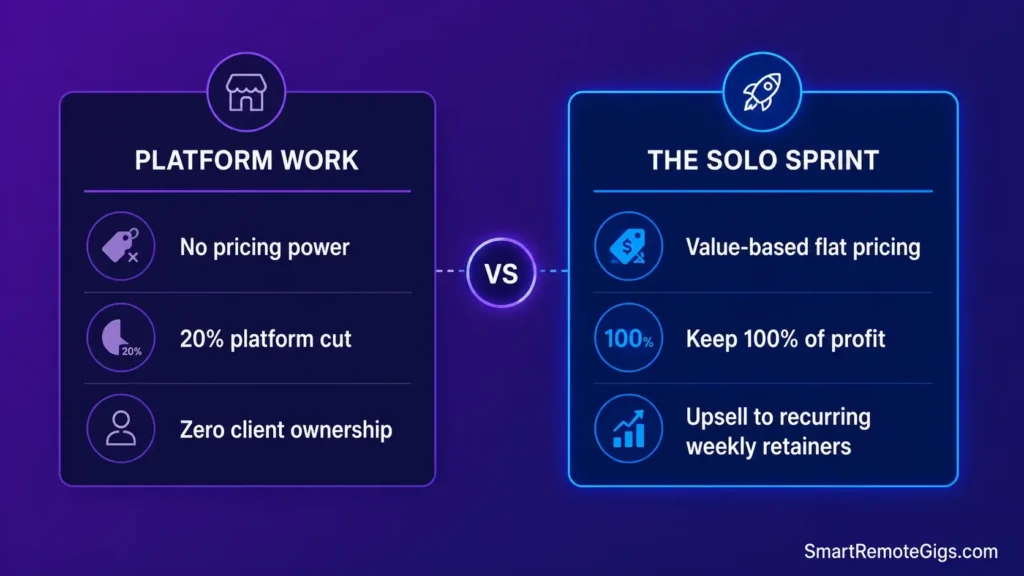
Rather than trading hours for a platform’s per-shift or per-task rate, some people package one specific skill (editing, tutoring, research, technical support) into a fixed-scope weekend offer sold directly to clients. This has a higher income ceiling than platform work because you set the price, but it also carries real client-acquisition risk that platform work doesn’t — there’s no guaranteed queue of work waiting for you.
Exact Workflow
- Pick one narrow, clearly-deliverable service based on a skill you already have (e.g., “I’ll proofread and format your 10-page report by Monday 8 AM” rather than “general editing services”).
- Price it as a flat “weekend sprint” rate rather than hourly, so clients know the total cost upfront.
- Land your first client through an existing freelance profile (Upwork, Fiverr) or your personal/professional network — a specific, fast-turnaround offer converts better than a generic listing.
- Deliver Friday evening through Sunday night, and explicitly offer a recurring weekly arrangement to your first few clients if the work went well — this is how a one-off weekend gig turns into standing income.
Workflow Limitations
This path has no guaranteed pipeline — unlike claiming a shift on an established platform, you’re responsible for finding every client yourself, and early weekends may have real gaps with no paid work at all. It also requires comfort with basic self-employment logistics (invoicing, scope-setting, client communication) that platform-based roles handle for you.
Pro Tip:
Start by offering your weekend sprint service to people already in your existing freelance or professional network before cold-pitching strangers — a warm first client is dramatically easier to close than a cold one.
Red Flag:
Underpricing your first “sprint” to win a client is a common trap — a rate that doesn’t cover your real time turns a income-building weekend into an unpaid one.
🗓️ The 3-Day Weekend Client Acquisition Plan
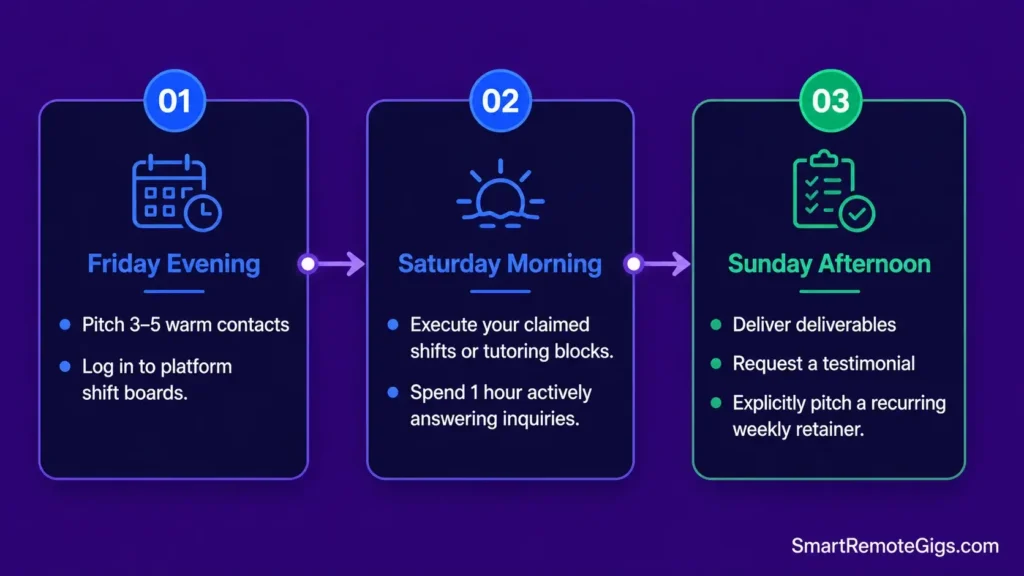
A practical Friday-to-Sunday framework for getting your first weekend booking, whichever scenario above fits you:
- Friday evening: Finalize your platform profile or service offer (pick one narrow focus, not “everything”). If you’re going the shift-worker route, check open shift boards on ModSquad/Working Solutions and claim your slot before it fills. If you’re going the solo-service route, message 3–5 people in your existing network with your specific weekend offer.
- Saturday morning: Work your claimed shift, tutoring block, or first client deliverable. If nothing is booked yet, spend an hour actively responding to platform inquiries or client replies rather than passively waiting.
- Saturday afternoon–Sunday: Deliver remaining work, request a review or testimonial from any client/platform interaction that went well, and — if the arrangement worked — explicitly ask about recurring weekly availability before the weekend ends.
This isn’t a guarantee of income in week one; it’s a repeatable structure for turning “I have some free weekend hours” into an actual booked shift or client by Sunday night.
The Anti-Burnout Strategy for Weekend Warriors
Working weekends sounds appealing until you remember weekends are when a lot of actual life happens — family time, social events, rest, recreation.
The sustainable approach: choose one day, not both. Work Saturday mornings or Sunday afternoons for roughly 4–6 hours, and leave the other day genuinely free. This generates a meaningful supplemental income stream while preserving real recovery time.
The common mistake: working both Saturday and Sunday, every week, indefinitely. Sustained weekend-plus-weekday work tends to catch up with people — through fatigue, strained relationships, or declining performance at the primary job. If the extra income is costing more than it’s worth, that’s a signal to scale back.
A rotation strategy: some people work three weekends a month and take the fourth off entirely, which can provide a regular recovery break while still generating solid supplemental income.
A seasonal approach: working weekends heavily during specific stretches (e.g., November–December for holiday income) and stepping back the rest of the year can help avoid chronic burnout.
For more on sustaining a second income stream without burning out, see our guide on balancing a part-time remote job without burnout.
Known Limitations
- Pay ranges vary significantly by platform, region, experience, and negotiation — the figures above are current market ranges, not guarantees.
- “Weekend premium” percentages are, in most categories above, estimates based on general market patterns rather than a single verified industry figure. Where we had platform-specific verified data (Wyzant, DataAnnotation, Rev), we’ve said so explicitly; where we didn’t, we’ve flagged it as an estimate rather than presenting it as fact.
- Seasonal and cyclical demand (school-year tutoring, holiday e-commerce, grant cycles, conference seasons) means income from several of these roles isn’t steady month to month.
- Platform-dependent risk: shift-based and task-based platforms can change pay structures, task availability, or grading policies with little notice — a pattern reflected in worker reviews across multiple platforms mentioned here.
Conclusion: Start Earning Next Saturday
The weekend income opportunity is real, even if it’s not always the fixed-percentage premium some guides promise. Choosing one role, working one consistent day, and setting firm hourly limits tends to work better — both financially and for actual sustainability — than trying to work every available hour both days.
To make sure your setup is ready for weekend shifts, check our list of essential home office tech under $200.
Most freelancers guess their rate. This free calculator helps you set yours with precision — built around your actual monthly expenses, desired profit, and billable hours so you never undercharge again.
Weekend remote work is a real, verifiable income lever — it’s just not a fixed-percentage guarantee, and the honest version of that story is more useful than the inflated one.






![AI Content Writer Jobs: [My 2026 Survival Playbook]](https://smartremotegigs.com/wp-content/uploads/2026/04/ai-content-writer-jobs-survival-playbook-1024x577.webp)
![Remote Copywriting Jobs 2026: [High-Ticket Method]](https://smartremotegigs.com/wp-content/uploads/2026/04/remote-copywriting-jobs-high-ticket-method-guide-1024x577.webp)
![Remote Technical Writing Jobs: [The $80K/Yr Guide]](https://smartremotegigs.com/wp-content/uploads/2026/04/remote-technical-writing-jobs-hero.webp)