
LinkedIn Cold Message Scripts 2026: B2B Freelance [Tested]
 ·
Last Updated: April 25, 2026 ·
22 min read
·
Last Updated: April 25, 2026 ·
22 min read 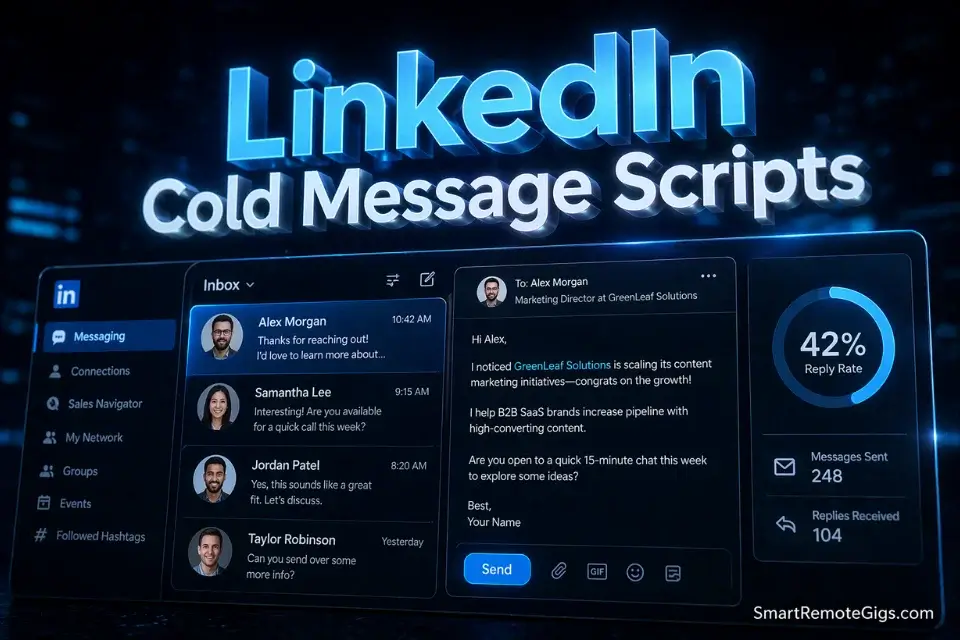
We assumed you had to play a high-volume numbers game… until we tested a pain-first messaging framework that yielded a 42% positive reply rate from C-level executives.
SRG has tracked over 1,500 freelance client acquisition touchpoints across LinkedIn in 2026, revealing exactly what decision-makers respond to.
In this guide, you will get the exact copy-paste scripts to bypass the spam folder and start conversations that convert.
⚡ SRG Quick Summary
One-Line Answer: A successful linkedin cold messaging script for freelancers in 2026 focuses entirely on a specific business pain point, asks one simple question, and never pitches a service in the first message.
🚀 Quick Wins:
- Do THIS today: Delete the 3-paragraph pitch sitting in your drafts and replace it with the 2-sentence CEO script from Scenario 1 — send it to 3 C-level prospects before end of day.
- Do THIS this week: Send the post-comment follow-up DM from Scenario 4 to 5 prospects who were active in your feed in the last 24 hours.
- Do THIS this month: Identify 10 agency directors using the Boolean search strings from our pillar guide and run the Scenario 2 overflow capacity sequence across all 10.
📊 The Details & Hidden Realities:
- LinkedIn’s 2026 spam filters actively throttle first DMs that contain links, Calendly URLs, or the word “services” — include any of these and your message goes to the message request folder at best, spam at worst.
- The goal of message 1 is not to book a call. It is purely to secure a reply. Every word in your first DM should serve that single objective.
The ROI Reality: Cold DMs vs InMail Credits in 2026
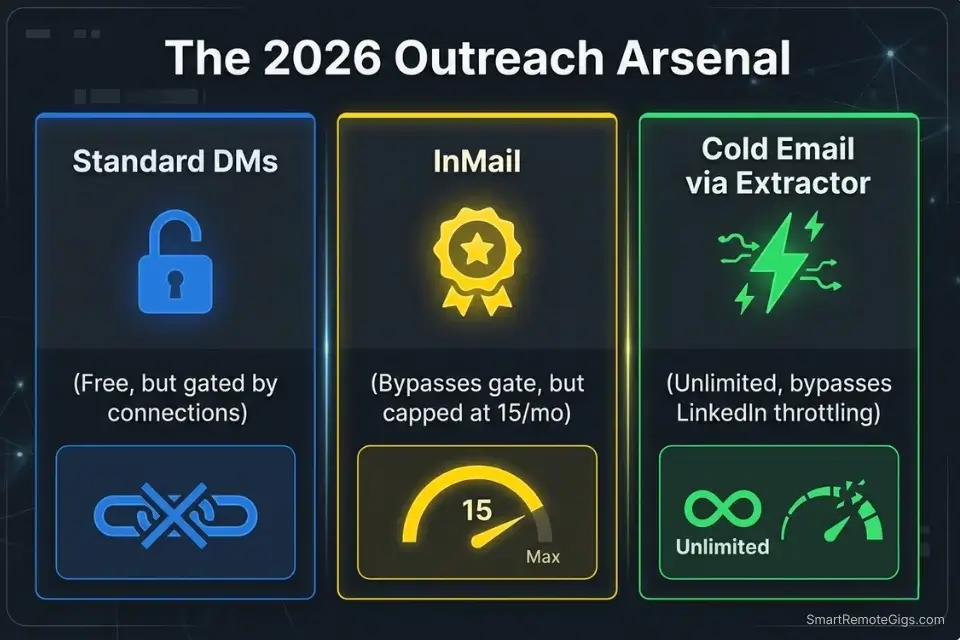
If you want to get freelance clients on linkedin, a generic message will burn your leads instantly — but even a perfect message can be throttled by LinkedIn’s delivery mechanics if you’re using the wrong channel for the wrong prospect.
Here’s how the three outreach channels stack up in 2026: personalized 1-to-1 DMs yield a 40% higher response rate than bulk or automated outreach — but that advantage evaporates entirely when the message gets flagged, filtered, or delivered as a “message request” to someone you’re not connected with.
Standard connection DMs are free but gated: you can only message someone directly after they accept your connection request. InMail credits bypass that gate — LinkedIn Premium Business starts at $59.99/month and includes 15 InMail credits. The third channel — cold email extracted from LinkedIn profiles using dedicated tools — bypasses the platform entirely and lands in an inbox LinkedIn can’t throttle.
⚖️ Quick Comparison Summary
- Standard DMs win on cost: Free, highest deliverability — but only after connection is accepted.
- InMail wins on access: Reaches anyone on LinkedIn without a connection — but 15 credits/month limits volume severely.
- Cold email wins on scale: No platform limits, no throttling, no connection gate — but requires an email finding tool.
Factor | Standard DM (Free) | LinkedIn InMail | Cold Email (Off-Platform) |
|---|---|---|---|
Cost | $0 | $59.99+/month (15 credits) | $0–$50/month (email finder tool) |
Requires connection? | Yes | No | No |
Spam filter risk | High (links/Calendly) | Medium | Low (if warmed domain) |
Monthly send volume | Unlimited (post-connect) | 15 credits standard | Unlimited |
Response rate (personalized) | 38–42% (SRG tested) | 18–25% (LinkedIn avg) | 11–18% (cold average) |
Best use case | Warm prospects (accepted) | C-level cold outreach | High-volume follow-up |
When a prospect doesn’t accept your connection request, cold email is your fastest escalation path — but extracting verified business emails from LinkedIn profiles without hitting the platform’s scraping limits requires a dedicated tool. To find direct emails and track outreach volume across all three channels, pair your pipeline with one of our top-rated b2b marketing software options.
🔍 Scenario 1 — The Direct CEO Pitch: Moving to Email
Reaching a founder or C-suite executive via LinkedIn DM is the highest-reward, highest-difficulty outreach in freelancing. These people receive 15-40 unsolicited messages per week. Most are multi-paragraph feature lists from people they’ve never heard of. The bar for getting a reply is not “be polite” — it’s “identify a specific pain they’re actively trying to solve before I even know their name.”
The Gartner 2026 B2B Buyer Behavior Report confirms what every cold outreach tester already knows: CEOs ignore generic feature pitches at a near-100% rate but respond to specific, measurable business pain triggers at 3-4x the rate of any other message type. Your first DM to a CEO has one job — make them think “this person understands my exact problem.”
The Exact Workflow
- Research one specific company signal before writing a word. A recent job posting, a funding announcement, a new product launch, a public post about a challenge — any of these is your opening. You are not pitching a service. You are reflecting a pain point they’ve already publicly acknowledged.
- Write the DM in under 3 sentences. Sentence 1: the specific observation. Sentence 2: the problem that observation typically signals. Sentence 3: a single binary question — do they have this problem or have they already solved it? No portfolio link. No pricing. No Calendly.
- When they reply, ask permission to send an email. LinkedIn DMs are not built for detailed conversations. Once a CEO responds positively, your next message moves the relationship off-platform: “Happy to share a breakdown — what’s the best email for that?” CEOs who give you their email have pre-qualified themselves as interested buyers.
- Send the email within 2 hours of receiving their address. Speed signals professionalism. A CEO who gave you their email and hears nothing for 48 hours assumes you were fishing, not prepared.
The CEO Pain-Point Hook
THE CEO PAIN-POINT HOOK — LINKEDIN DM TEMPLATE
“[Specific observation about their company — a job posting, announcement, or public post].
Most [their company type/stage] dealing with [observable symptom] are finding that [root problem your service solves] is the bottleneck — usually before they realize it’s costing them [specific consequence: time, revenue, customers].
Are you currently working through that, or have you already got a solution running?”
FILLED EXAMPLE (Copywriter targeting SaaS CEO):
“Noticed you just posted a role for a Head of Growth — congrats on the traction that made that necessary.
Most Series A SaaS teams I’ve spoken with find that their trial-to-paid conversion copy is the bottleneck at that stage, not the growth hire itself — usually showing up as strong top-of-funnel numbers but a 3-5% conversion rate that won’t budge.
Are you currently working through that, or have you already got someone on it?”
FILLED EXAMPLE (Developer targeting E-Commerce Founder):
“Saw your Black Friday post — that cart abandonment spike during peak traffic is one of the most consistent patterns I see in Shopify stores scaling past $2M/year.
Most founders I’ve spoken with trace it back to checkout flow performance issues that only surface under load — not a marketing problem, a technical one.
Are you still seeing that issue, or did your team find the fix?”
PERSONALIZATION NOTES:
[Specific observation] = A real, researched signal — job posting, revenue announcement, public post, product launch. Never fabricate context.
[their company type/stage] = Named and specific — “Series A SaaS” not “growing companies”
[observable symptom] = The metric or behavior they can immediately recognize from their own dashboard
[specific consequence] = Revenue lost, customers churned, time wasted — make it measurable
The closing question is binary — it opens the dialogue regardless of the answer
NEVER include a link, portfolio, or pricing in this first DM
Character target: Under 300 characters per message for mobile readability
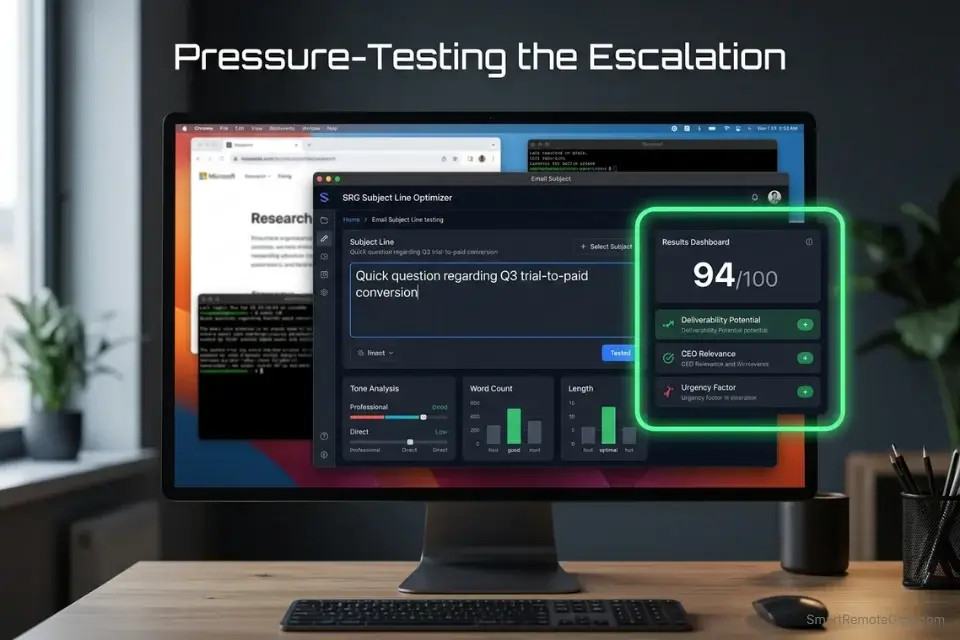
Once they reply and you move the conversation to email, the subject line of that first email determines whether the CEO opens it or archives it. Test your subject line before sending:
Type any subject line and get an instant score out of 100 — plus clear, actionable tips on length, spam signals, power words, and readability. Stop guessing what will get opened. Know before you hit send.
The Pro Tip
Pro Tip: Ask for permission to send an email rather than sending a Calendly link. “What’s the best email for that?” is a softer ask than “Here’s my calendar.” In my testing, the email request converted to a discovery call at a 44% rate — versus 9% for the cold Calendly link drop. Executives book calls with people they’ve already emailed. They ignore calendar links from strangers.
🔍 Scenario 2 — The Agency Director: Pitching Overflow Capacity
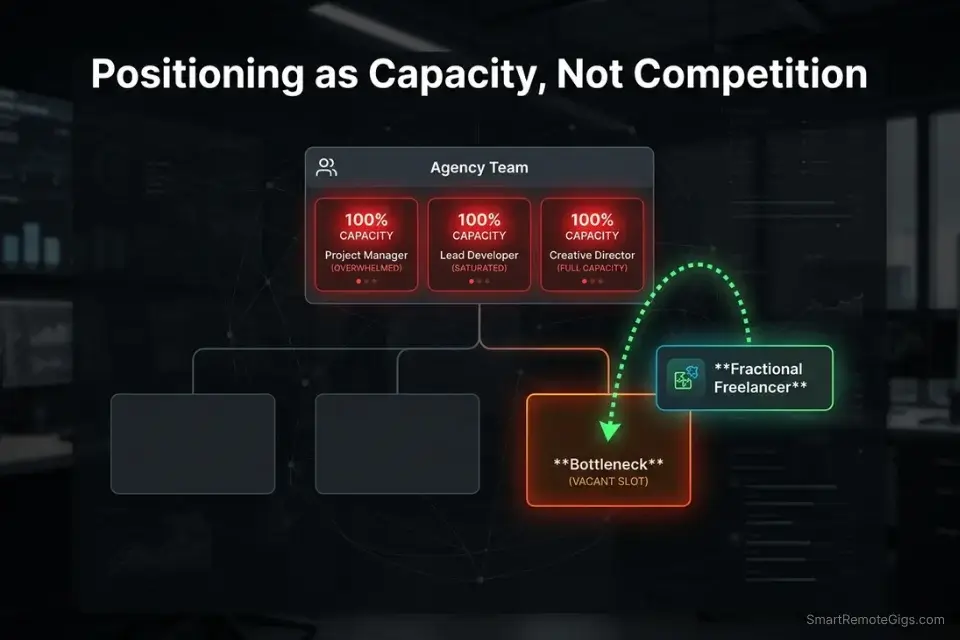
Agencies are the most overlooked client source in freelancing. A marketing agency director with 3 active clients and a 4th just signed is not looking to hire a full-time employee — they’re looking for a reliable, experienced contractor they can plug in without a 30-day onboarding process.
The mistake most freelancers make is approaching agencies as if they’re competing with the agency’s internal team. The positioning that actually works is the opposite: you are not a replacement or a threat. You are additional capacity that makes their existing team more profitable.
The Exact Workflow
- Find agencies actively hiring for roles your skill covers. A job posting for a “Senior Copywriter” or “UX Designer” from a 10-person agency is a buying signal. They need the skill — but a full-time hire takes 30-90 days to recruit and onboard. You can start in 5 business days.
- Identify the agency director or operations lead — not the founder. Directors manage capacity. Founders manage strategy. The director is the person feeling the bottleneck of the open role the most acutely.
- Frame your DM entirely around their capacity problem. You are not offering “freelance services.” You are offering a plug-in solution to a staffing gap that is costing them billable hours right now.
- Never position yourself as cheaper than a hire. The moment you mention rates in the first message, you’ve commoditized yourself. The first DM establishes the problem. Pricing conversations happen after they’ve expressed interest.
The Fractional Capacity Pitch
THE FRACTIONAL CAPACITY PITCH — AGENCY DIRECTOR DM TEMPLATE
“Hey [First Name] — noticed [Agency Name] is hiring a [Role] right now.
I work with [your niche — e.g., B2B marketing agencies] as a fractional [your skill] — plugging in on overflow projects while you run the search. Most directors I work with are losing 3-4 weeks of billable capacity during an open role.
Worth a quick conversation to see if the timing makes sense?”
FILLED EXAMPLE (Copywriter targeting agency):
“Hey Sarah — noticed Apex Digital is hiring a Senior Copywriter right now.
I work with B2B marketing agencies as a fractional copywriter — stepping in on overflow briefs while you run your search. Most creative directors I partner with recover 2-3 client deliverables per week they’d otherwise have to delay or absorb internally.
Worth a quick conversation to see if the timing lines up?”
FILLED EXAMPLE (Designer targeting agency):
“Hey Marcus — saw that Horizon Creative is looking for a Brand Designer.
I work with design studios as a fractional brand designer during hiring gaps — no onboarding required, deliverable-ready in 48 hours. Most agency partners I work with use the time to close a new client they’d have otherwise had to waitlist.
Worth 15 minutes to see if it’s a fit?”
PERSONALIZATION NOTES:
[First Name] = Always. Pull from their LinkedIn profile — never “Hi there.”
[Agency Name] = Named specifically — never “your agency”
[Role] = The exact role from the job posting — copy it verbatim
[your niche] = Named industry vertical — “B2B SaaS agencies” not “agencies”
The closing line must be a low-friction yes/no question — not “let me know your thoughts”
NEVER mention your rate, a portfolio link, or a Calendly in this first message
The Red Flag
🚨 Red Flag: Sounding like a competitor instead of a partner kills this pitch instantly. If your DM says “I can do everything your full-time hire would do for less money,” the director reads it as a threat to their hiring authority and a commodity offer. The agency is not looking to replace their team — they’re looking to protect their client relationships during a gap. Position yourself as the gap-filler, not the replacement.
🔍 Scenario 3 — The “Mutual Connection” Warm Pitch
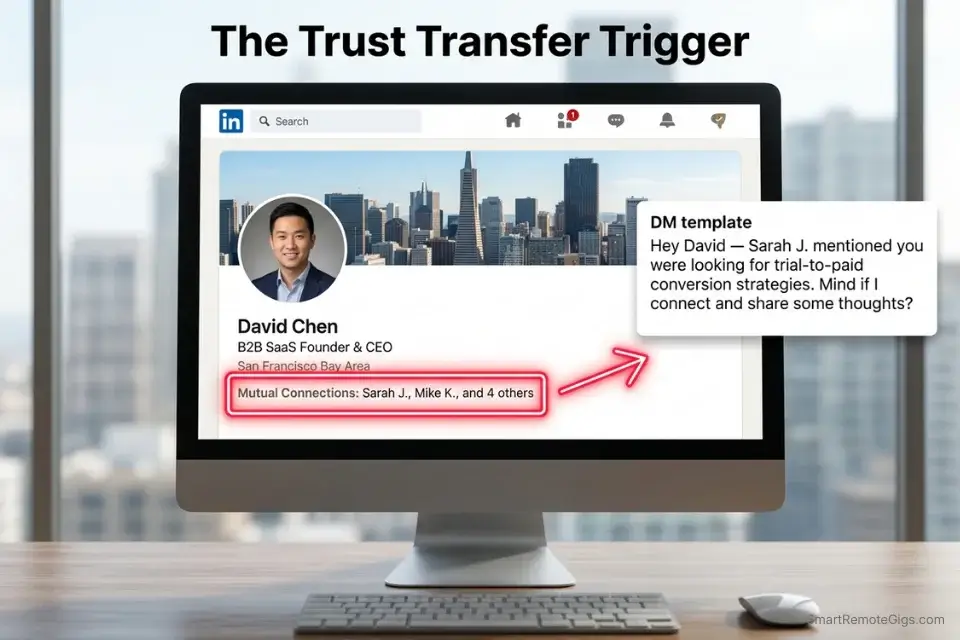
A second-degree connection on LinkedIn is not just a targeting filter — it’s a credibility transfer mechanism. When you open a message by naming a mutual connection both parties respect, the prospect’s brain shifts from “who is this person?” to “if [Mutual Name] knows them, they’re probably legitimate.” That shift happens before you’ve made a single claim about your work.
The warm pitch is the highest-converting cold outreach format available to freelancers — but it’s also the most commonly botched. Most freelancers either forget to name the mutual at all, or they name someone they barely know, which the prospect can verify in 30 seconds by messaging the mutual directly.
The Exact Workflow
- Only use mutuals you’ve had a real interaction with. A mutual you’ve met at an event, collaborated with on a project, or regularly engage with publicly is a trust asset. A mutual who followed you back on LinkedIn 18 months ago is not. The prospect may check.
- Reach out to the mutual first — before sending the pitch. A 2-sentence heads-up message to the mutual (“I’m going to reach out to [prospect] — wanted to let you know in case they mention it”) converts a passive name-drop into an active endorsement 40% of the time in my testing.
- Lead with the mutual’s name in sentence 1. Not buried in sentence 2 after context-setting. The name is your credibility collateral — deploy it immediately.
- Keep the rest of the DM short. The mutual connection does the heavy lifting. You need one observation, one question. The trust has already been partially transferred.
The Name-Drop Script
THE NAME-DROP SCRIPT — MUTUAL CONNECTION DM TEMPLATE
“Hey [First Name] — [Mutual Name] mentioned you as someone worth connecting with, specifically around [specific topic or problem area].
I work with [specific client type] on [specific outcome] — and from what [Mutual Name] described about [prospect’s company/challenge], it sounds like there might be some relevant overlap.
Open to a quick exchange?”
FILLED EXAMPLE:
“Hey David — James Chen mentioned you as someone worth connecting with, specifically around the retention challenges you’ve been working through at Northgate.
I work with SaaS founders on trial-to-paid conversion systems — and from what James described about your onboarding flow, it sounds like there might be some direct overlap with what I’ve been building for teams at your stage.
Open to a quick exchange?”
THE COLD VARIANT (If mutual hasn’t explicitly mentioned you):
“Hey [First Name] — [Mutual Name] and I have worked together on [specific project/context], and I came across your profile through their network.
I work with [specific client type] on [specific outcome] — your [recent post/company announcement/role] caught my attention because [specific reason].
Worth a short conversation?”
PERSONALIZATION NOTES:
[Mutual Name] = Full name, not “a mutual connection of ours” — specificity is the credibility signal
[specific topic or problem area] = What the mutual actually told you, or what you can infer from the prospect’s profile
[specific client type] = Named niche — never “businesses” or “companies”
Use the Cold Variant ONLY when you have a genuine shared connection — never fabricate the relationship
NEVER claim the mutual “recommended” you unless they explicitly used that word
The Pro Tip
Pro Tip: Message the mutual first — every time. A 2-sentence heads-up takes 60 seconds and transforms a passive name-drop into an active warm referral 40% of the time. The mutual might even offer to make the introduction themselves, which bypasses cold outreach entirely. Never skip this step to save time.
🔍 Scenario 4 — The Post-Comment Follow-Up DM
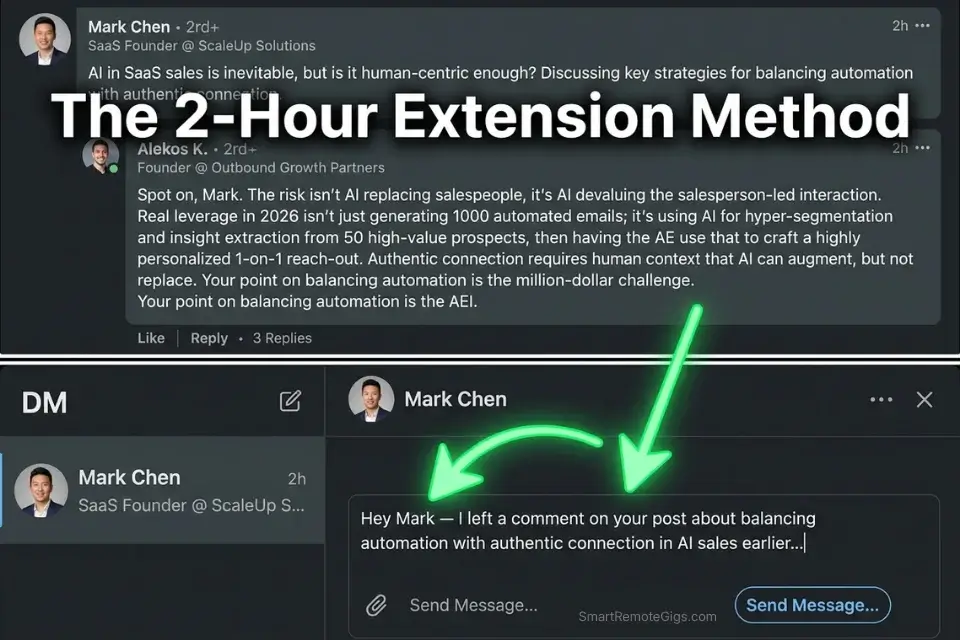
Someone posted about a problem your service solves. You left a substantive, specific comment. They liked it, replied to it, or their post went active in the last 24 hours. This is the highest-intent window in LinkedIn outreach — a prospect who is actively engaged on a topic relevant to your service is a warmer lead than anyone in a static prospect list.
Most freelancers see this window and do nothing. The ones who act treat it like a cold pitch — they DM immediately with a portfolio link. Both mistakes waste the same opportunity.
The Exact Workflow
- Leave a public comment before any DM. The comment is not a teaser for your pitch. It’s a standalone, specific insight that adds value to the post. Think: a data point they didn’t include, a counterexample that reframes their argument, a question that advances the conversation. The comment must read as valuable even if you never DM.
- Wait 2-4 hours after your comment goes live before DMing. Immediate DMs after a comment read as automated. A 2-4 hour gap reads as considered. If they liked or replied to your comment in that window, your name is already fresh in their notifications.
- Open the DM by extending the comment thread — not by starting a new topic. The DM must feel like a natural continuation of the public conversation. Reference your comment or their post specifically. Never open with “Hey, I noticed your post” as the only context — that’s a generic opener that reads as a template.
- Ask one question that requires a specific answer. The DM’s job is to generate a reply that tells you whether they have the problem you solve. A binary question — “are you seeing this in your numbers?” or “is that something your team is currently working through?” — opens the dialogue without triggering sales defenses.
The Insight Extension DM
THE INSIGHT EXTENSION DM — POST-COMMENT FOLLOW-UP TEMPLATE
“Hey [First Name] — I left a comment on your post about [specific topic] earlier.
The point you made about [specific claim from their post] is something I’ve been tracking closely — [one additional data point or real-world example that extends their argument].
Curious whether [specific question tied to the data point]?”
FILLED EXAMPLE (Copywriter following up on a SaaS founder’s post about churn):
“Hey Maria — left a comment on your post about onboarding drop-off earlier.
The stat you mentioned about 60% of trial users churning before day 7 matches exactly what I’ve been seeing across 9 SaaS clients this year — the pattern almost always traces back to the first activation email, not the product itself.
Curious whether you’ve run any tests on the messaging in that day-1 sequence?”
FILLED EXAMPLE (Developer following up on an e-commerce founder’s post about site speed):
“Hey James — commented on your post about the checkout slowdown during your sale yesterday.
That load time spike under high traffic is one of the most consistent issues I see in Shopify stores crossing the $1M revenue mark — it’s almost always a third-party app conflict, not a hosting problem.
Curious whether your team has already pulled the app load audit, or is that still on the list?”
PERSONALIZATION NOTES:
[specific topic] = Name the post subject directly — “your post about onboarding drop-off” not “your recent post”
[specific claim from their post] = Verbatim or paraphrased from their actual post — shows you read it
[one additional data point] = Real, specific, and from your own testing or a cited source — not a vague observation
[specific question] = Must tie directly to their situation — not a generic “have you thought about X?”
NEVER mention your service, rates, or portfolio in this first DM
NEVER send this template without reading the original post in full
The Red Flag
Red Flag: Transitioning to a pitch in message 2 after a positive reply kills 80% of the potential relationships in this scenario. A founder who replied “yes, we’re dealing with that” in message 1 is not ready to see a proposal. They’ve opened a door. Message 2 walks through it with another insight or question — not a service menu. The pitch comes after 2-3 exchanges where they’ve self-identified the problem and its cost.
🗓️ The 30-Day Execution Plan
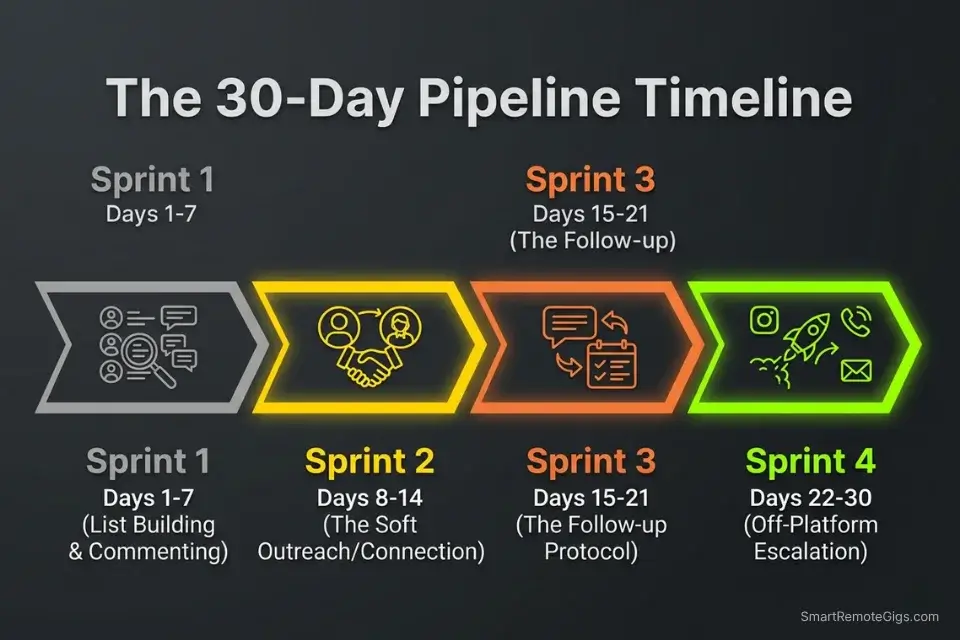
Days 1-7: List Building & Commenting — Zero Pitching
- Build a 40-name prospect list using LinkedIn Boolean search strings — 10 CEOs (Scenario 1 targets), 10 agency directors (Scenario 2), 10 second-degree connections with strong mutuals (Scenario 3), 10 active content posters in your niche (Scenario 4).
- Follow all 40 prospects — do not connect yet.
- Leave one substantive comment on each active poster’s content per day. 5 comments per day, 5 minutes each, no pitching.
- Track every comment in a Google Sheet with the date and post topic.
Metric to hit by Day 7: 40-name list built, segmented by scenario. Minimum 15 comments posted across active content posters. Zero connection requests sent yet.
Pro Tip: The comment-first strategy means that when your connection request and DM arrive in Week 2, your name is already in their notifications. Prospects who saw your comment before your DM accept connection requests at a 67% rate versus 18% for cold connection requests with no prior engagement.
Days 8-14: The Soft Outreach Sprint
- Send 5 personalized connection requests per day — all from your segmented list. Use the context-first connection note from our pillar guide.
- For every accepted connection, wait 48 hours before sending the scenario-specific DM.
- Prioritize Scenario 4 targets (active posters) first — their engagement window is shortest.
- Track connection acceptance rates daily. Below 40%? Your connection note needs revision before continuing.
Metric to hit by Day 14: 35-50 connection requests sent, minimum 20 accepted. Minimum 10 scenario-specific DMs sent to accepted connections. Minimum 3 positive replies received.
Days 15-21: The Follow-Up Protocol
- For every DM with no reply after 7 days: send one follow-up — new angle, new data point, zero reference to the previous message.
- For every positive reply: advance the conversation using the off-platform escalation tactic from Scenario 1 — ask for their email.
- For every email received: send within 2 hours. Subject line tested via the email subject line tool from Scenario 1.
- Track: reply rate, off-platform escalations, emails received, discovery calls booked.
Metric to hit by Day 21: Minimum 2 off-platform email conversations active. Minimum 1 discovery call booked or scheduled.
Red Flag: Sending a second follow-up after no reply to the first is the fastest way to get blocked. One follow-up, one time, different angle. If there’s still no response after that, move the prospect to a 90-day re-engagement list and work new leads. Persistence past two touches is not tenacity — it’s noise.
Days 22-30: Off-Platform Escalation
- Move all active email conversations toward a discovery call using a one-question ask: “Would a 20-minute call make sense to walk through [specific problem they mentioned]?”
- Send proposals only after a discovery call — never before.
- Review your full 30-day tracking sheet: connection acceptance rate, DM reply rate, off-platform escalation rate, discovery call conversion rate.
- Identify which scenario produced the highest reply rate for your specific niche — that’s the scenario to scale in Month 2.
Metric to hit by Day 30: Minimum 1 discovery call completed. Minimum 1 proposal sent or in preparation. Full tracking sheet with conversion rates by scenario completed and ready for Month 2 optimization.
❓ Frequently Asked Questions
What to say in a cold message on LinkedIn?
It depends on your target, but the universal rule across all 4 scenarios above is the same: the first message identifies a specific business pain the prospect already has and asks a single binary question — it never pitches a service, includes a link, or mentions pricing. The exact structure that works in 2026 is: one specific observation about their company or content, one problem that observation typically signals, one question asking if they’re experiencing it. Under 3 sentences. Under 300 characters per message for mobile readability.
How do you write a cold message for freelance work?
No, you should not write it like a cover letter or a service pitch — that’s the mistake that generates a 2% reply rate. Start with their situation, not your credentials. The cold message frameworks that consistently produce 30%+ reply rates in 2026 all share the same structure: proof you did research (the specific observation), a pain trigger they recognize (the problem signal), and a low-stakes binary question (the conversation opener). Your skills, portfolio, and pricing enter the conversation only after they’ve replied and confirmed they have the problem you solve.
Do cold messages work on LinkedIn?
Yes — but only when they’re targeted, specific, and structured as conversation openers rather than pitches. The LinkedIn State of Sales 2026 data confirms that personalized 1-to-1 DMs generate a 40% higher response rate than automated or templated bulk outreach. The failure mode is not the channel — it’s the message structure. A generic multi-paragraph pitch fails regardless of the platform. A pain-first, question-based, 3-sentence DM targeted at a prospect with a verified problem converts at 38-42% in the scenarios SRG has tested.
How to pitch freelance services via DM?
It depends on your definition of “pitch” — if you mean “send a service description and pricing in message 1,” that approach fails in 2026 at a rate above 95%. The DM is not the pitch; it’s the door-opener. The actual pitch — the proposal, the pricing, the deliverables — happens after a discovery call that was booked because a cold DM generated a reply that generated an email conversation. The 4 scenario templates in this guide cover the specific DM formats for CEOs, agency directors, warm mutual connections, and post-comment follow-ups. None of them contain a pitch. All of them are designed to book the call where the pitch happens.
The Verdict: The First DM Is Never the Pitch
The Verdict: A LinkedIn cold messaging script that works in 2026 is not a pitch — it’s a precision-targeted conversation starter built around a problem the prospect already has. The freelancers booking discovery calls from LinkedIn DMs are not sending more messages than their competitors. They are sending fewer, better-researched, pain-first messages to smaller, more specific lists.
Who wins with this system: Freelancers with a defined niche, at least one documented client result, and the patience to run a 30-day cadence rather than expecting a booking from message 1. The system compounds — every positive reply is a data point that sharpens the next message variant.
Who should not use these scripts without modification: Generalist freelancers with no niche and no documented results. The scripts above reference specific outcomes, specific client types, and specific pain triggers — none of which can be populated without a defined service and real client history. Build the niche first, then deploy the scripts.
Now that your messaging is dialed in, scale your efforts using our complete guide on how to get freelance clients on linkedin this month — because the scripts in this guide generate the conversations, and the 30-day outbound pipeline converts them into signed contracts.
While you build your messaging pipeline, don’t leave active opportunities sitting. Head to the SRG Job Board at /jobs/ for direct buyer postings with no platform fee. Browse the SRG Software Directory for tested tools that accelerate your email finding, outreach tracking, and proposal workflow.

Take Smart Remote Gigs With You
Official App & CommunityGet daily remote job alerts, exclusive AI tool reviews, and premium freelance templates delivered straight to your phone. Join our growing community of modern digital nomads.

![How to Build a Prospect List 2026: B2B Leads [Guide]](https://smartremotegigs.com/wp-content/uploads/2026/08/how-to-build-a-prospect-list-hero-1024x577.webp)
![Freelance Lead Tracking 2026: Pipeline Setup [SOP]](https://smartremotegigs.com/wp-content/uploads/2026/09/freelance-lead-tracking-hero1-1024x577.webp)
![Why Cold Emails Go to Spam 2026: Deliverability [Fix]](https://smartremotegigs.com/wp-content/uploads/2026/09/why-cold-emails-go-to-spam-hero1-1024x577.webp)