
Upwork vs Fiverr 2026: Which Is Actually Better? (Tested)
 ·
Last Updated: March 27, 2026 ·
12 min read
·
Last Updated: March 27, 2026 ·
12 min read
If you’re starting your freelance journey today and trying to figure out how to get your first Fiverr client (or your first Upwork contract), the Upwork vs Fiverr debate is probably the first real decision you’ve hit. Most people make it wrong by treating it as a coin flip rather than a fundamental personality and business model question.
In my first year of freelancing, I ran identical strategies on both platforms simultaneously. On Upwork, I burned through $100 in Connects and got nothing. On Fiverr, my gig sat dead for weeks. Preventing new freelancers from burning their limited time and capital on the wrong platform is exactly why we built Smart Remote Gigs. We created this platform to cut through the marketing hype and give you the raw, tested reality of how these marketplaces actually operate in 2026.
It wasn’t until I recognized that these two platforms require completely opposite mindsets that I finally broke through on one of them. This guide exists so you don’t waste six months figuring that out the hard way.
|
Feature |
🟢 Fiverr |
🔵 Upwork |
|---|---|---|
|
The Core Model |
Productized gigs — buyers find you |
Active pitching — you find buyers |
|
The Cost to Play |
Free to list; 20% commission per sale |
Paid “Connects” system to apply for jobs |
|
Ideal Freelancer |
Introverts, creatives, productized service sellers |
Extroverts, consultants, relationship-driven professionals |
|
Client Type |
One-off tasks, startups, small businesses |
Long-term contracts, enterprise clients, agency retainers |
The Core Difference: Storefront vs. Job Board
Every meaningful difference between these two platforms flows from one foundational distinction: Fiverr is a storefront and Upwork is a job board. They look like competitors. They’re actually different products serving different types of freelancers.
Fiverr: The “Productized” Service Model
On Fiverr, you build a gig — a fixed, packaged service with defined scope, price, and delivery time. When you set up your seller profile on Fiverr, the platform’s search algorithm surfaces your packages to buyers who are actively searching for what you offer. You set it up once, optimize it for the algorithm, and let inbound traffic do the work.
The trade-off: you’re competing on a public marketplace where buyers compare you to dozens of other sellers simultaneously. Your thumbnail, your title, your price, and your reviews are all visible side-by-side with competitors. The platform controls the distribution; you control the product.
This model rewards sellers who can productize their skills cleanly — people who can say “I deliver X, in Y format, within Z days, for $N” and mean it consistently. It’s inherently less flexible than Upwork, and that’s a feature, not a bug: the constraint forces you to get specific, and specificity is what the algorithm rewards.
Upwork: The “Active Pitching” Model
On Upwork, clients post jobs and freelancers submit proposals. You browse listings, write personalized cover letters, and compete for contracts in a model closer to traditional job applications than an e-commerce marketplace.
The trade-off: you have far more control over the client relationship from the start. You can negotiate scope, rate, and timeline in a direct conversation before any money changes hands. Long-term contracts — retainers, ongoing engagements, multi-month projects — are the norm rather than the exception.
This model rewards sellers who are genuinely comfortable with outbound sales: writing compelling pitches, handling objections, and building relationships from cold outreach. If the idea of sending 15 proposals a week to hear back from two of them sounds energizing, Upwork is built for you.
Pro Tip: Fiverr is for introverts who want to build a system and let the algorithm bring clients to them. Upwork is for extroverts who want to actively hunt, negotiate, and pitch directly to enterprise clients. Neither platform is objectively better — but one of them is almost certainly a much better match for your actual personality. Be honest with yourself about which one that is before you invest time in either.
Take Smart Remote Gigs With You 🌍
Get daily remote job alerts, exclusive AI tool reviews, and premium freelance templates delivered straight to your phone. Join our growing community of modern digital nomads.
Quick Links: Software Directory | Free Templates | Remote Jobs
Upwork vs Fiverr: Core Feature Comparison
1. The Cost of Doing Business (Fees & Connects)
Fiverr’s fee structure is simple and consistent: 20% of every transaction, regardless of order value or seller level. A $100 order nets you $80. A $1,000 order nets you $800. There are no subscription fees, no listing fees, and no cost to create your first gig. The barrier to entry is genuinely zero.
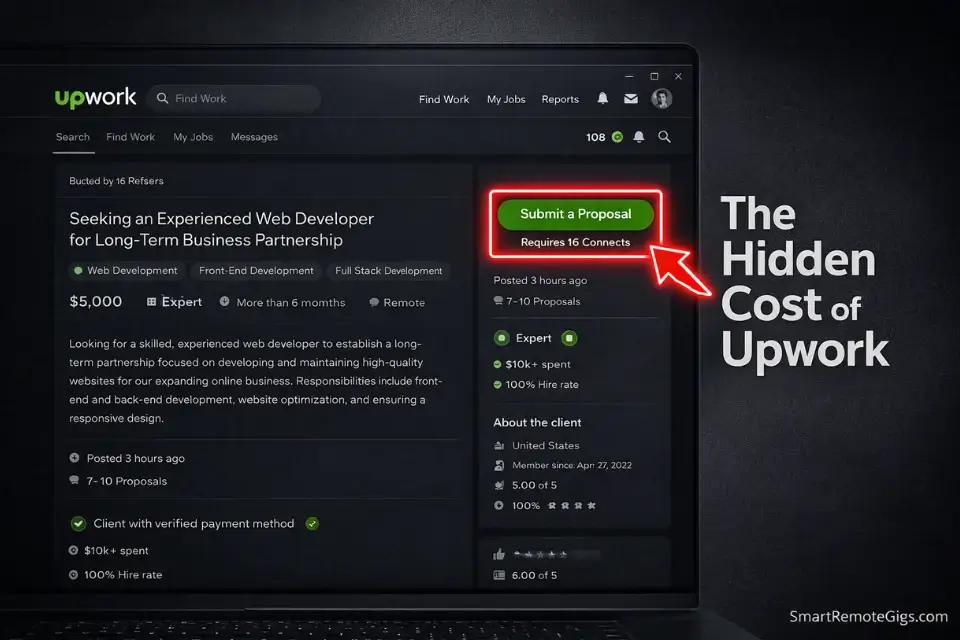
Upwork’s fee structure is more complex. The platform uses a “Connects” system — a virtual currency you spend to submit proposals on job listings. According to Upwork’s official Connects guide, as of 2026, most job applications cost between 6 and 16 Connects depending on the contract value. Connects are purchased in bundles; new accounts receive a limited free allocation that depletes quickly.
On top of Connects costs, Upwork charges a 20% service fee on the first $500 earned from each client, dropping to 10% between $500–$10,000 and 5% above $10,000 with the same client. For new freelancers working on small contracts, you’re paying 20% commission on top of spending real money just to apply.
Red Flag: Upwork’s Connects system means you pay money just to apply for jobs — before a single client has responded to you. If you’re starting with zero capital and need to earn before you spend, Upwork is genuinely hostile to beginners in 2026. You can burn through $50 in Connects in a week without a single reply. Fiverr costs nothing to start. For anyone bootstrapping from zero, Fiverr is the only rational first choice.
2. The Quality of Clients (One-Off vs. Long-Term)
This is the comparison that actually matters most for your long-term income strategy, and it’s consistently underweighted in Upwork vs Fiverr discussions.
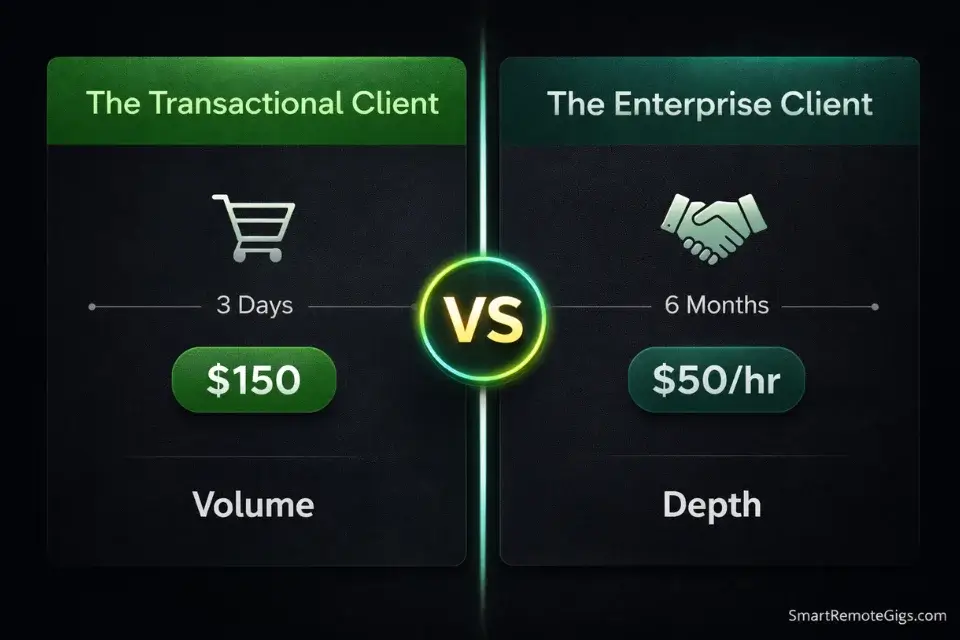
Fiverr clients are predominantly transactional. They have a specific, bounded task — a logo, a product description, a website bug fix — and they want it done cleanly and quickly. Repeat business happens, but it’s the exception rather than the model. Your income on Fiverr is inherently project-by-project.
Upwork clients skew toward ongoing engagements. Enterprise companies use Upwork to hire contractors for months-long projects. Marketing agencies use it to build extended teams. The client acquisition cost per dollar earned is higher upfront (proposal time + Connects cost) but the long-term value of a single good client relationship can exceed anything a transactional Fiverr buyer would generate.
If you’re building toward a stable monthly income from a small number of high-value clients, Upwork’s model fits that trajectory better. If you’re building toward a high-volume, systematized operation where algorithm optimization does the selling for you, Fiverr’s model fits better.
3. The Algorithm (Search vs. Match)
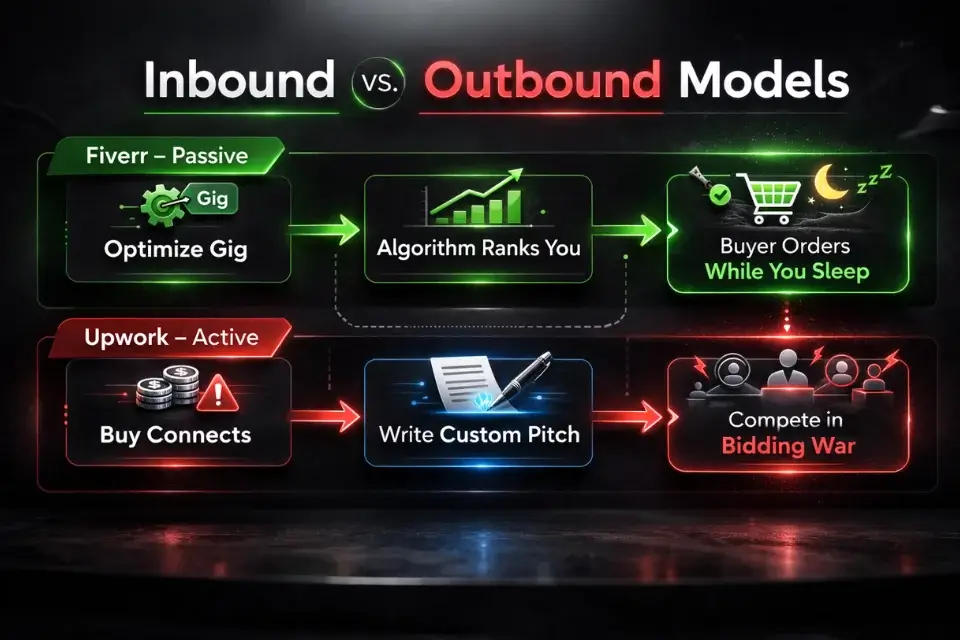
Fiverr’s discovery mechanism is a search-and-rank algorithm. Buyers type a query, the algorithm returns a ranked grid of gigs. Your placement in that grid depends on your CTR, conversion rate, response time, and review score — all seller-controlled variables that improve with optimization and experience.
Fiverr also runs a passive matching system through its Briefs feature — Fiverr’s new Briefs matchmaking system notifies sellers when buyers submit project descriptions that match their gig metadata. This is inbound lead generation without any active effort on the seller’s part.
Upwork’s matching layer is secondary to the primary job board model. Upwork does surface freelancers to clients based on profile strength and match scores, but the platform’s core engagement loop is still proposals — active pitching to listings. Passive inbound from Upwork’s algorithm alone rarely generates enough volume to build a business on, especially in the early months.
Which Platform Pays More in 2026?
The honest answer: it depends on your niche, your experience level, and how you define “pays more.”
The Race to the Bottom Myth
Fiverr has a reputation for low rates because of its $5 origin story. In 2026, that reputation is substantially outdated for sellers who understand pricing strategy. Mid-tier and premium Fiverr gigs routinely command $75–$300+ for well-defined, professional-grade deliverables. The sellers stuck at the bottom are choosing to stay there — usually out of fear or bad advice, not because the platform forces it.
Upwork has a reputation for higher rates, which is accurate for established freelancers with strong profiles and niche positioning. But for newcomers, Upwork’s proposal competition is brutal. Experienced freelancers with 100+ five-star reviews are bidding on the same jobs as new accounts. The gap in conversion rate between a polished Upwork profile with client history and a brand-new one is enormous.
The realistic rate comparison for a new freelancer:
- Fiverr, months 1–3: $25–$75 per order, modest volume, building reviews
- Upwork, months 1–3: Highly variable — many new freelancers land nothing for weeks before the first contract; others, in less competitive niches, land $30–$50/hr contracts early
Neither platform hands you high rates. Both require investment — in gig optimization on Fiverr, in profile and proposal quality on Upwork.
Hourly Rates vs. Fixed-Price Gigs
Upwork supports both hourly and fixed-price contracts, with time-tracking built in for hourly work. This makes it structurally better for services that are difficult to scope in advance — consulting, ongoing development, research-heavy writing.
Fiverr is almost entirely fixed-price. This works well for productized services but creates awkward scope negotiations for anything open-ended. If your service is inherently variable in scope, Fiverr’s package model forces you to draw lines that may not suit every project naturally.
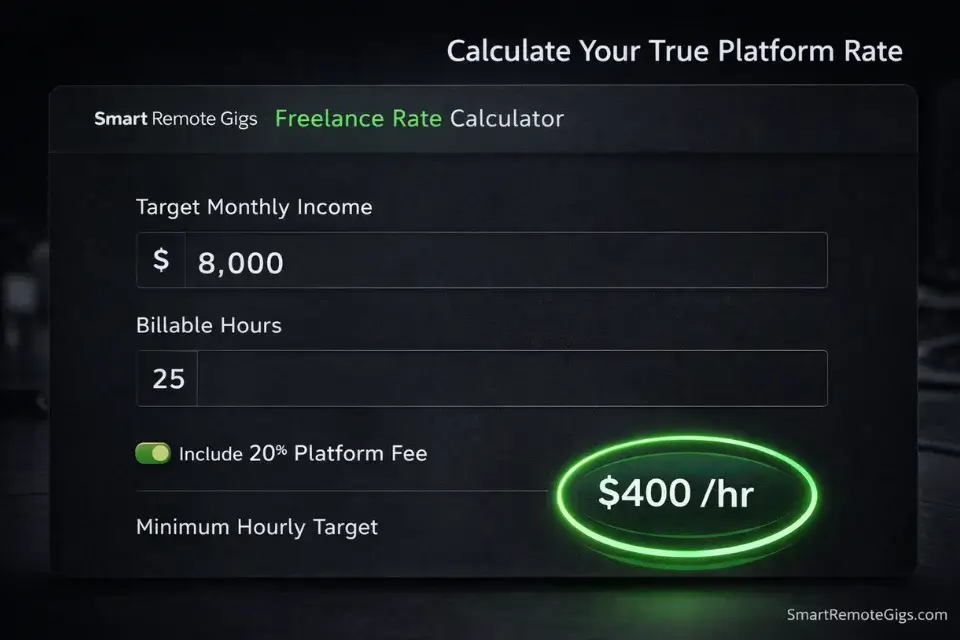
Before setting any price on either platform, knowing your actual cost-based floor is the starting point. Use our Free Freelance Hourly Rate Calculator to figure out exactly what you need to charge. It automatically factors in the 20% platform fees for both Upwork and Fiverr, ensuring you aren’t accidentally working for minimum wage after deductions.
The Hybrid Strategy (Can You Do Both?)
Technically yes. Practically, for most new freelancers, trying to run both simultaneously produces the exact failure mode I described in the introduction — mediocre results on both platforms because neither gets enough focused attention to gain traction.
Why Beginners Should Pick ONE
Both platforms have learning curves that aren’t obvious from the outside. Fiverr’s gig SEO, thumbnail optimization, tag strategy, and Brief matching take weeks to understand well. Upwork’s proposal writing, Connects budgeting, profile positioning, and client vetting have their own entirely separate skill set.
Trying to master both at the same time means you’re operating at 50% effectiveness on each while a specialist competitor is running at 100% on the platform you’re competing with. The specialist wins almost every time.
Pick the platform that matches your personality and business model, go deep on it until you’re generating consistent revenue, and then consider expanding.
When to Expand to the Second Platform
The threshold I’d suggest: stable monthly revenue from Platform 1 for at least 90 consecutive days. “Stable” means you’re not anxious about whether orders will come in next week. At that point, you have a working system on Platform 1 that runs with minimal active management, and you have the mental bandwidth and financial cushion to experiment with Platform 2 without derailing what’s working.
Expanding from a position of stability rather than desperation produces completely different results. Desperation bleeds into your proposals and your pricing. Stability lets you be selective, patient, and strategic — the qualities that actually win on either platform.
Frequently Asked Questions
Is it easier to get your first client on Upwork or Fiverr?
For most beginners, Fiverr has a lower barrier to the first order. There’s no Connects cost, no proposal competition with experienced freelancers, and the discovery mechanism is search-based — meaning a well-optimized gig can generate its first order without any active outbound effort. Upwork’s first client typically requires more time investment in proposals and profile optimization, and the Connects cost means you’re spending money before earning anything.
That said, in some highly specific professional niches (certain engineering disciplines, specialized legal or financial consulting), Upwork has less saturation and first clients can come faster. Know your niche before assuming either answer.
Does Upwork take a larger percentage than Fiverr?
For small contracts and new clients, yes. Upwork charges 20% on the first $500 with any given client, compared to Fiverr’s flat 20%. At that level they’re equivalent in percentage terms, but Upwork also charges you Connects to apply — so your real cost per transaction is higher when you factor in the acquisition cost.
Upwork’s fee drops to 10% after $500 with the same client and 5% above $10,000, which is where the platform becomes more economical than Fiverr for high-value long-term relationships. For short, one-off projects under $500, Fiverr and Upwork are roughly equivalent on commission percentage; Upwork is more expensive in total when Connects are included.
Can I offer the same services on both platforms?
Yes, and many established freelancers do. The important nuance is that your positioning should be different on each platform even if the underlying service is the same. On Fiverr, you productize: “I will write 5 Shopify product descriptions, 150 words each, in 3 days, for $65.” On Upwork, you position for relationship: “E-commerce copywriter with 3 years of DTC brand experience, available for ongoing content partnerships.” Same skill, different framing for the different buyer psychology on each platform. Using the same copy-paste profile on both is one of the most common mistakes in the hybrid approach.
The Final Verdict: Who Wins?
Verdict: There is no universal winner — and anyone telling you otherwise is selling a course. If you want to build long-term client relationships, work on high-value hourly contracts, and are genuinely comfortable with active outbound pitching, Upwork is your platform. If you want to productize your skills, build a system that generates inbound orders while you sleep, and never want to write a cold pitch in your life, Fiverr is your platform. The one you’ll succeed on is the one that matches how you actually prefer to work — not the one with the most impressive case studies in someone else’s YouTube ad.
Pick one. Go deep. Get consistent results. Then, if it makes sense, expand.
At Smart Remote Gigs, our mission is to map out these platform realities so you can build a sustainable, remote income without the expensive trial-and-error phase. We test the algorithms, track the hidden fees, and compare the business models so you can confidently choose the marketplace that fits your strengths and get straight to work.
Decided that Fiverr’s productized model fits your personality? Start on the right foot by following our masterclass on how to get your first Fiverr client — the complete system from zero profile to first paid order.



![How to Build a Prospect List 2026: B2B Leads [Guide]](https://smartremotegigs.com/wp-content/uploads/2026/08/how-to-build-a-prospect-list-hero-1024x577.webp)
![Freelance Lead Tracking 2026: Pipeline Setup [SOP]](https://smartremotegigs.com/wp-content/uploads/2026/09/freelance-lead-tracking-hero1-1024x577.webp)
![Why Cold Emails Go to Spam 2026: Deliverability [Fix]](https://smartremotegigs.com/wp-content/uploads/2026/09/why-cold-emails-go-to-spam-hero1-1024x577.webp)