
Remote Copywriting Jobs 2026: [High-Ticket Method]
 ·
Last Updated: April 21, 2026 ·
22 min read
·
Last Updated: April 21, 2026 ·
22 min read 
Pitching one-off projects on crowded job boards and getting undercut by bottom-feeders is the fastest way to burn out in this industry.
One targeted conversion tear-down pitched directly to a D2C e-commerce founder closed a $4,000 monthly retainer in exactly 48 hours.
Here is the exact pitching system and copy-paste templates to bypass the algorithms and land high-ticket remote copywriting clients directly.
Smart Remote Gigs (SRG) builds street-level freelance strategies—we don’t just list jobs, we give you the exact scripts to close them. SRG has analyzed over 500 successful cold pitches across the e-commerce and B2B sectors in 2026.
⚡ SRG Quick Summary
One-Line Answer: Landing high-paying remote copywriting jobs requires abandoning job applications and instead pitching custom conversion optimizations directly to founders.
🚀 Quick Wins:
- Execute a 3-point conversion tear-down for an e-commerce landing page today (takes 20 minutes).
- Send the Ghosting Revival pitch to 5 dead leads in your pipeline this week.
- Pivot a single successful email sequence delivery into a $2k+ monthly retainer this month.
📊 The Details & Hidden Realities:
- $72,270 — The baseline median wage for writers, but direct-response copywriters actively scaling ROI easily clear six figures.
- Brands do not care about your creative wordplay; they only care if your copy lowers their Customer Acquisition Cost (CAC).
🔄 Scenario 1 — The Retainer Trap: Converting a One-Off Gig
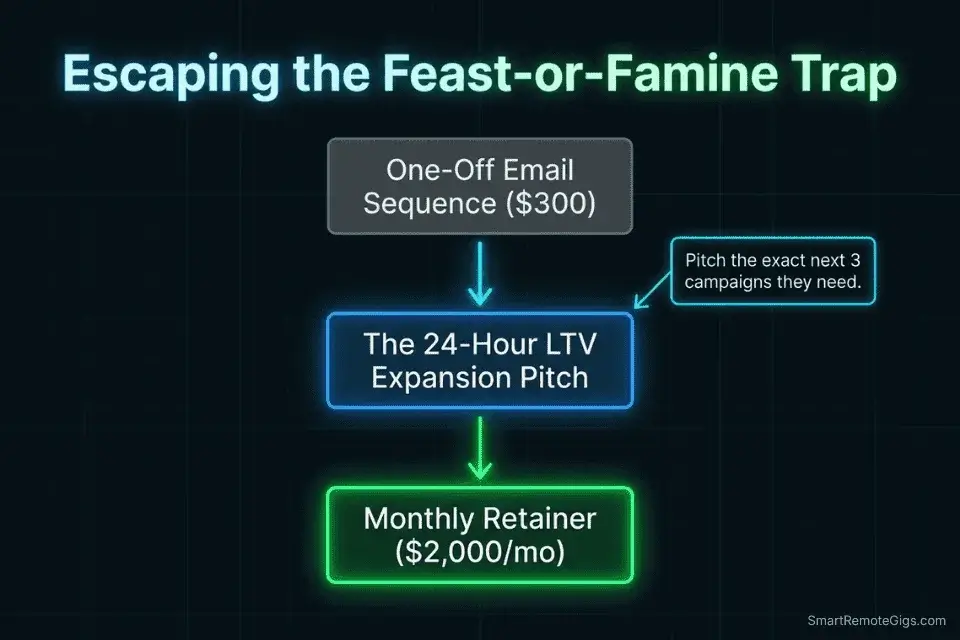
You deliver a clean email sequence. The client loves it. You get paid. Then you go right back to the pitch grind — sourcing, pitching, following up — for the next one-off that pays the same rate. That cycle is the feast-or-famine trap that keeps most copywriters stuck at $2,000–$3,000 months regardless of how good their writing is.
The exit is not finding better clients. The exit is converting the clients you already have.
When it comes to scaling high-paying remote writing jobs, your primary metric for success is how many one-off transactions you convert into recurring revenue — because recurring revenue is the only thing that breaks the feast-or-famine cycle permanently.
The Exact Playbook
- Deliver the one-off email sequence 24 hours early and completely error-free. On-time is average. Early is the move that makes them think “I need to keep this person.” Error-free is non-negotiable — one typo in a delivered email sequence erases the case for trusting you with an ongoing retainer.
- Include a “LTV (Lifetime Value) Expansion Plan” alongside your final delivery. A one-page Google Doc: what happens to the customer after the sequence ends? Where are they dropping off? What 3 campaigns would extend their lifetime value by another 30–60 days? This document costs you 20 minutes and looks like $800 worth of strategy.
- Propose managing their ongoing weekly newsletter and promotional blasts to retain the customers you just acquired. You already know their brand voice. You already know their customer. The transition from one-off to retainer is the lowest-friction sale you will ever make — the client doesn’t have to onboard anyone new.
- Offer a slight discount for locking in a 3-month commitment. Cap it at 10–15%. Enough to feel like a win for them, not enough to erode your monthly floor. Frame it as “locking in the rate” not “giving a discount.”
The Retainer Pivot Script
Strike while the client is thrilled with your first delivery — that window is 24–48 hours after approval and it closes fast.
Subject: Your [ONE-OFF DELIVERABLE] is live — and I found 3 retention gaps
Hi [CLIENT NAME],
Your [ONE-OFF DELIVERABLE] is attached — delivered 24 hours ahead of schedule. Let me know if you want any final tweaks.
While wrapping this up, I mapped out what happens to these customers after the sequence ends. Right now, you’re leaving a significant LTV window uncaptured.
I’d like to manage your [NEW ONGOING SERVICE] on a monthly retainer at [MONTHLY RETAINER PRICE]/month, locked in for 3 months. That gives you a 12% discount versus one-off rates and keeps the momentum from this campaign alive.
I can send the full LTV Expansion Plan as a Google Doc — takes 5 minutes to review.
Want me to send it over?
[YOUR NAME]
PLACEHOLDER NOTES:
[CLIENT NAME] — First name only. Always.
[ONE-OFF DELIVERABLE] — The exact asset you just delivered: “your 5-part welcome sequence,” “your product launch email,” “your homepage copy.” Be specific — it confirms you are talking about their project, not a mass email.
[NEW ONGOING SERVICE] — Name the exact next service: “weekly promotional newsletter,” “monthly campaign calendar,” “abandoned cart sequence.” Propose the specific thing — never “ongoing copywriting work.”
[MONTHLY RETAINER PRICE] — Starting floor: $1,200–$2,000/month for 4–6 emails per month. Calibrate to their company size and email list volume. Do not go below $1,000/month regardless of their hesitation.
DO NOT CHANGE: The LTV Expansion Plan offer. It reframes the retainer pitch as a strategic consultation, not a sales ask. Clients accept consultations; they resist sales pitches.
The Pro Tip / Red Flag
Red Flag: Never ask “Do you have any more copy needs right now?” That forces the client to do the strategic thinking — and if nothing comes to mind immediately, you lose the moment. Always prescribe the exact next three campaigns they need by name. Prescriptive wins. Passive loses.
👻 Scenario 2 — The Resurrection: Reviving the Ignored Pitch
You sent the pitch. You followed up. Nothing. Most copywriters delete the thread and move on, convinced the lead is dead. It is not dead — the timing was wrong, or the subject line missed, or they were buried in a product launch and your email sat unread for 9 days. That is not a lost lead. That is a timing problem with a script attached.
Abandoning dead leads is burning your own pipeline — the most expensive leads you will ever have are the ones you already did the sourcing work to find.
People hunting for entry level remote writing jobs quit after one ignored email; professionals know the real money is made on the fifth follow-up, where 80% of sales that eventually close actually happen.
The Exact Playbook
- Wait exactly 7 days after your last follow-up email. Not 3. Not 14. Seven days is the gap that reads as professional persistence rather than desperation. Anything shorter feels like pressure; anything longer feels like you forgot them.
- Find a new piece of industry news, a competitor’s ad, or a broken element on their site. Spend 10 minutes on this. A competitor just launched a similar product. A major platform updated its algorithm. Their checkout button is broken on mobile. Any of these gives you a credible, value-forward reason to reach back out.
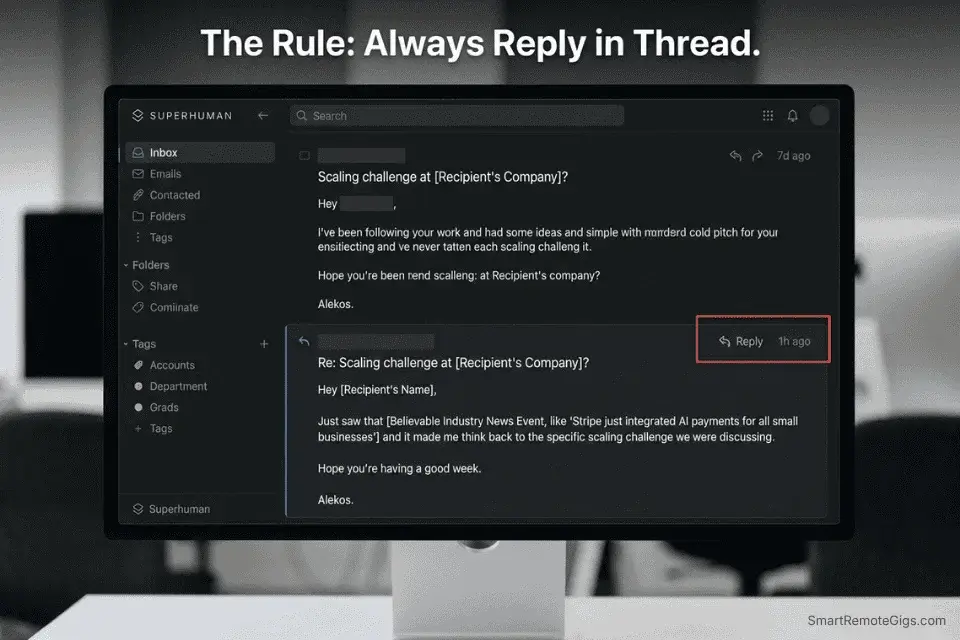
- Reply directly to your original email thread — do not start a new one. The thread preserves context. Starting a new email forces them to do cognitive work to remember who you are. Keep the thread alive and all the prior context comes with it.
- Frame the check-in entirely around the new value — completely ignore the fact they ghosted you. No “just following up.” No “I wanted to circle back.” You are an industry peer flagging something relevant, not a vendor chasing a reply.
The 7-Day Ghosting Revival Pitch Script
This script works because it removes the guilt of the unreturned email and positions you as someone watching their space — not someone waiting for a paycheck.
[Reply to original email thread — DO NOT start a new email]
Subject: [Keep the original subject line — just hit Reply]
Hi [CLIENT NAME],
Wanted to flag something relevant before you head into the week.
[INDUSTRY NEWS/COMPETITOR MOVE] just dropped — and it directly affects [HOW IT IMPACTS THEIR COPY]. Specifically, it means [ONE CONCRETE IMPLICATION: audience shift, new objection to handle, competitor angle to counter].
Given the pitch I sent over earlier, this actually strengthens the case for [THE COPY SOLUTION YOU ORIGINALLY PROPOSED]. Happy to adjust the approach if you’d like to revisit.
Still available this week if the timing works better now.
[YOUR NAME]
PLACEHOLDER NOTES:
[CLIENT NAME] — First name. Still. Every time.
[INDUSTRY NEWS/COMPETITOR MOVE] — Be specific. “Meta just rolled out a new landing page ad format” or “[Competitor Brand] launched a loyalty program targeting your exact customer.” Generic “industry news” kills the credibility of the entire script.
[HOW IT IMPACTS THEIR COPY] — Connect it directly to their funnel. If they sell skincare, how does this news affect their conversion copy or ad targeting? Do the inference work for them — that inference is what makes you valuable.
DO NOT CHANGE: The final line — “Still available this week if the timing works better now.” It implies timing was the issue, not disinterest. That reframe removes the awkwardness of the ghost entirely and gives them a graceful way back into the conversation.
The revival email lives or dies on the subject line. A weak subject on a third touchpoint gets auto-archived before the body is read.
Type any subject line and get an instant score out of 100 — plus clear, actionable tips on length, spam signals, power words, and readability. Stop guessing what will get opened. Know before you hit send.
The Pro Tip / Red Flag
Pro Tip: Keep your revival subject lines insanely casual. “Quick question regarding [Brand Name]” or “Saw this and thought of your Q3 launch” outperform formal subject lines by a wide margin on third-touch emails. The casual framing signals peer, not vendor — and peers get opened.
🛒 Scenario 3 — The Tear-Down: Pitching an E-Commerce Brand
D2C e-commerce founders are drowning in ad spend and watching their landing pages bleed conversions. They know something is wrong. They do not know what. Most of them have neither the time nor the copywriting vocabulary to diagnose it themselves — which is exactly why a structured, specific tear-down email from a stranger gets a response when a polished pitch deck does not.
You are not pitching your services. You are handing them the diagnosis. Then you offer to perform the surgery.
Much like landing remote technical writing jobs, securing e-commerce clients requires auditing the existing asset and proving you know how to fix it before you demand a paycheck — the value demonstration precedes the contract.
The Exact Playbook
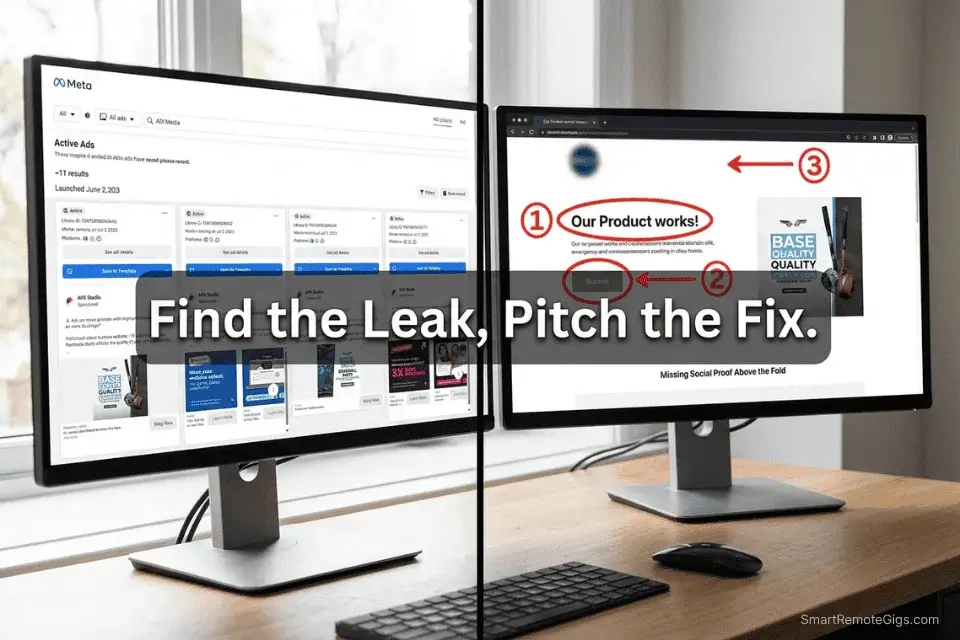
- Find D2C brands actively running ads on the Meta Ad Library. Go to Meta’s Ad Library, filter by “Active” ads, and search your target niche: skincare, supplements, apparel, home goods. Brands spending on ads are generating revenue and have active marketing budgets. That is the only qualifier you need.
- Click through to their landing page and identify 3 critical friction points. You are looking for: a headline that leads with features instead of outcomes, missing or generic social proof above the fold, a CTA that says “Shop Now” instead of something desire-specific. Three specific friction points is the format — more than three and it reads like a complaint; fewer than three and it reads like you didn’t look hard enough.
- Write a structured “Tear-Down” email or record a 3-minute Loom video walking through the fixes. The Loom video converts at a higher rate than text alone because it is harder to ignore — a personal video in a founder’s inbox from someone who clearly watched their page is a pattern interrupt. Either format works; the Loom just works faster.
- Send it directly to the Founder or Head of Growth — not the marketing@email address. Find them on LinkedIn, their About page, or their podcast appearances. The founder is the decision-maker and the one who feels the financial pain of a leaking funnel most directly.
The Conversion Rate Tear-Down Script
This is a high-value, high-leverage pitch. You are giving away the strategy and selling the execution — that structure is what separates this from every other cold email in their inbox.
Subject: 3 things costing [BRAND NAME] conversions on [LANDING PAGE URL]
Hi [FOUNDER NAME],
I was browsing [BRAND NAME]’s ad from [PLATFORM] and clicked through to your landing page. I do conversion copywriting for D2C brands, so I couldn’t help auditing it.
Here’s what I found:
[SPECIFIC FLAW 1 from 3 SPECIFIC FLAWS] — [Why it costs them conversions in one sentence]
[SPECIFIC FLAW 2 from 3 SPECIFIC FLAWS] — [Why it costs them conversions in one sentence]
[SPECIFIC FLAW 3 from 3 SPECIFIC FLAWS] — [Why it costs them conversions in one sentence]
Each of these is fixable in a single rewrite session. I charge [YOUR REWRITE RATE] for a full above-the-fold rewrite with 2 headline variations and a revised CTA block — turnaround is 48 hours.
Worth a quick call this week?
[YOUR NAME]
PLACEHOLDER NOTES:
[FOUNDER NAME] — First name. Find via LinkedIn, their brand’s About page, or podcast appearances. Founders respond at a far higher rate than any marketing@ inbox.
[LANDING PAGE URL] — Include the actual URL in the subject line. Seeing their own URL in a stranger’s email creates instant relevance and stops the scroll.
[3 SPECIFIC FLAWS] — These must be real and specific to their exact page. “Your headline leads with ingredient names instead of the transformation your customer wants” is specific. “Your copy could be clearer” is useless. Do the work before you hit send.
[YOUR REWRITE RATE] — Floor: $1,000 for a full above-the-fold rewrite. Never quote below this in a cold pitch — anchoring low signals you don’t understand the value of conversion copy.
DO NOT CHANGE: The numbered list structure. It signals analytical thinking, not creative pitch energy. Founders respond to structured diagnosis — it looks like the output of a professional, not a freelancer hoping for work.
The Pro Tip / Red Flag
Red Flag: Never insult their current copy directly. Do not say “your headline is weak” or “this CTA is terrible.” Say “I noticed an opportunity to reduce bounce rate on the above-the-fold section.” The insight is identical — the framing is the difference between a reply and a block. Ego kills deals at the founder level faster than anything else.
📈 Scenario 4 — The Multiplier: Upselling a Client on Ad Copy
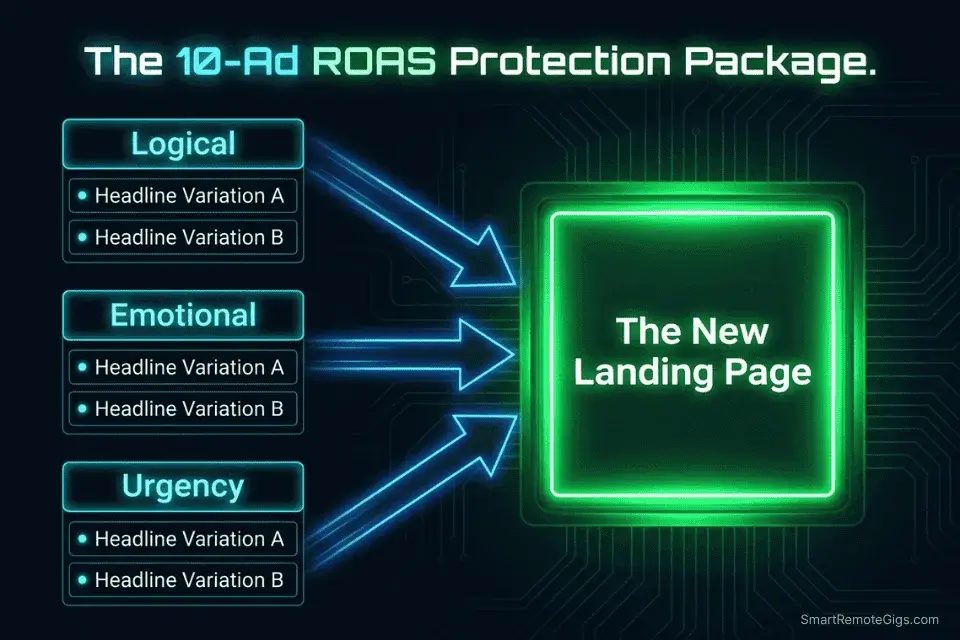
You rewrote the landing page. It is live and converting. The client is happy. Now they need traffic to feed it — and if you are not the one writing the ads, someone else is. That someone else is now in the client relationship you built. Do not let that happen.
The ad copy upsell is not a separate pitch. It is the logical next sentence of the same conversation.
Scaling from single projects to multi-channel retainers is impossible unless you aggressively manage your client pipeline through dedicated productivity platforms — without a structured CRM tracking every delivery date, upsell window, and follow-up trigger, the multiplier opportunity slips past you every single time.
The Exact Playbook
- Deliver the final landing page copy or email sequence on schedule. Clock starts the moment they confirm it is live. The upsell window is 24–72 hours after go-live — while the product is front of mind and the excitement of launching is still running.
- Wait for the client to confirm the copy is live — then pitch the same day. Do not pitch before it is live. You want them in the mental state of “this is live and I need results” — that is the exact psychological moment when ad copy feels necessary, not optional.
- Pitch a package of 5–10 Meta or Google ad variations designed specifically to feed the new funnel. Not generic ads. Ads that match the messaging architecture you already built into the landing page. The continuity is the pitch — their media buyer doesn’t have to brief a new writer on the brand voice because you already own it.
- Position the ad copy as “protecting their investment” in the landing page rewrite. A high-converting landing page with no traffic is a parked car. The ad copy is the engine. Frame it that way and the upsell stops feeling like an upsell and starts feeling like the obvious next step.
The ROAS Upsell Pitch Script
ROAS (Return on Ad Spend) is the only metric that matters at this stage. Frame your upsell around feeding the funnel you already built — not around adding a new service.
Subject: Your new page is live — here’s how to feed it
Hi [CLIENT NAME],
Saw the new page is live — looking sharp. Now comes the part that actually moves the needle: getting the right traffic to it.
I put together a proposal for a 10-ad package (3 angles × 2 headline variations + 4 static ad bodies) built specifically to match the messaging framework on the new page. Running mismatched ad copy against a high-converting landing page kills ROAS before you get clean data.
The full package is [AD COPY PACKAGE PRICE], delivered within 5 business days. Ready to test immediately.
Want me to send the creative brief?
[YOUR NAME]
PLACEHOLDER NOTES:
[CLIENT NAME] — First name. Still.
[LIVE FUNNEL URL] — Reference the specific landing page URL in conversation to anchor the pitch to something they just launched and are emotionally invested in.
[AD COPY PACKAGE PRICE] — Floor: $800–$1,200 for a 10-variation ad package. Never sell individual ads — a single ad is too easy to say no to and too small to move the revenue needle for either party.
DO NOT CHANGE: The ROAS framing. “Mismatched ad copy kills ROAS before you get clean data” is the technical reason that makes this pitch impossible to rationally decline. It shifts the frame from “buying more copy” to “protecting the investment they already made.”
The Pro Tip / Red Flag
Pro Tip: Bundle your ad copy — never sell one ad. Sell 3 angles (Logical, Emotional, Urgency) with 2 headline variations each. That gives their media buyer 6 headlines and 3 body copy directions to split-test on day one. A media buyer who can actually test your copy is a media buyer who tells the founder your package was worth it.
💰 The ROI Reality: Pricing Your Words Like a Revenue Function
Copywriting is not paid by the word. It is paid by the yield. A 10-word headline that lifts a brand’s conversion rate by 1.5% on a $500K monthly revenue store is worth more than 50 blog posts. That is the framing you need to internalize before you ever quote a price.
The Bureau of Labor Statistics places median writer earnings at $72,270 — but direct-response copywriters operate in a fundamentally different financial bracket where output is measured in revenue generated, not words delivered. Business publications including Forbes consistently list sales copywriting as one of the few high-income freelance skills capable of scaling into the multiple six-figure range without hiring a team.
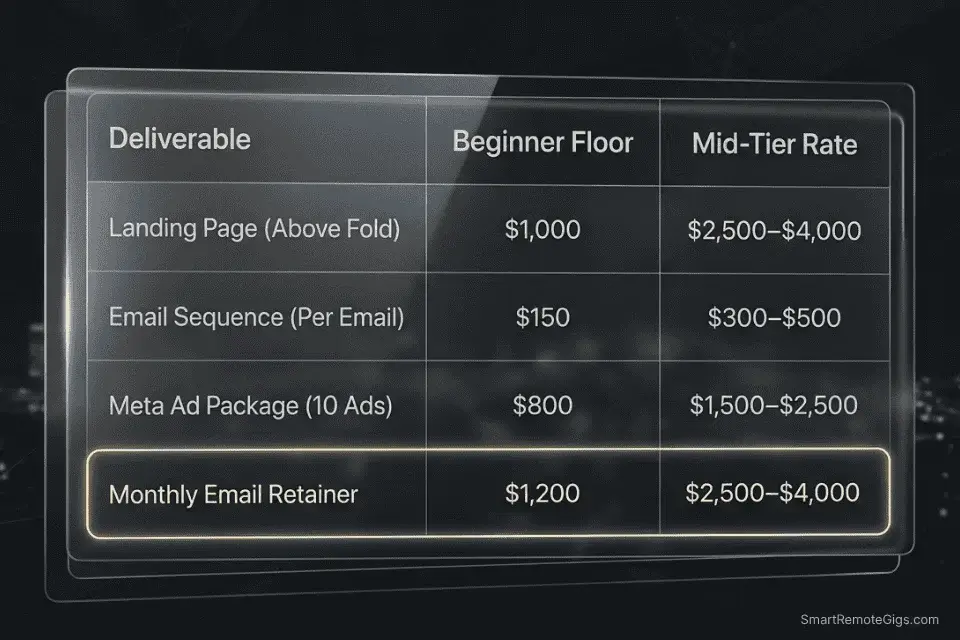
Here is a defensible rate floor for every deliverable in your copywriting stack:
Deliverable | Beginner Floor | Mid-Tier Rate | Retainer Anchor |
|---|---|---|---|
Landing page (above fold) | $1,000 | $2,500–$4,000 | — |
Email sequence (per email) | $150 | $300–$500 | — |
Facebook/Google ad package (10 ads) | $800 | $1,500–$2,500 | — |
Monthly email retainer (4–6 emails) | $1,200 | $2,500–$4,000 | 3-month lock-in |
Full funnel (landing page + sequence + ads) | $3,500 | $7,000–$12,000 | — |
Never charge hourly for direct-response copy. Charge a flat rate for the asset. If you charge $50/hour, you are punishing yourself for writing fast — and fast delivery is one of your core competitive advantages.
Knowing your floor before a negotiation call is what prevents the anchor from being set by the client.
Most freelancers guess their rate. This free calculator helps you set yours with precision — built around your actual monthly expenses, desired profit, and billable hours so you never undercharge again.
🗓️ The 30-Day Execution Plan
Days 1-3: The Asset Audit
- Remove all generic “content writing” or “blog writing” terminology from your LinkedIn profile, portfolio, and email signature.
- Reposition yourself explicitly as a “Direct-Response Copywriter” or “Conversion Copywriter.” That title change alone filters out low-budget content buyers and attracts founders who understand copy as a revenue lever.
- Build 3 strong spec pieces: a 5-part email welcome sequence, a landing page above-the-fold rewrite, and a 10-variation Facebook ad package. These three formats cover 90% of what high-ticket clients need.
Pro Tip: Prospects do not want to see academic essays or blog samples. Show them mockups of your copy placed directly onto a live webpage design — screenshot their actual competitor’s page and overlay your version. The visual comparison closes the gap between “nice writing” and “this will make me money.”
Days 4-7: The Target List
- Identify 20 D2C e-commerce brands or B2B SaaS companies actively spending on ads. Use the Meta Ad Library filtered by niche — if they are running paid traffic, they have a marketing budget and a conversion problem.
- Find the exact names and direct emails of the Founders, CMOs, or Heads of Growth. LinkedIn Sales Navigator and Hunter.io are your tools here. Contact forms and marketing@ addresses go into a void.
- Audit 5 of those landing pages using the Tear-Down framework. Screenshot the current above-fold, note 3 specific friction points, and draft your pitch email before you move on. Prep work done in advance is the only way to sustain pitch volume.
Copywriters who refuse to use AI for research are rapidly losing ground to freelancers using ai content writer jobs platforms and tools to scale their market analysis 10x faster — specifically for competitor ad research and audience language mining.
Days 8-14: The Pitching Sprint
- Send 5 Tear-Down pitches or direct cold emails every single morning before 10 AM. Morning sends consistently outperform afternoon sends for B2B and founder-level inboxes.
- Use the templates provided in this playbook. Do not alter the core psychology of any script — the structure is what converts, not the personalization alone.
- Track every pitch, open, and response in a simple CRM. If you are not tracking, you are guessing. Volume without tracking is noise.
Days 15-21: The Follow-Up Game
- Deploy the 7-Day Ghosting Revival pitch to every non-responder from Week 2. One revival per lead. Short. New value hook. No apology for the silence.
- Respond to every interested founder by immediately offering a 15-minute discovery call link — not a proposal, not a quote. A call. Proposals sent without a call close at under 15%.
- Close your first landing page or email sequence project. That first closed deal funds the next 30-day cycle and gives you a real client result to reference in future pitches.
If you stumble on discovery calls or lose control of the pricing conversation, grab our outreach frameworks and sales scripts to keep the close on track.
Days 22-30: The Delivery and Upsell
- Deliver the copy flawlessly — 24 hours ahead of the agreed deadline. Early delivery is the most effective trust signal you have before you have a track record of results.
- Immediately trigger the Retainer Pivot Script or the ROAS Upsell Script within 24 hours of client approval. The upsell window closes fast — do not let it go cold.
- By Day 30: You are no longer a one-off freelancer. You are a retained growth partner with a predictable monthly revenue floor and a client who has already said yes to you twice.
❓ Frequently Asked Questions
How long does it take to land a remote writing job?
It depends on your pitching method. Using the Tear-Down approach, most copywriters close their first project within 7–14 days of consistent outreach. Converting that project into a retainer typically happens within 30 days of the first delivery. Job board applications average 6–10 weeks of rejection before a single callback.
What are the highest paying remote writing jobs?
It depends on the niche and the deliverable. Direct-response sales copywriting, VSL (video sales letter) scripting, and email marketing retainers for D2C e-commerce brands consistently sit at the top of the compensation stack. VSL writers command $5,000–$25,000 per script. Email retainers for high-volume brands range from $3,000–$8,000 per month. The pattern is always the same: the closer your copy is to a revenue event, the higher it pays.
Can I get a remote copywriting job with no experience?
Yes — with a spec piece strategy, not a job application. Build 3 targeted spec pieces in the format your niche actually buys (landing pages, email sequences, ad copy), then pitch the tear-down approach to 20 D2C brands. Your ability to identify conversion problems in their existing funnel is more convincing to a founder than 3 years of blog writing for someone else.
Are online freelance copywriting jobs legit?
Yes — the high-paying ones are real, but they are almost never found on generic job boards. Direct-response copywriting retainers at $3,000–$8,000/month are sourced through direct founder outreach, referrals from other freelancers, and copy-specific communities like the Copywriter Club or Copy Chief. Upwork and Fiverr have copywriting categories, but the rate ceiling on those platforms rarely reaches what direct outreach closes in the first week.
How much do remote copywriters make per hour?
It depends on how you price your work. Copywriters billing hourly earn $40–$75/hour at the mid-tier. Copywriters billing by deliverable — landing pages at $1,000–$4,000, email sequences at $150–$500 per email — earn the equivalent of $150–$400/hour on the same output volume. Never bill hourly for direct-response copy. The work’s value is in the revenue it generates, not the time it took to write.
Where can I find full-time remote copywriting jobs?
Yes — We Work Remotely, LinkedIn, and direct outreach to growth-stage D2C and SaaS companies are the three highest-yield channels. In-house copywriting roles at funded companies pay $70K–$120K annually with benefits, and they are almost always filled before they hit public job boards. The fastest path to a full-time offer is closing 2–3 successful freelance projects for a company and proposing the in-house role yourself.
Do you need a degree for remote copywriting jobs?
No. Direct-response copywriting is evaluated entirely on whether your words move people to act. A portfolio of 3 converting spec pieces and one closed client project outperforms a marketing degree in every copywriting interview I have ever seen or been part of.
The Verdict: Ditch the Job Boards, Hunt Direct
The barrier to entry for remote copywriting jobs is non-existent — which means the bottom of the market is a bloodbath. If you submit resumes on job portals, you are asking to be compared against thousands of cheap alternatives on price alone. That is a race with no finish line and no prize.
The top copywriters working today do not apply for jobs. They find businesses leaking revenue through a broken funnel, write the solution, and pitch the founder directly with proof of the problem already in hand. They stop asking for permission to write and start proving they know how to sell.
Copywriters who keep treating this like a job search — sending resumes, waiting for callbacks, competing for remote writing jobs posted on public boards — will stay at the bottom of the market indefinitely, because the board is where buyers go to find the cheapest option, not the best one.
When you are ready to bypass the race to the bottom, find remote writing roles directly through platforms built for high-ticket freelancers who price on value, not volume.
The Verdict: The job board is where copywriters go to compete on price. The founder’s inbox is where they go to compete on value. Pick one and commit.
While you build your copywriting income, don’t leave money on the table. Head to the SRG Job Board at /jobs/ for vetted, high-paying retainers. Browse the SRG Software Directory at /software/ for the AI and productivity tools to scale your output.

Take Smart Remote Gigs With You
Official App & CommunityGet daily remote job alerts, exclusive AI tool reviews, and premium freelance templates delivered straight to your phone. Join our growing community of modern digital nomads.

![AI Content Writer Jobs: [My 2026 Survival Playbook]](https://smartremotegigs.com/wp-content/uploads/2026/04/ai-content-writer-jobs-hero.webp)
![Remote Technical Writing Jobs: [The $80K/Yr Guide]](https://smartremotegigs.com/wp-content/uploads/2026/04/remote-technical-writing-jobs-hero.webp)
![Entry Level Remote Writing Jobs: [Tested Playbook]](https://smartremotegigs.com/wp-content/uploads/2026/04/entry-level-remote-writing-jobs-hero.webp)