
AI Content Writer Jobs: [My 2026 Survival Playbook]
 ·
Last Updated: April 21, 2026 ·
25 min read
·
Last Updated: April 21, 2026 ·
25 min read 
Watching generative AI pump out soulless, hallucinated garbage while agencies fire their writers to save a few bucks is terrifying if you don’t know how to pivot.
One pitch to audit and “humanize” a struggling marketing agency’s AI output landed a $4,000 monthly fact-checking and editing retainer.
Here is the exact survival playbook and copy-paste scripts to stop competing against bots and start getting paid to train, manage, and fix them.
Smart Remote Gigs (SRG) builds street-level freelance strategies—we don’t just list jobs, we give you the exact scripts to close them.
SRG has analyzed over 500 successful AI content training and editing contracts across tech platforms and digital agencies in 2026.
⚡ SRG Quick Summary
One-Line Answer: Surviving as a writer in 2026 means transitioning from writing from scratch to training AI models, engineering prompts, and rigorously editing AI output for agencies.
🚀 Quick Wins:
- Apply to one human-in-the-loop LLM training platform (like Outlier or Scale AI) today.
- Pitch 3 local marketing agencies an “AI Content Audit” to fix their robotic blog posts this week.
- Finalize your custom AI Workflow SOP to double your own content output this month safely.
📊 The Details & Hidden Realities:
- $72,270 — The baseline median wage for writers, but specialized AI prompt editors are charging $50–$80/hour premium rates for fact-checking work that requires genuine expertise.
- Brands thought AI would make content free; instead, it created a massive legal and branding liability that only human editors can fix.
🧠 Scenario 1 — The Model Trainer: Applying for LLM Prompt Engineer Roles
AI companies are not replacing writers. They are hiring them — aggressively — to do something more cognitively demanding than churning out blog posts. They need writers who can identify when a model is hallucinating, enforce logic chains, score response quality, and catch the subtle errors that non-writers completely miss.
This is the new entry-level writing gig. And it pays better than most mid-tier content mill rates.
Writers who have been pursuing standard remote writing jobs through job boards are increasingly finding that the same skills that make them strong editors — attention to logic, tone consistency, and factual accuracy — make them ideal candidates for LLM training roles that pay significantly more.
These LLM training roles have effectively replaced traditional entry level remote writing jobs, offering a much higher baseline pay for those willing to do the tedious grading work that requires genuine reading comprehension and domain expertise.
The Exact Playbook
- Search platforms like LinkedIn, Scale AI, Outlier, and DataAnnotation for “AI Editor,” “RLHF Trainer,” or “Prompt Engineer” roles. Filter by “Remote” and sort by date posted — these roles open and close fast. Set a daily job alert so you catch new postings within hours of them going live, not days.
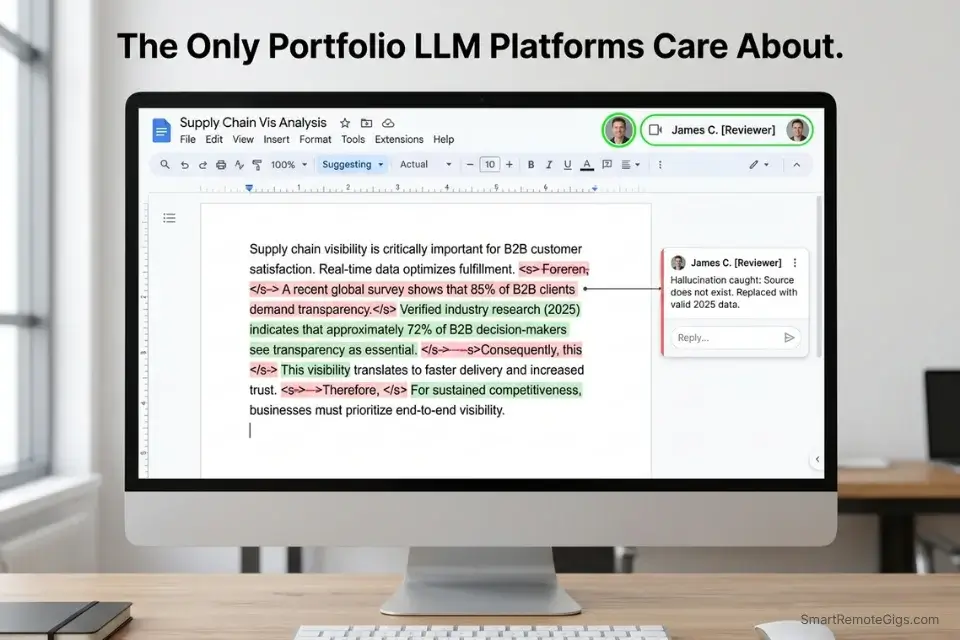
- Build a portfolio that shows the raw AI prompt next to your human-edited final version. Not just finished articles. A before-and-after comparison where you highlight every hallucination caught, every tone correction made, and every logical gap you closed. That diff is your entire credential in this hiring process.
- Focus your application on your ability to spot hallucinations and enforce brand guidelines. LLM hiring managers are not looking for creative writers. They are looking for rigorous, detail-obsessed editors who can grade AI responses against a rubric without letting sloppy outputs slide. Position that skill explicitly.
- Bypass standard applications by messaging the project manager directly with a sample prompt teardown. Find them on LinkedIn using the company name and title. Send a brief DM with one example of an AI response you would flag and why — that demonstration of real skill gets more responses than 50 submitted applications.
The Prompt-Editor Portfolio Pitch Script
Show them you understand that your job is not to write — it is to enforce logic, catch fabrication, and ensure the model output meets a defined quality standard.
Subject: AI Content Editor — Sample Prompt Teardown for [AI COMPANY/MODEL]
Hi [HIRING MANAGER NAME],
I specialize in [YOUR NICHE EXPERTISE] and have been tracking the quality gaps in AI-generated content in this space closely. I put together a sample teardown of a hallucinated [YOUR NICHE EXPERTISE] response to demonstrate how I evaluate model output.
Here it is: [PORTFOLIO LINK]
The teardown shows: one fabricated statistic I flagged and sourced correctly, one logical inconsistency I identified, and one tone deviation I corrected against a defined brand voice.
I am available for a test task if that fits your evaluation process.
[YOUR NAME]
PLACEHOLDER NOTES:
[HIRING MANAGER NAME] — Find via the company’s LinkedIn page, their Careers page, or by searching “[Company Name] + Content Lead” on LinkedIn. Address them by first name.
[AI COMPANY/MODEL] — Name the exact platform: “Scale AI,” “Outlier,” “DataAnnotation,” “Appen.” Customizing for each company shows you are not mass-applying.
[YOUR NICHE EXPERTISE] — The more specific the better. “Healthcare compliance documentation,” “fintech regulatory copy,” “B2B SaaS onboarding flows” — a niche signals you can catch domain-specific hallucinations that a generalist editor would miss entirely.
[PORTFOLIO LINK] — A Google Doc or Notion page showing the raw AI output with your edits and annotations visible. Turn on “Suggesting” mode so the changes are visually clear — this is your entire pitch.
DO NOT CHANGE: The three-point teardown structure. It proves methodical thinking in 30 seconds — exactly what LLM project managers are screening for.
The Pro Tip / Red Flag
Pro Tip: LLM training jobs often pay tiered rates based on subject-matter expertise. If you have a background in law, medicine, or finance, state it in the first sentence of every application — not in a bullet point buried in your resume. Niche expertise automatically bumps you to a higher pay tier where the hourly rate can double the standard rate for general content editing.
🕵️ Scenario 2 — The Fixer: Pitching Agencies to “Humanize” Their Output
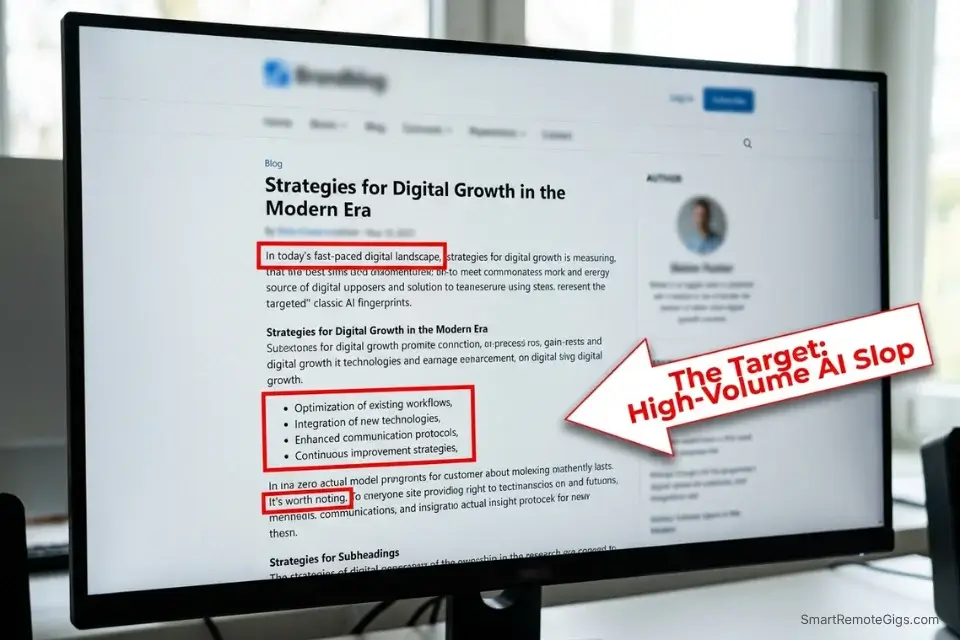
Marketing agencies made a calculation: fire the writers, use ChatGPT, keep billing the clients the same rate. That math worked for about six months. Now their clients’ organic traffic is dropping, their blog posts all start with “In today’s fast-paced digital world,” and the agency owner is fielding complaints about content that reads like a terms-of-service document.
They created the problem. You are the solution. And you need to walk in framing yourself exactly that way.
If you want to secure high-paying remote copywriting jobs right now, stop pitching raw copy creation and start pitching risk-mitigation for agencies drowning in AI-generated liability they do not know how to fix.
The Exact Playbook
- Identify mid-sized marketing or SEO agencies outputting high volumes of blog content. Look for agencies that publish 3–5 blog posts per week for multiple clients. At that volume, manual writing is economically impossible — which means they are almost certainly running AI at scale and hoping no one checks.
- Run their recent posts through an AI detector or simply read the first two paragraphs. You are looking for: the “In today’s fast-paced” opener, stat-heavy paragraphs with no citations, generic listicles with no field experience behind them, and transition phrases like “it’s worth noting” and “it goes without saying.” These are AI fingerprints. Screenshot them.
- Rewrite their worst introductory paragraph to inject actual human emotion, a real statistic, and field-specific pacing. Do not rewrite the whole post. One paragraph. Before and after. The contrast is your pitch — you are showing them in 30 seconds what they are sending to their clients and what it could be.
- Pitch the agency owner on a retainer to “humanize and fact-check” their automated output. Frame it as a quality assurance layer, not as a critique of their workflow. They know the AI output is weak — they do not want to admit it. You are giving them the cover to fix it quietly.
The AI-Audit Agency Pitch Script
Do not insult their use of AI. Frame this entirely as helping them scale safely — their clients never have to know what the workflow looks like behind the scenes.
Subject: Your [CLIENT/BLOG POST LINK] has a problem — here’s a quick fix
Hi [AGENCY OWNER NAME],
I was reviewing some content from your agency and ran into [THE SPECIFIC AI FLAW] in a recent post. I rewrote the opening to show what a human edit looks like against it.
Original: [CLIENT/BLOG POST LINK]
Rewritten: [YOUR REWRITE LINK]
I specialize in AI content auditing and humanization for agencies running high-volume content pipelines. My standard retainer covers 10 pieces per month — fact-checked, human-edited, and brand-voice consistent — for $2,000/month.
The first audit is free so you can see the before-and-after before committing to anything.
Worth a 15-minute call?
[YOUR NAME]
PLACEHOLDER NOTES:
[AGENCY OWNER NAME] — First name. Find via the agency’s About page or LinkedIn. Target boutique agencies with 5–20 employees — large agencies route everything through procurement; small agencies have the owner making every vendor decision.
[CLIENT/BLOG POST LINK] — Link to the actual published post you audited. Referencing their real content proves you did the work and creates immediate recognition — they know exactly which post you’re talking about.
[THE SPECIFIC AI FLAW] — Name the exact issue: “a fabricated statistic in paragraph 3,” “an ‘In today’s fast-paced world’ opener,” “a hallucinated citation that links to a 404 page.” Specific beats general every time.
[YOUR REWRITE LINK] — A Google Doc with Track Changes or Suggesting Mode active. Shows the exact edits without claiming ownership of their content.
DO NOT CHANGE: The free first audit offer. It removes 100% of the financial risk on their side and puts your editing quality directly in front of the decision-maker before any commitment is required.
Your subject line on an agency cold pitch is doing the same filtering work your headline does on a landing page — a weak one gets archived before the body is read.
Type any subject line and get an instant score out of 100 — plus clear, actionable tips on length, spam signals, power words, and readability. Stop guessing what will get opened. Know before you hit send.
The Pro Tip / Red Flag
Red Flag: Never position yourself as “anti-AI” or signal that you think agencies should stop using it. Agencies use AI because it protects their margins — that is a financial reality, not a moral failure. Position yourself as the final quality assurance layer that keeps their clients from noticing the workflow and keeps the agency from getting fired. That framing keeps you in the room.
⚖️ Scenario 3 — The Auditor: Negotiating Rates for AI Fact-Checking
Editing AI output is not like editing a human draft. When a human writer makes an error, they usually made a plausible mistake. When an AI hallucinates, it fabricates case law that does not exist, invents statistics with realistic-sounding decimal points, and quotes real people saying things they never said — all with complete confidence and zero indication that anything is wrong.
Unraveling a single fabricated AI statistic can take 45 minutes of deep research across primary sources. You cannot charge a per-word rate for that.
Standard remote writing jobs are priced based on content creation — but AI editing jobs must be priced based on liability protection, or you will consistently lose money doing work that is worth far more than you charged for it.
The Exact Playbook
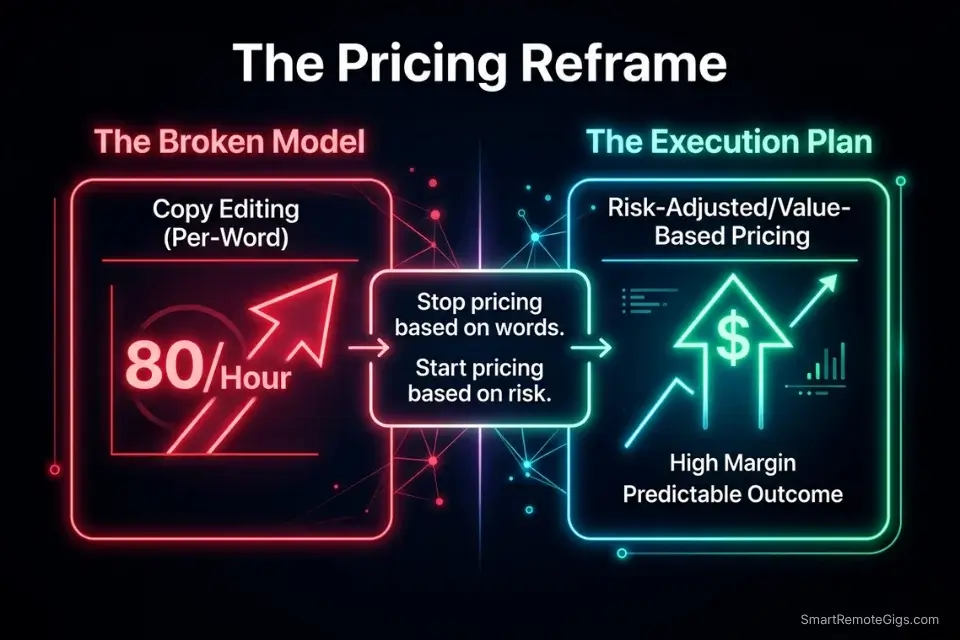
- Refuse any per-word pricing model for AI editing. Per-word rates were designed for human writers producing original content at a predictable pace. AI generates 2,000 words in 8 seconds — per-word pricing for editing that output means you are paid next to nothing for work that requires genuine expertise. The model is broken. Do not accept it.
- Propose a high hourly rate anchored to “Fact-Checking and Liability Reduction” — not “editing.” The framing is the negotiation. “Editing” sounds like proofreading. “Liability Reduction” sounds like legal risk management. The second framing commands $50–$80/hour. The first commands $25/hour. Same work, different price, entirely because of how you named it.
- Define strict scope boundaries upfront. If the AI draft is more than 40% hallucinated content — meaning most of the factual claims require primary-source verification — you hold the right to scrap the draft entirely and charge your standard rate to rewrite from scratch. Get this in writing before you start.
- Use hard industry data to justify your hourly rate in every proposal. Pull the BLS median for editors ($63,350) and frame your rate as the specialist premium above that median. You are not just an editor — you are a liability shield. Price accordingly.
The Fact-Check Rate Anchor Script
Anchor your price against what it costs the client to look incompetent — a hallucinated statistic published to 50,000 subscribers is a brand crisis, not a content error.
Hi [CLIENT NAME],
Before we finalize the scope, I want to make sure we’re aligned on how AI fact-checking is priced — it’s structurally different from standard copy editing.
My rate for AI content auditing and fact-checking is [HOURLY RATE]/hour. A standard 1,500-word AI draft typically requires [EXPECTED HOURS PER PIECE] hours of verification, sourcing, and structural correction.
I also include a rewrite clause in every engagement: [REWRITE CLAUSE — e.g., “If more than 40% of factual claims require primary-source correction, I reserve the right to charge my standard rewrite rate rather than the editing rate, and I will flag this within the first 30 minutes of the engagement so you can approve before I proceed.”]
This structure protects both of us — you get a defensible quality standard, and I’m not absorbing the cost of a heavily hallucinated draft.
Happy to walk through a sample piece on a 15-minute call if that helps set expectations before we start.
[YOUR NAME]
PLACEHOLDER NOTES:
[CLIENT NAME] — First name. This is a negotiation conversation, not a cold pitch — you are already in the door. Warmth matters here.
[HOURLY RATE] — Floor: $50/hour for general AI fact-checking. $65–$80/hour for niche-specific domains (legal, medical, financial). Never quote below $50 regardless of the client’s initial pushback — below that rate, the math does not work for complex hallucination correction.
[EXPECTED HOURS PER PIECE] — Be honest and specific. “1.5–2 hours per 1,500-word piece” is a defensible range. Track your actual time on the first test piece and adjust accordingly.
[REWRITE CLAUSE] — Non-negotiable. Include the exact trigger threshold (percentage of hallucinated claims) and the approval step. Clients who balk at the rewrite clause are clients who plan to send you heavily hallucinated drafts and expect you to absorb the cost.
DO NOT CHANGE: The “protects both of us” framing. It converts a potential pricing objection into a shared-interest alignment. You are not defending your rate — you are protecting their quality standard.
Before any negotiation call, you need a defensible hourly number that is grounded in the actual time and expertise the work requires — not guesswork under pressure.
Most freelancers guess their rate. This free calculator helps you set yours with precision — built around your actual monthly expenses, desired profit, and billable hours so you never undercharge again.
The Pro Tip / Red Flag
Pro Tip: Track your time ruthlessly on every AI fact-checking engagement, starting with the first test piece. Unraveling a fabricated AI statistic — finding the real source, confirming the accurate number, and rewriting the claim correctly — can take 45 minutes on a single sentence. If you do not have that data, you cannot negotiate from a position of evidence on the next contract.
⚙️ Scenario 4 — The Cyborg: Scaling Your Own Output Safely
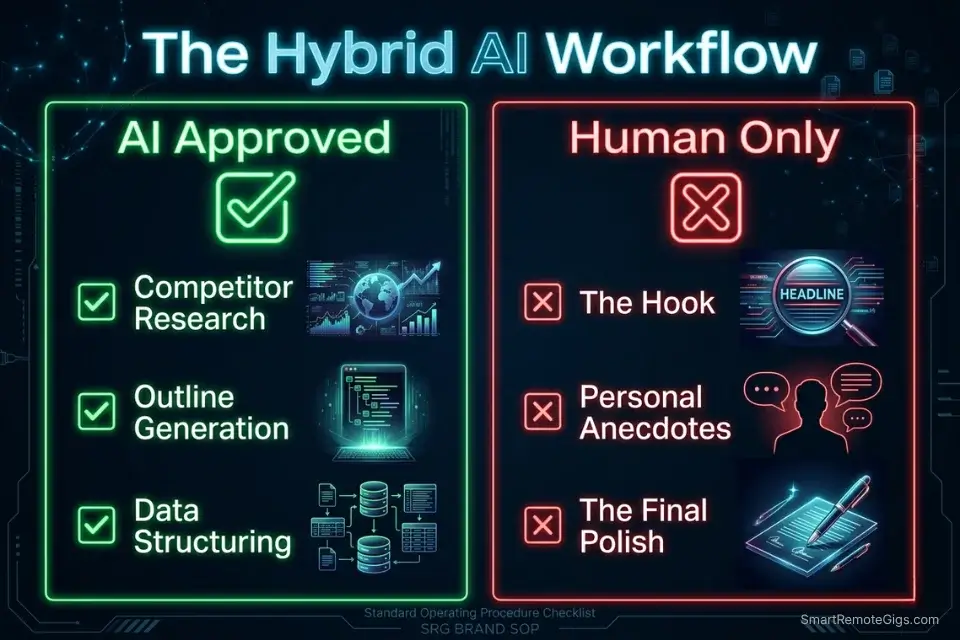
The writers who are thriving in 2026 are not the ones who refused to touch AI and the ones who handed it the wheel entirely. They are the ones in the middle — using AI as an exoskeleton for the parts of writing that do not require a human, and writing the parts that do themselves.
This hybrid approach doubles output without cutting quality. But it requires a strict SOP, or the AI starts bleeding into the sections it has no business touching.
Freelancers who refuse to touch ai writing software are being outpaced by cyborg writers who use it strictly for research and data structuring while writing the actual prose, hooks, and conclusions themselves.
This hybrid approach is especially relevant for remote technical writing jobs, where AI can format the JSON code blocks and generate the structural scaffold while you write the contextual explanations that require genuine product understanding.
The Exact Playbook
- Build a strict SOP for where AI is allowed in your workflow. Approved uses: competitor research, outline generation, summarizing long-form source material, formatting code blocks, generating data tables from structured inputs. Banned uses: writing the hook, generating personal anecdotes, producing the final polish pass, or creating any factual claim without a primary source attached.
- Ban AI from your hook, your personal anecdotes, and your final polish. These three elements are what make your writing identifiably human and genuinely valuable to clients paying a premium. The moment AI writes your hook, the entire piece loses the field-tested voice that justified your rate in the first place.
- Feed AI specific constraints, target audiences, and structured data — never a blank prompt. “Write an article about email marketing” produces garbage. “Summarize the 3 most common objections that B2B SaaS buyers have about email automation tools, sourced from G2 reviews, in under 200 words” produces research you can actually use. The quality of your output is entirely determined by the quality of your constraints.
- Use this hybrid workflow to double your capacity without dropping quality. In practice, this means AI handles the 40% of the writing process that is structural and mechanical, and you handle the 60% that requires judgment, voice, and field experience. The output is faster and the quality floor is higher because you are not starting from a blank page.
The AI Workflow SOP Script
This is your internal prompt framework — use it at the start of every new project to constrain the AI before it constrains your output quality.
INTERNAL AI WORKFLOW SOP — USE BEFORE STARTING EVERY NEW PROJECT
STEP 1 — RESEARCH PROMPT:
“Summarize the top 5 pain points that [TARGET AUDIENCE] experience with [TOPIC], using only publicly verifiable data from the last 18 months. Cite your sources. Do not invent statistics. Flag any claim you are uncertain about with [UNCERTAIN].”
STEP 2 — OUTLINE PROMPT:
“Create a structured outline for a 2,000-word guide on [TOPIC] targeting [TARGET AUDIENCE]. The outline must address [3 SPECIFIC PAIN POINTS]. Use H2 and H3 headers only. Do not write any body copy yet.”
STEP 3 — DATA PULL PROMPT:
“Pull the most recent verifiable statistics on [TOPIC] from [DATA SOURCES TO PULL FROM]. Format as a markdown table with: Stat | Source | Year. Flag any stat you cannot verify with [UNVERIFIED].”
STEP 4 — HUMAN WRITING:
Hook, personal anecdote, scenario intros, field observations, final polish, and conclusion = WRITTEN BY YOU. No exceptions.
STEP 5 — FINAL QA:
Read every AI-sourced statistic aloud. Google the source before publishing. If the source does not exist or the number is wrong, flag it and find the real figure before the draft leaves your hands.
PLACEHOLDER NOTES:
[TOPIC] — The specific article subject. The tighter the better. “Email marketing for B2B SaaS” not “email marketing.”
[TARGET AUDIENCE] — Name the exact reader: “Mid-level marketing managers at companies with 50–200 employees” not “business professionals.”
[3 SPECIFIC PAIN POINTS] — The three conversion objections or reader frustrations you identified in your client brief or keyword research. Feeding these in prevents the outline from going generic.
[DATA SOURCES TO PULL FROM] — Name specific sources: “HubSpot State of Marketing Report, Statista, BLS.gov.” Leaving this blank produces hallucinated statistics. Filling it in produces verifiable data.
DO NOT CHANGE: Step 4 and Step 5. These are not optional workflow steps — they are the firewall between your professional reputation and the AI’s tendency to generate plausible nonsense with complete confidence.
The Pro Tip / Red Flag
Red Flag: Never paste sensitive client data, internal revenue metrics, proprietary source code, or confidential strategy documents into a public LLM like ChatGPT or Claude’s free tier. You will violate your NDA, potentially expose your client’s competitive data to the model’s training pipeline, and destroy a professional relationship that took months to build — in one careless copy-paste.
💰 The ROI Reality: What AI Editors Actually Make
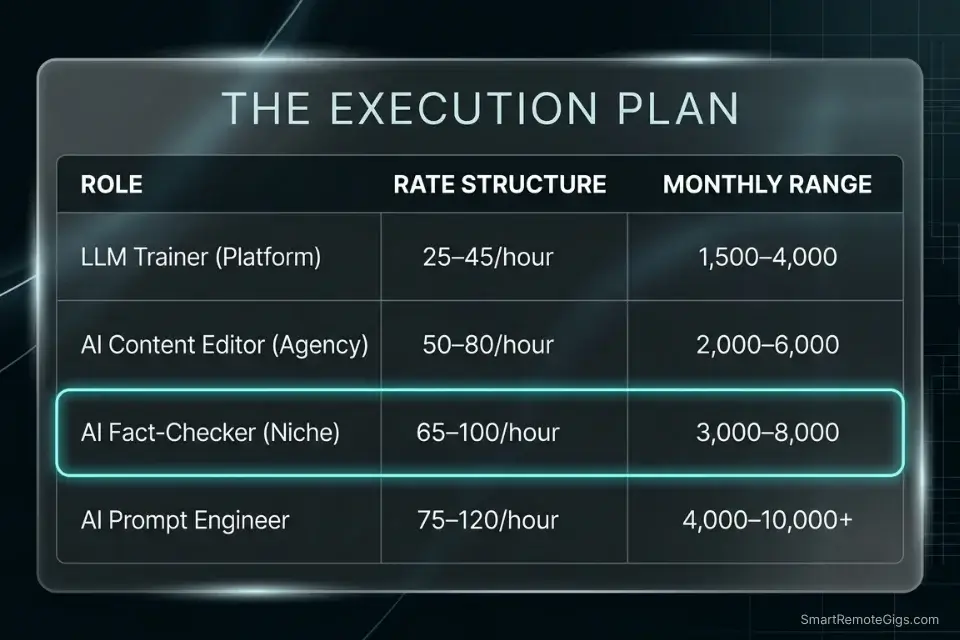
The standard objection from clients is: “The AI wrote the rough draft, so the editing should be cheap.” That objection is wrong on every level — and you need to be ready to dismantle it with data before the negotiation starts.
The Bureau of Labor Statistics places the baseline median wage for writers at $72,270, but technical editors and fact-checkers command higher premiums due to the expertise and liability protection their work provides. Forbes and industry analysts consistently flag AI management and human-in-the-loop quality control as among the most lucrative freelance skills on the current market — because demand is outpacing supply by a wide margin.
Here is what the AI content editing market actually pays in 2026:
Role | Rate Structure | Monthly Range |
|---|---|---|
LLM Trainer / RLHF Grader | $25–$45/hour (platform) | $1,500–$4,000 |
AI Content Editor (agency) | $50–$80/hour or per-piece | $2,000–$6,000 |
AI Fact-Checker (specialist) | $65–$100/hour | $3,000–$8,000 |
AI Prompt Engineer (freelance) | $75–$120/hour | $4,000–$10,000+ |
AI Audit Retainer (10 pieces/mo) | Flat $2,000/month | $2,000 floor |
The rule: charge $50–$80/hour for rigorous AI fact-checking, or build a retainer where you audit 10 pieces of AI content per month for a $2,000 flat. Never accept per-word rates for AI editing — the model is structurally wrong for the work.
🗓️ The 30-Day Execution Plan
Days 1-3: The Paradigm Shift
- Stop applying for traditional “blogging” or “content writing” roles. Archive those saved job searches and replace them with alerts for “AI Editor,” “Prompt Engineer,” “LLM Trainer,” and “AI Content Auditor.”
- Update your LinkedIn headline to: “AI Content Editor & Prompt Engineer | Fact-Checking & LLM Training.” That specific title string appears in recruiter searches that the generic “Freelance Writer” headline never will.
- Create two portfolio pieces showing the full workflow: the AI prompt you used, the raw output with hallucinations highlighted, and your polished human edit with annotations explaining every change.
Pro Tip: Visually highlight every change in your portfolio using Google Doc’s Suggesting Mode or a side-by-side screenshot. Prospects should be able to see in 10 seconds exactly which fluff you removed and which fabricated facts you caught and replaced. The visual contrast is your entire sales argument.
Days 4-7: The Target Acquisition
- Identify 10 AI platforms actively hiring LLM trainers: Outlier, Scale AI, DataAnnotation, Appen, Invisible Technologies, Surge AI. Apply to all 10 this week — these platforms run cohort hiring and spots close without warning.
- Identify 15 marketing agencies clearly running AI at scale for their clients’ SEO. Check their blog output frequency: 3+ posts per week for multiple clients is the tell. Read the first paragraph of their three most recent posts — if you spot the AI fingerprints, you have a pitch target.
- Map the decision-makers for each agency on LinkedIn. You want the agency owner or the Head of Content — not the “Marketing Coordinator” who has no hiring authority.
If you are balancing multiple AI editing retainers alongside LLM platform training hours, failing to centralize your schedule in dedicated productivity platforms will lead to missed deadlines and lost contracts. A simple Notion board with client, deliverable, deadline, and status columns takes 20 minutes to set up and eliminates the mental overhead of tracking everything in your head.
Days 8-14: The Pitching Sprint
- Apply to 2 LLM training platforms every morning — not in batches at the end of the week. Daily applications keep you visible in the platform’s active applicant pool.
- Send 3 direct AI-Audit pitches to agency owners every morning using the Agency Humanizer script. Personalize the specific AI flaw for each agency — mass pitches with generic flaws get deleted.
- Follow up on any agency pitch that shows an open or click but no reply. One follow-up, 3 days later, with a new piece of industry evidence about AI content risk.
Days 15-21: The Trial Run
- Secure a paid editing test piece from at least one agency. Do not work for free — a test piece at your stated rate is a reasonable ask and weeds out clients who do not respect your pricing.
- Time yourself strictly on every task. If it takes longer to fix the AI draft than it would have taken to write from scratch, document the hours and use that data as negotiation leverage in your next contract discussion.
Stop overthinking the follow-up and rate conversation — grab our outreach frameworks to confidently negotiate your rates once the trial piece is approved and the client is ready to commit.
Days 22-30: The Stabilization
- Lock in your first recurring agency retainer for AI fact-checking — target the $2,000/month flat-rate for 10 pieces. That single retainer establishes your income floor and frees your remaining capacity for LLM platform work.
- Complete onboarding for at least one LLM training platform to build a second, predictable income stream that runs parallel to your direct client work.
- By Day 30: You have insulated yourself against the AI replacement wave. You are not competing with the bots — you are the human layer that makes the bots safe to deploy at scale.
❓ Frequently Asked Questions
How long does it take to land a remote writing job?
It depends on which AI content role you target. LLM training platform applications on Scale AI or Outlier typically return a response within 7–14 days. Direct agency pitches using the AI-Audit approach typically close a first test piece within 10–21 days of consistent outreach. The direct pitch route moves faster and pays significantly higher rates.
What are the highest paying remote writing jobs?
It depends on the niche and the complexity of the work. Freelance AI Prompt Engineers billing $75–$120/hour for enterprise clients sit at the top of the current market. Below that: specialist AI fact-checkers in legal, medical, and financial content at $65–$100/hour. LLM training platform roles pay $25–$45/hour and are best treated as a credential-building income floor, not a ceiling.
Can I get a remote AI content writing job with no experience?
Yes — with the right portfolio. Build two before-and-after AI editing samples that show a hallucinated draft, your edits with annotations, and the corrected final version. LLM training platforms like DataAnnotation and Outlier have a structured onboarding process that is open to writers with strong reading comprehension and domain knowledge, regardless of prior AI-specific experience.
Are online AI content editing jobs legit?
Yes — the established platforms are legitimate and pay reliably. Scale AI, Outlier, DataAnnotation, and Appen have verifiable track records of paying contractors. The red flags to watch: any “AI editor” role that asks you to pay for training materials, any platform without a clear payment schedule, and any job posting with vague deliverables and no stated hourly or per-task rate.
How much do AI content editors make per hour?
It depends on the platform and the domain. LLM training platforms pay $25–$45/hour for general editing tasks. Freelance AI fact-checkers with niche expertise in law, medicine, or finance charge $65–$100/hour directly with clients. The gap between those two rates is closed by niche expertise, direct client relationships, and the ability to price based on liability protection rather than task completion.
Where can I find full-time remote AI content writing jobs?
Yes — LinkedIn, Indeed, and direct outreach to AI companies are the three primary channels. Search terms that surface the best roles: “AI Content Reviewer,” “RLHF Editor,” “Prompt Quality Analyst,” and “AI Training Data Writer.” Companies like Anthropic, OpenAI, Scale AI, and Cohere post these roles regularly. The SRG Job Board at /jobs/ also surfaces vetted AI-adjacent writing roles as they are posted.
Do you need a degree for AI content writer jobs?
No. LLM training platforms evaluate you on a scored test task, not your credentials. Direct clients evaluate you on your before-and-after portfolio samples. Domain expertise in a specialized niche (law, medicine, finance, engineering) matters far more than a writing degree — because the value you provide is catching domain-specific hallucinations that a generalist editor would not even recognize as wrong.
The Verdict: Adapt or Get Replaced
The bottom tier of freelance writing is gone. Generative AI killed the $20 SEO article and it is not coming back. But the chaos that AI created — hallucinated content, legal liabilities, destroyed brand voices, tanking organic rankings — opened a different market. A better-paying one.
Brands are not looking for writers who can produce 2,000 words on any topic in 20 minutes. AI does that. They are looking for writers who can tell when the AI is lying, fix it before it goes live, and build the quality assurance layer that makes automated content safe to publish at scale.
Writers who keep pitching themselves through the same channels where remote writing jobs are competed for on price will find the floor dropping every quarter — because AI keeps lowering the cost of average output while raising the premium for human oversight.
If you cling to writing from scratch for content mills, you are competing directly against a tool that works for free. If you position yourself as the premium human editor, prompt engineer, and fact-checker that makes AI output trustworthy, you become the layer no automated system can replace.
When you are ready to stop competing against bots and start getting paid to fix them, find remote writing roles directly through the SRG job board — where the roles are vetted for legitimate rates and real human expertise.
The Verdict: The writers who thrive in 2026 are not the ones who ignored AI and not the ones who surrendered to it. They are the ones who learned to charge a premium for being the human in the loop.
While you build your AI editing income, don’t leave money on the table. Head to the SRG Job Board at /jobs/ for vetted, high-paying retainers that demand human expertise. Browse the SRG Software Directory at /software/ for the professional tools needed to streamline your fact-checking workflows.

Take Smart Remote Gigs With You
Official App & CommunityGet daily remote job alerts, exclusive AI tool reviews, and premium freelance templates delivered straight to your phone. Join our growing community of modern digital nomads.

![Remote Copywriting Jobs 2026: [High-Ticket Method]](https://smartremotegigs.com/wp-content/uploads/2026/04/remote-copywriting-jobs-hero.webp)
![Remote Technical Writing Jobs: [The $80K/Yr Guide]](https://smartremotegigs.com/wp-content/uploads/2026/04/remote-technical-writing-jobs-hero.webp)
![Entry Level Remote Writing Jobs: [Tested Playbook]](https://smartremotegigs.com/wp-content/uploads/2026/04/entry-level-remote-writing-jobs-hero.webp)