
Remote Technical Writing Jobs: [The $80K/Yr Guide]
 ·
Last Updated: April 21, 2026 ·
22 min read
·
Last Updated: April 21, 2026 ·
22 min read 
Getting low-balled by tech recruiters for complex API documentation work because they don’t understand the market is a fast track to burnout.
One data-backed salary counter to a Series B open-source startup secured an $85,000 remote role with full benefits in under 10 minutes.
Here is the exact pitching system and negotiation scripts to bypass HR and land high-paying remote technical writing jobs directly from lead developers.
Smart Remote Gigs (SRG) builds street-level freelance strategies—we don’t just list jobs, we give you the exact scripts to close them. SRG has analyzed over 500 successful technical writing offers across the open-source and API software sectors in 2026.
⚡ SRG Quick Summary:
One-Line Answer: Securing a remote technical writing job requires skipping the HR portal and pitching technical solutions directly to the engineers building the product.
🚀 Quick Wins:
- Rewrite one confusing open-source GitHub README today (takes 30 minutes).
- Pitch 3 Lead Developers on LinkedIn regarding a documentation gap this week.
- Anchor your minimum salary requirement at $80,000 using hard industry data this month.
📊 The Details & Hidden Realities:
- $72,270+ — The baseline median wage for writers, with API specialists easily clearing six figures.
- Developers hate writing documentation; if you can translate complex code into human English, you hold all the leverage in the negotiation.
💻 Scenario 1 — The Open-Source Hustle: Pitching Tech Startups
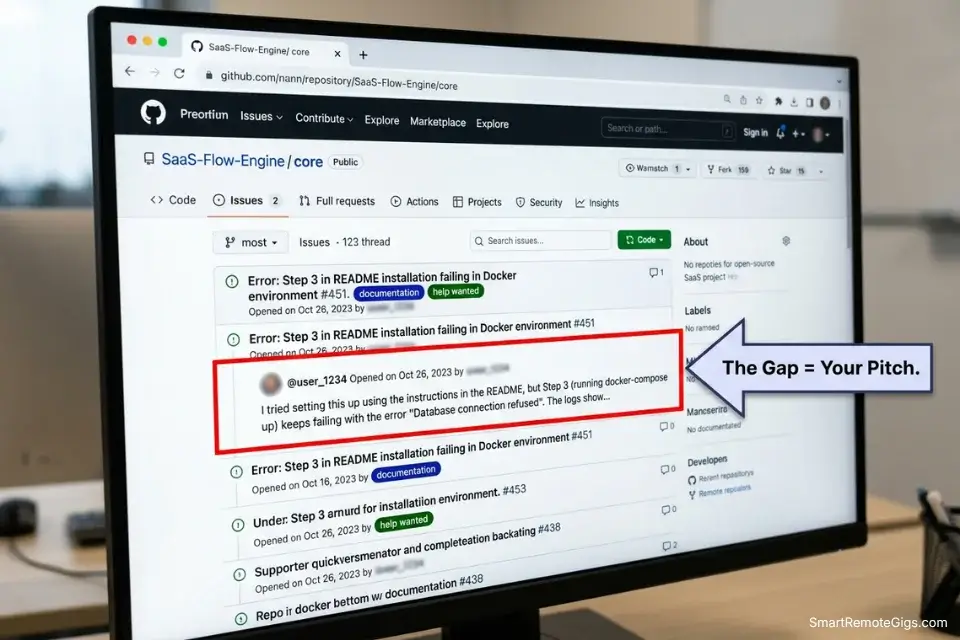
Open-source tech startups are sitting on millions in VC funding and bleeding users because no one can figure out how to deploy their tool. The “Getting Started” page reads like it was written for someone who already knows the answer. New users hit step 3, get confused, and churn.
That is a retention problem. And retention problems cost founders real money every single month.
While amateurs fight over generic remote writing jobs, technical writers target the massive budgets of venture-backed software companies where documentation is directly tied to activation and revenue.
The Exact Playbook
- Identify a recently funded open-source startup on GitHub or TechCrunch. Filter for Series A or Series B companies that announced funding in the last 6 months. New money means active hiring budgets. Search “open source [niche] startup funding 2026” and cross-reference with their GitHub activity to confirm the project is live.
- Attempt to use their “Getting Started” documentation. Actually try to install or run the tool following only their docs. Do not reference Stack Overflow or YouTube. Every point where you get stuck is a billable problem you just identified.
- Rewrite the most confusing 3-step process into clean, structured Markdown. Use numbered steps, code blocks with syntax highlighting, and a “Expected Output” section after each command. The before-and-after contrast is your pitch deck.
- Email the Lead Maintainer or CTO directly with the fix. Find them on the GitHub contributors list or the company LinkedIn page. Do not contact the generic info@ email. You want the person who merges pull requests.
The Documentation Gap Pitch Script
This script works because you are solving an immediate user retention problem — not pitching a writing service.
Subject: Your [SOFTWARE NAME] “Getting Started” docs are dropping users at Step 3
Hi [CTO NAME],
I spent 40 minutes trying to deploy [SOFTWARE NAME] using your current documentation and got stuck at [CONFUSING DOC SECTION]. I checked your GitHub Issues — 7 other users reported the same friction point in the last 30 days.
I rewrote that section. Here’s the original versus my version: [YOUR REWRITTEN LINK]
If that improvement is useful, I specialize in API and developer documentation for early-stage SaaS products. I work on a flat-rate per-sprint basis — no hourly billing, no bloated retainers.
Worth a 15-minute call this week?
[YOUR NAME]
PLACEHOLDER NOTES:
[CTO NAME] — Find via GitHub contributors tab (look for the most active committer) or the company’s LinkedIn “Team” page. Use first name only.
[SOFTWARE NAME] — Exact product name as it appears in their GitHub repo title. Spelling errors here kill credibility instantly.
[CONFUSING DOC SECTION] — Name the specific page or section: “the Docker configuration step in your Linux installation guide” not “the docs.” Specificity proves you actually tested the product.
[YOUR REWRITTEN LINK] — A public GitHub Gist or Google Doc showing the before-and-after in clean Markdown. Never a PDF attachment — developer inboxes auto-filter attachments.
DO NOT CHANGE: The GitHub Issues reference. Citing real user pain points transforms your pitch from opinion to data. Check their Issues tab before sending.
The Pro Tip / Red Flag
Red Flag: Never pitch marketing fluff to a CTO. Do not mention SEO, brand voice, or synergy. Focus strictly on user onboarding metrics and reducing support tickets. The second you sound like a marketer, the conversation is over — developers have a hair-trigger for corporate language.
🤝 Scenario 2 — The Insider: Reaching Out to a Lead Developer on LinkedIn
HR managers do not understand technical writing. They filter candidates for certifications that have nothing to do with whether you can explain an OAuth flow. Lead Developers, on the other hand, feel the daily cost of bad documentation in their support queue, their Slack channels, and their churn rate.
They have hiring authority and they have pain. That combination is your entire pitch.
Familiarizing yourself with standard coding and dev tools allows you to speak the developer’s language, which instantly separates you from 95% of traditional copywriters who have never opened a terminal.
The Exact Playbook
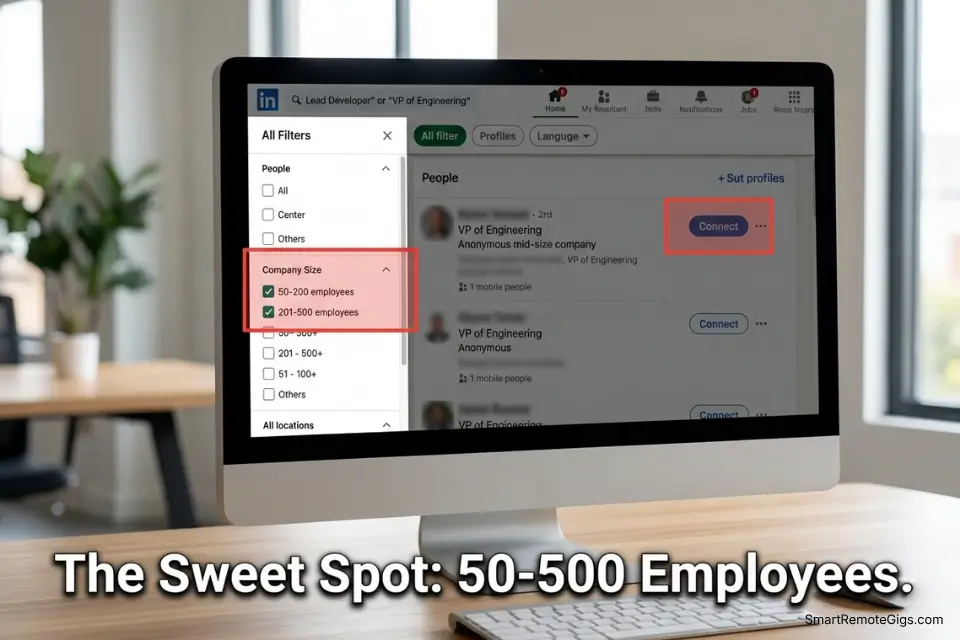
- Search LinkedIn for “Lead Developer” or “VP of Engineering” at mid-size SaaS companies. Filter by company size: 50–500 employees. Large enterprises route everything through HR. Startups under 50 move too fast to budget properly. The 50–500 range has both the budget and the agility to hire you directly.
- Audit their public API or developer portal before making contact. Spend 20 minutes reading their docs. Find one specific, concrete problem: an endpoint with no example response, a parameter with no description, a rate limit section that contradicts itself. One specific problem is worth ten vague compliments.
- Send a hyper-concise LinkedIn connection request noting a specific documentation flaw. The connection request is not the pitch. It is the hook. Keep it under 200 characters. One sentence. One specific observation. No ask.
- Follow up with a 15-minute consultation offer to outline a new documentation architecture. Once they accept the connection, wait 24 hours. Then send a two-paragraph follow-up proposing a short scoping call — not a commitment, not a proposal. A conversation.
The Dev-to-Writer Connect Script
Engineers appreciate directness. Cut the small talk and get straight to the technical debt their users are drowning in.
[LinkedIn Connection Request — 200 characters max]
Hi [DEV NAME], I audited your [SPECIFIC API ENDPOINT/DOC] and found [THE EXACT PROBLEM]. I fix this for SaaS teams. Worth connecting?
[Follow-Up Message — sent 24 hours after connection accepted]
Thanks for connecting. To give you more context: [THE EXACT PROBLEM] in your [SPECIFIC API ENDPOINT/DOC] typically causes integration delays for new enterprise clients trying to connect your API on day one.
I’ve restructured documentation like this for [X] SaaS teams. I work on flat-rate sprints — usually a 2-week audit and rewrite — so there’s no open-ended commitment.
If a 15-minute scoping call makes sense, here’s my calendar: [CALENDAR LINK]
[YOUR NAME]
PLACEHOLDER NOTES:
[DEV NAME] — First name only. Find via LinkedIn profile or GitHub contributions. Never “Dear Developer” or “Hi there.”
[SPECIFIC API ENDPOINT/DOC] — Name the exact page or endpoint. “Your POST /users endpoint” or “the Webhooks configuration section in your developer portal.” Vague references signal you didn’t actually read the docs.
[THE EXACT PROBLEM] — One precise, technical issue. “No example JSON response body” or “The authentication section references a deprecated API key format.” Do not say “the docs could be clearer” — that is not a technical insight, it is an opinion.
[CALENDAR LINK] — Calendly, Cal.com, or Google Calendar appointment link. Remove the friction of back-and-forth scheduling — developers will not chase you.
DO NOT CHANGE: The connection request character limit. LinkedIn connection requests over 200 characters read like marketing copy. Keep it surgical.
The Pro Tip / Red Flag
Pro Tip: Developers practically live on platforms like Discord and GitHub. If a Lead Developer isn’t active on LinkedIn, find their public GitHub repo and open a well-researched “Issue” regarding a documentation gap. Frame it as a user reporting a friction point — not a writer pitching services. That context shift will get a response from engineers who ignore every cold email.
🛠️ Scenario 3 — The Code Translator: Pitching API Documentation Cleanups
API documentation is the highest-paying sub-niche in the entire technical writing field. A poorly documented API costs a SaaS company enterprise deals — not because the product is broken, but because the client’s engineering team cannot integrate it without a support ticket every other day. That support cost is measurable and it appears on their P&L.
When you tie your pitch to a number that shows up in a board meeting, you get hired.
As the market for standard ai content writer jobs gets crowded, technical writers who use AI to decipher dense API logs are doubling their rates by positioning at the engineering layer — not the content layer.
The Exact Playbook
- Find SaaS tools with public APIs that lack code snippets or have outdated endpoint descriptions. The easiest targets: API reference pages with no example request/response pairs, parameters listed without data types, or error codes with no explanation. These are not cosmetic flaws — they are integration blockers.
- Run their dense technical explanations through an AI summarizer to extract the core logic. You are not inventing the content — you are restructuring it. Use AI to isolate the key action, the required parameters, and the expected output from paragraphs of developer jargon. Then rewrite the structure in plain English with code examples.
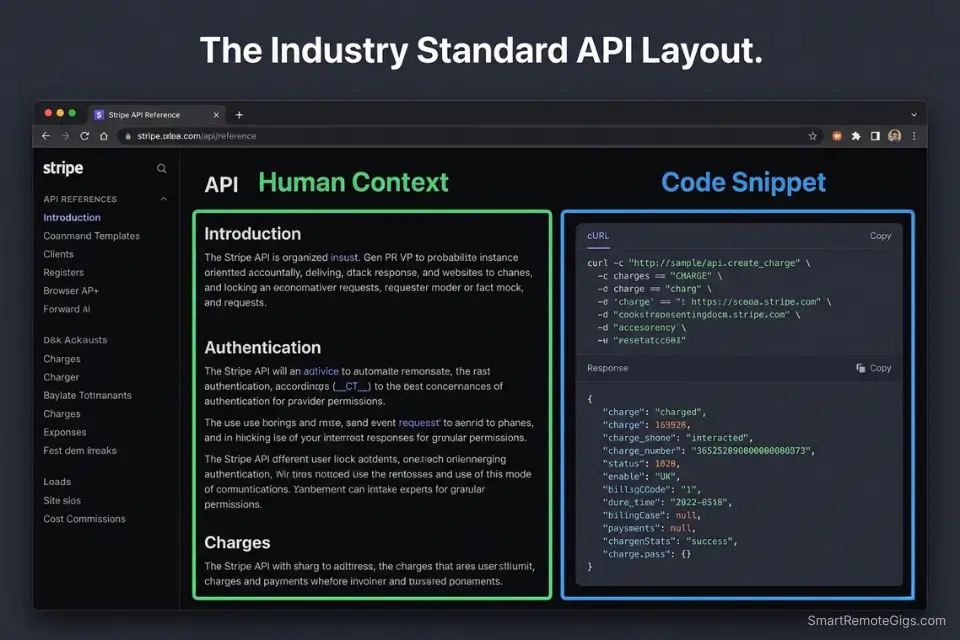
- Format a clean, dual-pane layout: explanation on the left, code snippet on the right. This is the industry standard for API reference docs. Stripe, Twilio, and Plaid use this format for a reason — it lets developers scan the explanation and copy the code without switching contexts. Matching that standard signals you know the field.
- Pitch the Head of Product on an API Restructure project. Not the CTO (too technical), not HR (too removed). The Head of Product owns the developer experience and understands the revenue implication of integration friction.
The API Restructure Pitch Script
Frame your pitch around enterprise sales. Good APIs close enterprise deals — bad APIs kill them in the proof-of-concept stage.
Subject: Your [API NAME] docs are costing you enterprise integrations
Hi [HEAD OF PRODUCT NAME],
I audited your [API NAME] reference documentation and found 4 endpoints with no example response bodies and 2 authentication methods that reference deprecated parameters.
For enterprise clients trying to integrate on a tight timeline, that gap typically triggers 3–5 support tickets per new account — before they’ve even gone live. At scale, that is a hidden revenue drag: [LOST REVENUE IMPLICATION].
I restructure API documentation for mid-stage SaaS products. The standard engagement is a flat-rate 2-week sprint starting at $3,000 — no hourly billing, no scope creep.
Would a 15-minute call this week make sense to scope the project?
[YOUR NAME]
PLACEHOLDER NOTES:
[HEAD OF PRODUCT NAME] — Find via LinkedIn. Their title is often “VP of Product,” “Head of Developer Experience,” or “Director of Product.” Use first name only.
[API NAME] — Exact API name as it appears in their developer portal. Not just “your API” — that reads like a mass pitch.
[LOST REVENUE IMPLICATION] — Calculate a rough number: average enterprise contract value × estimated churn rate from integration friction. Even a rough estimate (“that’s roughly $15K–$40K in delayed or lost ARR per quarter”) makes the pitch concrete and board-room legible.
DO NOT CHANGE: The $3,000 floor. Never negotiate below this number in your opening pitch. Anchoring below $3,000 signals you see yourself as a writer, not a technical consultant. The market rate for API documentation sprints at this scope is $3,000–$8,000.
When you are restructuring dense API content, distilling 800 words of developer-speak into 4 clear steps is where most writers slow down. The right summarizer tool cuts that processing time by 60% on a complex endpoint.
Overwhelmed by long articles, dense reports, or never-ending email threads? Paste any paragraph and get a clear, accurate summary in one or two sentences — instantly, for free, with no account needed.
The Pro Tip / Red Flag
Red Flag: Never attempt to write API documentation without testing the endpoints yourself in a tool like Postman or Insomnia. If your code snippets throw errors, your credibility is destroyed on first use — and developers will not give you a second chance to fix it. Test every request. Confirm every response. Document what you actually see, not what the old docs claim.
📈 Scenario 4 — The Closer: Negotiating Salary for a Full-Time Remote Tech Role
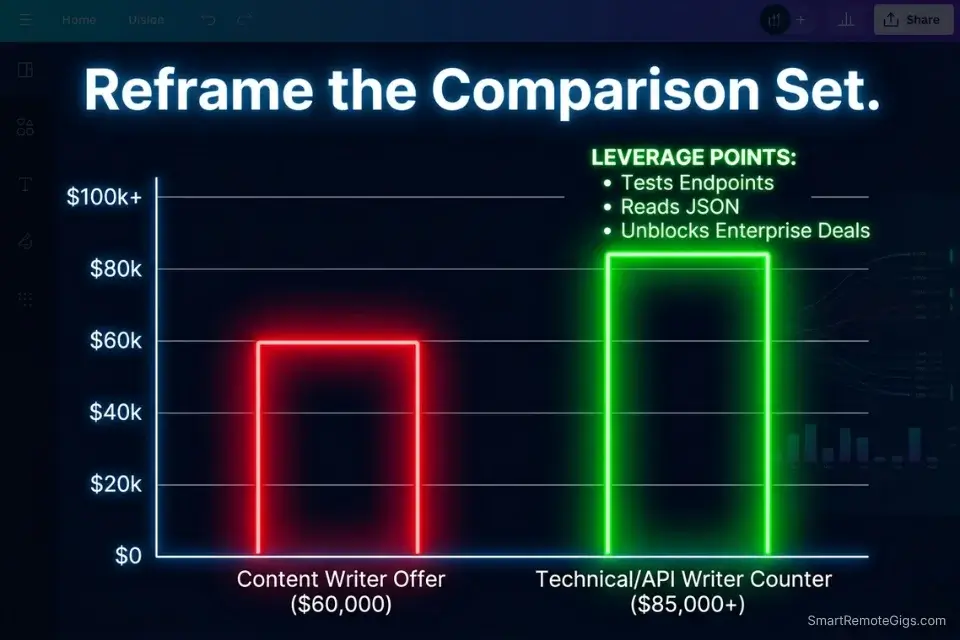
The offer arrives. The number is low. It always is the first time — because companies benchmark technical writers against content managers, not against software engineers. Your job in the negotiation is to reframe the comparison set entirely before you touch the number.
You are not a writer who happens to understand APIs. You are a technical communicator who sits at the intersection of engineering output and user revenue. That is a different job grade with a different pay scale.
If you accept a salary benchmarked against standard remote copywriting jobs, you will be leaving twenty to thirty thousand dollars on the negotiation table every single year — compounding with each raise and bonus calculation tied to that base.
The Exact Playbook
- Receive the initial offer via email or phone — do not respond immediately. “Thank you, I’ll review this and come back to you” is a complete sentence. You need 24 hours minimum to build your counter. Any response in under an hour signals you were waiting and willing.
- Acknowledge it professionally, then do not accept. “I appreciate the offer and I’m genuinely excited about the role” closes nothing. It buys you time and keeps the door open while you build your data case.
- Compile industry data to justify a higher tier. Pull the BLS technical writers median ($78,060 as of the latest report). Pull Glassdoor and Levels.fyi ranges for the company’s stage and geography. Identify 2–3 comparable roles at peer companies with higher listed salaries. This is your evidence file.
- Send a formal, data-backed counter-offer highlighting your specific ability to read, test, and translate code. You are not asking for more money because you want it. You are demonstrating that the market rate for someone who can write documentation AND validate code outputs is objectively higher than what they offered.
The Data-Backed Salary Counter Script
Remove emotion from the negotiation entirely. Base your counter on market data and technical scope — not on what you need or what you hope for.
Subject: Re: [ROLE TITLE] Offer — Counter Proposal
Hi [HR/MANAGER NAME],
Thank you for the offer of [INITIAL OFFER]. I’m genuinely excited about the role and the team.
After reviewing current market data, I’d like to propose a counter of [YOUR COUNTER OFFER].
Here’s my rationale:
The BLS reports a median of [MARKET DATA/BLS NUMBER] for technical writers. However, this role requires active endpoint testing, JSON payload interpretation, and the ability to QA code examples — skills that typically place the position in the senior technical communicator bracket, which runs $85,000–$105,000 at comparable Series B companies.
I’m confident I can deliver documentation that directly reduces your support ticket volume and accelerates enterprise onboarding — both of which have a measurable impact on ARR.
I’m ready to move quickly if we can align on [YOUR COUNTER OFFER]. What flexibility exists at your end?
[YOUR NAME]
PLACEHOLDER NOTES:
[HR/MANAGER NAME] — Address whoever sent the offer, by first name. If it came from an ATS system with no name, reply to the last human who emailed you.
[INITIAL OFFER] — State the exact number they gave you. This signals you are negotiating in good faith and not inflating what was offered.
[MARKET DATA/BLS NUMBER] — Use the current BLS figure for technical writers ($78,060 median). Pull from bls.gov directly so the number is defensible if challenged.
[YOUR COUNTER OFFER] — Set your counter 15–20% above the initial offer. If they offered $68,000, counter at $82,000–$85,000. Never counter below $80,000 for a role requiring code literacy.
DO NOT CHANGE: The ARR sentence. Tying your documentation output to Annual Recurring Revenue reframes you from a cost center to a revenue function. That one sentence shifts the entire frame of the negotiation.
The Pro Tip / Red Flag
Pro Tip: If they cannot meet your base salary requirement, immediately pivot — do not fold. Ask for a 4-day work week, a guaranteed 6-month performance review with a defined raise trigger, or a signing bonus. Any of these converts the delta between their number and yours into real compensation value. Walking away with a 4-day week and $78K beats accepting $72K at 5 days without negotiating.
💰 The ROI Reality: What Remote Technical Writers Actually Make
Technical writing is not a gig economy hustle. It is a high-ticket profession that sits at the intersection of engineering output and user experience — and it pays accordingly.
The Bureau of Labor Statistics reports a median annual wage of $72,270 for writers as a baseline, providing a firm floor for your opening negotiation. However, industry reports from Forbes consistently show that specialized writers in the SaaS and API documentation sectors command salaries that clear six figures — because they are doing work that directly ties to product adoption and enterprise deal velocity.
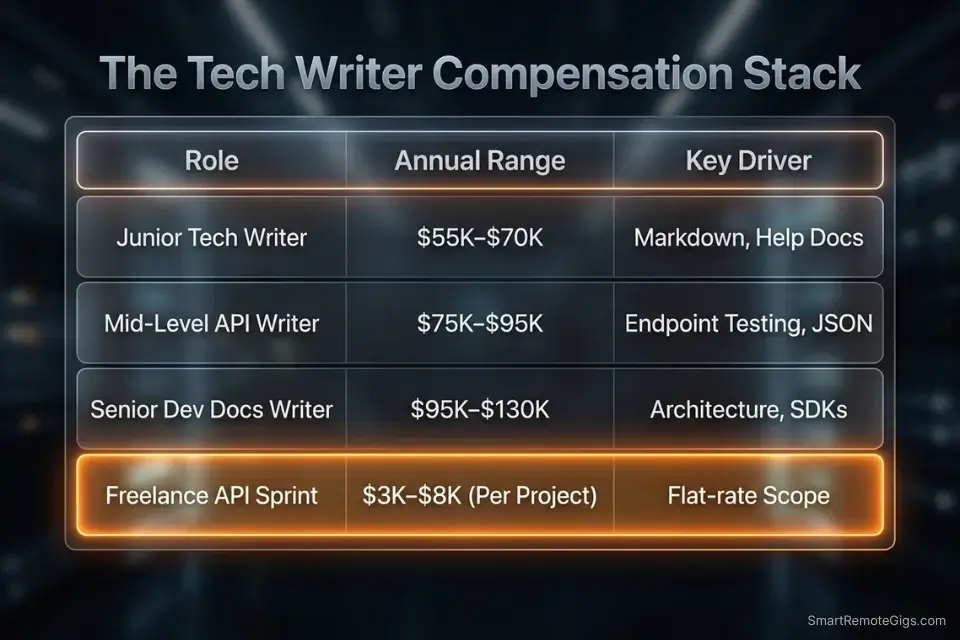
Here is what the compensation stack actually looks like in 2026:
Role | Annual Range | What Drives the Top End |
|---|---|---|
Junior Tech Writer (no code) | $55K–$70K | Basic Markdown, help docs |
Mid-Level API Writer | $75K–$95K | Endpoint testing, JSON fluency |
Senior API / Dev Docs Writer | $95K–$130K | Architecture decisions, SDK docs |
Staff / Principal Tech Writer | $130K–$160K+ | Cross-functional ownership, code review |
Freelance API Sprint (per project) | $3K–$8K | Flat-rate, scope-defined |
If you are freelancing, do not charge by the hour. Charge by the sprint or by the endpoint. An API documentation overhaul for a mid-sized product should start at $3,000 minimum — because you are not selling words, you are selling reduced churn and faster enterprise onboarding.
Before you walk into any negotiation — client or employer — you need a defensible number in your head.
Most freelancers guess their rate. This free calculator helps you set yours with precision — built around your actual monthly expenses, desired profit, and billable hours so you never undercharge again.
🗓️ The 30-Day Execution Plan
Days 1-3: The Technical Foundation
- Learn the absolute basics of Markdown formatting, GitHub navigation, and REST API structure. You do not need to build apps — you need to read JSON payloads and explain them clearly.
- Rewrite one bad piece of open-source documentation and publish it as a GitHub Gist or Notion page. This is your first portfolio asset. It costs nothing and takes under 90 minutes.
- Update your LinkedIn headline to: “Technical Writer | API & SaaS Documentation.” Not “Freelance Writer.” Not “Content Specialist.” The headline is what gets you found by the CTOs and DevEx leads who are actively searching.
Pro Tip: You do not need to know how to build a web app from scratch. You need to know how to read a JSON payload and explain what it does to someone who has never seen one. That specific skill — translating structured data into plain English — is what separates a $45K tech writer from an $85K one.
Days 4-7: The Target Acquisition
- Build a spreadsheet of 25 Series A or Series B SaaS startups in a niche you understand — fintech, HR tech, DevOps, e-commerce infrastructure. Funded companies have active budgets; bootstrapped companies pay in equity promises.
- Locate the exact names and direct emails of their CTOs, Lead Developers, or Heads of Developer Experience. LinkedIn Sales Navigator and Hunter.io are your two tools here. Contact form submissions go to inboxes no one monitors.
- Audit the public docs of all 25 targets and score each one for: missing code examples, deprecated parameter references, and unclear error handling sections. Prioritize your outreach by severity of the gap.
If you lack technical clips at this stage, treat this phase like you would when hunting for entry level remote writing jobs: create the asset first — rewrite one section of their docs — then pitch. The rewrite is your credential.
Days 8-14: The Outreach Blitz
- Send 5 direct-to-developer pitches every morning before 10 AM. Use the Documentation Gap script for cold CTOs and the Dev-to-Writer Connect script for LinkedIn outreach. Do not mix them up — the channel determines the format.
- Track every sent email, LinkedIn message, open rate, and response in a simple CRM. Notion, Airtable, or a Google Sheet with five columns — Pitched, Followed Up, Responded, Proposal Sent, Closed — covers everything you need.
- Do not follow up yet during this sprint. Volume first. Consistency over 7 days is what builds the pipeline — not the perfect subject line.
Days 15-21: The Follow-Up Game
- Send the 3-day follow-up to every unread pitch from Week 2. One follow-up per lead. Short. Add one new data point — a recently filed GitHub Issue, a competitor’s new API release, anything that creates urgency without desperation.
- For every developer who responds with interest, reply with a calendar link for a 15-minute scoping call. Do not negotiate over email — get them on a call where you can hear the real objection.
- Provide a flat-rate proposal for an initial “documentation audit” after the call. $500–$800 for a full audit with a written gap report. This is the foot in the door before the $3K+ restructure engagement.
Days 22-30: The Close and Negotiate
- Land your first paid technical writing sprint or secure your first full-time interview. Either outcome validates the system and builds momentum for the next pitch cycle.
- Execute the Salary Counter Script when the offer arrives. Do not accept the first number. The first number is always negotiable — the company expects a counter and budgets for one.
- By Day 30: Secure a technical writing contract or full-time role anchored at the $80K+ level. One closed deal at this rate covers more ground than 6 months of content mill work.
❓ Frequently Asked Questions
How long does it take to land a remote technical writing job?
It depends on your pitching method. The direct-to-developer approach typically closes a first paid sprint within 14–21 days of consistent outreach. A full-time offer at the $80K+ level typically takes 30–60 days from first contact to signed offer letter — faster if you already have one published API documentation sample in your portfolio.
What are the highest paying remote technical writing jobs?
It depends on the niche and technical depth. API documentation and SDK writing for fintech and developer infrastructure companies command the highest rates — $95K–$160K for full-time senior roles and $3K–$8K per project for freelance sprints. Staff and Principal-level technical writers who own documentation architecture across entire product lines hit $130K–$160K+ at late-stage SaaS companies.
Can I get a remote technical writing job with no experience?
Yes — if you build the credential before you pitch. Rewrite one real piece of open-source documentation, publish it as a GitHub Gist, and use it as your portfolio anchor. Developers evaluate work samples, not resumes. One clean, functional doc rewrite outperforms three years of generic blog writing in a technical hiring conversation.
Are online freelance technical writing jobs legit?
Yes — the high-paying ones absolutely are, and they are not where you expect to find them. Upwork has a technical writing category, but the best-paying freelance technical writing work is sourced through direct outreach to CTOs and Heads of Developer Experience. Platforms commoditize the rate; direct outreach lets you price against engineering value.
How much do remote technical writers make per hour?
It depends on your positioning. Junior technical writers without code literacy earn $30–$40/hour. Mid-level API writers who can test endpoints and read JSON earn $55–$75/hour. Senior technical writers with SDK and architecture documentation experience bill $90–$130/hour on freelance engagements. For project-based work, the hourly rate is irrelevant — price the sprint, not the hour.
Where can I find full-time remote technical writing jobs?
Yes — GitHub Jobs, the We Work Remotely tech writing category, and direct LinkedIn outreach to engineering leadership at SaaS companies are your three highest-yield channels. The SRG Job Board at /jobs/ also surfaces vetted technical roles that require actual documentation skills — not just content marketing experience.
Do you need a degree for remote technical writing jobs?
No. Clients and engineering hiring managers evaluate whether your code examples run and whether your explanations reduce support tickets — not your diploma. A GitHub portfolio with 3–5 clean documentation samples and the ability to test an API endpoint in Postman will outperform an English degree in a technical writing interview every single time.
The Verdict: Stop Acting Like a Blogger
The companies with the biggest budgets do not care about your prose style or your vocabulary range. They care if you can take their complex software and explain it so clearly that new users stop quitting at Step 3 and enterprise clients stop filing integration support tickets.
If you apply through HR portals, you are competing against thousands of generic writers being filtered by keyword-matching algorithms. If you pitch the Lead Developer directly with a rewritten API endpoint and a GitHub Issues citation, you are competing against essentially no one — because no one else is doing it.
Act like an insider. Price yourself like a technical consultant. Bypass the traditional job hunt entirely.
Writers who treat technical documentation as a subset of generic remote writing jobs will always be priced like one — the positioning distinction is what unlocks the $80K+ bracket.
When you are ready to stop fighting the ATS algorithms, find remote writing roles directly through platforms built for vetted technical professionals who have already done the credential work.
The Verdict: The gap between a $45K content writer and an $85K technical writer is not talent — it is positioning. Reframe yourself as an engineering-adjacent professional, pitch direct, and price against the value you protect.
While you build your technical writing income, don’t leave money on the table. Head to the SRG Job Board at /jobs/ for vetted, high-paying retainers that respect your technical skills. Browse the SRG Software Directory at /software/ for the developer and AI tools required to scale your documentation output.

Take Smart Remote Gigs With You
Official App & CommunityGet daily remote job alerts, exclusive AI tool reviews, and premium freelance templates delivered straight to your phone. Join our growing community of modern digital nomads.

![AI Content Writer Jobs: [My 2026 Survival Playbook]](https://smartremotegigs.com/wp-content/uploads/2026/04/ai-content-writer-jobs-hero.webp)
![Remote Copywriting Jobs 2026: [High-Ticket Method]](https://smartremotegigs.com/wp-content/uploads/2026/04/remote-copywriting-jobs-hero.webp)
![Entry Level Remote Writing Jobs: [Tested Playbook]](https://smartremotegigs.com/wp-content/uploads/2026/04/entry-level-remote-writing-jobs-hero.webp)