Build A Fiverr Portfolio 2026: Zero Client Hack (Tested)
 ·
Last Updated: March 27, 2026 ·
13 min read
·
Last Updated: March 27, 2026 ·
13 min read
The hardest part of freelancing is the Catch-22: you need work to show work. If you want to build a Fiverr portfolio from scratch to finally get your first Fiverr client, you can’t sit around waiting for someone to hire you first — because no one hires a profile with an empty gallery.
When I started on Fiverr, my gallery was completely empty. Instead of stealing images from Google or begging for free work, I spent one weekend executing the Spec Work Hack. Breaking down these exact portfolio roadblocks is why we built Smart Remote Gigs. We created this platform to equip new freelancers with the AI workflows and strategic hacks required to bypass the impossible “experience required” loop and launch a professional storefront in days, not months.
It landed my first $50 order four days later. This guide is the exact system I used, updated for 2026’s AI tools and Fiverr’s current gallery rules.
|
Niche |
❌ The Amateur Approach |
✅ The Spec Work Hack |
|---|---|---|
|
Designers |
Leaving the gallery completely blank or uploading low-res screenshots from school projects |
Unsolicited redesign of a real local business logo — presented on professional 3D mockups |
|
Copywriters & Marketers |
Linking to academic college essays or a personal blog with three posts from 2021 |
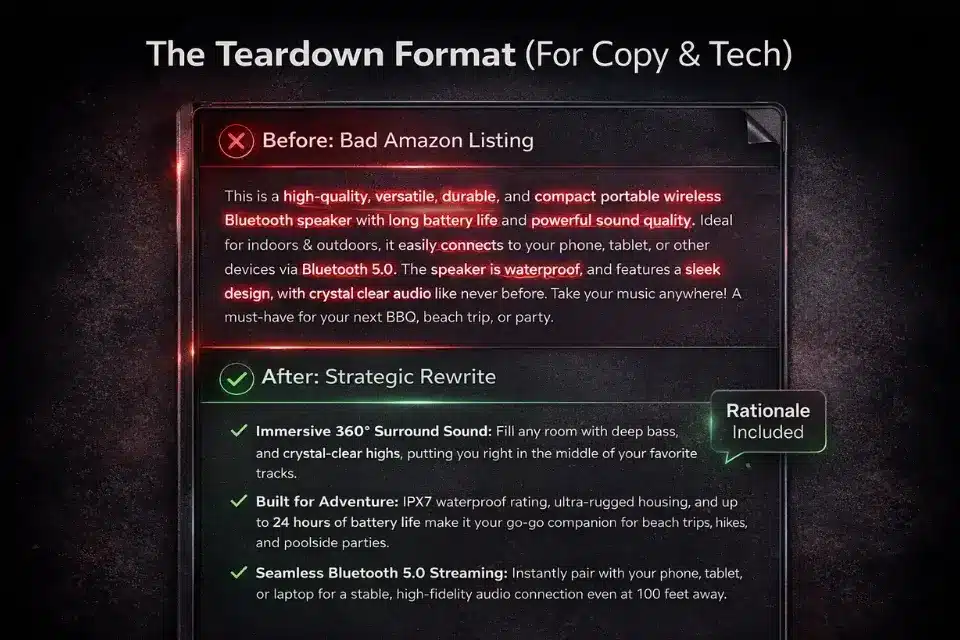
A teardown and full rewrite of a terrible Amazon product listing — before/after format |
|
Tech & Developers |
“I will code anything” text graphics with no actual work shown |
A fully functional micro-tool on GitHub, or a public dataset cleaned and visualized end-to-end |
The Catch-22 (And Why “Free Work” is the Wrong Answer)
Every new freelancer hits the same wall: the profile needs portfolio samples to convert buyers, but portfolio samples require completed orders. The instinctive solution — offer free or heavily discounted work to get reviews — feels logical but creates two serious problems.
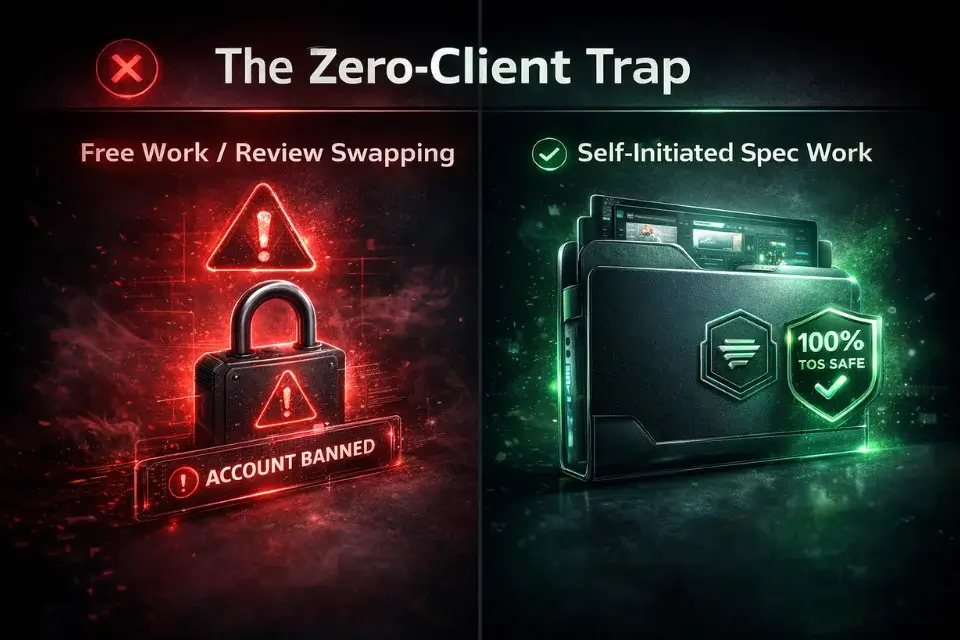
The Danger of Discounting for Reviews
The first problem is practical. Buyers who pay nothing or next to nothing for your work develop the same psychology as $5 gig buyers: they expect unlimited patience, unlimited revisions, and a sense that their dissatisfaction is your personal failing. You’re not getting a quick, easy review — you’re getting a demanding client with no skin in the game and no deadline pressure.
The second problem is existential to your account.
Red Flag: Offering free work in exchange for 5-star reviews is strictly against Fiverr’s Terms of Service. In 2026, Fiverr’s trust and safety systems are sophisticated enough to detect coordinated “review swapping” — patterns where a seller’s early reviews come from accounts with no order history or from connections within the same network. Getting caught doesn’t mean a warning. It means a permanent account ban, with no appeals process that reliably restores accounts. Do not do this. The spec work approach achieves the same portfolio-building goal with zero platform risk.
The “Spec Work” Framework (Faking It The Right Way)
Spec work — speculative work — means creating professional samples for fictional or real-but-unpaid clients, with the explicit purpose of demonstrating your capabilities. It’s been standard practice in advertising, design, and copywriting for decades. Every agency creative director who ever applied for a job has submitted a spec portfolio.
On Fiverr, it’s both legal and effective. The rules around it are simple.
What is Speculative Work?
Spec work is any sample you create without being commissioned for it. You choose the brief, you execute the work to professional standard, and you upload the output as a portfolio sample.
The best spec work targets a real, recognizable context — an actual local business whose logo genuinely could use a redesign, an actual Amazon product whose listing genuinely performs below its potential, an actual data problem that genuinely exists in a public dataset. Using a real-world context makes the work look more credible and gives you a richer case study to describe in your gig gallery captions.
Rule 1: Always Disclose It’s a Concept Project
This is non-negotiable. In your gig gallery caption or PDF case study, label spec work clearly: “Concept redesign — not a commissioned project” or “Spec work — created to demonstrate approach.”
This isn’t a legal requirement on Fiverr, but it’s a trust requirement. Buyers in 2026 are sophisticated enough to ask “did you actually work for this brand?” If you’ve been transparent upfront, the answer is honest and the work still demonstrates exactly what you can do. If you implied it was commissioned work and a buyer asks directly, you’ve created a credibility problem that’s worse than having an empty gallery.
Transparency on spec work has never cost me an order. Ambiguity about it has.
Take Smart Remote Gigs With You 🌍
Get daily remote job alerts, exclusive AI tool reviews, and premium freelance templates delivered straight to your phone. Join our growing community of modern digital nomads.
Quick Links: Software Directory | Free Templates | Remote Jobs
Generating Spec Work with AI (The Weekend Sprint)
This is where 2026 gives new Fiverr sellers an advantage that simply didn’t exist three years ago. AI tools let you compress a week of portfolio-building into a single weekend — and produce output that looks more polished than most manually assembled spec work.
Using ChatGPT to Generate Fake Client Briefs
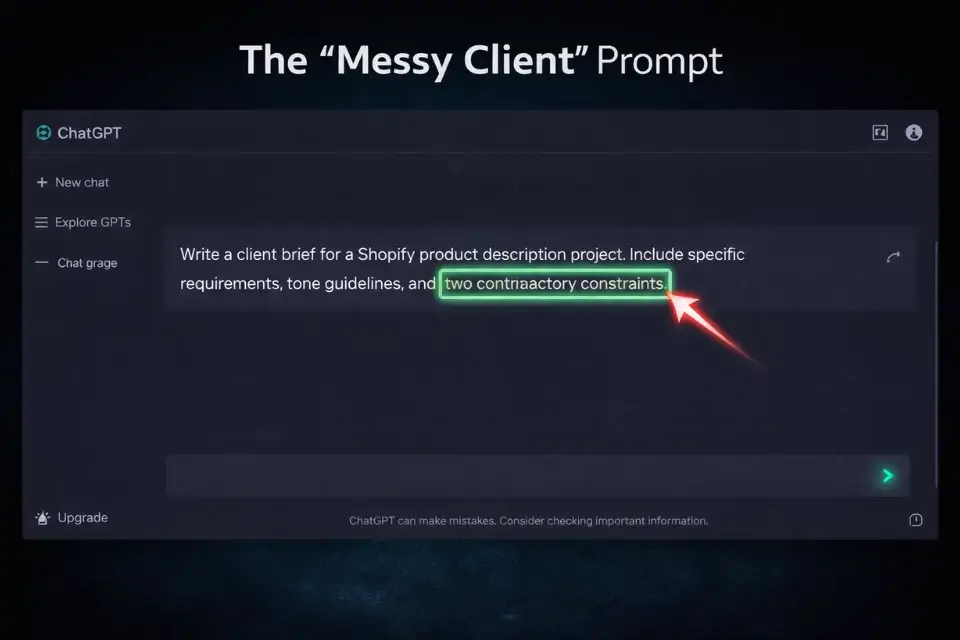
The fastest way to create realistic spec work scenarios is to have ChatGPT generate the client brief for you. Prompt it: “Write a client brief for a [your service] project for a small [industry] business. Include specific requirements, tone guidelines, target audience, and two or three contradictory constraints.”
That last instruction — contradictory constraints — is critical. Real clients give messy, ambiguous, sometimes self-contradictory instructions. A brief that says “make it professional but also fun, and keep it under 200 words but cover all five features” is exactly the kind of real-world challenge your spec work should reflect.
ChatGPT’s briefs tend to be too clean without this instruction. Perfectly structured, logically consistent briefs produce spec work that looks like it was solved on easy mode. Brief yourself like a real confused, non-technical client would — “I want it to pop but not be too loud, something modern but also classic” — and your resulting spec work will demonstrate a higher level of professional problem-solving to buyers who’ve dealt with exactly those clients themselves.
Use it as your brief generator. Then actually do the work. Don’t use ChatGPT to complete the deliverable for the same portfolio piece you used it to brief — buyers in your niche will be able to tell, and it defeats the purpose.

ChatGPT
Best for: Generating highly realistic, deliberately messy client briefs to build authentic spec work.
Using Midjourney to Create Stunning Product Mockups
For designers, the gap between “here’s a flat logo on a white background” and “here’s how this logo looks on a branded coffee cup, a storefront sign, and a business card” is enormous in terms of perceived value — and Midjourney closes that gap in minutes.
Generate your logo or design asset first using your actual design tools. Then use Midjourney to create photorealistic mockup environments: “A minimalist ceramic coffee cup on a marble surface, soft natural lighting, product photography style, no text — ar 4:3.” Import your design into Canva or Photoshop, overlay it onto the mockup, export. Done.
The same principle works for web designers (mockup on a MacBook screen), print designers (mockup on a tote bag or poster wall), and social media designers (mockup on a phone screen in a lifestyle context).
Pro Tip: Don’t upload a flat logo or a plain text document and expect buyers to fill in the blanks. Put every piece of spec work into a realistic context before it goes into your gallery. A logo placed on a 3D coffee cup mockup looks three to five times more expensive than the same logo on a white background — without the logo itself being any different. A rewritten Amazon listing formatted in a branded PDF case study looks more credible than the same text pasted into a gallery image. Context sells the skill.
The limitation with Midjourney for mockup generation: it isn’t a template tool. It generates environments, not editable frames. If you need perfect perspective alignment for a logo placement, you’ll still need to do manual perspective warping in Photoshop or use a dedicated mockup tool like Smartmockups for pixel-perfect results. Use Midjourney to create the scene, then composite your design in manually.

Midjourney
Best for: Creating photorealistic 3D environments and mockups to display your flat designs in a premium context.
The “Teardown” Method (For Non-Visual Gigs)
Designers can show finished images. Writers, marketers, SEO specialists, and developers work in formats that don’t naturally produce gallery-ready visuals — and they often leave their galleries blank as a result. This is a missed opportunity with a straightforward fix.
How Writers and Marketers Can Show Visual Proof
The teardown method converts a text-based deliverable into a visual portfolio piece by framing it as a before/after transformation.
Find a real, publicly accessible piece of bad work in your niche: a product description on Amazon that undersells the product, a Google Ads headline that wastes its character limit on generic phrases, a landing page whose above-the-fold copy buries the value proposition. Screenshot the original.
Rewrite it to professional standard. Apply your actual methodology — the same approach you’d use for a paying client. Format your rewrite clearly.
Then build a one-page PDF case study: Original (with your annotated critique), Your Version (with brief notes on each change and why), and a one-sentence summary of the strategic thinking behind the transformation.
That PDF is your portfolio piece. Upload it directly to your Fiverr gig gallery — Fiverr accepts PDF uploads alongside images, and a well-formatted PDF case study signals a level of professionalism that a plain text screenshot never achieves.
The Before/After Case Study
The before/after format works across almost every non-visual service category:
- SEO copywriter: Original page meta description → rewritten version with keyword and CTR rationale
- Email marketer: Anonymized low-performing subject line set → rewritten test variants with open-rate hypothesis
- Data analyst: Raw messy dataset (publicly available) → cleaned, visualized, summarized in a clear dashboard
- Developer: A GitHub repo with documented code smells → refactored version with a written explanation of improvements
In each case, the before demonstrates you can identify problems. The after demonstrates you can solve them. The written rationale demonstrates you understand why — which is what separates a professional from someone who just followed a tutorial.
Uploading to the Fiverr Gallery (Max Visibility)
Building the spec work is only half the job. How you upload and sequence your gallery directly affects whether buyers engage with it or skip past it.
The 3-Image Rule and PDF Uploads
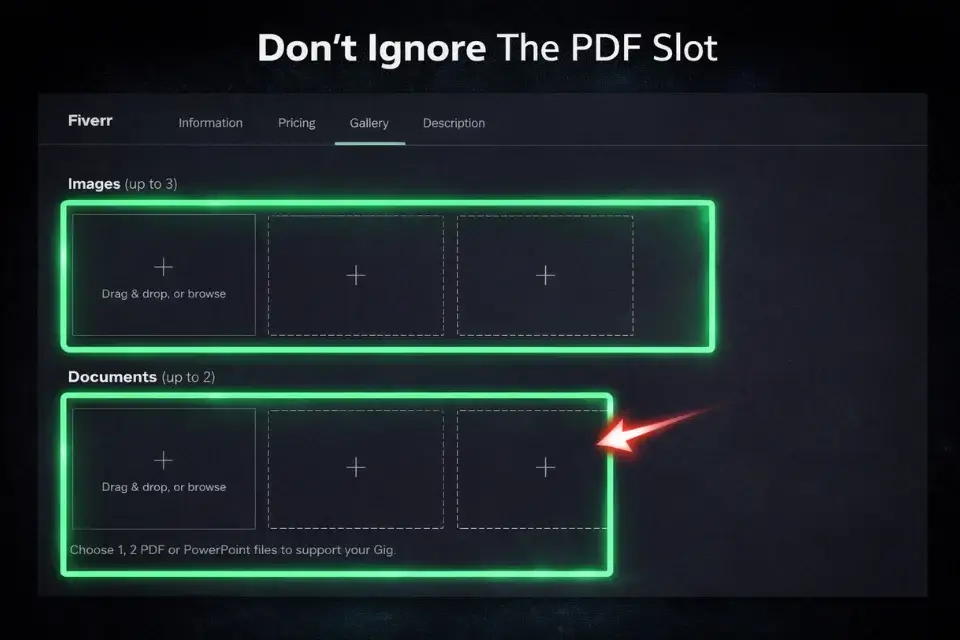
Fiverr allows up to three images and one PDF in your gig gallery before you’ve established a track record. Use all of them. An incomplete gallery signals an incomplete commitment to the gig.
Sequence matters: your single strongest piece goes first. Buyers preview the first gallery image from the search results page without ever clicking into your gig. That first image is your secondary thumbnail — it needs to communicate the quality and style of your work in one glance.
Image two should show range or process: a different style variant, a mockup showing real-world application, or a side-by-side showing your creative decision-making.
Image three can be social proof adjacent — a before/after, a testimonial graphic (even a fictional one formatted as a pull quote from your spec brief), or a visual summary of your deliverable scope.
The PDF slot is your case study. Use it. Most sellers leave it empty, which makes any seller who uploads a formatted PDF case study stand out immediately as someone who takes their craft seriously.
For every image you upload, make sure the file is named with your target keyword before uploading — not screenshot_final_v2.png but shopify-copywriter-before-after-portfolio.png. Make sure your primary portfolio thumbnail follows our gig image clarity rules — dimensions, contrast, and text legibility all apply here exactly as they do for your main gig thumbnail.
Frequently Asked Questions
Can I use spec work in my Fiverr portfolio?
Yes. Fiverr has no policy against spec work in your portfolio gallery, provided it doesn’t misrepresent your relationship with a brand. You cannot claim you worked for Apple or Nike if you didn’t — that’s misrepresentation.
But a clearly labeled concept redesign, a self-initiated writing sample, or an independently built tool are all legitimate portfolio entries. Disclose that pieces are spec work in the gallery caption, and you’re fully within platform guidelines.
How many portfolio items do I need to get my first order?
Three solid pieces consistently outperform one exceptional piece and two empty gallery slots. Buyers pattern-match across a gallery — three items in different contexts or styles signals that you’re capable of consistent output, not just one lucky result.
If you can only produce one genuinely strong piece in your first weekend, upload that one and fill the remaining slots with process-oriented content (a screenshot of your working methodology, a brief breakdown PDF, a mockup in progress) rather than leaving them blank.
Does Fiverr allow links to external portfolios like Behance?
Fiverr’s Terms of Service prohibit including external URLs in your gig description for the purpose of directing buyers off-platform. You cannot link to your Behance, personal website, or Dribbble portfolio directly in your gig copy.
However, you can mention that you have additional work available upon request — buyers can then ask for it through Fiverr’s messaging system, and you can share a link there within the context of a legitimate buyer conversation. The restriction is on gig copy URLs, not on all off-platform references in every context.
The Verdict: Your Portfolio is a Demonstration, Not a Museum
Verdict: Buyers don’t care whether a Fortune 500 company commissioned your work or whether you created it on a Saturday afternoon with an AI brief and a Midjourney mockup. They care whether the work proves you can solve their specific problem. Spec work bridges the zero-client gap perfectly — and in many cases, a well-executed spec piece with a clear case study narrative is more convincing than a real client project presented without context. Build the demonstration. Label it honestly. Let the quality speak.
The Catch-22 only exists if you’re waiting for someone else to give you permission to do good work. Give yourself the brief. Execute it properly. Upload it tonight.
At Smart Remote Gigs, our mission is to dismantle the barriers that keep talented beginners locked out of the freelance economy. We test the AI tools, build the spec work frameworks, and map the platform rules so you can prove your value on day one—without breaking the Terms of Service.
Now that your portfolio is full, it’s time to learn the exact system for getting eyes on it. Read our ultimate guide on how to get your first Fiverr client and turn your new gallery into paying orders.
![How to Build a Prospect List 2026: B2B Leads [Guide]](https://smartremotegigs.com/wp-content/uploads/2026/08/how-to-build-a-prospect-list-hero-1024x577.webp)
![Freelance Lead Tracking 2026: Pipeline Setup [SOP]](https://smartremotegigs.com/wp-content/uploads/2026/09/freelance-lead-tracking-hero1-1024x577.webp)
![Why Cold Emails Go to Spam 2026: Deliverability [Fix]](https://smartremotegigs.com/wp-content/uploads/2026/09/why-cold-emails-go-to-spam-hero1-1024x577.webp)