Price Your Freelance Services 2026: Max Pay Math [Chart]
 ·
Last Updated: Mar 26, 2026
·
Last Updated: Mar 26, 2026

If you are constantly battling scope creep and burnout, you need to fundamentally rethink how you price your freelance services. The old “hourly rate” model is officially a trap in 2026, replaced by value-based math that actually scales your income.
For three years, I was stuck at $35/hour — penalized for becoming faster at my job. Every time I got better, I earned less per project. Everything changed when I finally ran the “Max Pay Math” and switched to value-based retainers.
Teaching freelancers how to escape this exact hourly trap is the core reason we built Smart Remote Gigs. Here is the exact formula that tripled my effective hourly rate.
2026 Freelance Pricing Models: The Breakdown
|
Pricing Model |
Best For |
Risk Level |
2026 Income Potential |
|---|---|---|---|
|
Hourly |
Exploratory consulting, unstructured work |
🔴 High (scope creep, time tracking disputes) |
Low — capped by hours available |
|
Fixed Project |
Defined deliverables with clear scope |
🟡 Medium (scope creep if poorly defined) |
Medium — depends on scoping discipline |
|
Value-Based |
Experienced freelancers with measurable ROI |
🟢 Low (client pays for outcome, not hours) |
High — directly tied to client results |
|
Retainer |
Ongoing relationships with predictable workload |
🟢 Low (predictable revenue, defined deliverables) |
High — recurring income that compounds |
The Minimum Acceptable Rate (MAR) Formula
Crunching the Base Numbers
Before you can charge what you’re worth, you need to know your floor. Most freelancers skip this step and pull an hourly rate out of thin air based on what they think clients will pay. That’s not pricing — that’s guessing.
Your MAR is the rate below which you are literally losing money by working.
Here’s the formula I use:
Step 1: Calculate your true annual costs.
Start with your personal living expenses — rent, food, insurance, subscriptions, everything. Add your business overhead: software tools, accountant fees, equipment depreciation, marketing costs. Don’t forget self-employment tax (roughly 15.3% in the US on top of income tax). A freelancer earning $80k grosses closer to $58k after taxes and overhead when you run it honestly.
Step 2: Account for non-billable hours.
You are not billing 40 hours a week. You are billing somewhere between 15 and 25 of them. The rest disappears into admin, prospecting, invoicing, revisions not covered in scope, and the inevitable client email that eats your afternoon. Divide your annual cost target by realistic billable hours — not theoretical ones.
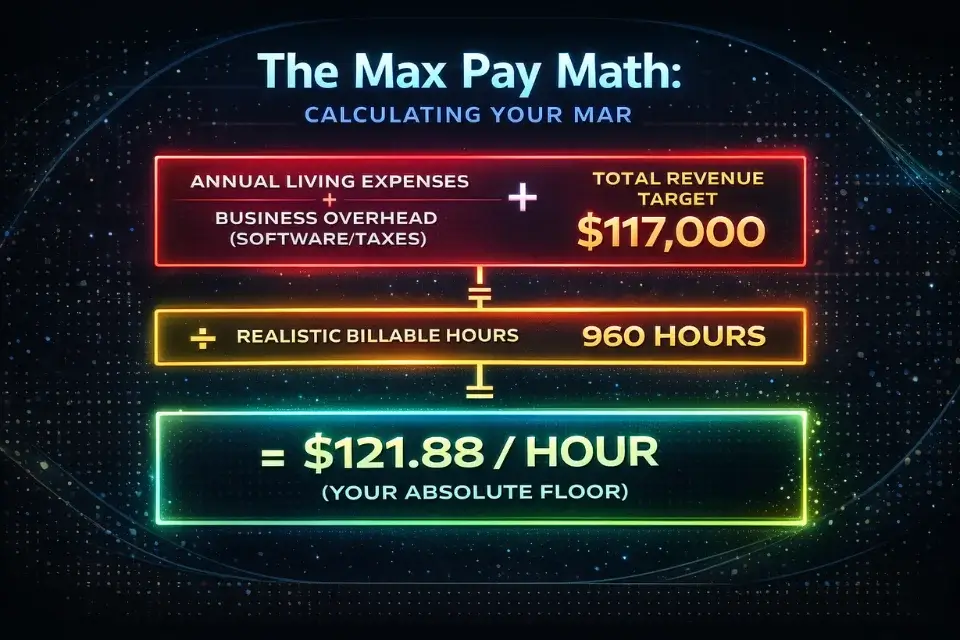
A simple version of the math:
- Annual income target: $90,000
- Add 30% for taxes and overhead: $117,000
- Realistic billable hours per year (20 hrs/week × 48 weeks): 960 hours
- MAR = $117,000 ÷ 960 = $121.88/hour
That’s your floor. Not your rate. Your floor.
Plug your own numbers into our freelance rate calculator to get your exact MAR in under 3 minutes — it handles the tax and overhead math automatically.
The 3 Core Pricing Models (And When to Abandon Them)
1. The Hourly Trap (Why You’re Penalized for Efficiency)
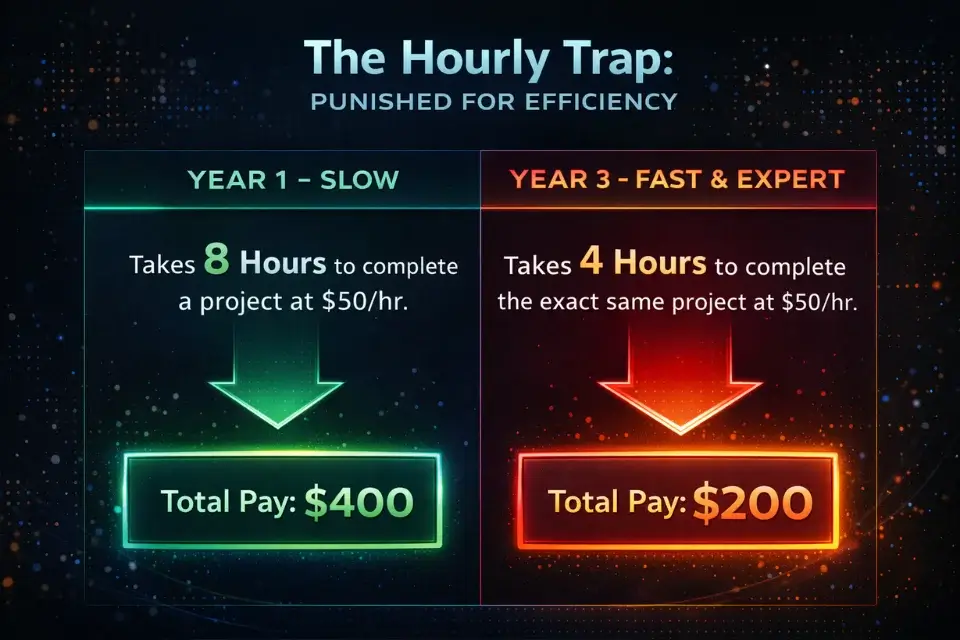
Hourly billing has one fatal structural flaw: it punishes competence.
When you start a project, you’re slow. You make mistakes, you learn the client’s preferences, you iterate. The client pays for all of that friction. As you get faster and better, you complete the same quality of work in half the time — and get paid half as much. The client wins. You lose.
I billed hourly for three years. When I moved a project that previously took me 8 hours to one I could deliver in 4, my income dropped by $140 per project. I had improved my craft and earned less for it. That is the hourly trap in a single sentence.
Warning: Hourly billing means the better and faster you get at your job, the less money you make. This model should be reserved exclusively for unstructured consulting, discovery sessions, or genuinely exploratory work where scope is unknowable upfront. For anything with a defined outcome, walk away from hourly pricing.
2. Fixed Project Pricing (The Stepping Stone)
Fixed pricing is the first real upgrade from hourly. You quote a flat fee for a defined deliverable, the client knows their total cost upfront, and you get rewarded for working efficiently.
The discipline required here is ruthless scope definition. Fixed pricing only works when you have a crystal-clear statement of what is and isn’t included. “Three rounds of revisions. Delivered in 10 business days. Additional revisions billed at $150/hour. Copy changes requested after final approval are a new project.” That level of specificity is what protects your margins.
The failure mode is soft scoping — agreeing to “a website” without specifying the number of pages, the inclusion of copywriting, or the revision limit. Fixed pricing with fuzzy scope becomes hourly pricing with extra steps.
Fixed pricing is the right model for newer freelancers who haven’t yet built the track record to charge based on outcomes. It’s a stepping stone, not a destination.
3. Value-Based Pricing (The 2026 Standard)
Value-based pricing reframes the entire conversation. You stop asking “how long will this take me?” and start asking “what is this worth to the client?”
The math is simple and uncomfortable in the best way:
A client sells a SaaS product at $300/month average contract value. They want a 6-email onboarding sequence to reduce 30-day churn. Their current churn rate costs them $40,000/month in lost revenue. If your email sequence reduces churn by 15%, that’s $6,000/month in recovered revenue — $72,000/year.
You charging $3,500 for that sequence is not expensive. It’s a 48x ROI for the client in year one alone.
This is the value-based conversation. You price against the outcome, not your hours. To make this work, you need to ask the right discovery questions upfront: What does this project need to achieve? What does success look like in dollar terms? What’s the cost of not solving this problem?
The freelancers who bill $10,000–$25,000 for single projects aren’t working 10x as many hours as the ones billing $1,000. They’re having a fundamentally different pricing conversation. According to research from HoneyBook’s freelancer income study, freelancers who use value-based pricing report 40% higher annual income than those using hourly models in equivalent skill categories.
Productizing Your Services to Build Real Wealth
The Bridge Between Active and Passive Income
Value-based pricing is the ceiling of the active income model. There’s a ceiling because it still requires your personal involvement in every project. To break through that ceiling, you productize.
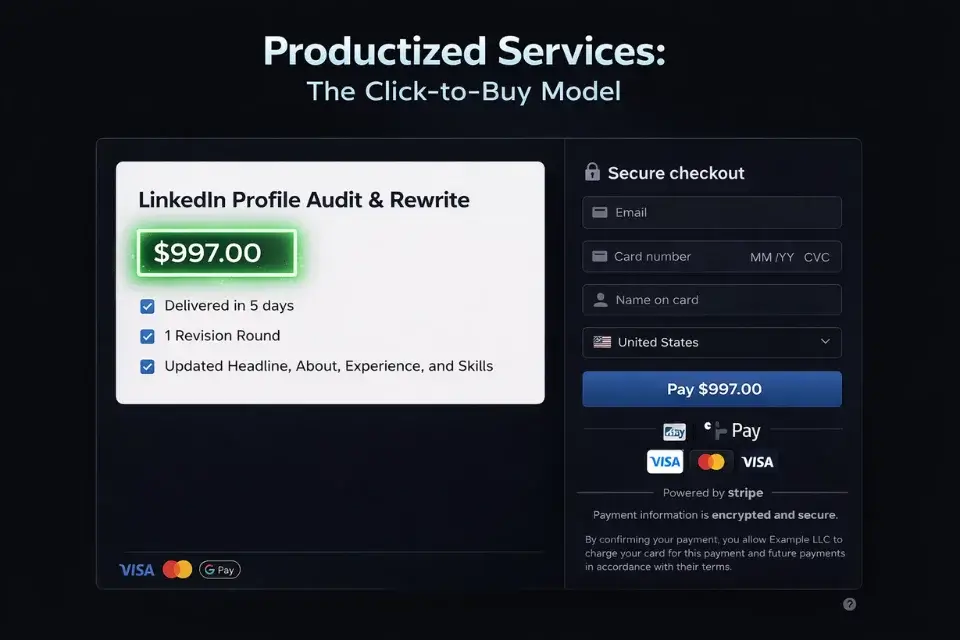
A productized service takes your highest-value, most repeatable offering and turns it into a fixed-scope, fixed-price, click-to-buy package. No custom quotes. No discovery calls for every inquiry. No negotiation.
“LinkedIn Profile Audit & Rewrite: $997. Delivered in 5 business days. Here’s exactly what you get.”
That is a product. You built it once. You deliver it on a system. You can hire someone else to deliver it. You can sell it while you sleep.
The pricing model for a productized service is still value-based at its core — you’re pricing the outcome the client gets, not the hours you spend. But the packaging reduces friction to near zero, which means higher conversion rates and lower time-per-sale.
This is the direct bridge between how you price today and how you build passive income tomorrow. Our passive income guide for freelancers covers the full architecture — the productized service sits in Asset Class 3, and it feeds directly into a scalable income engine that runs without your constant involvement.
Pro Tip: Never sell your “time” on a retainer. Sell “access” or a specific monthly deliverable package. “10 hours/month” is a time-for-money model with a different label. “4 SEO articles per month, published and optimized” is a product. The first invites scope negotiation every billing cycle. The second is a contract with clear deliverables that protects your margins and your sanity.
How to Handle Client Pushback in 2026

The “Sticker Shock” Rebuttal
You will raise your prices. A client will say “that’s more than I expected.” Here is exactly how to respond.
When a client says “You’re too expensive”:
Don’t apologize. Don’t immediately offer a discount. The client is not telling you the price is wrong — they’re testing whether you believe in it.
The script I use: “I understand it’s a significant investment. Based on what you’ve described — [restate their specific goal and the dollar value attached to it] — this project needs to deliver [X outcome] to make financial sense for you. My pricing is based on that outcome, not my hours. Would it help to walk through the expected return together?”
This reframe does two things: it repositions the price as an investment, and it forces a conversation about ROI rather than cost. Clients who walk away after this conversation were never going to pay you what you’re worth anyway. Let them go.
When a client asks for an itemized hourly breakdown:
This is a red flag, not a negotiation tactic. A client who insists on seeing your hours is signaling they want to manage your time, not buy your outcome. That’s the hourly trap wearing a different hat.
The response: “I don’t bill by the hour, so I don’t track time on projects. What I can walk you through is the scope of deliverables and the specific milestones we’ll hit together.”
On the operational side — professional systems justify premium rates. A client paying $150/hour expects a different delivery experience than one paying $25/hour. Using dedicated client portals, structured onboarding documents, and clear project dashboards signals that you operate at a higher level. Our breakdown of the best project management tools for freelancers covers exactly which tools create that impression most efficiently — Basecamp in particular is built for client-facing portals that make premium rates feel obvious.
Frequently Asked Questions
How do I calculate my freelance hourly rate as a beginner?
Start with your MAR (Minimum Acceptable Rate) as outlined above — calculate your annual income target, add 30–35% for taxes and overhead, then divide by realistic billable hours (not total working hours). That gives you your floor. Then research market rates for your skill and experience level on platforms like Contra or Glassdoor’s freelance data.
Your starting rate should sit at or above your MAR, ideally within the bottom third of market range for your niche. Raise it every 6 months until clients push back consistently — that tells you where the ceiling is.
Is value-based pricing better than hourly billing?
For any freelancer with a defined skill set and measurable outcomes — yes, categorically. Value-based pricing removes the income ceiling imposed by hourly models, rewards efficiency, and shifts client conversations from cost to ROI.
The only situations where hourly billing makes sense: genuinely exploratory work where scope is undefined, short consulting sessions, or clients who contractually require it. For everything else, fixed or value-based pricing is objectively better for your income and your client relationships.
How do I raise my prices for existing freelance clients without losing them?
Give 60–90 days notice before the new rate takes effect. Frame it as an annual business review, not a personal ask. The script: “I review my service pricing annually, and my rates are increasing to [new rate] effective [date]. Because you’re an existing client, I’m giving you advance notice and honoring the current rate through [end date].”
Most clients who value your work will stay. Some won’t — and that’s the intended result. Clients who leave over a reasonable rate increase were already at risk of churning over the first scope dispute. The ones who stay become your highest-value long-term relationships. Raising prices strategically is how you replace 5 low-paying clients with 2 high-value ones and work half as many hours for the same income.
At Smart Remote Gigs, our mission is to arm you with the financial frameworks and tools to charge what your outcomes are actually worth.
Stop guessing your worth. Go run your numbers through our Freelance Rate Calculator right now — then read our Ultimate Guide to Passive Income to learn how to completely detach your earnings from your time.

![How to Find Client Email Addresses: B2B Method [Guide]](https://smartremotegigs.com/wp-content/uploads/2026/10/how-to-find-client-email-addresses-hero-1024x577.webp)