Project Manager Cover Letter 2026: Proven Formula [Wins]
 ·
Last Updated: April 4, 2026 ·
10 min read
·
Last Updated: April 4, 2026 ·
10 min read 
If you want to stand out to a high-tier remote company in 2026, a generic project manager cover letter generated by ChatGPT is a guaranteed rejection. You need a highly targeted pitch that proves you can architect async systems, not just schedule Zoom calls—and you need to deliver that proof in under 300 words before the hiring manager’s attention moves to the next application.
When I was hiring remote PMs for our globally distributed engineering team, I stopped reading cover letters altogether—until one candidate used theirs to outline a 30-day plan to reduce our weekly syncs by 40% using Jira automations. They got the interview instantly. Everyone else sent me paragraphs about how passionate they were about project management.
That exact realization—that 99% of candidates don’t know how to pitch their async value—is why we built Smart Remote Gigs. We wanted to give top-tier operators the exact frameworks that actually win over technical hiring managers.
Here’s the formula that candidate used, broken down step by step.
The 2019 Fluff vs. The 2026 Pitch
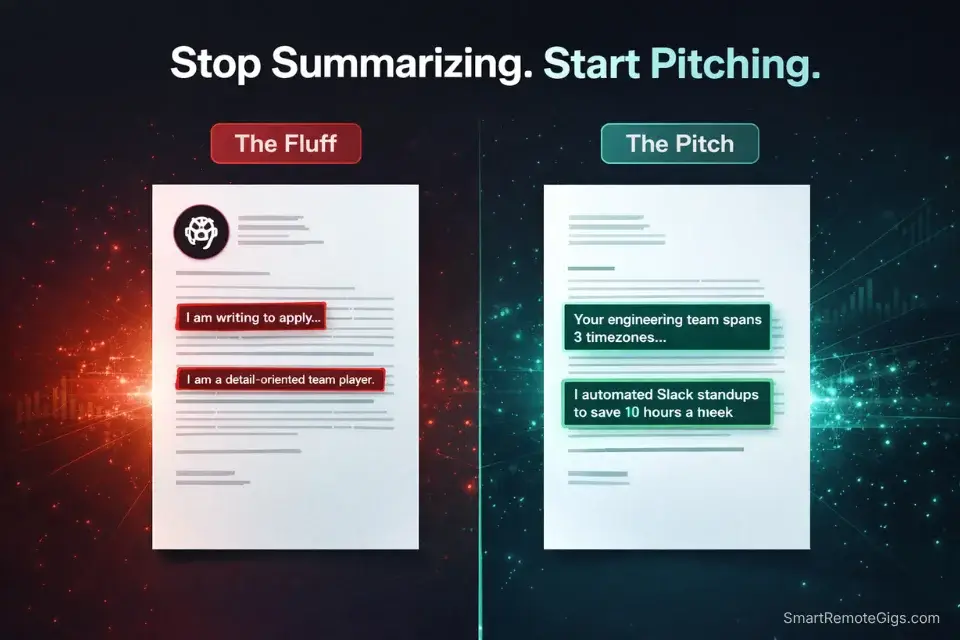
Element | The Old Way (Ignored) | The 2026 Way (Hired) |
|---|---|---|
The Opening | “I am writing to apply for the role of…” | “I noticed your engineering team is distributed across 3 time zones…” |
The Focus | “My past duties included managing budgets…” | “How I build async systems to protect developers’ deep work time…” |
The Proof | “I am a detail-oriented communicator.” | “I automated Slack standups to save 10 hours a week.” |
The CTA | “I look forward to hearing from you.” | “I’d love to show you the custom Notion matrix I built to solve [Pain Point].” |
The Fatal Mistake: Repeating Your Resume
Most candidates treat the cover letter as a prose version of their resume. That is a complete misunderstanding of what each document is for.
Your resume’s job is singular and mechanical: beat the ATS algorithm by hitting the right keyword thresholds. It is a technical document optimized for a parser, not a human. It does not need to tell a story. It needs to pass a filter.
Your cover letter’s job is the opposite. By the time a hiring manager reads it, you’ve already cleared the bot. Now you’re talking to a person who wants to understand one thing: how do you think? They want to see whether you understand their specific operational problem, whether you’ve solved something like it before, and whether you communicate with the kind of clarity and brevity that a high-functioning async team demands.
The candidates who repeat their resume in cover letter form signal immediately that they don’t understand this distinction. The candidates who come in with a sharp, targeted argument about the company’s remote scaling challenges get the callback.
Warning: Never open with “I am writing to apply for the Project Manager position.” They already know what you applied for—you submitted an application. Start with a specific, researched observation about their company’s remote operations. That first line is the only thing standing between getting read and getting deleted.
The 2026 Formula: Pitching “Async Leadership”
The core reframe you need to make before writing a single word: you are not applying for a job. You are pitching a solution to a specific operational problem.
Every async-first remote company at scale is dealing with the same cluster of pain points: developer context-switching from too many interruptions, cross-timezone handoff failures that create 8-hour delays, and status reporting that requires live meetings to function. Your cover letter names one of these problems specifically, demonstrates that you’ve solved it before, and offers a concrete preview of how you’d solve it for them.
This reframe changes the entire tone. Instead of “here is my background,” it becomes “here is your problem, here is my track record with it, here is what changes when I join.” That is the difference between a cover letter that reads like a formality and one that reads like a business case.
For the tactical breakdown of how top async PMs handle cross-timezone handoffs specifically—which is one of the most credible pain points to reference in a cover letter for distributed companies—read our masterclass on managing teams across time zones before you write your opening paragraph.
Pro Tip: Research the company’s tech stack before writing a single word. Check their job listings for tool names, scan their engineering blog, and look at their team’s LinkedIn profiles. Mentioning a specific operational bottleneck you suspect they’re experiencing—cross-timezone developer handoffs, sprint visibility gaps, async documentation debt—and offering a high-level solution puts you in the top 1% of applicants before they’ve even finished your first paragraph.

Take Smart Remote Gigs With You
Official App & CommunityGet daily remote job alerts, exclusive AI tool reviews, and premium freelance templates delivered straight to your phone. Join our growing community of modern digital nomads.
Name-Dropping Your Remote Tech Stack Correctly
There is a version of tool name-dropping that impresses hiring managers and a version that wastes their time. The difference is specificity.
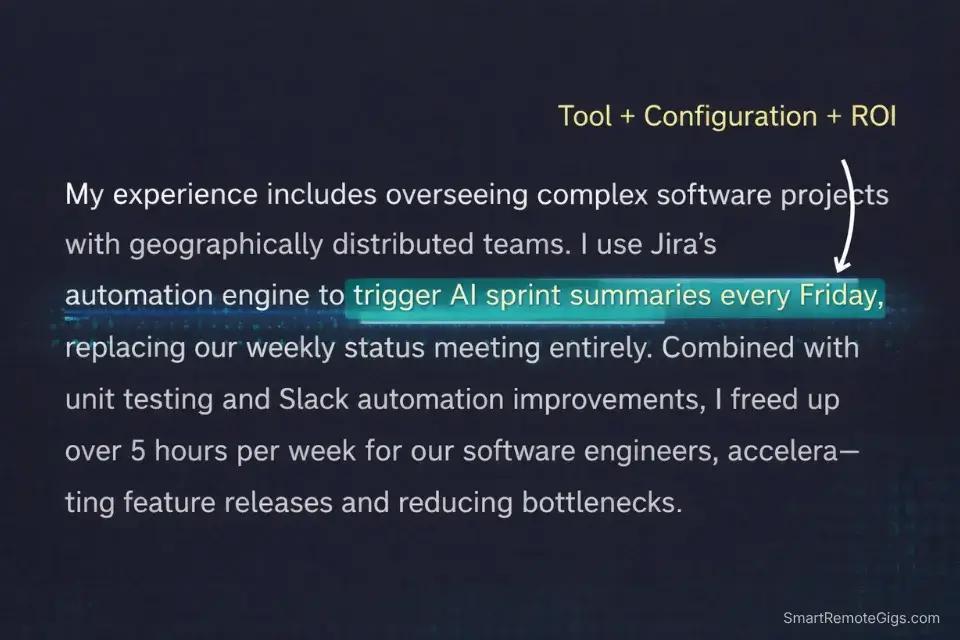
“Proficient in Jira” says nothing. Every PM applicant claims Jira proficiency. What actually lands is operational specificity: “I use Jira’s automation engine to trigger AI sprint summaries every Friday, replacing our weekly status meeting entirely.” That sentence tells the hiring manager you’ve configured the tool at a meaningful depth, you think in terms of async systems, and you measure success by meeting elimination rather than meeting facilitation.
The honest caveat worth knowing before you pitch Jira in a cover letter: its configuration overhead is genuinely steep. If you name-drop Jira and can’t speak to custom workflows, JQL queries, or automation rule architecture in the interview, you will get exposed fast. Only lead with Jira if you’ve actually gone deep on it—surface-level familiarity will crater your credibility the moment a technical hiring manager pushes back.
The same principle applies to Asana. Don’t mention it—describe the custom portfolio dashboard you built to give three executive stakeholders real-time sprint visibility without a single recurring report call. That said, Asana’s biggest failure mode is well-documented: without strict task ownership rules and due-date enforcement baked in from day one, it devolves into a graveyard of untracked subtasks and stale projects that nobody trusts. If you’re pitching Asana fluency, be ready to talk about the governance system you built around it, not just the tool itself.
Specificity is the signal. Vagueness is the noise. Hiring managers filter fast.
For guidance on which tool to lead with based on company size and engineering team structure—Jira for dev-heavy orgs, Asana for cross-functional teams—read our technical comparison of Asana vs Jira for remote teams before you finalize your tool references.

Best For: Advanced Issue Tracking, Developer Deep-Work Protection & Agile Sprints

Best For: The cleanest project management tool for freelancers managing multi-client workflows — until you hit the per-seat pricing wall at scale.
The 3-Paragraph Cover Letter Blueprint (With Examples)
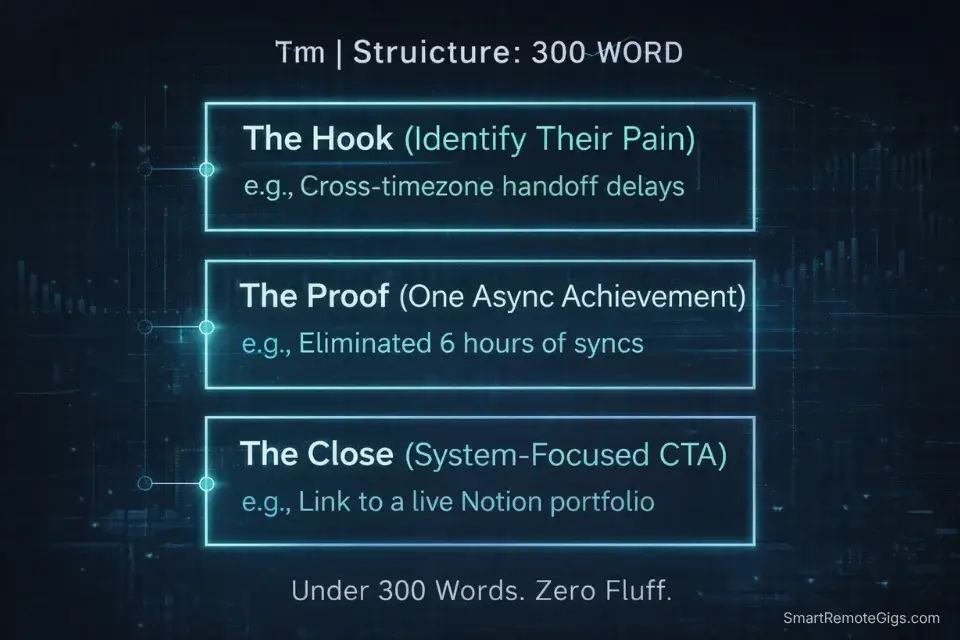
This is the structure. Three paragraphs. Under 300 words total. Every sentence earns its place.
Paragraph 1: The Hook — Identify Their Pain
Open with a specific, researched observation about their remote operations challenge. Not a compliment about the company. Not a statement about how excited you are. A diagnosis.
Example:
“Your engineering team is distributed across four time zones, which means every mishandled async handoff costs you an eight-hour delay before the next overlap window. For a team shipping on two-week sprints, that’s a structural risk that compounds every cycle.”
That opening tells the hiring manager three things immediately: you did your research, you understand distributed team operations at a systems level, and you think in terms of risk and compounding—not tasks and meetings.
Paragraph 2: The Proof — One ROI-Driven Async Achievement
One achievement. Not three. The instinct to list accomplishments here is the same instinct that produces mediocre cover letters. Pick your single strongest async operations win, and make it as specific as possible.
Example:
“At [Previous Company], I inherited a 12-person engineering team running on five recurring weekly syncs and no documented decision log. Within 90 days I had replaced every status meeting with automated Asana reporting, built a Notion decision database that eliminated 80% of revisited discussions, and reduced the team’s meeting load from 6 hours per week to under 45 minutes—without a single complaint from the engineers.”
Numbers. Tools. Timeline. Outcome. That is the proof structure.
Paragraph 3: The Close — A System-Focused CTA
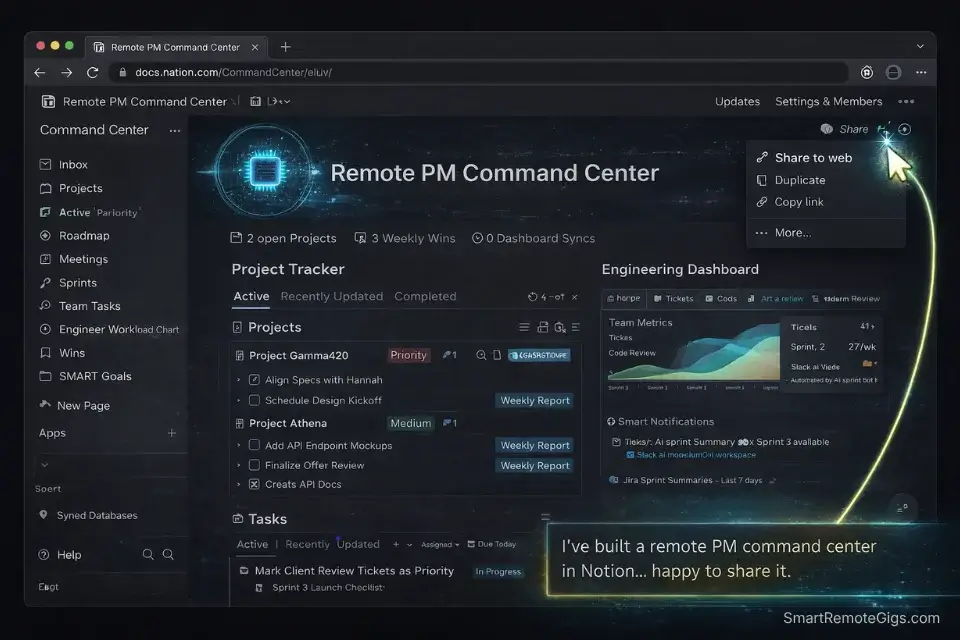
Don’t close with “I look forward to hearing from you.” That is a passive, forgettable exit. Close with a specific, curiosity-generating offer that makes not responding feel like leaving value on the table.
Example:
“I’ve built a remote PM command center in Notion that I use to manage distributed teams without recurring syncs—I’d love to walk you through how I’d adapt it for your team’s current sprint structure. Happy to share it ahead of any call if that’s useful.”
That closing does three things: it proves you have a tangible, existing system, it creates a curiosity gap around what the system looks like, and it lowers the barrier to a response by offering value before asking for anything.
Managing a distributed team shouldn't mean spending six hours a day chained to a webcam asking, "So, what's the status on this?" If your team is drowning in Slack notifications...
Frequently Asked Questions
Are cover letters still necessary for project managers in 2026?
Yes—specifically for remote startups and async-first companies, and for a reason that’s directly relevant to the role itself. In a fully distributed environment, written communication is your primary management tool. A cover letter is the hiring manager’s first data point on whether you write with clarity, structure, and brevity.
Submitting without one, or submitting a weak one, signals that your async communication—the actual core of the job—may be equally underdeveloped.
How long should a project manager cover letter be?
250 to 300 words maximum. Three tight paragraphs. If it reads longer than a well-structured async Slack update, the hiring manager will reasonably assume that your sprint briefs, stakeholder updates, and handoff documentation are equally verbose.
Length in a cover letter is not a signal of effort—it is a signal of poor editing, which is a direct red flag for a role built on async communication precision.
Can I use AI to write my project manager cover letter?
You can use AI to brainstorm structure or tighten editing passes—that’s a reasonable tool use. But submitting raw, unedited AI output in 2026 is a significant red flag for remote PM roles specifically. According to Greenhouse’s State of Hiring report, hiring teams are increasingly screening for authentic communication as a direct proxy for async leadership capability.
A letter that reads like a language model wrote it signals two things simultaneously: that you lack authentic written communication skills, and that you don’t understand the difference between using AI as leverage and outsourcing your thinking to it entirely. For a deeper dive into how this is reshaping the job market, Wharton’s recent research on how AI is killing the traditional cover letter provides crucial insights into why authenticity is your only remaining differentiator.
The Verdict: A 2026 cover letter is not a polite introduction. It is an aggressive, value-driven sales pitch proving you are an Async Operator who solves distributed team problems before they compound. Show, don’t tell. Prove you can communicate asynchronously by making the letter itself brief, structured, and highly actionable.
At Smart Remote Gigs, we’ve seen firsthand that candidates who use this exact pitch format bypass the ATS and secure interviews at a remarkably high rate.
Once your cover letter is dialed in, skip the generic job aggregators and check the Smart Remote Job Board for vetted, async-first roles. For a deeper dive into the hiring landscape, read our complete guide on landing high-paying remote project manager jobs and prepare for the callback with our breakdown of the top remote PM interview questions.

![AI Content Writer Jobs: [My 2026 Survival Playbook]](https://smartremotegigs.com/wp-content/uploads/2026/04/ai-content-writer-jobs-survival-playbook-1024x577.webp)
![Remote Copywriting Jobs 2026: [High-Ticket Method]](https://smartremotegigs.com/wp-content/uploads/2026/04/remote-copywriting-jobs-high-ticket-method-guide-1024x577.webp)
![Remote Technical Writing Jobs: [The $80K/Yr Guide]](https://smartremotegigs.com/wp-content/uploads/2026/04/remote-technical-writing-jobs-hero.webp)