Do you mentally correct your friends’ text messages? Do typos on restaurant menus drive you crazy? That isn’t just a personality quirk—it’s a marketable skill called “The Eagle Eye.”
Most people believe you need an English Literature degree or 10 years of publishing experience to get paid to read. Meanwhile, bad grammar is costing businesses millions in credibility, and they need help now.
Here’s what nobody tells you: the demand for proofreaders has never been higher. Every business has a blog. Every entrepreneur has a newsletter. Every author has a manuscript. And almost all of it is riddled with embarrassing errors that damage their professional reputation.
This guide will show you how to monetize your natural attention to detail, turning your “grammar police” tendencies into a legitimate side hustle—or full-time career—without going back to college.
📝 Proofreading Career Specs
Feature | The Reality |
|---|---|
Startup Cost | $0 (If you have a laptop) |
Avg. Starter Rate | $20 – $35/hr |
Primary Skill | Attention to Detail (Not Creative Writing) |
Best For | Introverts & Perfectionists |
Threat Level | Low (AI still misses context/nuance) |
Proofreading vs. Editing: Don’t Confuse Them
Let’s clear up the biggest misconception right now because clients will try to blur these lines and get free labor.
Proofreaders catch errors. You’re hunting for typos, grammar mistakes, punctuation problems, formatting inconsistencies, and factual errors that are objectively wrong. You’re the last line of defense before something goes public.
Editors change the story. They reorganize paragraphs, rewrite awkward sentences, adjust tone, cut fluff, and improve flow. They’re making creative decisions about how the content should read.
Copy editors sit in the middle. They fix grammar like proofreaders but also improve clarity and style without changing the author’s voice.
Task | Proofreading | Copy Editing |
|---|---|---|
Fix typos & spelling | ✅ Yes | ✅ Yes |
Correct grammar & punctuation | ✅ Yes | ✅ Yes |
Rewrite awkward sentences | ❌ No | ✅ Yes |
Reorganize paragraphs | ❌ No | ✅ Yes |
Change tone or voice | ❌ No | ✅ Yes |
Why does this matter? Because proofreading is easier to start and harder to mess up. You’re not making subjective creative decisions that clients can argue with. You’re catching objective errors. Either “their” should be “they’re” or it shouldn’t. There’s a right answer.
Warning: Do not offer “editing” services yet. Stick to proofreading to avoid scope creep. Clients will pay you for proofreading, then expect you to rewrite their terrible content for free. Draw a hard line.
Start with pure proofreading. Once you have 6 months of experience and strong client relationships, you can offer copy editing at a higher rate.
Step 1: The “Unlearning” Phase (Tools vs. Brain)
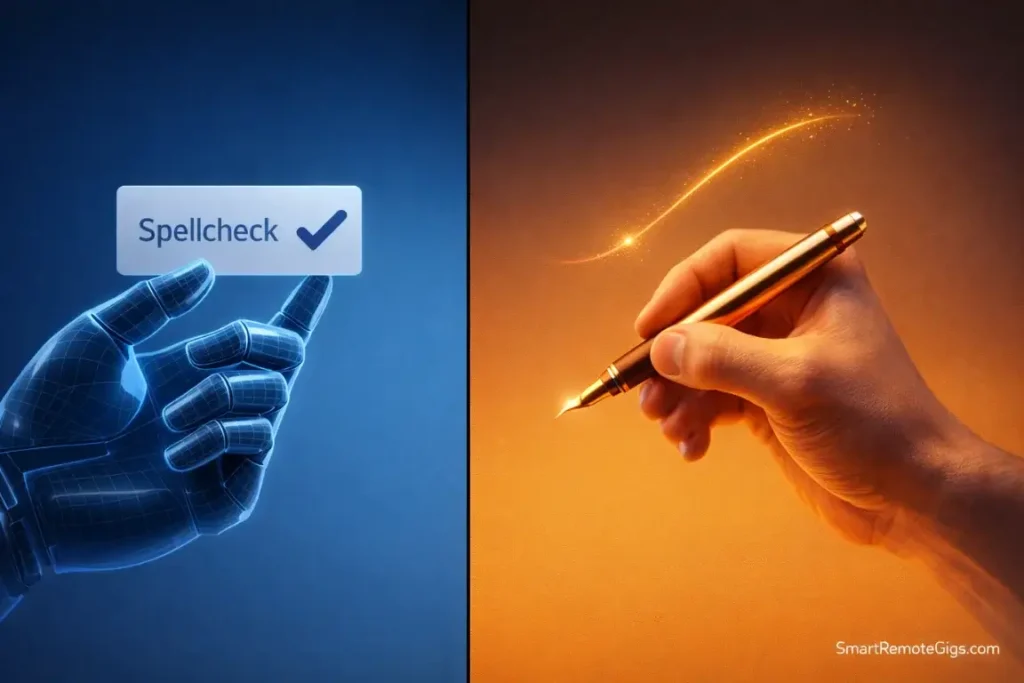
Here’s what beginners get wrong: they think Grammarly or ChatGPT can do the job for them.
It can’t. And that’s exactly why you still have a career.
AI is phenomenal at catching obvious mistakes. Spelling errors, basic grammar, missing punctuation—software handles that instantly. But AI is catastrophically bad at context, nuance, and meaning.
Real examples AI misses constantly:
- “The company is looking for pubic relations experts” (should be “public”)
- “He lead the team” vs “He led the team” (both are real words, wrong tense)
- “The defendant was present at the trial” vs “The defendant was absent at the trial” (opposite meanings, both grammatically correct)
- Inconsistent style choices (Oxford comma used sometimes but not always)
- Factual errors that are grammatically perfect (“The meeting is on February 31st“)
This is where you come in. You’re not competing with Grammarly. You’re cleaning up after Grammarly.
Pro Tip: AI is great at catching typos, but terrible at catching context (e.g., “public” vs “pubic”). That’s why humans get paid. Position yourself as “the human quality check after the AI pass.”
Your sales pitch should be: “I catch what the robots miss.” Because you do.
Use Grammarly as your first-pass tool to eliminate the obvious stuff quickly. Then apply your human brain to catch the subtle errors that require understanding what the author actually meant to say.
Step 2: Pick Your Niche (Generalist = Low Pay)

Don’t just “proofread anything.” That’s the fastest way to compete with 50,000 other beginners offering the same generic service for $5 per 1,000 words.
High-value niches where proofreaders get paid 2-3x more:
Court transcripts: Legal transcription companies need proofreaders to catch errors before documents are filed. This work pays $25-$40/hour starting because accuracy is legally critical. You don’t need a law degree—you just need to understand legal formatting conventions, which you can learn in a weekend.
Academic papers: Grad students and researchers need their work proofread before journal submission. They have funding. They can’t afford rejection due to typos. This niche pays $30-$50/hour because the stakes are high and the clients aren’t price-sensitive.
Translated content: Companies translate their websites into multiple languages, but automated translation creates awkward phrasing. If you’re a native English speaker, you can proofread translated-to-English content for $25-$35/hour. You’re not checking grammar—you’re checking if it sounds natural.
Technical documentation: Software companies, medical device manufacturers, and engineering firms need proofreaders who can handle dense, technical content without getting overwhelmed. Pays $30-$45/hour because most people find it boring and quit.
eBook authors: Self-published authors are desperate for affordable proofreading before launch. They’re not corporations with huge budgets, but they value quality and will pay $200-$500 per book (usually 2-4 hours of work).
The Verdict: Court transcript proofreading is the hidden gem of 2026. Steady demand, clear standards, and clients who understand the value of accuracy. Most people don’t even know this niche exists.
Pick one niche. Build your profile around it. Get 3-5 clients in that niche. Then expand if you want.
Step 3: Setting Your Rates (Word Count vs. Hourly)
Proofreaders typically charge one of two ways: per word or per hour.
Per word pricing (most common for beginners):
- $0.01-$0.02 per word for general content
- $0.02-$0.04 per word for specialized/technical content
- A 2,000-word blog post = $20-$80 depending on complexity
Most beginners can proofread 1,000-1,500 words per hour. So if you’re charging $0.02/word, you’re making $20-$30/hour effective rate.
Hourly pricing (better for complex or heavily flawed content):
- $20-$25/hour for beginners
- $30-$40/hour with 6+ months experience
- $50-$75/hour for specialized niches
I recommend starting with per-word pricing because it’s easier for clients to understand and compare. “I charge $25 to proofread your 1,500-word article” is clearer than “I charge $30/hour and it’ll take me… I’m not sure how long.”
Once you know your speed in different content types, you can quote confidently.
Avoid the race to the bottom. Read our guide on How to Price Your Freelance Services to set sustainable rates that don’t leave you resenting your clients.
Need to convert word count to an hourly wage? Use our Freelance Hourly Rate Calculator to make sure your per-word rate actually pays you fairly.
The beginner trap: Don’t charge $0.005/word ($5 per 1,000 words) thinking it’ll get you hired faster. It won’t. It attracts nightmare clients who want free rewrites and will blame you for their terrible writing.
Price yourself in the middle of the market. You’re not the cheapest. You’re not the most expensive. You’re the reliable option.
Step 4: Finding Work (The ‘No Portfolio’ Strategy)

You have two primary hunting grounds:
Marketplaces (Fast but competitive)
Upwork, Fiverr, Freelancer.com all have thousands of proofreading jobs posted daily. The volume is real. So is the competition.
Your profile needs to stand out immediately:
- List your niche (don’t just say “I proofread anything”)
- Show a before/after sample (find a public blog post with errors, proofread it, screenshot the improvements)
- Offer a first-job discount (not forever, just to get your first review)
Should you start on the big platforms? We compare Upwork vs. Fiverr to help you choose based on your niche and pricing strategy.
Specialized job boards:
- Reedsy for book proofreaders
- EditFast for academic proofreading
- ProofreadingPal (they hire contractors)
These platforms have less competition than Upwork but also fewer total jobs. Apply to work for the companies that hire proofreading contractors—you get steady work without hunting for clients.
Cold Pitching (Higher pay, requires confidence)
This is where beginners make easy money fast: find content with obvious errors and offer to fix it.
Go to Medium, LinkedIn, or industry blogs. Find articles with typos in the first three paragraphs. Screenshot the errors. Email the author:
“Hi [Name], I loved your article on [topic]. Quick heads up—I noticed a few typos that might hurt credibility (screenshot attached). I’m a freelance proofreader specializing in [their niche]. If you publish regularly, I’d love to help you polish future posts before they go live. Would you be open to a quick call?”
See exactly what to say to potential clients in our Freelance Cold Emailing guide.
Half of them won’t respond. A quarter will say “thanks but no thanks.” But that last quarter? They’ve been embarrassed by typos before and will absolutely hire you.
This strategy works because you’re solving an immediate, visible problem they didn’t know they had.
Step 5: The “Beta Client” Technique
The classic problem: clients want samples, but you need clients to create samples.
Here’s how you break the loop in one week:
Find 3 small businesses or bloggers in your target niche. Not Fortune 500 companies. Not famous authors. Small fish who publish regularly but clearly don’t proofread.
Offer to proofread 500 words for free with one condition: if they’re happy with the work, they write you a LinkedIn recommendation or testimonial you can use publicly.
Make it frictionless: “No commitment. No pitch. Just send me your next blog post draft, I’ll clean it up, and if you love it, a quick testimonial would be amazing for my portfolio.”
Most people say yes because the risk is zero and they’re getting free value.
Do exceptional work. Catch every error. Add helpful comments. Make them look like a genius.
Get your testimonial. Screenshot it. Now you have social proof.
Within two weeks, you can have 3 glowing testimonials and real before/after samples. That’s enough to charge full price.
Critical rule: Only do this for your first 3 clients. After that, never work for free. Your time is valuable, and “exposure” doesn’t pay rent.
Is This Right For You?
Let’s be honest about who thrives as a proofreader and who burns out:
You’ll love this if:
- You get genuine satisfaction from finding mistakes
- You can focus on repetitive tasks for hours without getting bored
- You prefer clear, objective work over creative decision-making
- You’re an introvert who wants minimal client interaction
- You like flexibility—proofreading can be done at 2 AM in your pajamas
You’ll hate this if:
- You find detail work tedious and soul-crushing
- You want to write your own content, not fix other people’s
- You need constant variety and new challenges
- You get eye strain easily (this is screen-heavy work)
- You’re impatient—proofreading requires slow, methodical reading
The biggest complaint I hear from ex-proofreaders: “I felt like a robot.” The work can be monotonous. You’re reading the same types of content repeatedly, catching the same types of errors.
But for the right personality type—the person who finds meditation in precision—this is perfect.
Love the detail but hate the words? If you prefer numbers, check out How to Become a Remote Bookkeeper instead. Same need for accuracy, different application.
Frequently Asked Questions
Is proofreading in demand in 2026?
Absolutely. The explosion of AI-generated content has actually increased demand for human proofreaders. Companies are publishing more content faster, which means more errors slip through. They need humans to catch the mistakes that AI creates or misses. Court transcription, academic publishing, and self-publishing are particularly hungry for proofreaders right now.
Do I need a certificate to be a proofreader?
No. Certificates exist (Caitlin Pyle’s course, Proofread Anywhere, etc.), but they’re not required. Clients care about samples, testimonials, and your ability to catch errors. Save your money unless you want structured training. Most successful proofreaders are self-taught through practice and style guides.
How much do beginner freelance proofreaders make?
$20-$30/hour on average, or $0.01-$0.02 per word. If you work 20 hours per week at $25/hour, that’s $2,000/month or $24,000/year part-time. Full-time proofreaders with specializations can make $50,000-$70,000/year once they build a client base and raise rates.
What is the best website to find proofreading jobs?
For general work, Upwork has the highest volume. For book proofreading, Reedsy connects you directly with authors. For academic work, EditFast and Scribendi hire contractors. For court transcripts, check Transcription Certification Institute job boards. Don’t put all your eggs in one basket—use 2-3 platforms simultaneously.
Conclusion: Your Eye for Detail is an Asset
Proofreading is the “gateway drug” to the freelance world. It has the lowest barrier to entry—you don’t need software, certifications, or startup costs—but requires the highest level of focus.
If you’ve made it this far and you’re still not bored by the idea of reading about grammar, you’re probably wired for this work.
The people who fail at proofreading are the ones who thought it would be easy passive income. It’s not passive. It’s active, focused, detail-oriented work that demands your full attention.
The people who succeed are the ones who genuinely enjoy the hunt. Who get a little dopamine hit every time they catch an error everyone else missed.
If that’s you, you don’t need permission to start. You don’t need a course. You don’t need perfect conditions.
Open a Google Doc, find a blog post with errors, and practice your markups today. Your career starts with the first correction.