Build Freelance Portfolio From Scratch 2026: AI Fix [Guide]
 ·
Last Updated: Mar 26, 2026
·
Last Updated: Mar 26, 2026
If you are trapped in the paradox of needing experience to get hired, figuring out how to build a freelance portfolio from scratch is your only escape route. In 2026, you don’t need to wait for a client to give you permission to show off your skills — you can manufacture your own proof.
I spent a weekend testing whether a completely fabricated, AI-assisted mockup portfolio could win jobs against freelancers with 5 years of real experience. The result? Clients don’t care if the company is real. They care if the work is good.
Breaking down these traditional gatekeeping barriers so you can launch immediately is exactly why we built Smart Remote Gigs. Here’s the exact 48-hour blueprint.
The 48-Hour Portfolio Tech Stack
|
Step |
The 2026 AI Tool |
Cost |
Time to Complete |
|---|---|---|---|
|
Brief Generation (Inventing the client) |
ChatGPT |
Free |
30–60 minutes |
|
Asset Creation (Producing the work) |
Your core skill tool (Canva, Figma, Docs) |
Free–$15/mo |
3–6 hours per piece |
|
Mockup Packaging (Making it look real) |
Canva (Device Mockups) |
Free |
30–45 minutes per piece |
|
Portfolio Hosting (Publishing your case studies) |
Notion |
Free |
1–2 hours total |
|
Pitch Script (Sending to prospects) |
ChatGPT + your own voice |
Free |
20 minutes |
The “Experience Paradox” (And The 2026 AI Fix)
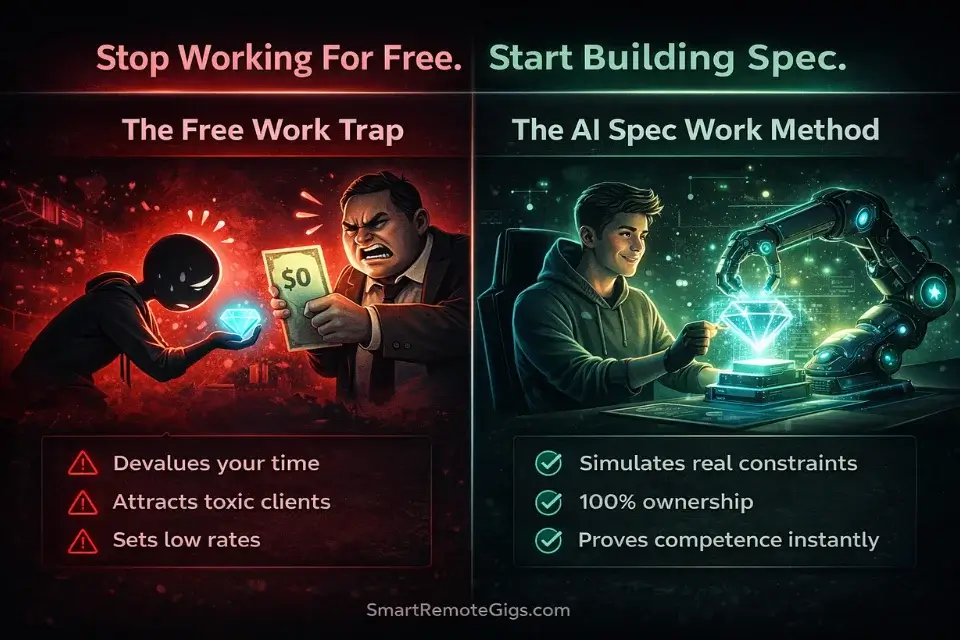
Every beginner freelancer hits the same wall: clients want proof, but you only get proof by working for clients. For years, the default advice was to do free work for exposure — offer your services for nothing to build your portfolio, get a testimonial, and leverage it into paid work.
That advice is outdated and economically corrosive. Free work trains clients to devalue your services from the first interaction. It attracts the worst clients — the ones who can’t or won’t pay. And it sets a precedent that follows you into your first paid rate negotiation.
The 2026 replacement is Spec Work — speculative portfolio pieces built to simulate real client constraints. Every advertising agency in the world runs “spec ads” as a hiring test. Every design school teaches students to build concept projects for imaginary brands. This is not a hack or a shortcut. It is the standard professional method for demonstrating competence before you have a track record.
The AI acceleration layer is what makes this viable in a weekend rather than a month. You use AI to generate the brief, simulate the client context, and accelerate parts of the production process. The work itself — the judgment, the craft, the problem-solving — is yours.
Red Flag: Never steal another designer’s or writer’s work and present it as your own. And never claim a mockup was produced for a real paying client. Both will destroy your professional reputation the moment a prospect checks. The correct framing is simple and honest: label every spec piece as a “Concept Project” or “Portfolio Case Study.” No client will disqualify you for this. They will respect the transparency.
Step 1: Inventing the “Perfect” Client Brief
This is the step most beginners skip — and it’s why their portfolio pieces look amateur even when the underlying work is technically competent.
A random blog post about “marketing tips” proves nothing. A random logo for a made-up coffee shop proves nothing. What proves your competence is work that was produced to solve a specific, realistic problem for a well-defined client. The brief is what makes the work legible to a prospective buyer.
Here’s what a proper spec brief contains:
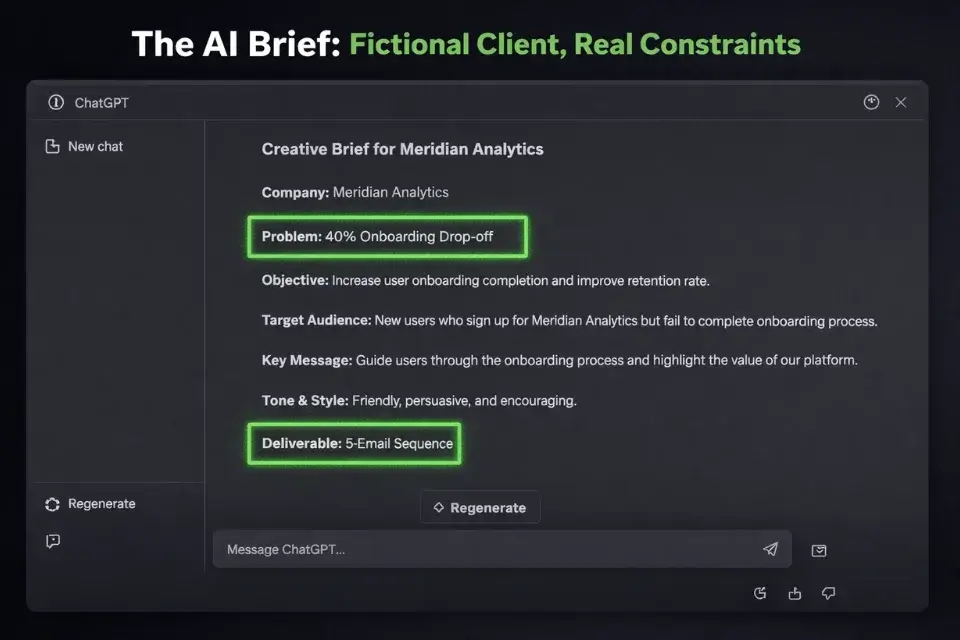
- Company name and industry (fictional but specific — not “a tech company,” but “Meridian Analytics, a Series A B2B SaaS company selling predictive churn analytics to mid-market e-commerce brands”)
- Target audience (who the company sells to, in demographic and psychographic detail)
- The specific problem the piece needs to solve (“Their onboarding email sequence has a 40% drop-off at Day 3”)
- The deliverable and success metric (“A 5-email onboarding sequence targeting Day 3 churn with a goal of reducing drop-off by 20%”)
- Constraints (brand voice, word count, platform, format)
ChatGPT generates all of this in 60 seconds if you prompt it correctly. Ask it to roleplay as a client in your target industry, give you a realistic brief for the type of work you want to showcase, and include specific metrics and constraints. The output gives your spec work the professional framing that separates it from amateur “practice pieces.”
Align every brief directly to the specific gig you want to sell. If you’re building a Notion Workspace gig on Fiverr, your spec brief should be for a fictional client who needs exactly that. If you want to write SaaS onboarding emails, your brief should simulate that exact scenario. Our Fiverr gig ideas guide maps out the highest-demand gig types in 2026 — use it to pick your niche, then reverse-engineer the brief to match.

ChatGPT
Best for: Generating highly detailed, realistic creative briefs and fictional company profiles for your spec work.
Step 2: Designing High-Fidelity Mockups
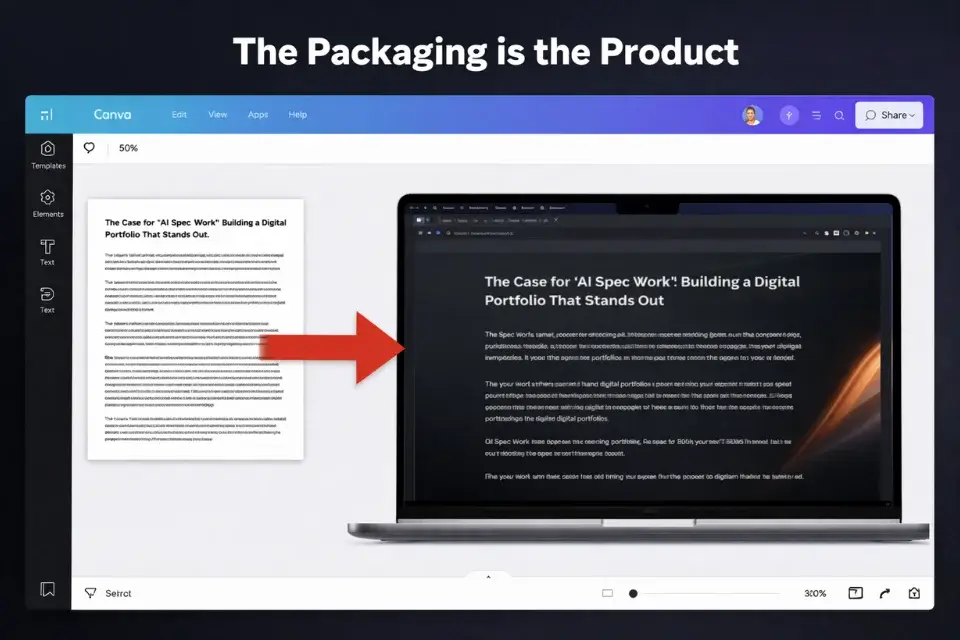
Here’s a truth most beginners resist: the packaging of your work is part of the work.
A Google Doc link is not a portfolio. A raw PNG file attached to an email is not a portfolio. A wall of bullet points describing what you did is not a portfolio. A portfolio is a visual presentation of a professional output that allows a prospect to immediately understand the quality of your thinking and execution.
This is true even if you are a writer. Especially if you are a writer.
A copywriter who shows a screenshot of their text dropped into a beautifully designed landing page mockup — complete with a photorealistic browser frame around it — looks like a professional. A copywriter who pastes their text into a Google Doc and shares the link looks like an amateur. The underlying words might be identical. The perception is completely different.
Canva’s device mockup library solves this for every skill type. Drag your design, document screenshot, or exported PDF into a laptop, phone, or tablet mockup frame. Add a clean background. Export at high resolution. You now have a portfolio image that looks like it was produced by an established agency.
For writers: screenshot your best-formatted Google Doc version, drop it into a laptop mockup. For designers: export your Figma or Illustrator file and frame it. For social media managers: use Canva’s phone mockup to show your posts in a realistic Instagram or LinkedIn feed frame.
The honest Canva limitation: if your work involves complex data visualization, advanced vector illustration, or highly technical design systems, Canva won’t replicate the fidelity of native design tools. Use it for the packaging layer, not as your primary production environment.
Canva
Best for: Dropping your text, designs, or raw outputs into stunning, photorealistic laptop and mobile device mockups for your portfolio gallery.
Step 3: Hosting Your Assets for Free (Without Coding)
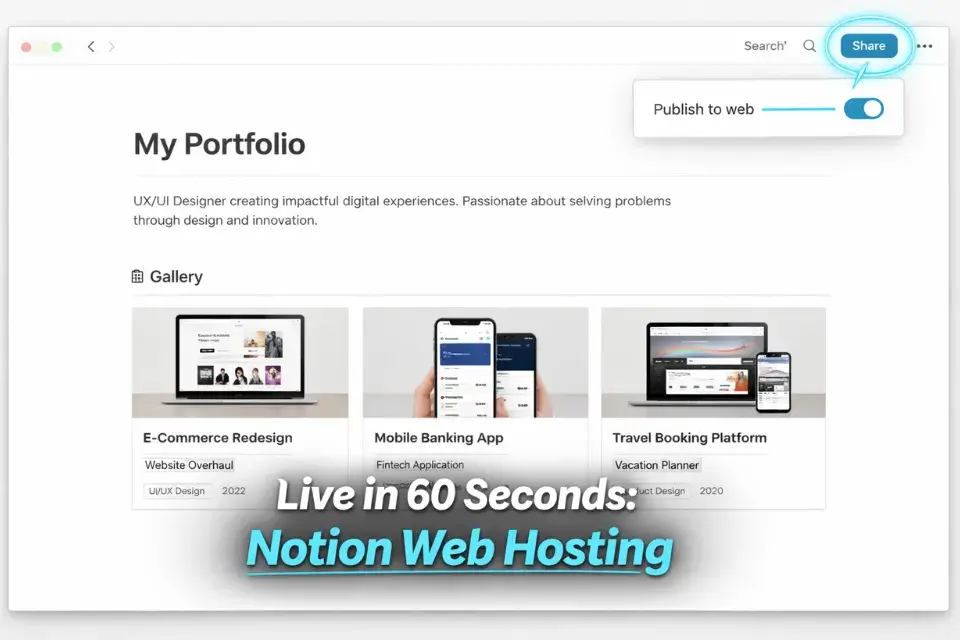
You do not need a WordPress site, a custom domain, or a web developer to launch a professional portfolio in 2026.
I have watched beginners spend three weeks obsessing over their portfolio website color scheme before they have a single piece of work to put in it. That is procrastination wearing the costume of productivity. Your hosting solution should take one afternoon, not one month.
Notion is the fastest and cleanest free portfolio host available. Build one page per case study using this structure:
- Header: The fictional company name, the deliverable type, and one outcome metric (“Reduced onboarding churn by 22% — Concept Project”)
- The Brief: A short summary of the fictional client’s problem (1–2 paragraphs)
- The Approach: What you decided to do and why (this is where your strategic thinking shows)
- The Output: Embedded images of your Canva-packaged mockups
- The Result: What success would have looked like, in specific, measurable terms
Link all three case studies from a single Notion home page. Enable “Share to web.” You now have a professional portfolio with a clean URL you can paste into any proposal, email, or Fiverr gig description in under two hours.
The Notion caveat worth mentioning: the platform’s free-tier pages have a Notion.so domain (e.g., notion.so/yourpage) rather than a custom domain. For most early-stage freelancers, this is completely fine — the content is what clients evaluate, not the URL structure. If you want a custom domain, Notion’s paid plan or a free Carrd page solves it for under $10/year.
Notion
Best for: Building a sleek, minimalist portfolio website in under an hour using pre-built gallery databases and case study page templates.
How to Pitch Mockups to Real Clients (The Script)
Your portfolio is built. Now the question is how to present it without underselling it or over-explaining it.
Most beginners make one of two mistakes. Either they apologize for the work (“I should mention these are just practice projects…”) or they say nothing at all and hope the prospect figures out the context. Both approaches are wrong.
The correct framing is confident, transparent, and outcome-focused. Here is the exact script structure I tested:
“I’ve attached a link to three case studies from my portfolio — including a concept project I built for [fictional industry/company type] that’s directly relevant to what you’re working on.
In that piece, the brief was: [one sentence describing the fictional client’s problem]. My approach was [one sentence describing your strategic decision]. The output was [describe the deliverable].
Happy to walk you through my thinking on any of them — I find that conversation more useful than a portfolio review alone.”
What this script does: it leads with the work, not an apology. It demonstrates strategic thinking before the client even opens the link. And the offer to discuss your thinking shifts the evaluation from “does this person have clients” to “does this person think about problems the right way.” Experienced clients know the second question is more predictive of quality.
Once your portfolio is ready, the next step is deploying it in the right places. Our Upwork first job guide shows exactly how to attach your Notion portfolio link to a proposal for maximum impact — including where in the proposal structure it converts best. And when you’re deciding which platform to launch on first, our breakdown of the best freelance websites for beginners maps out where your specific skill type is most likely to get traction.
Pro Tip: Format every portfolio piece as a proper case study using this three-part structure: The Problem (from your AI-generated brief) → The Approach (your strategic reasoning) → The Solution (the deliverable and its outcome). Clients hire problem solvers, not just executors. This format proves you can think, not just produce — and that distinction is what separates the freelancers who charge $25/hour from the ones charging $150.
Frequently Asked Questions
Do clients care if my freelance portfolio is just personal projects?
No — and this is one of the most liberating truths for beginners to internalize. Clients evaluate portfolios for one thing: evidence that you can solve their specific problem at an acceptable quality level. Whether the project was for a Fortune 500 company or a fictional brand you invented on a Saturday morning is irrelevant if the work demonstrates the right thinking and output. The research on this is consistent across the freelance economy: according to the World Economic Forum’s ‘Putting Skills First’ research, businesses are overwhelmingly shifting to evaluate candidates based directly on demonstrated skills and portfolio outputs rather than past job titles, client names, or traditional credentials.
Do I need a paid website domain for my first freelance portfolio?
Not in 2026. A clean Notion link with well-structured case studies is fully accepted and genuinely professional at the beginner stage. Platforms like Contra and LinkedIn’s featured section also function as effective portfolio hosts with zero hosting cost.
A custom domain becomes worth the $10–$15/year investment once you’re actively pitching high-ticket clients who will Google you — but that’s a month two or month three decision, not a prerequisite to launching.
How many projects should be in a beginner freelance portfolio?
Exactly three — and that number is deliberate. One project looks thin. Five projects from a beginner looks like you’re padding. Three high-quality, highly relevant case studies is the sweet spot: enough to demonstrate consistency, few enough that every piece gets serious attention. Each of the three should target the same niche or skill type you’re selling.
A generalist portfolio of three unrelated projects is significantly less convincing than three focused pieces that form a coherent body of work.
At Smart Remote Gigs, our absolute mission is to remove the technical and psychological friction stopping you from launching your freelance business.
Stop overthinking your website design. Head over to our Software Directory to grab your full tech stack, build 3 mockups this weekend, and start pitching on Monday.