Remote Project Manager Interview Questions 2026 [Answers]
 ·
Last Updated: March 25, 2026 ·
17 min read
·
Last Updated: March 25, 2026 ·
17 min read 
Preparing for a high-level distributed role requires a completely new playbook. If you review the top remote project manager interview questions asked by tech companies in 2026, you will notice a massive shift: they are no longer testing your “people skills”—they are testing your systems. They want to know whether your instinct when something breaks is to call a meeting or fix the workflow.
I learned this the hard way. I once bombed an interview at a major distributed tech company because I proudly talked about my “highly engaging daily Zoom standups.” The VP of Engineering looked horrified. That day I understood that high-ticket remote companies don’t want communicators—they want system architects.
That exact realization—that highly capable PMs were failing interviews because they used outdated, synchronous language—is why we built Smart Remote Gigs. We wanted to give candidates the exact frameworks that actually pass the technical bar at async-first companies.
Here are the 15 questions they’re asking in 2026, and exactly how to answer them.
The 2019 Answer vs. The 2026 Answer
Scenario | The Old Way (Rejection) | The 2026 Way (Hired) |
|---|---|---|
Team Misalignment | “I host a 1-hour alignment meeting.” | “I audit the Notion Wiki and update the Jira workflow.” |
Developer Goes Dark | “I ping them constantly on Slack.” | “I check their async outputs and unblock them via ticketing.” |
Project Updates | “I run a Friday status call.” | “I use AI to summarize the week’s sprint into a 3-min Loom.” |
Time Zones | “I work crazy hours to overlap.” | “I build global handoff protocols.” |
The Red Flag Trap: Words That Will Get You Rejected
Before covering the questions themselves, understand the psychological filter every 2026 technical recruiter is running in real time.
They are not listening to your answers passively. They are scanning for specific phrases that pattern-match to “administrative overhead”—the kind of PM who generates work for the team rather than removing it. Every time you use one of those phrases, you lose a point. Lose enough points and it doesn’t matter how strong the rest of your answer is.
The phrases that trigger this filter are more specific than most candidates realize. It’s not just about avoiding the word “meeting.” It’s about the entire cognitive framework your language reveals. Saying “I make sure everyone is aligned” sounds harmless but signals that alignment depends on your active presence rather than a well-documented system. Saying “I check in regularly” signals surveillance, not leadership.
Warning: Never use the phrases “jump on a quick call,” “enforce attendance,” or “make sure everyone shows up” in a remote PM interview. These instantly flag you as an administrative burden who will disrupt the engineering team’s deep work blocks and create calendar drag across time zones. The interviewer will mentally move you to the rejection pile mid-sentence.
The alternative framing is always system-first. Not “I make sure the team is aligned” but “I maintain a decision log in Notion that eliminates the need for alignment calls.” Not “I check in with developers regularly” but “I monitor sprint velocity in Jira and flag anomalies before they become blockers.” Same intent, completely different signal.
Category 1: Testing Your Async & AI Leadership
These questions are designed to expose candidates who have remote job titles but traditional PM instincts. There is no partial credit here—your answer either signals async fluency or it doesn’t.
Question 1: “How do you manage a project when your team is spread across 4 different time zones?”
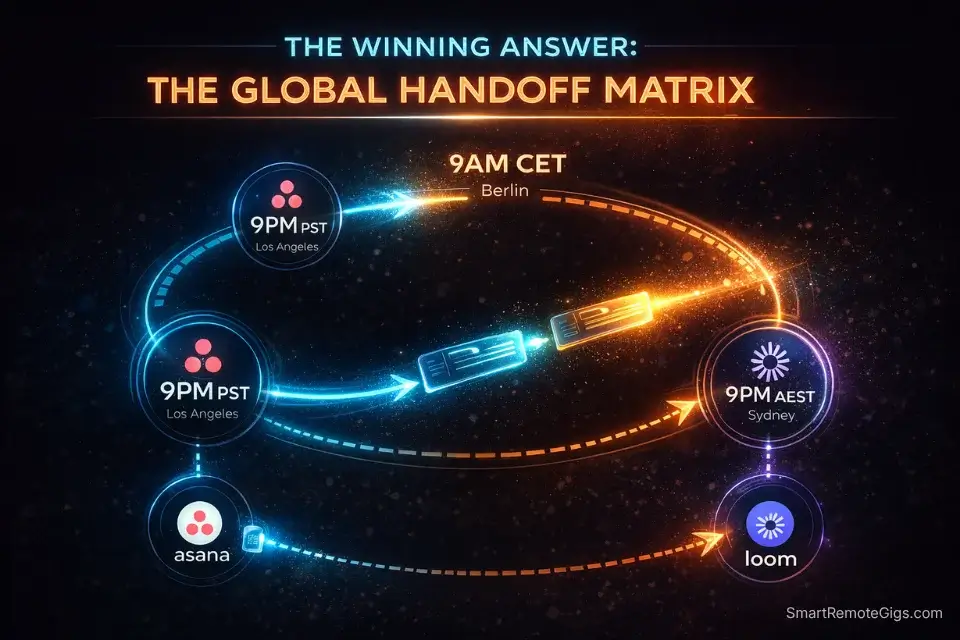
This is the single most common opening question for distributed PM roles, and it is where the majority of candidates fail. The wrong answer—in any form—involves working extended hours to create live overlap. That signals to the interviewer that your system depends on your personal sacrifice rather than structural design.
The winning answer framework:
“I build a Global Handoff Matrix at the start of every project. Each team segment has a documented handoff window—a specific time when they package their current status, blockers, and next actions into a structured Asana task update and a brief Loom recording. The next timezone’s team wakes up to full context and can start executing immediately without waiting for an overlap window. My involvement is in designing and maintaining that protocol, not in being awake for every timezone’s working hours.”
Then get specific about the tools: what the Asana task structure looks like, how the Loom recordings are embedded, how you handle escalations that can’t wait for the next overlap window. Specificity is credibility.
For a complete tactical breakdown to reference in your preparation, read our masterclass on managing teams across time zones to deeply understand the mechanics of an async global handoff before you walk into the interview.
Question 2: “How do you keep stakeholders updated without drowning them in meetings?”
The trap here is a nuanced one. Most candidates know to avoid answering “I run a weekly status call.” But they overcorrect into “I send weekly email updates”—which is still a manual, unscalable process that signals low operational sophistication.
The winning answer framework:
“I build automated dashboards and AI-generated summary reports so stakeholders can self-serve the information they need without requiring me to produce it manually. In my last role, I used Slack’s workflow automation to push a Friday sprint summary—auto-generated from Jira data—directly into the stakeholder channel. They could see velocity, blockers, and next-week priorities in a 90-second read. The result was zero recurring status meetings and a measurable increase in stakeholder satisfaction because they had more current information more frequently than a weekly call could ever provide.”
The key phrase to hit: “self-serve.” Stakeholders who can get information without requesting it from you are stakeholders who trust the system. That is what elite async companies are listening for.
The honest operational caveat worth knowing before you pitch Slack in an interview: without strict thread discipline enforced from day one, Slack devolves into a synchronous chat nightmare. Messages get buried, context gets lost, and the “async” communication channel becomes a real-time interruption machine that’s even worse than email. If you’re pitching Slack fluency, be ready to describe the specific channel architecture and thread rules you enforce—because a hiring manager who has seen Slack chaos will probe exactly that point.
Slack
Best for: Async Communication & Automated Stakeholder Updates
Category 2: The Tech Stack Deep-Dive
These questions exist specifically to catch resume inflation. Hiring managers at technical companies know exactly what advanced tool usage looks like, and they will ask follow-up questions precise enough to expose anyone who listed a tool without actually going deep on it.
Question 3: “Walk me through how you structure a sprint for a distributed dev team.”
Surface-level answer: “I create tickets, assign them, and track progress.” That answer tells them you’ve used Jira at a basic level and nothing more.
The winning answer framework:
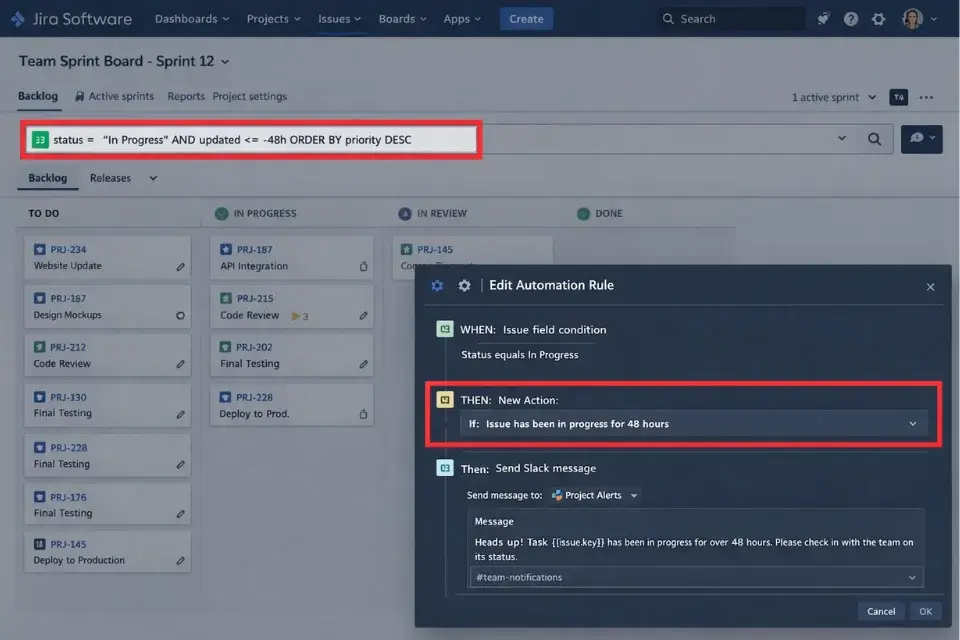
“I start every sprint with a structured backlog refinement pass in Jira where I write acceptance criteria directly into the ticket description—not in a separate document, in the ticket—so developers have everything they need to start without a kickoff call. I use JQL to build a custom sprint board view that surfaces blocked tickets and tickets with approaching due dates as the top priority rows. I’ve also set up automation rules that trigger when a ticket has been in ‘In Progress’ for more than 48 hours without a status update—it automatically posts a Slack message to the assignee asking for a brief async update. That single automation replaced about three manual follow-up conversations per sprint week.”
Then walk them through the specific Jira configuration: the automation rule structure, the JQL syntax you use, how you handle story point calibration across time zones. The more specific you get, the more credible you become.
Jira
Best for: Advanced Issue Tracking & Agile Reporting
Question 4: “How do you handle a marketing or design team that struggles with complex ticketing systems?”
This question is testing your judgment, not just your tool knowledge. The wrong answer is forcing a non-technical team to use Jira because that’s what the engineering team uses. That signals poor operational empathy and a one-size-fits-all approach to tooling.
The winning answer framework:
“I run parallel tooling environments when the teams have genuinely different workflow needs. Engineering runs on Jira for the granularity and developer integrations it provides. Marketing and design run on Asana for the visual timeline views and the lower configuration overhead. The integration point is a structured handoff protocol—when design delivers an asset, the Asana task status triggers a Jira ticket update via Zapier, so the engineering team sees the dependency resolved without either team having to operate in an unfamiliar tool. The PM’s job is to make the integration invisible to both sides.”
Be ready to talk about where this approach breaks down too—Zapier integrations between Asana and Jira can create sync delays that cause confusion if the automation isn’t well-maintained. Showing you know the failure mode proves you’ve actually operated this setup.
For a full breakdown of when each tool wins, check out our technical comparison of Asana vs Jira for remote teams so you can tailor your answer to the company’s specific stack.
Asana
Best for: Cross-Functional Workflows & Visual Timelines
Category 3: The Behavioral & Conflict Scenarios
These questions are where candidates with strong async frameworks still lose points—because behavioral answers require a different kind of specificity than technical answers. The interviewer isn’t just evaluating what you would do. They’re evaluating how you think about why the problem happened in the first place.
Question 5: “A developer isn’t responding on Slack, and a deadline is looming. What do you do?”
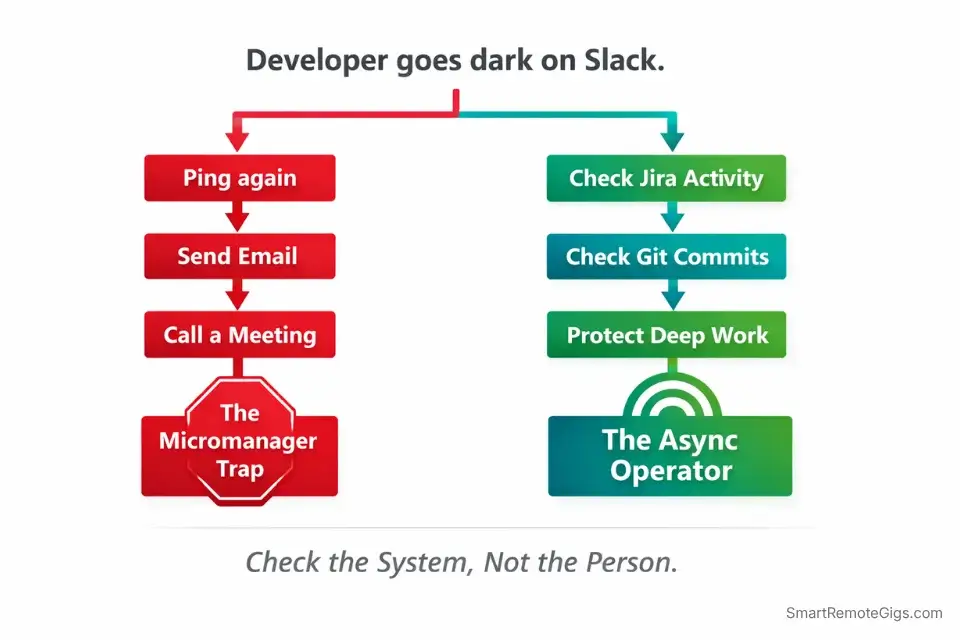
The instinct most candidates fight here is the urge to answer with escalating communication pressure—multiple Slack messages, an email, eventually a phone call. That answer signals micromanagement and a fundamental misunderstanding of how high-performing developers work.
The winning answer framework:
“My first move is never to send another message—it’s to look at the system. I check their Jira board to see if their tickets are moving. I check Git commits to see if code is being pushed. If both are showing activity, the developer is in a deep work block and the work is getting done. My job is to protect that block, not interrupt it. If the tickets aren’t moving and there are no commits, that’s a blocker signal—not a communication failure—and I investigate the upstream dependency before I ping the individual.”
Then address the deadline specifically: “If the timeline is genuinely at risk, I adjust the sprint scope or escalate the blocker in writing with a clear decision request, never with a meeting request. A written escalation creates a paper trail and forces a specific decision. A meeting call just delays the decision by 30 minutes and burns everyone’s focus.”
Pro Tip: Always frame behavioral conflict answers around “Where did the system fail?” rather than “Who is to blame?” The highest-paid remote PMs are ruthless about fixing processes, not people. An interviewer who hears you blame an individual for a workflow breakdown will immediately wonder if you’ll create a blame culture on their team.
Question 6: “How do you handle a stakeholder who keeps requesting more meetings?”
The winning answer framework:
“I treat recurring meeting requests as a system diagnostic, not a personality problem. When a stakeholder keeps requesting syncs, it’s almost always because they don’t trust the information they’re getting—either the frequency is too low, the format doesn’t answer their actual questions, or they’ve been burned by surprises in the past. I sit down with them once, asynchronously via a Loom recording, and ask them to tell me the three specific things they most need to know at any given time. Then I build a dashboard or automated report that surfaces exactly those three things on a schedule that pre-empts their need to ask. In my experience, that single conversation eliminates 80% of recurring meeting requests permanently.”
Question 7: “Describe how you’ve used AI in your project management workflow.”
This question is becoming standard at senior remote PM interviews in 2026, and vague answers—”I use ChatGPT to draft emails”—will not pass the bar at companies paying $140K+. This shift is well-documented: according to PMI’s Pulse of the Profession report, AI adoption in project management has accelerated significantly, with high-performing teams far more likely to embed AI tooling directly into their delivery workflows than their lower-performing counterparts. The interviewers at these companies know the landscape—they will probe for operational specificity, not general awareness. For additional context on how AI is reshaping PM roles industry-wide, Harvard Business Review’s analysis of AI in knowledge work is worth reading before your final round.
The winning answer framework:
“I have three AI integrations built into my standard workflow. First, I use a custom prompt that takes raw Jira sprint data and generates a structured weekly summary—blockers, velocity, risks, decisions made—formatted for three different audiences: engineers, stakeholders, and executives. Second, I use Notion AI to maintain our decision log: any time a significant project decision is made in a Slack thread, I paste the thread into a Notion template prompt and it extracts the decision, the rationale, and the dissenting views into a structured record. Third, I’ve built a risk-flagging prompt that I run every Friday—it takes the current sprint status and flags any ticket combination that historically predicts a missed deadline based on the pattern. That last one has saved two sprints in the past year by surfacing risk 10 days before it would have become visible in the traditional velocity metrics.”
Specificity at this level signals genuine operational AI integration, not surface-level experimentation.
Question 8: “How do you onboard a new team member to a fully distributed team?”
The winning answer framework:
“Async onboarding lives entirely in documentation. Before the new hire’s first day, I make sure three things exist and are current: a structured Notion onboarding wiki that covers the team’s operating principles, tool stack, and communication protocols; a 30-day async task plan in Asana that gives them clear deliverables without requiring them to ask what to work on; and a library of Loom recordings covering the five most common questions new team members ask. The goal is that they can be productive and oriented within 72 hours without a single onboarding call. The only live touchpoint I schedule in the first week is a 20-minute async-first introduction with their direct collaborators—not a full team meeting.”
Question 9: “What does your daily schedule look like as a remote PM?”
This question is a culture fit probe. The interviewer wants to know whether you operate with async discipline or whether you’re going to create meeting drag across the team.
The winning answer framework:
“My day is structured around protecting deep work—mine and the team’s. I start with a 60-minute async triage block where I review overnight standup digests and Jira updates. I have a two-hour deep work block from mid-morning that is calendar-blocked and notification-silent—this is when I build sprint architecture, write documentation, and do strategic planning. My afternoon overlap window is when any necessary live communication happens, and it’s always pre-scheduled with a written agenda. I average under 90 minutes of live meetings per day, by design.”
Question 10: “How do you measure your own performance as a remote PM?”
Most candidates answer this with output metrics—projects shipped, deadlines hit. Those are the right metrics but the wrong framing for a 2026 async-first interviewer.
The winning answer framework:
“I measure myself primarily on meeting load reduction and async documentation quality. Specifically: how many hours of recurring meetings did I eliminate this quarter through automation and documentation improvements? How often does the team reference the Notion wiki versus asking me questions directly? What is the ratio of decisions made asynchronously versus decisions that required a live call? Those metrics tell me whether I’m building a system that scales, or whether I’m still the bottleneck.”
The Ultimate Interview Hack: Screen-Share Your Portfolio
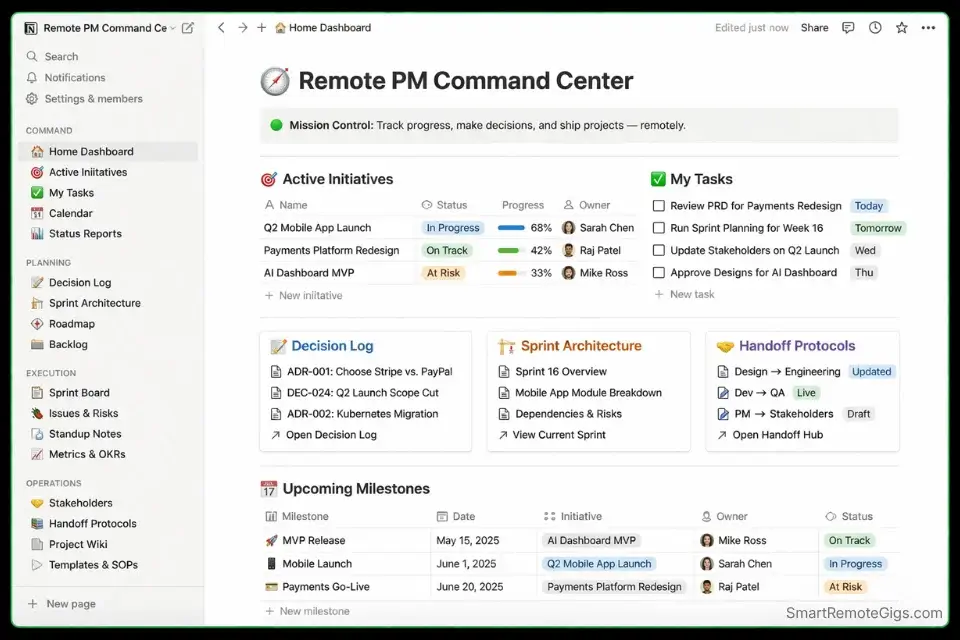
Most candidates answer interview questions. The ones who get offers show their work.
At the end of your technical round—or when they ask if you have any questions—offer to share your screen and walk them through your actual async workspace. Not a mock-up. Not a template you found online. A real, structured operational environment that demonstrates everything you just described in your answers.
This move works because it converts abstract claims into concrete evidence in real time. When you say “I maintain a decision log in Notion,” and then you share your screen and show them an actual decision log with real structure and real entries, you’ve just done something almost no other candidate does: you’ve proved it.
The workspace doesn’t need to be from your current job. A personal project, a freelance engagement, or a portfolio build specifically for the interview process all work equally well. What matters is that it’s real, it’s structured, and it visually demonstrates the async operating principles you’ve been describing.
One honest caveat before you build this portfolio: a raw, un-templated Notion workspace causes immediate blank-page paralysis for anyone seeing it for the first time—including an interviewer. If your screen-share opens to a chaotic web of nested pages with no clear hierarchy or navigation logic, it will undermine everything your answers just built. Structure the workspace deliberately before you show it. Clear top-level sections, a logical information hierarchy, and pre-built templates that demonstrate system thinking are what impress. Chaos does the opposite.
Notion
Best for: Showcasing Async Documentation & Team Wikis
🎁 Free Digital Asset: The Remote PM Command Center
This is the exact Notion template to use as your interview portfolio. Clone it, populate it with your own project data, and have it ready to screen-share at the close of your technical round. A hiring manager who sees a real, structured async workspace during the interview has already received more proof of competency than any answer you could give.
Frequently Asked Questions
How many interview rounds are typical for a remote PM job?
In 2026, expect three to four rounds at most serious remote companies: an initial recruiter screen focused on background and salary alignment, a hiring manager behavioral interview testing your async leadership framework, a technical or system architecture round where they probe your tool fluency and operational depth, and a final cultural fit conversation with a VP or Founder.
Some companies add a take-home case study between rounds two and three.
Do remote project manager interviews require a presentation?
Increasingly, yes—and the format has evolved significantly. Top async-first companies now commonly assign a take-home case study where you design a remote workflow for a fictional distributed team, build it in Notion or Asana, and record a five-minute Loom video walking through your logic and decisions.
This format tests async communication, tool fluency, and systems thinking simultaneously. Treat it as the highest-signal round in the process, not an afterthought.
What questions should I ask the interviewer?
Ask system-level questions that signal you think like an operator, not a job seeker. Strong options: “What percentage of your team’s communication is strictly asynchronous?” — “How do you currently protect your engineers’ deep work blocks during sprint week?” — “What does your onboarding documentation look like for new remote hires?”
These questions do double duty: they give you genuine signal about whether this company actually operates async-first, and they demonstrate to the interviewer that you evaluate companies by their operational sophistication, not just their brand or compensation.
The Verdict: Passing a 2026 remote PM interview comes down to one core shift—proving you are a ruthless protector of your team’s time and a master of async systems. If your instinctive answer to any problem involves adding a meeting to the calendar, you gave the wrong answer. Every question is a test of the same thing: do you fix the system, or do you call a meeting?
At Smart Remote Gigs, we’ve trained hundreds of professionals to master these exact async frameworks and command top-tier salaries.
Once you have your interview answers dialed in, skip the noise of LinkedIn and check the Smart Remote Job Board for vetted roles at companies that actually respect deep work. For a broader overview of the market, read our ultimate guide to landing high-paying remote project manager jobs and explore the top 20 tech companies actively hiring PMs this year.



![AI Content Writer Jobs: [My 2026 Survival Playbook]](https://smartremotegigs.com/wp-content/uploads/2026/04/ai-content-writer-jobs-survival-playbook-1024x577.webp)
![Remote Copywriting Jobs 2026: [High-Ticket Method]](https://smartremotegigs.com/wp-content/uploads/2026/04/remote-copywriting-jobs-high-ticket-method-guide-1024x577.webp)
![Remote Technical Writing Jobs: [The $80K/Yr Guide]](https://smartremotegigs.com/wp-content/uploads/2026/04/remote-technical-writing-jobs-hero.webp)