



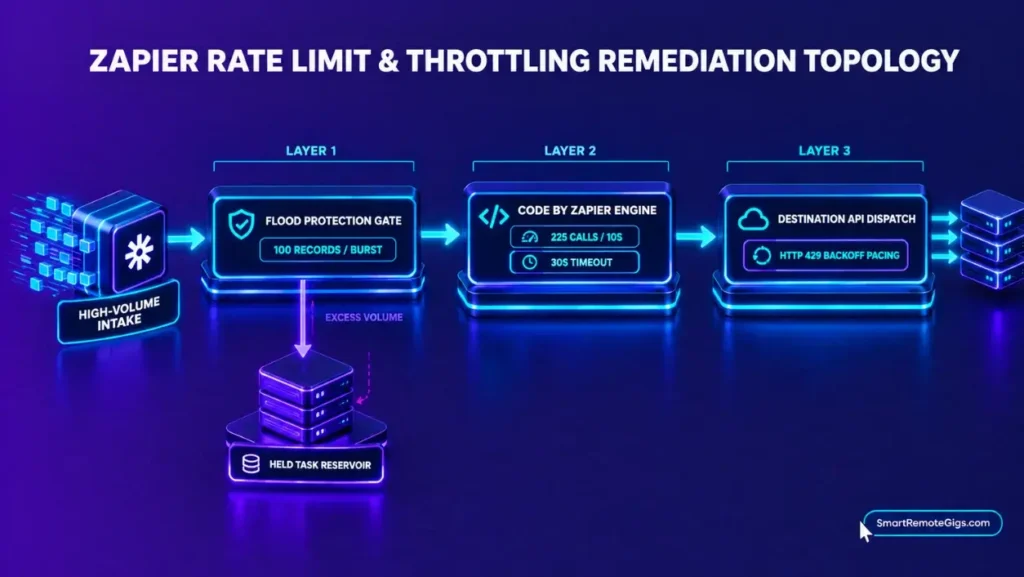
The Zapier rate limit boundaries that operators hit most often are documented in Zapier’s Zap limits documentation. Flood protection holds tasks when a trigger receives more than 100 records all at once, and Code by Zapier runs 225 calls per 10 seconds on paid plans. Each boundary has a different remedy, so identifying the layer comes first.
This runbook is written for automation architects, freelance integrators, and technical operations engineers managing high-volume Zapier pipelines. It excludes purchasing negotiations and non-technical setup overviews. Smart Remote Gigs (SRG) publishes source-backed technical guides, SOPs, and career blueprints.
Method: compiled from 3 sources reviewed on October 2026 for Zapier (documentation and runtime specifications as of October 2026). SRG did not hands-on test this setup.
SRG Quick Fix
One-Line Resolution: Keep each trigger burst under the 100-record flood protection threshold, and keep Code by Zapier usage within 225 calls per 10 seconds and the 30-second paid-plan script timeout. (Confidence Level: High)
🔧 Immediate Steps: 1. Identify which layer produced the failure: flood protection, Code by Zapier limits, or a destination app’s own limits ➔ 2. Reduce the size of each trigger batch below 100 records ➔ 3. Process records inside a single Code by Zapier step instead of one step per record, and keep the script within the documented timeout.
📊 Escalation & Fallback: For destination-side 429 errors, consult Zapier’s node troubleshooting article and the destination API’s own rate-limit documentation.
Zapier Rate Limit Anatomy: Account vs. App vs. Flood
Third-Party API 429 Rate Limits
Destination applications set their own request limits, and those limits are outside Zapier’s documented quotas. Zapier covers field mapping and node errors in its node troubleshooting article. The destination API’s documentation is the authority for its specific limit values.
Zapier Flood Protection: The 100-Record Ingestion Boundary
Zapier’s Zap limits documentation states that flood protection holds tasks when a trigger receives more than 100 records all at once. The same documentation lists a maximum limit of 1,500 records.
Code by Zapier Limits: 225 Calls / 10 Seconds and 30-Second Timeouts
Code by Zapier runs 225 calls per 10 seconds on paid plans, per the same documentation. Script timeout is capped at 30 seconds on paid plans and 10 seconds on Starter and Free.
Diagnostic Matrix: Identifying the Limit Layer
| Observed Symptom | Documented Limit | Documented Reference |
|---|---|---|
| Tasks held after a burst of trigger records | Flood protection activates above 100 records received all at once | Zap limits documentation |
| Code by Zapier step stops near the timeout | Timeout is 30 seconds on paid plans and 10 seconds on Starter and Free | Zap limits documentation |
| Code by Zapier calls exceed the throttle | 225 calls per 10 seconds on paid plans | Zap limits documentation |
HTTP 429 returned by a destination app | The destination app’s own rate limit | Destination API documentation and Zapier’s node troubleshooting article |
Engineering the Solution: Rate-Limiting Mitigation Architectures
Protocol A: Keeping Trigger Bursts Under the Flood Protection Threshold
Flood protection holds tasks above 100 simultaneous records, so the working rule is to keep each batch under that number. Stagger bulk imports at the source, or split a large import into batches smaller than 100 records. The sourced documentation does not describe pacing steps such as Delay by Zapier, so this guide does not specify their configuration.
Protocol B: Processing Records Inside a Single Code by Zapier Step
When one trigger delivers several records, a single Code by Zapier step can process the whole list in one script instead of running a separate step per record. The script must still finish inside the 30-second paid-plan timeout.
The sample below is an SRG reference pattern. It groups a list of records into batches of 25 and returns the batch count.
// Reference pattern: split a list of records into batches of 25.
// Replace the sample records with the list your Zap maps into the step.
const records = [
  { id: 1, email: "[email protected]" },
  { id: 2, email: "[email protected]" },
  { id: 3, email: "[email protected]" }
];

const batchSize = 25;
const batches = [];

for (let i = 0; i < records.length; i += batchSize) {
  batches.push(records.slice(i, i + batchSize));
}

output = { batchCount: batches.length, batches: batches };
This script demonstrates an SRG reference architecture; validate syntax in a sandbox before deploying to live client workloads. It does not itself raise or bypass any documented Zapier limit.
Protocol C: Reviewing Held Tasks
When a trigger burst activates flood protection, tasks are held. The sourced documentation does not describe the release or replay procedure, so review Zapier's Zap limits documentation before releasing held tasks in bulk.
Production Configuration Baseline for High-Volume Webhooks
- Flood protection: holds tasks when a trigger receives more than 100 records all at once, with a documented maximum limit of 1,500 records.
- Code by Zapier throttle: 225 calls per 10 seconds on paid plans.
- Code by Zapier timeout: 30 seconds on paid plans and 10 seconds on Starter and Free.
- Webhook payload ceilings: 10 MB for triggers and 5 MB for actions, per Zapier's troubleshooting documentation.
Paid Zapier plans list a 30-second script timeout for Code by Zapier steps, against 10 seconds on Starter and Free. For full plan specifications and limits, see the Zapier dossier:

Best For: Operators running trigger-and-action workflows within documented limits: 100 to 2,000 included tasks per month at entry tiers, webhook payloads up to 10 MB inbound and 5 MB outbound, and Code by Zapier scripts within a 30-second paid-plan timeout.
- Free Free · 100 tasks/mo
- Starter From $19.99 /mo
- Pro From $69.00 /mo
Known Limitations: What This Fix Cannot Solve
- Payload oversize (HTTP 413): Rate-limit handling does not change the 10 MB trigger or 5 MB action webhook ceilings. Payloads above either ceiling receive HTTP 413.
- Webhook payload formatting (HTTP 400): A nested JSON array sent through a standard webhook action fails with status 400. Review the Zapier Error 400 fix instead of adjusting batch sizes.
- Destination-side limits: The sourced documentation does not state any destination app's rate-limit values or retry rules.
The Verdict: Documented Decision Boundaries
Zapier's documentation places two quotas on the platform side: flood protection above 100 simultaneous trigger records, and Code by Zapier limits of 225 calls per 10 seconds with a 30-second paid-plan timeout. Destination-app 429 responses sit outside those quotas and follow each app's own documentation.
The decision rule follows the layer. Keep trigger batches under 100 records for flood protection, keep Code by Zapier steps within the documented call and time limits, and treat destination-side limits as a separate configuration task.
For broader patterns on structuring multi-step pipelines, see the best Zapier SOP workflows and the master Zapier implementation guide.
Documented via 3 official vendor sources as of October 2026. SRG did not hands-on test this setup.
Freelance automation architects and technical integration leads can explore contract roles and remote operations opportunities on the Smart Remote Gigs Exchange. Plan allowances and licensing tiers are documented in the Zapier software fact-sheet.

Never Miss a New Remote Job
Remote job alertsGet notified about new remote jobs and access practical freelance tools from your phone.