
Get A 5-Star Review On Fiverr 2026: Fast Method (Tested)
 ·
Last Updated: March 27, 2026 ·
12 min read
·
Last Updated: March 27, 2026 ·
12 min read

Figuring out exactly how to get your first Fiverr client is a massive milestone, but learning how to get a 5-star review on Fiverr is what actually keeps them coming back and builds a sustainable business. The work itself is only half the equation — the other half is a communication process that most sellers never think about until a silent 3-star review tanks their ranking.
On my third Fiverr order, a buyer gave me 3.5 stars over a miscommunication I could have fixed in five minutes if I’d known it existed. It buried my gig in search results for weeks. Engineering communication systems to prevent exactly this kind of career-stalling feedback is why we built Smart Remote Gigs. We created this platform to equip freelancers with tested, psychological frameworks that protect your reputation and keep your income secure.
That review didn’t happen because my work was bad — it happened because I had no system for managing buyer psychology from order placement to delivery. What follows is the copy-paste system I built after that.
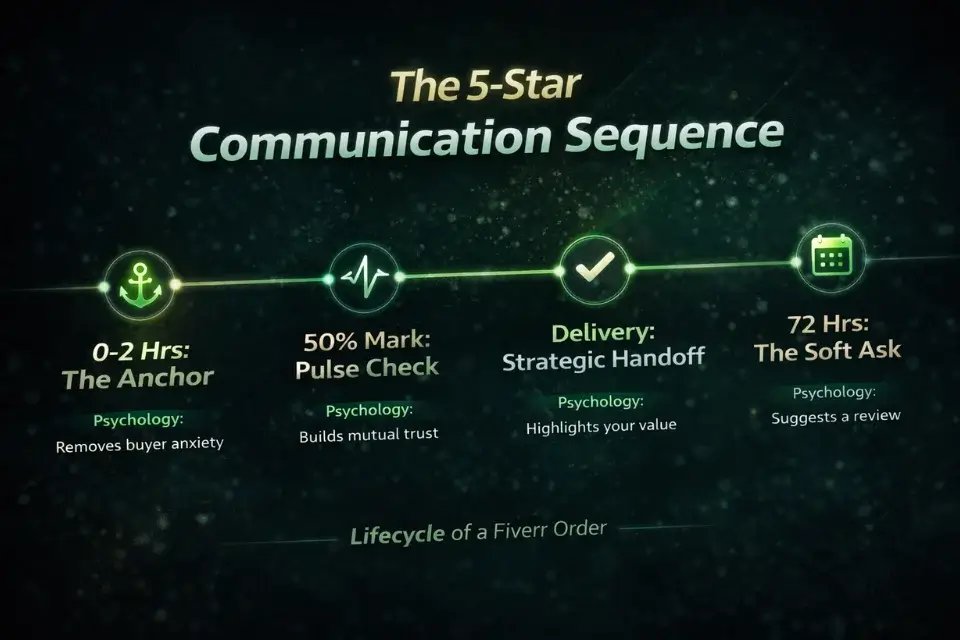
|
Stage |
Action |
Psychological Goal |
|---|---|---|
|
Order Placed |
The Onboarding Anchor |
Remove buyer anxiety — confirm they made the right decision |
|
Mid-Point |
The Pulse Check |
Prove you are actively working — eliminate the “silence = dread” response |
|
Delivery |
The Strategic Handoff |
Frame the work positively before the buyer reads a single line of it |
|
Post-Delivery |
The Soft Ask |
Trigger the review naturally without pressure or explicit solicitation |
The “Over-Delivery” Myth (Stop Working for Free)
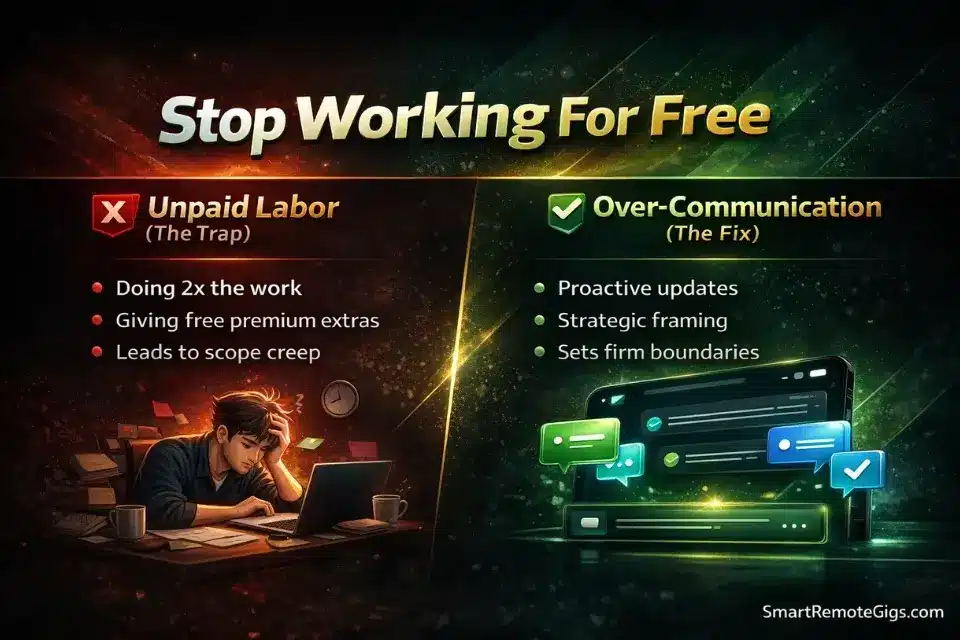
There’s a persistent piece of Fiverr advice that tells new sellers to “over-deliver” on every order — do more than promised, throw in extras, give the buyer a pleasant surprise. The logic sounds right. In practice, it creates a specific set of problems that undermine both your income and your client relationships.
Why Doing Twice the Work Doesn’t Equal 5 Stars
Buyers don’t calibrate their review rating against how much free work you gave them. They calibrate it against how smoothly the experience felt — did communication feel clear, was the delivery on time, did the work match what they imagined when they ordered?
I’ve done orders where I delivered 50% more than promised and received a 4-star review because one minor element didn’t match the buyer’s mental image. I’ve done orders where I delivered exactly what was scoped, communicated proactively throughout, and received an effusive 5-star review with an unprompted tip.
The variable that moved wasn’t the quantity of work. It was the communication quality.
Red Flag: Habitually over-delivering by giving away free premium services doesn’t earn loyalty — it trains buyers to expect more than they paid for, and it signals that your stated scope is negotiable. When you eventually deliver exactly what was promised (which is appropriate and correct), that buyer will feel shortchanged. Over-deliver on communication clarity, responsiveness, and the strategic framing of your work. Never over-deliver on unpaid labor.
Take Smart Remote Gigs With You 🌍
Get daily remote job alerts, exclusive AI tool reviews, and premium freelance templates delivered straight to your phone. Join our growing community of modern digital nomads.
Quick Links: Software Directory | Free Templates | Remote Jobs
The 4-Message Sequence (Copy & Paste)
This is the full system. Four messages, specific timing, specific psychological purpose for each. You can adapt the language to your voice — the structure is what matters.
Message 1: The Onboarding Anchor (0–2 Hours After Order)
Send this within two hours of the order being placed. Most sellers wait until they have something to show. That’s a mistake — the buyer’s anxiety is highest in the first few hours after ordering, before they’ve heard a word from you.
Hi [Name], great to have you on board — I’ve reviewed your order details and everything is clear.
I’m starting on [specific element of their project] now. Before I get too far in: [ask one specific, genuinely useful clarifying question — e.g., “Do you have a preferred color palette, or should I work from your existing brand assets?”].
This will help me nail the first delivery so we don’t need multiple revision rounds. I’ll keep you posted as I make progress.
[Your Name]
What this message accomplishes: It confirms you exist, you’ve read their brief, and you’re already working. The clarifying question demonstrates engagement and surfaces any misalignment before you’ve invested hours in the wrong direction.
Message 2: The Mid-Project Pulse Check (At the 50% Mark)
For a three-day order, send this at the end of day one or start of day two. For a one-day order, a brief mid-day check-in is enough. For orders longer than five days, send it at the genuine midpoint.
Quick update, [Name] — I’m about halfway through and things are looking solid.
[One specific sentence about your actual progress — e.g., “The copy structure is drafted and I’m now refining the hooks for each section.”].
Still on track for [delivery date]. Nothing needed from your end right now — just wanted to make sure you weren’t left wondering where things stood.
[Your Name]
What this message accomplishes: It eliminates the buyer’s “silence = something is wrong” anxiety, which is one of the most common triggers for pre-emptive, worried messages that disrupt your workflow. A buyer who has received a progress update arrives at delivery in a positive frame of mind.
Message 3: The Strategic Delivery Note
This is the most important message in the sequence. Most sellers write some version of “Here’s your order, let me know if you need anything.” That message does nothing to frame how the buyer receives the work.
The strategic delivery note explains two or three deliberate choices you made and why — before the buyer has read a single line of your output. It shifts their brain from evaluator mode to understanding mode.
|
Version |
Message Content |
Buyer’s Psychological State |
|---|---|---|
|
❌ The Generic Delivery |
“Here is your completed order. Please accept and let me know if you need any changes. Thank you!” |
Buyer opens the work as a cold evaluator. Any element that doesn’t match their mental image is registered as a flaw. Zero context for your choices. |
|
✅ The Strategic Delivery |
“Delivered — a few notes on what I did and why: [choice 1 + rationale], [choice 2 + rationale]. If you’d like [minor adjustable element] changed, that’s a quick tweak — just let me know. Everything else is built exactly to your brief.” |
Buyer opens the work primed to understand your thinking. Deliberate choices are perceived as expertise, not errors. The “minor tweak” offer removes the psychological friction of requesting a change. |
Hi [Name] — your [deliverable] is ready.
A few notes on what I did and why:
[Choice 1]: I [specific decision] because [reason tied to their stated goal — e.g., “led with the benefit rather than the feature in the headline because your brief mentioned conversion rate as the primary goal”].
[Choice 2]: I [specific decision] because [reason — e.g., “kept the tone conversational rather than formal, based on your target demographic being 25–35-year-old DTC buyers”].
If you’d like [the most likely minor adjustment — e.g., “a more formal tone on the intro paragraph”], that’s a quick change — just flag it. Otherwise, everything is delivered to spec.
[Your Name]
Message 4: The 72-Hour “Soft” Follow-Up
Send this 72 hours after delivery, only if the buyer hasn’t yet accepted the order or left a review. This message serves double duty: it gently nudges acceptance and creates a natural opening for feedback without explicitly soliciting a specific star rating.
Hi [Name] — just checking in to make sure everything landed correctly on your end.
Happy to make any final tweaks if something isn’t quite right. And if everything’s looking good, I’d love to hear how it’s working out for you whenever you get a chance.
[Your Name]
The critical rule for Message 4: “I’d love to hear how it’s working out for you” is the extent of the review ask. Do not write “please leave me a 5-star review” or “I’d appreciate a positive rating.” This crosses into review solicitation that Fiverr’s system flags. The soft language triggers the review behavior without violating platform rules. More on exactly where that line sits in the next section.
How to Neutralize a Dissatisfied Buyer
Even with the full sequence in place, you will eventually have an order where the buyer is unhappy. The communication system significantly reduces the frequency — it doesn’t eliminate it. Here’s how to handle the situation when it happens.
The Revision De-escalation Script
The moment a buyer expresses dissatisfaction, your instinct will be to defend your work. Suppress it. Defense reads as dismissiveness to a frustrated buyer, and it escalates the situation every time.
The de-escalation response has three components: acknowledge the specific concern without admitting total failure, confirm you understand what they wanted differently, and offer a concrete next step.
Hi [Name] — thanks for the detailed feedback, I hear you.
It sounds like [restate their concern in your own words — e.g., “the tone came across as too formal for your audience, which isn’t what you were after”]. That’s absolutely fixable.
I’ll revise [specific element] to [specific change] and have the updated version to you within [realistic timeline]. No additional charge.
[Your Name]
This response accomplishes something most sellers miss: it makes the buyer feel heard before the revision even happens. A buyer who feels heard is dramatically less likely to leave a punitive review even if the final result is imperfect.
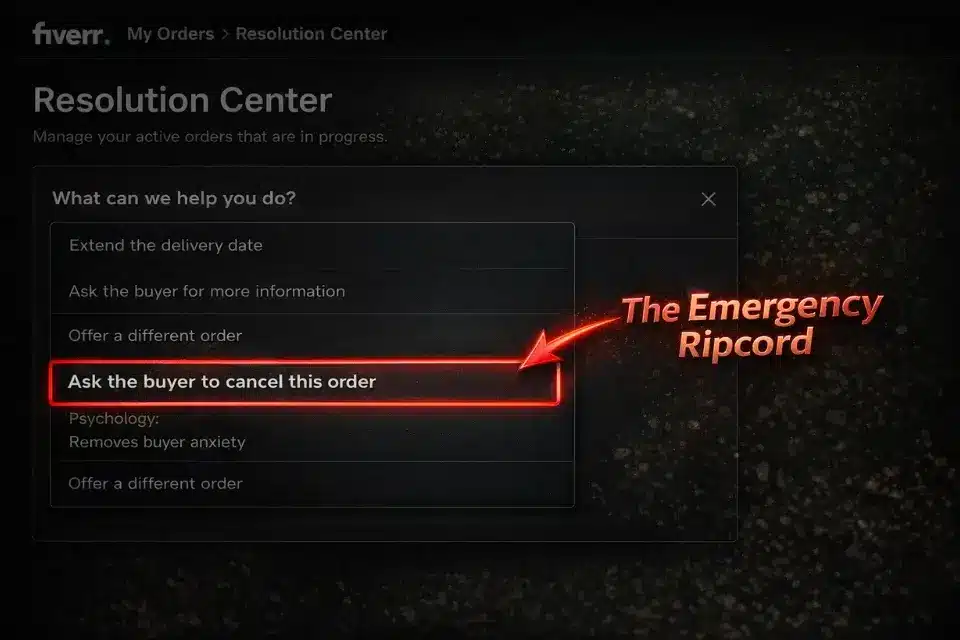
Pro Tip: If a buyer is angry, never argue in the chat. Every message you send in a dispute is visible to Fiverr’s Trust & Safety team if the order is escalated. Instead, use the Resolution Center to offer a mutual cancellation before they submit a review. Protecting your overall rating is worth absorbing the loss on a $30 order. A single 1-star review from a difficult client can suppress your gig’s search ranking for four to six weeks — far more expensive than the refunded order value.
The Rules of Asking for Reviews (Don’t Get Banned)
Fiverr’s review policy has specific boundaries. Most sellers either don’t know them or interpret them so conservatively that they never ask at all. Both errors cost you reviews.
What Fiverr’s Terms of Service Actually Say
According to Fiverr’s official Community Standards on reviews, sellers are permitted to remind buyers that they can leave a review. What is explicitly prohibited is: requesting a specific star rating, offering any incentive in exchange for a review, threatening consequences for negative reviews, or coordinating review exchanges with other sellers.
The key word is “specific.” You can ask for feedback. You cannot ask for five stars.
The “Feedback” Loophole
The language distinction that keeps you compliant while still prompting reviews is simple: ask for feedback, not for a rating.
Prohibited: “Please leave me a 5-star review if you’re happy with the work.”
Compliant: “I’d love to hear your feedback on the project whenever you get a chance.”
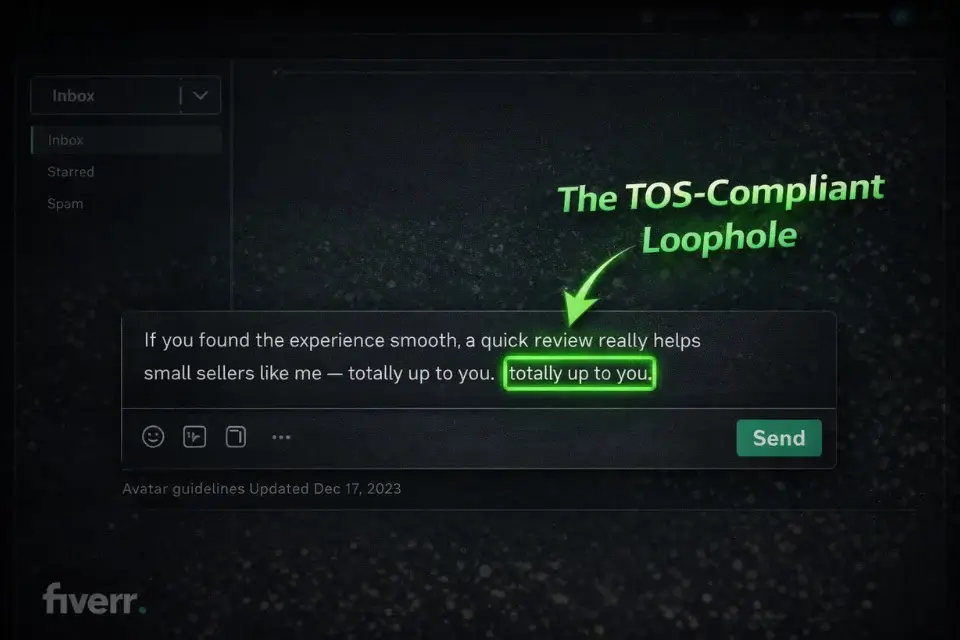
Compliant: “If you found the experience smooth, a quick review really helps small sellers like me — totally up to you.”
The second compliant version is as far as you can push it. It references the review explicitly without specifying a rating and includes an opt-out (“totally up to you”) that removes any implied pressure. Fiverr’s automated systems scan for rating-specific language. Feedback-framed requests don’t trigger them.
Once your review strategy is working consistently, apply the same professional communication standards to your outbound pitching. Use these principles to win your next Fiverr Briefs match and convert matched buyers into another 5-star order.
Frequently Asked Questions
Can I buy fake Fiverr reviews to start my account?
No — and the risk is categorically not worth it. Fiverr’s trust and safety systems in 2026 actively detect review manipulation patterns: accounts with no purchase history leaving reviews, clusters of reviews arriving simultaneously, IP address overlaps between reviewers.
The penalty for detected fake reviews is permanent account termination, not a warning. Your account, your gigs, and all accumulated revenue history are gone. The spec work approach combined with the communication sequence in this article generates real reviews from real buyers — slower, but permanent and risk-free.
What happens if I get a 1-star review on Fiverr?
A 1-star review has two effects: it reduces your overall average rating and it suppresses your gig’s search visibility for a period the algorithm determines based on your overall rating history. The practical recovery timeline for a single 1-star review on an account with fewer than 10 total reviews is four to eight weeks of reduced impressions.
For accounts with 20+ reviews, the dilution effect is less severe. You cannot delete a legitimate review — Fiverr only removes reviews that violate its review policy (e.g., reviews left in exchange for a refund). Focus on accumulating genuine positive reviews to dilute the impact rather than disputing one that won’t be removed.
Can I explicitly ask a buyer to leave a 5-star review?
No. Explicitly requesting a specific star rating violates Fiverr’s Terms of Service and risks account action. What you can do is ask for feedback or mention that reviews help your business — without specifying what rating you expect.
The distinction is “I’d love your feedback on this project” (compliant) versus “Please leave me a 5-star review” (prohibited). Fiverr’s automated review system scans messages for rating-specific solicitation language. Use the soft ask from Message 4 above and you stay safely within the rules.
The Verdict: 5 Stars is a Process, Not an Accident
Verdict: Great work gets 4 stars. Great work wrapped in exceptional communication gets 5 stars. The four-message sequence works because it removes buyer anxiety at every stage — from the post-purchase doubt that sets in an hour after ordering to the silent uncertainty during delivery to the psychological friction of actually writing a review. By controlling the narrative proactively, you make 5 stars the path of least resistance for a satisfied buyer. That’s not manipulation — it’s professionalism.
The sellers who consistently accumulate 5-star reviews aren’t doing dramatically better work than everyone else. They’re doing the same work with a communication layer that makes the experience feel premium from start to finish.
At Smart Remote Gigs, our mission is to hand you those exact premium communication layers. We write the scripts, test the boundaries of platform Terms of Service, and map out buyer psychology so you can operate like a top-tier agency from day one.
Now that you know how to secure a perfect rating, make sure you’re charging enough to make that premium experience sustainable. Read our Fiverr pricing strategy 2026 guide to stop underpricing the 5-star service you’re now delivering.

![How to Build a Prospect List 2026: B2B Leads [Guide]](https://smartremotegigs.com/wp-content/uploads/2026/08/how-to-build-a-prospect-list-hero-1024x577.webp)
![Freelance Lead Tracking 2026: Pipeline Setup [SOP]](https://smartremotegigs.com/wp-content/uploads/2026/09/freelance-lead-tracking-hero1-1024x577.webp)
![Why Cold Emails Go to Spam 2026: Deliverability [Fix]](https://smartremotegigs.com/wp-content/uploads/2026/09/why-cold-emails-go-to-spam-hero1-1024x577.webp)