
Fiverr Buyer Request Templates 2026: Briefs Guide (Won)
 ·
Last Updated: September 11, 2026 ·
13 min read
·
Last Updated: September 11, 2026 ·
13 min read
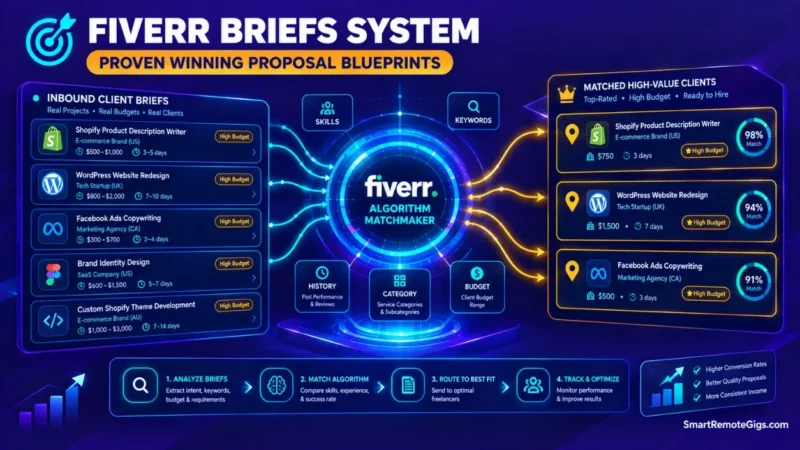
If you are actively trying to get your first Fiverr client and searching for fiverr buyer request templates to use on the classic requests page, stop right now — Fiverr completely killed that feature. The tab is gone, the system is gone, and any course or blog post telling you to refresh it at midnight is selling you 2022 advice in 2026.
When Briefs replaced Buyer Requests, my inbound leads dried up overnight. I had to reverse-engineer how the new matching algorithm worked from scratch. Helping freelancers navigate these sudden, career-threatening platform shifts is exactly why we built Smart Remote Gigs. We created this platform to decode the algorithmic black boxes that govern your income, so you never have to guess how to get your leads back.
After sending 100+ proposals through the new system, I figured out the exact template structures that win high-paying matches — and the specific mistakes that get you ignored. Both are in this guide.
| Feature | ❌ Old Buyer Requests (Dead) | ✅ New Fiverr Briefs (2026) |
|---|---|---|
| How You Find Jobs | Manual refreshing of a public list — first come, first served, race to the bottom | Algorithm matches buyers to you based on your gig tags, pricing, and metadata |
| Quality of Buyers | Low budgets, $5 spam requests, vague briefs from tire-kickers | Vetted buyers with real projects — Fiverr pre-screens Brief submissions |
| The Winning Strategy | Copy-paste generic pitches sent to 20 requests per day | Hyper-personalized problem-solving responses to a small number of matched briefs |
Stop Looking for the Buyer Requests Tab (It’s Gone)
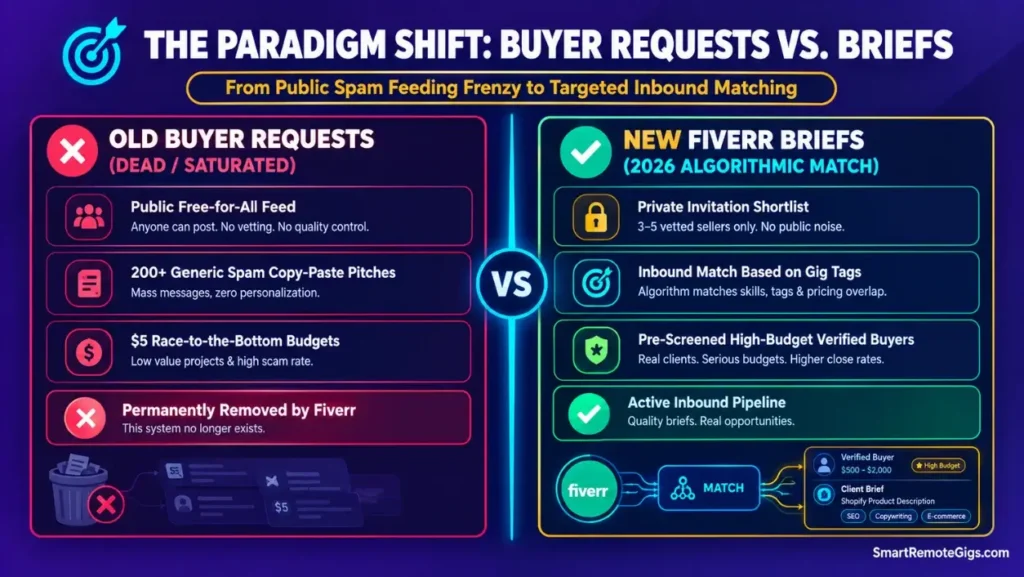
This section exists because the confusion is genuinely widespread. Sellers returning to Fiverr after a break, new sellers who learned from outdated YouTube tutorials, and experienced sellers who never adjusted — all of them are still hunting for a page that no longer exists.
Why Fiverr Killed the Old System
The old Buyer Requests system had a structural problem that was never going to fix itself: it created a public feeding frenzy. A buyer would post a request, 200 sellers would paste near-identical pitches within the hour, and the buyer would either pick someone random or abandon the request entirely.
Conversion rates were terrible. Buyer experience was terrible. Fiverr’s take on every transaction was affected.
Briefs fixes this by removing the public queue entirely. Buyers submit a project description, Fiverr’s algorithm selects a small shortlist of sellers to notify, and those sellers receive a private match notification. No public competition. No 200-seller pile-on. Just you and a handful of other well-matched sellers, responding to a buyer who was specifically pointed at your profile.
Red Flag:
Do not buy courses or read outdated 2022 articles that tell you to “refresh the Buyer Requests page at midnight.” The page doesn’t exist anymore. That advice will waste your time and mislead your entire approach to Fiverr’s current matching system. Check the publication date on anything you read about Fiverr’s outbound strategy — if it’s pre-2024, the core mechanics it describes are no longer live.

Never Miss a New Remote Job
REMOTE JOB ALERTSGet notified about new remote jobs and access practical freelance tools from your phone.
How the 2026 “Fiverr Briefs” Match System Actually Works
Understanding the mechanics before you write a single template is the difference between getting matched to relevant, high-budget briefs and getting matched to nothing at all.
The Inbound Match Algorithm
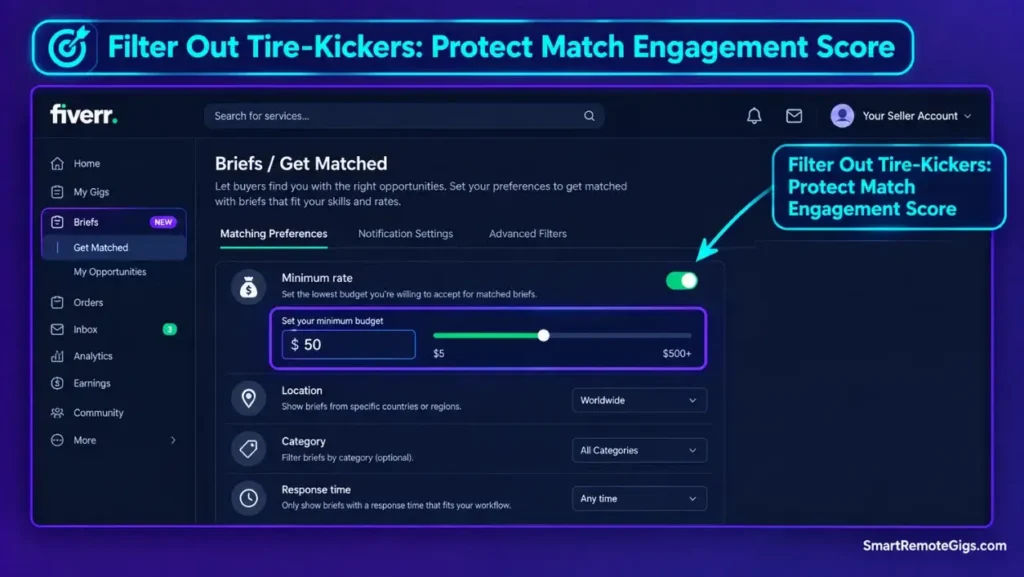
Fiverr’s Briefs algorithm doesn’t read your bio or care about your review count in the same way that search ranking does. It matches buyers to sellers based on three primary signals:
Gig tags are the most important. When a buyer submits a Brief describing what they need, the algorithm scans seller tags for relevance to the buyer’s language. If a buyer writes “I need someone to write product descriptions for my Shopify store,” sellers with tags like “product descriptions for Shopify” get matched. Sellers with the tag “copywriting” likely don’t.
Pricing overlap is the second signal. Buyers set a budget range when submitting a Brief. If your gig has no pricing tier that falls within that range, you won’t be matched — regardless of how relevant your tags are. This is why filling out all three pricing tiers matters: it maximizes the budget ranges you’re eligible for.
Gig category and sub-category work as a relevance filter before the tags are even evaluated. If you’re in the wrong sub-category, the algorithm may never surface you for relevant briefs in your actual niche.
Your gig tags determine which Briefs you get matched with — read our full Fiverr gig SEO 2026 guide for the complete tag optimization system before you touch your metadata.
Setting Your “Minimum Price” Filter
Fiverr lets you set a minimum Brief budget filter — a threshold below which you won’t receive match notifications. This is one of the most underused settings on the platform.
Set it. If you’re not willing to respond to a $15 Brief, don’t receive them. Every notification you ignore signals to the algorithm that you’re a low-engagement seller, which quietly reduces your future match frequency.
A minimum filter of $50–$75 for most service categories eliminates the low-budget tire-kickers while keeping you in range for the buyers who matter. Adjust based on your actual package pricing — your minimum filter should sit at or just below your Basic package price.
5 Fiverr Briefs Templates to Win High-Paying Matches
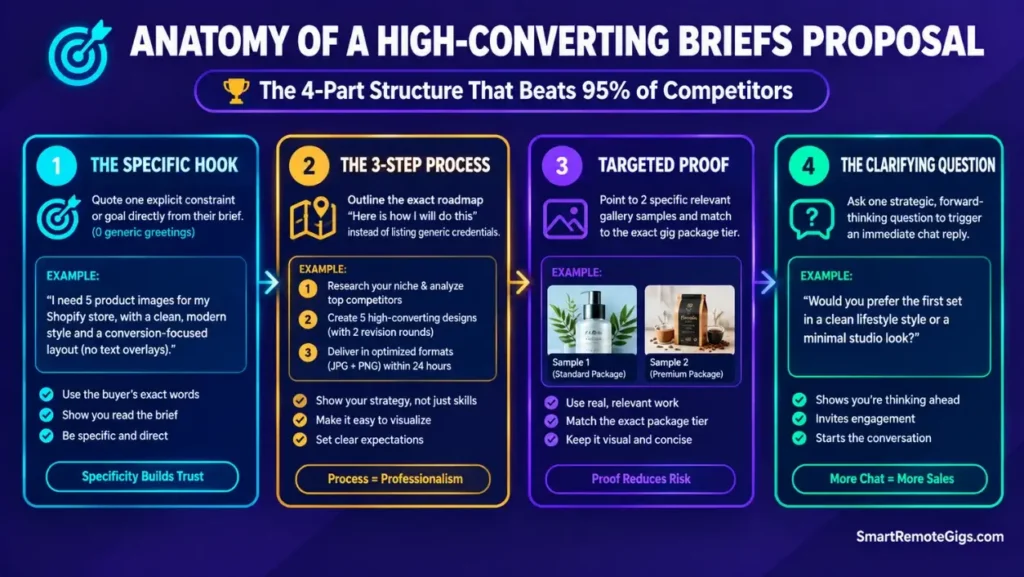
These aren’t generic frameworks — each one is engineered for a specific buyer psychology and gig type. Use the one that matches your Brief, not the one that’s easiest to copy-paste.
Template 1: The “Specific Solution” Framework (Best for Creatives)
Best for: Logo designers, illustrators, brand identity, creative writing, video editing.
Why it works: Creative buyers are scared of ambiguity. They’ve been burned by freelancers who delivered something technically competent but completely wrong for their brand. This template immediately signals that you’ve read their brief carefully and have a specific approach in mind.
Hi [Name],
I read your brief — specifically the part about [reference one specific detail from their brief, e.g., “wanting something modern but approachable for a wellness brand”]. That’s a direction I know well.
Here’s exactly how I’d approach this: [2–3 sentences describing your specific process or creative angle for their stated need — not generic, not templated].
You can see three directly relevant samples in my gallery: [describe which samples, not just “check my portfolio”]. Package [X] covers exactly what you’ve described.
One quick question before you decide: [ask one genuinely useful clarifying question that shows you’re thinking ahead, e.g., “Do you have brand colors locked in, or is that part of what you need from this project?”].
[Your Name]
Template 2: The “Technical Audit” Pitch (Best for Developers/SEO)
Best for: Web developers, SEO specialists, technical writers, data analysts.
Why it works: Technical buyers want proof of competence before they trust you with anything sensitive. Demonstrating that you can spot a problem they may not have articulated signals a level of expertise that generic pitches never achieve.
Hi [Name],
Based on what you’ve described, the core issue is likely [name a specific technical root cause relevant to their stated problem — e.g., “a redirect chain that’s bleeding link equity” or “a missing index on your database query”]. This is fixable and I’ve handled it before.
My process for this specific problem:
1. [Step one — specific to their situation]
2. [Step two — shows you understand scope]
3. [Deliverable — exactly what they receive at the end]
Turnaround: [X] days. Everything is documented so you own the solution completely, not just the output.
Does this match what you’re looking for, or is there a specific constraint I should know about before we start?
[Your Name]
Template 3: The “Speed & Precision” Offer (Best for Transactional Gigs)
Best for: Data entry, transcription, file conversion, voiceover, simple design tasks.
Why it works: Buyers on transactional gigs don’t want a relationship — they want the job done correctly and fast. This template respects their time, answers their implicit questions immediately, and moves directly to logistics.
Hi [Name],
I can handle this. Here’s what you get:
✅ [Deliverable 1 — specific to their brief]
✅ [Deliverable 2 if applicable]
✅ [Turnaround time] delivery
✅ [Number of revisions] revision included
Format delivered: [exactly the file format or output they need].
No questions from my end — your brief was clear. If you want to proceed, the [Basic/Standard] package covers this scope exactly. Message me to confirm and I’ll start within the hour.
[Your Name]
Template 4: The “ROI-Focused” Proposal (Best for Marketers/Copywriters)
Best for: Email copywriters, paid ads specialists, conversion rate optimizers, sales page writers.
Why it works: Marketing buyers think in outcomes, not deliverables. They don’t want “5 email sequences” — they want more conversions. Framing your pitch in the language of business outcomes immediately separates you from every freelancer who led with their word count.
Hi [Name],
The goal here isn’t [deliverable — e.g., “a welcome email sequence”]. It’s [business outcome — e.g., “turning new subscribers into first-time buyers before they go cold”].
For [their specific niche/context], the approach that moves that metric is [specific tactic or framework — e.g., “a 4-email sequence with a pattern-interrupt subject line on email 3 that re-engages the disengaged segment before the final offer”].
I’ve done this for [type of client, without naming them unless you have permission] — the result was [specific outcome if you have one, or describe the mechanism that drives results].
The [Standard] package is sized for exactly this scope. Want me to sketch out the email-by-email strategy before you commit? Happy to put a brief outline together in the chat.
[Your Name]
Template 5: The “Clarifying Question” Hook (Best for Vague Briefs)
Best for: Any Brief that’s under-specified, missing key details, or could apply to ten different types of freelancers.
Why it works: Most sellers respond to vague briefs with generic pitches and hope for the best. Responding with a smart, specific question demonstrates you read the brief closely enough to identify what’s missing — and that you’re already thinking about their project more carefully than every other respondent.
Hi [Name],
Before I put together a specific proposal, one question that will shape everything: [ask the single most important missing piece of information — e.g., “Is this for an existing brand with established guidelines, or are you building the identity from scratch?” or “What does success look like for you 30 days after this project wraps?”].
The reason I ask: depending on your answer, the scope and approach differ significantly, and I’d rather spend 30 seconds making sure I’m quoting the right thing than send you a proposal that misses the mark.
While you’re thinking about that — I work with [type of client] on [type of project] and the relevant samples for your situation are [describe specifically]. More than happy to share more context once I understand your situation better.
[Your Name]
Pro Tip:
Never write “I can do this.” Always write “Here is how I will do this.” Buyers matched with multiple sellers are pattern-matching for one signal above all others: evidence that you’ve actually thought about their specific problem. Sellers who describe their process win over sellers who list their credentials, every time. Process demonstrates confidence. Credentials are just text.
The AI Trap: Why Your Proposals Are Getting Ignored
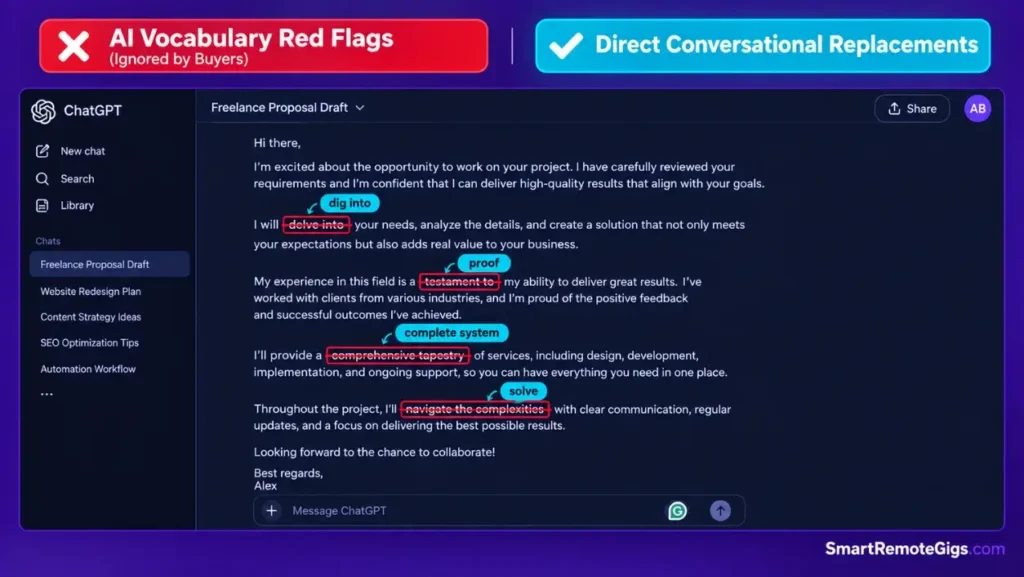
This is the section I wish someone had told me six months into using the Briefs system. My response rate was inexplicably low until I ran a test: I sent the same proposal in two versions — one drafted with ChatGPT assistance, one written entirely from scratch. The hand-written version got a reply. The AI-assisted one didn’t.
The “ChatGPT Vocabulary” Problem
Buyers who receive Fiverr proposals in 2026 are reading dozens of them. They’ve developed an involuntary pattern recognition for AI-generated text that they often can’t articulate but consistently act on.
The tells are specific: “I would be delighted to assist,” “this is a testament to,” “navigate the complexities of,” “I can help you delve into,” “a comprehensive tapestry of solutions.” These phrases appear constantly in AI-assisted proposals and nowhere in how actual humans pitch their services.
ChatGPT is genuinely useful for structuring your proposal — building the bones of a Template 2 technical breakdown, generating the ROI framing for Template 4, organizing your deliverable list for Template 3. Use it for that. But the hook — the first two sentences that determine whether a buyer keeps reading — must be written in your own voice, referencing something specific from their brief that an AI scanning a generic prompt couldn’t have noticed.
Rewrite every AI-generated opening before you send. Swap every “delve,” “testament,” “comprehensive,” and “navigate” for the word you’d actually use in a Slack message to a colleague. The structural help is worth keeping. The vocabulary is not.

Frequently Asked Questions
Why did Fiverr remove Buyer Requests?
Fiverr has not made an official detailed public statement attributing the removal to a single cause, but the functional reason is clear from the system that replaced it: Buyer Requests created a low-quality, high-volume free-for-all that produced poor buyer experiences and low conversion rates.
The Brief matching system gives Fiverr more control over the seller-buyer pairing, which improves platform conversion metrics and buyer satisfaction scores. From a business standpoint, a better match means a more likely completed order — which benefits Fiverr’s revenue directly.
How do I get Fiverr Briefs to show up?
Brief notifications require three things: at least one published, active gig in a relevant category; complete metadata including all five tag slots filled with specific long-tail phrases; and at least one pricing tier that overlaps with Brief budget ranges in your category.
New sellers with a freshly published gig may experience a short delay of 1–2 weeks before the algorithm has enough data to begin matching them confidently. If you’ve been active for more than two weeks and are receiving zero Briefs, the most likely cause is generic or incomplete tag metadata. Review your tags against the autocomplete method described in our Fiverr gig SEO 2026 guide.
Can I still send custom offers to buyers?
Yes. Custom offers remain fully functional in 2026 — they’re sent through the messaging system after a buyer contacts you directly or after a Brief match initiates a conversation. Custom offers let you price a specific scope outside your standard package structure, which makes them particularly useful for complex or non-standard projects.
The key difference from the old Buyer Requests: you can no longer send unsolicited pitches to a public list. All custom offer conversations now start from an inbound touchpoint — either a buyer message, a Brief match, or a buyer clicking your gig and reaching out.
The Verdict: Quality Over Quantity
Verdict:
The old system rewarded sellers who spammed 10 pitches a day and hoped something stuck. The new Briefs system rewards sellers who take 10 minutes to write one hyper-targeted, process-demonstrating proposal. The five templates above are your starting line, not your finish line — every one of them requires you to insert specific details from the actual Brief before you send. A template sent as-is is just slower spam.
The sellers winning on Briefs in 2026 are treating each match like a job interview for one position, not a lottery ticket in a barrel of thousands. That mindset shift is the real system.
At Smart Remote Gigs, our mission is to equip you with the exact words, frameworks, and strategies to win those high-stakes algorithmic matches. We burn through the trial-and-error phase and test the pitches relentlessly, so you can approach every Brief with a proven, data-backed blueprint.
A great proposal means nothing if your portfolio is empty when the buyer clicks your profile. Read our guide on how to build a Fiverr portfolio from scratch with zero clients to ensure you convert every Brief click into an order.






![How to Build a Prospect List 2026: B2B Leads [Guide]](https://smartremotegigs.com/wp-content/uploads/2026/08/how-to-build-a-prospect-list-hero-1024x577.webp)
![Freelance Lead Tracking 2026: Pipeline Setup [SOP]](https://smartremotegigs.com/wp-content/uploads/2026/09/freelance-lead-tracking-hero1-1024x577.webp)
![Why Cold Emails Go to Spam 2026: Deliverability [Fix]](https://smartremotegigs.com/wp-content/uploads/2026/09/why-cold-emails-go-to-spam-hero1-1024x577.webp)