
Fiverr Pricing Strategy 2026: Why $5 Is A Trap (Tested)
 ·
Last Updated: March 27, 2026 ·
12 min read
·
Last Updated: March 27, 2026 ·
12 min read

When you’re desperate for your first order, charging the platform minimum feels like the only logical move. (If you are still struggling to cross that initial hurdle, stop right here and read our master blueprint on exactly how to get your first Fiverr client before adjusting your rates). But relying on a $5 Fiverr pricing strategy in 2026 isn’t a business model—it’s a fast track to burnout, bad clients, and an hourly rate that would embarrass a lemonade stand.
After fulfilling fifty $5 orders and dealing with endless revision requests, I audited my actual hourly rate. After Fiverr’s 20% cut and time spent on revisions, I was making less than minimum wage. Helping freelancers escape that exact cycle of underpaid burnout is the core reason we built Smart Remote Gigs. We created this platform to replace the “grind for $5” hustle culture with mathematical, profitable frameworks that actually respect your time.
What follows is the pricing system I rebuilt from scratch—designed to repel nightmare clients and attract buyers who actually have a budget.
|
Pricing Element |
❌ The $5 Trap |
✅ The 2026 Value Model |
|---|---|---|
|
Starting Price |
$5 “to get reviews” — a race to the bottom that never ends |
$25+ baseline built on a calculated real hourly rate |
|
Packages |
Single flat package — no anchoring, no upsell path |
3-tier psychological anchor pushing buyers toward Standard |
|
Upsells |
None — every add-on negotiated awkwardly in the chat |
High-margin Gig Extras (fast delivery, source files, commercial rights) |
|
Perceived Value |
“Cheap and desperate” — attracts the worst buyer segment |
“Premium professional” — filters for serious buyers with real budgets |
The $5 Trap (Why Cheap Gigs Repel Good Buyers)
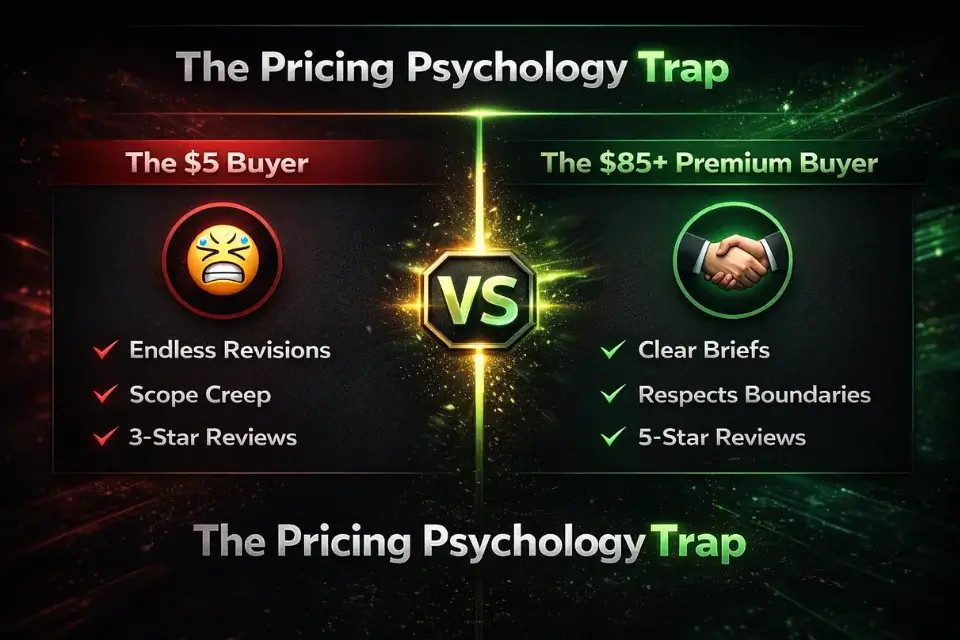
The instinct to start low makes complete sense when you have zero reviews. But the logic breaks down the moment you understand who actually searches for $5 gigs — and what they expect for that price.
The Psychology of “Perceived Value”
Price is a quality signal. Every buyer, consciously or not, uses price as a proxy for competence before they’ve read a single word of your gig description.
A $5 price tag doesn’t say “affordable.” It says “this person either has no experience or no confidence in their work.” Neither of those messages attracts the kind of buyer who has a real project, a real deadline, and a real budget.
Research from Jonah Berger’s pricing psychology work at the Wharton School consistently shows that price anchoring shapes quality perception before any other product signal. On Fiverr, where buyers make split-second judgments across a grid of 48 gigs, your price is visible before your portfolio, before your bio, before your reviews. It’s doing enormous psychological work you’re probably not thinking about.
The buyers who do respond to a $5 price are self-selecting for a reason.
The “Nightmare Client” Correlation
I tracked this across my first 50 orders. The pattern was ugly but undeniable.
Orders under $10 accounted for 80% of my revision requests. They generated 100% of my disputes. They produced every single review that mentioned something negative, no matter how minor. The buyers who spent $40–$80 with me in the same period? Zero disputes. Average review: 4.9 stars.
This isn’t a coincidence. Buyers who hunt for the cheapest possible option are predisposed to feel like they’re owed more than the price implies. The transaction starts with a scarcity mindset on their end, and it almost always ends with friction on yours.
Warning: Buyers who hunt for $5 gigs are statistically the most demanding, the most likely to request unlimited revisions, and the most likely to leave a bad review when they don’t get them. Cheap prices don’t just shrink your revenue — they actively attract the clients who will cost you the most time, stress, and rating points. You are not being accessible; you are being a magnet for headaches.
Establishing Your True Baseline
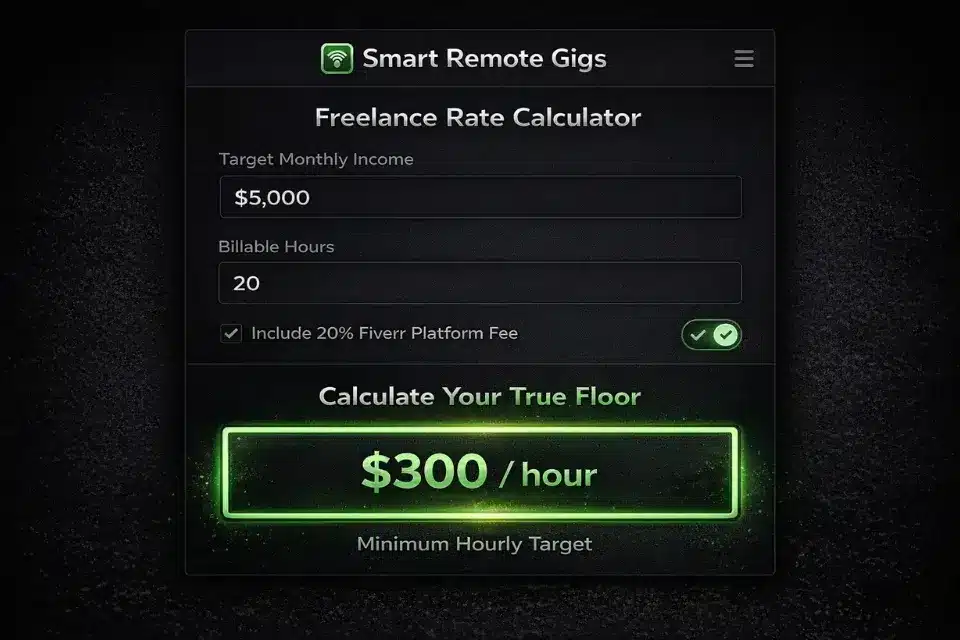
Before you set a single price, you need to know your floor. Not what you hope to charge, not what your competitor charges — your actual minimum viable rate given your time, your costs, and Fiverr’s cut.
Factoring in Fiverr’s 20% Cut and Withdrawal Fees
Fiverr takes 20% of every transaction, flat. There are no graduated tiers for top sellers in 2026 — everyone pays the same rate regardless of volume. On top of that, withdrawal fees vary by method: PayPal, bank transfer, and Payoneer all carry different costs depending on your region.
The real-world math hits harder than most sellers expect. A $25 gig becomes $20 after Fiverr’s commission. Factor in one round of revisions, your time on client communication, and a payment withdrawal fee, and that $25 can represent well under $18 in actual take-home value per hour if the job runs long.
According to Fiverr’s official Terms of Service, sellers also incur withdrawal fees depending on their chosen payment provider, which eats directly into your margin. Know every single deduction before you set your baseline price.
Calculating Your Target Hourly Rate
Start with what you need to earn per hour to make freelancing worth your time. Factor in:
- Your target monthly income
- Average hours per week you can realistically bill
- Non-billable time (client communication, admin, revisions)
- Fiverr’s 20% commission applied to your gross figure
Divide your monthly target by realistic billable hours. That number — not $5, not what your competitor charges — is your floor.
Pro Tip: Remember that a $5 gig is actually a $4 gig after Fiverr’s commission. If that $4 gig takes two hours to complete including one revision round, your effective hourly rate is $2. You are subsidizing your clients’ projects with your own time. Stop. Every hour you spend on a $2/hr gig is an hour you can’t spend building something that actually pays you.
To make this math effortless, use our Free Freelance Hourly Rate Calculator. It automatically factors in Fiverr’s 20% platform fee and your non-billable hours to give you a mathematically sound baseline.
One important caveat when using the calculator: no tool can account for the premium your niche commands. It tells you your cost-based floor — the minimum you need to break even. It has no way to factor in that Shopify migration specialists, medical copywriters, or bilingual localization experts can and should charge significantly above that floor because of specialized demand. Use the calculator to find your baseline. Use your market research to find your ceiling. The gap between those two numbers is your pricing room.
Take Smart Remote Gigs With You 🌍
Get daily remote job alerts, exclusive AI tool reviews, and premium freelance templates delivered straight to your phone. Join our growing community of modern digital nomads.
Quick Links: Software Directory | Free Templates | Remote Jobs
The 3-Tier Psychological Pricing Model
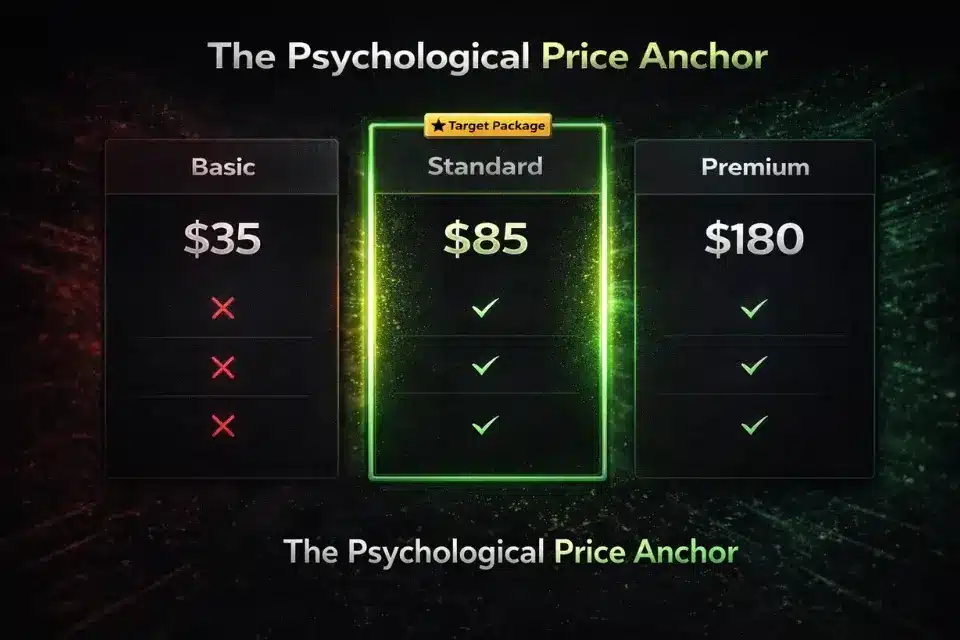
A single flat package is one of the most common and most damaging structural mistakes on Fiverr. Without tiers, there’s no anchoring, no upsell path, and no way to communicate the difference between your baseline offering and your best work.
The three-tier model works because of how buyers make decisions. When presented with three options, most buyers default to the middle one — it feels like the “sensible” choice between too little and too much. Your job is to build the packages so the middle (Standard) is where you actually want most buyers to land.
Basic (The “Foot in the Door” Teaser)
Your Basic package should be real but deliberately limited. Its job is to get the most budget-conscious buyers into the door with a low-risk entry point — and then let the scope limitations naturally push them toward Standard on their next order.
Keep Basic scoped tightly: one deliverable, one revision, longer delivery time. It should feel complete but leave obvious gaps (no source files, no commercial rights, slower turnaround) that motivated buyers will recognize immediately.
Standard (The Core Offer)
This is your flagship. Price it where you actually want to work. Give it everything a serious professional buyer needs: expanded scope, two revisions, faster delivery, and at least one upgrade over Basic that justifies the price jump clearly.
This package should represent 60–70% of your total order volume if your pricing is calibrated correctly. If most buyers are choosing Basic, your Standard price is too high relative to Basic or the value gap isn’t clear enough.
Premium (The “Price Anchor”)
Your Premium package exists primarily to make Standard look reasonable. Its actual conversion rate matters less than its psychological function: it shifts the buyer’s reference point so that Standard feels like a bargain by comparison.
That said, Premium should be genuinely valuable for buyers with real budgets and complex needs — source files, commercial licensing, priority support, expanded deliverables. Don’t build a package you can’t deliver excellently. But don’t be afraid to price it high enough that it reframes the entire pricing conversation.
|
Feature |
Basic — $35 |
Standard — $85 ⭐ Most Popular |
Premium — $180 |
|---|---|---|---|
|
Deliverables |
1 item |
3 items |
6 items + variations |
|
Revisions |
1 revision |
2 revisions |
Unlimited revisions |
|
Delivery Time |
5 days |
3 days |
2 days |
|
Source Files |
❌ Not included |
❌ Not included |
✅ Included |
|
Commercial Rights |
❌ Not included |
✅ Included |
✅ Included |
|
Priority Support |
❌ |
❌ |
✅ Direct response within 2hrs |
Mastering Gig Extras and Custom Offers
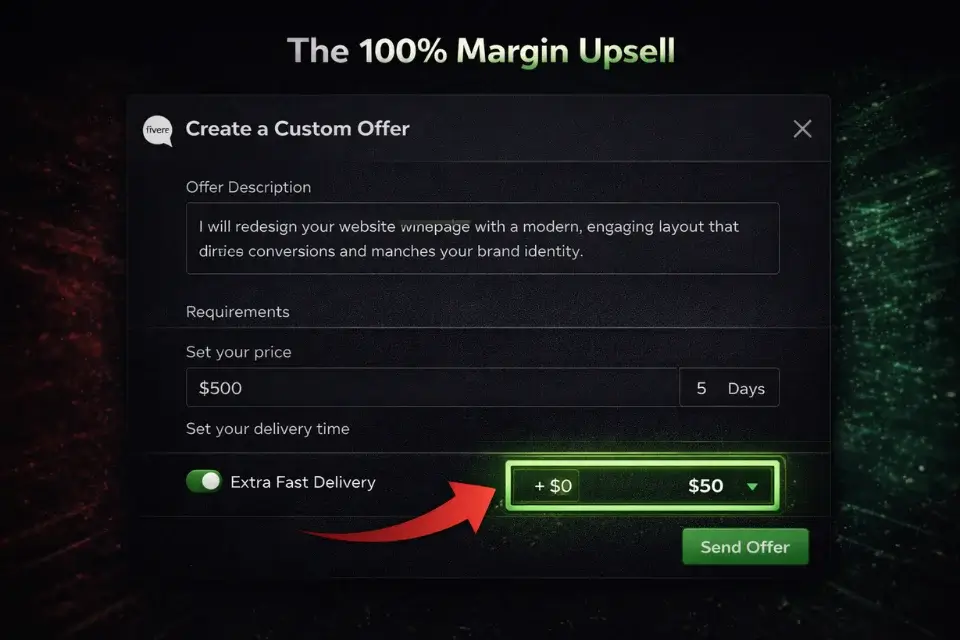
Your package prices are your baseline. Gig Extras are where the real margin lives — and most sellers either underuse them or price them so low they defeat the purpose.
The Fast Delivery Upsell (High Margin)
Expedited delivery is the highest-margin Gig Extra available to you because it costs you nothing except prioritization. You’re already doing the work. Delivering it in 24 hours instead of 72 hours doesn’t require more skill — it requires moving the job up your queue.
Price your fast delivery Extra at 40–60% of your Standard package price. Buyers with real deadlines will pay it without hesitation. Buyers who balk at it didn’t actually have an urgent deadline — they were just testing you.
Source Files and Commercial Use Rights
These are the Extras that separate buyers who need professional deliverables from buyers who are kicking tires. A buyer building a real brand needs source files. A buyer launching a product commercially needs the rights to use your work.
Price both as separate Extras rather than bundling them into your lower tiers. Commercial rights in particular carry real legal value — price them accordingly. A $15 commercial rights Extra on a $35 Basic gig is leaving money on the table for every serious buyer who would have paid $40 for it without blinking.
When pitching custom offers through Fiverr Briefs, always build a custom quote from scratch rather than directing buyers to a package. Custom offers let you price the specific scope without the structural constraints of your standard tiers — and they consistently convert at higher values than package orders.
When and How to Raise Your Prices
Price increases feel risky until you’ve done the first one and watched your order quality improve. Here’s the framework I use so it’s a data-driven decision rather than a guess.
The “Review Threshold” Rule
Raise your prices at natural review milestones: 10 reviews, 25 reviews, 50 reviews. Each threshold represents a meaningful increase in your social proof and, therefore, your ability to command a higher price.
The increase doesn’t need to be dramatic. A 15–20% price bump at each threshold is enough to filter for higher-quality buyers without killing your conversion rate. By the time you hit 50 reviews, your pricing should reflect a professional with a track record — not a beginner trying to get noticed.
Don’t wait until you “feel ready.” Raise the price when you hit the threshold and let the market tell you if you’ve gone too far. If order volume drops significantly and stays down for more than three weeks, walk the price back 10% and hold. If volume holds, you priced correctly.
Grandfathering Old Clients (Should You Do It?)
Short answer: no, with one exception.
Keeping old clients at their original price creates a two-tier system that eventually becomes unmanageable and quietly breeds resentment on your end. If a client returns six months later expecting the same price you charged when you had two reviews, that expectation was never set sustainably.
The exception: a high-volume repeat client who accounts for meaningful recurring revenue and operates professionally. For that relationship, a private custom offer that acknowledges the ongoing relationship is reasonable. For everyone else, new price, full stop.
Frequently Asked Questions
Do I have to start at $5 on Fiverr to get reviews?
No. Fiverr’s minimum order price is $5, but nothing requires you to use it. In my testing, starting at $25–$35 for a clearly scoped Basic package attracted fewer but meaningfully better buyers — and those buyers left better reviews.
The review accumulation was slower, but the review quality was higher, which compounded positively on my search ranking. A 5-star review from a $35 order carries the same algorithmic weight as a 5-star review from a $5 order. Price for the client you want.
How much does Fiverr actually take from sellers?
Fiverr charges a flat 20% commission on every order, regardless of your seller level or total volume. On a $25 order, you receive $20. There are no volume discounts or tiered commission structures for high-earning sellers in 2026.
Additionally, payment withdrawal fees apply depending on your withdrawal method and region — PayPal, Payoneer, and bank transfer each carry different fee structures. Factor both the 20% commission and your typical withdrawal fee into your baseline price calculation before publishing any gig.
Can I change my gig price after I publish it?
Yes, you can update your package prices at any time without affecting your gig’s URL or search ranking. Active orders at the time of the change are processed at the original agreed price — the new pricing only applies to orders placed after the update.
There is no penalty for raising prices. The only risk is a temporary dip in conversion rate as the algorithm recalibrates around new pricing data, which typically stabilizes within 2–3 weeks.
The Verdict: Price for the Clients You Want, Not the Ones You Have
Verdict: The $5 model works for Fiverr’s marketing department, not for your bank account. A strategic, tiered pricing structure built on a realistic hourly baseline — with high-margin Extras on top — is the only way to build a freelance business in 2026 that doesn’t slowly eat you alive. Price like a professional and you’ll attract professionals. Price like you’re desperate and you’ll attract people who treat you accordingly.
The math is simple. The psychology is simple. The hard part is overcoming the fear that raising your prices means losing orders. In almost every case I’ve tracked, it means losing the wrong orders — which is exactly the point.
At Smart Remote Gigs, our mission is to empower you to build a freelance business that funds your life, rather than one that drains it. We build the calculators and test the pricing psychology so you have the data and the confidence to finally charge what your skills are actually worth.
Once your prices are set, you need the right buyers to actually find your gig. Make sure your title and metadata are working as hard as your packages by following our Fiverr gig SEO 2026 framework to rank on page 1.

![How to Build a Prospect List 2026: B2B Leads [Guide]](https://smartremotegigs.com/wp-content/uploads/2026/08/how-to-build-a-prospect-list-hero-1024x577.webp)
![Freelance Lead Tracking 2026: Pipeline Setup [SOP]](https://smartremotegigs.com/wp-content/uploads/2026/09/freelance-lead-tracking-hero1-1024x577.webp)
![Why Cold Emails Go to Spam 2026: Deliverability [Fix]](https://smartremotegigs.com/wp-content/uploads/2026/09/why-cold-emails-go-to-spam-hero1-1024x577.webp)