
Companies Hiring Remote Project Managers 2026 [Top 20]
 ·
Last Updated: March 25, 2026 ·
11 min read
·
Last Updated: March 25, 2026 ·
11 min read 
Finding a legitimate distributed role is harder than ever because the job market is flooded with hybrid bait-and-switches. The best companies hiring remote project managers in 2026 aren’t just looking for someone to work from home—they are looking for async leaders to run their global operations, and they are paying US-market rates to find them.
After my 50th generic rejection from a corporate job board, I realized my strategy was fundamentally broken. High-paying, true async companies don’t recruit system architects through “Easy Apply.” They hire from niche tech communities, referrals, and direct outreach. When I pivoted my search to strictly async-first tech companies, I had three six-figure offers in a month.
That exact pivot is why we built Smart Remote Gigs—to help top-tier PMs stop wasting time on fake-remote corporate bait-and-switches, and connect directly with tech companies that actually operate asynchronously.
Here is the vetted list I wish I’d had.
Fake Remote vs. True Async: Know the Difference
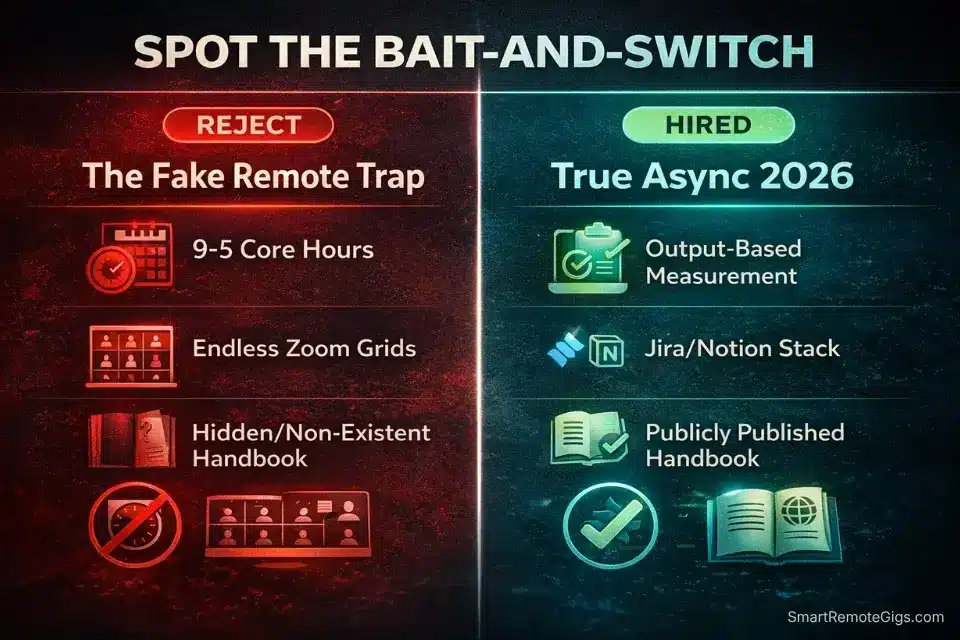
Category | The “Fake Remote” Corporate Job | The “True Async” 2026 Company |
|---|---|---|
Hours | Required 9–5 EST overlap | Work from anywhere, output-measured |
Tools | Excel, Email, heavy Zoom culture | Jira, Notion, AI-driven workflows |
Culture | Micromanaged, presence-based | Deep-work protected, trust-based |
PM Role | “Facilitate daily standups” | “Architect async delivery systems” |
Handbook | Internal only, rarely referenced | Publicly published, actively enforced |
Every company on this list falls into the True Async column. If a listing you find doesn’t match that profile, it’s not worth your time.
The LinkedIn “Easy Apply” Trap
LinkedIn Easy Apply is optimized for volume, not quality. When you click that button, you are entering a pool of 400–2,000 applicants who all did the same thing in the same 48-hour window. The ATS filters that pool down to 20. A recruiter skims those 20. You are playing a numbers game with terrible odds for a role that—if it’s genuinely async-first and pays $130K+—was probably already internally referred before the listing went live.
The companies worth targeting in 2026 don’t fill senior PM roles through passive job board applications. They fill them through community reputation, direct outreach, and referral networks. The job listing is often a compliance formality after the preferred candidate has already been identified.
This doesn’t mean job boards are useless—it means your strategy on them has to be different. Apply directly through company career pages, not aggregators. Target companies with async-first cultures explicitly. Customize every application to reference something specific about how that company operates. And supplement the passive application strategy with proactive direct outreach to hiring managers.
Warning: If a job listing highlights “managing daily live standups” or “facilitating cross-functional alignment meetings” as core duties, that is not an async-first company. You will spend your days as a meeting facilitator, burning out across time zones, wondering why your $130K salary feels like $50K worth of value. The language in the job description is the culture diagnostic. Read it carefully.
Tier 1: The Async-First Pioneers (Highest Salaries)
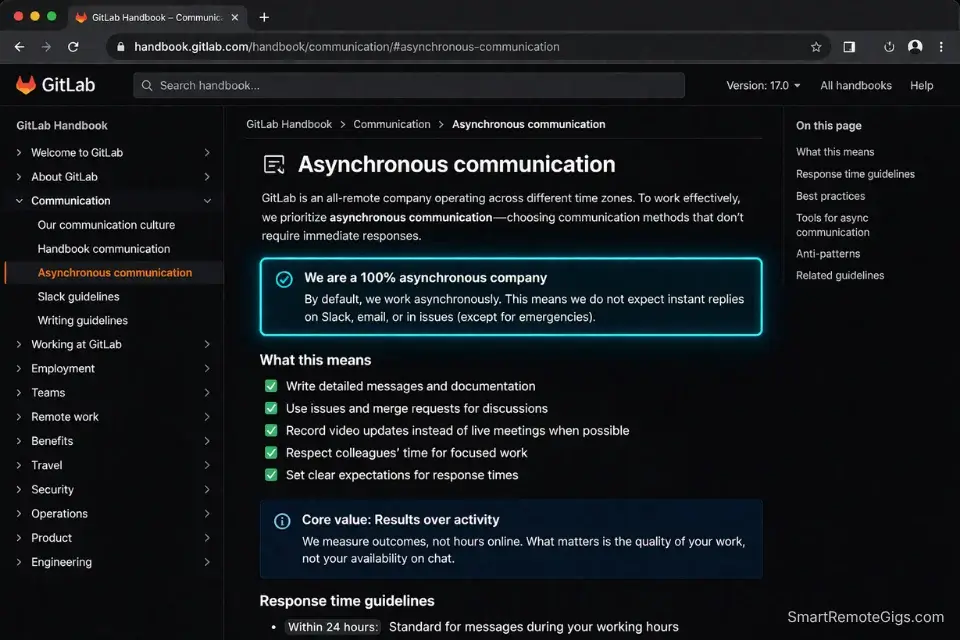
These are the companies that didn’t just adopt remote work—they invented the operational playbook for it. Their employee handbooks are publicly available, their no-meeting cultures are genuinely enforced, and they pay among the highest PM rates in the industry because they know exactly what a high-performing async operator is worth.
GitLab is the gold standard. Their entire company handbook is public, updated continuously, and covers everything from how decisions get made to how to write an async status update. A PM who has read and internalized that handbook before applying is already in the top 5% of candidates. GitLab pays senior PM rates in the $150K–$190K range and expects you to operate at the level their handbook describes.
Automattic — the company behind WordPress.com, Tumblr, and WooCommerce — has been fully distributed since 2005. They communicate almost entirely through internal blogs and P2 (their async communication tool), and they are deeply skeptical of candidates who default to meetings. Senior PM roles here regularly clear $140K+ and the async culture is one of the most mature in the industry.
Zapier hires PMs who can operate in a no-meeting culture and build workflow automations as naturally as writing an email. Given that their entire product is about eliminating manual work, they have zero patience for PMs who create manual overhead. Expect deep questions about your automation stack and specific async workflow architecture in the interview process.
Doist — makers of Todoist and Twist — is a smaller team but one of the most intentional async cultures in tech. They have explicitly rejected Slack in favor of Twist precisely because they wanted to eliminate real-time communication pressure. If you can demonstrate genuine async-first philosophy in your application, you are a rare candidate for them.
Buffer publishes its salaries, its equity structure, and its remote operating principles publicly. That level of transparency is the cultural signal. Their PM roles skew toward product and growth, and they value candidates who can demonstrate measurable async outcomes over candidates with impressive-sounding titles.
To land at any of these companies, your resume needs to pass a significantly higher bar than a standard PM application. Ensure your application survives the algorithm by applying our ATS-beating remote PM resume framework.
Tier 2: AI & High-Growth SaaS Startups
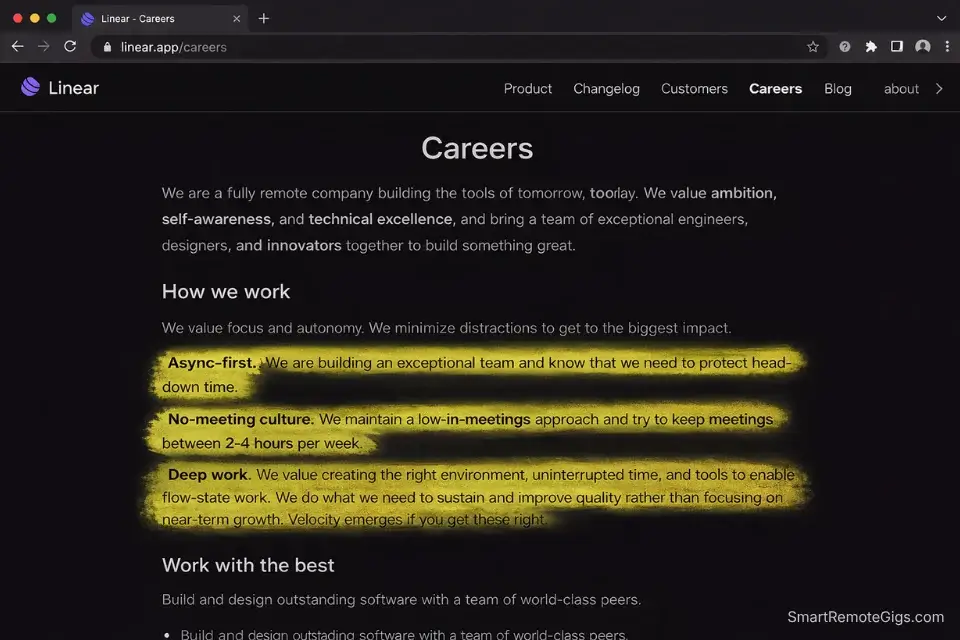
These companies are scaling fast enough that their PM infrastructure hasn’t caught up with their headcount. That is an opportunity. A PM who walks in with a ready-built async operating system—documentation structure, sprint automation, handoff protocols—can compress six months of operational chaos into two weeks of setup. That value is visible immediately, and these companies pay for it.
Notion itself hires remote PMs, and the meta-signal of knowing Notion deeply before applying is obvious and significant. Their PM roles span product, operations, and growth, and they have an internal culture that genuinely practices what the product preaches.
Linear is the fastest-growing issue tracker in the engineering community and a direct Jira competitor built specifically for async-first software teams. They are a small, opinionated team that hires PMs who think deeply about developer workflows and async sprint architecture.
Loom — now part of Atlassian — hires PMs who can both use async video communication fluently and think strategically about how distributed teams adopt it. Understanding their product from the inside is a genuine competitive advantage.
Miro has scaled dramatically and now hires remote PMs across product, operations, and customer success. Their distributed team spans 12+ countries and they have invested seriously in async infrastructure. Strong candidates will demonstrate experience managing cross-functional teams without synchronous dependency.
Figma remote PM roles are competitive but consistently well-compensated. They lean heavily on candidates who can bridge design and engineering workflows—which means Jira and Asana fluency are non-negotiable, and the ability to manage async design review cycles is a differentiator.
Webflow, Airtable, Calendly, Hotjar, and Oyster HR round out the mid-market SaaS tier. All are genuinely distributed, all have meaningful async cultures, and all are actively scaling PM headcount in 2026.
Building a strong Notion portfolio before applying to any of these companies dramatically increases your conversion rate. A well-structured async workspace demonstrates operational thinking before the first interview question is asked.
Notion
Best for: Proving You Can Build Company Wikis & Async Workflows
Tier 3: Remote-Friendly Agencies & Consultancies
Toptal places senior remote PMs with enterprise clients and runs one of the most rigorous vetting processes in the industry—but the compensation and client quality at the top of their network are exceptional. Getting through their screening is the barrier; once you’re in, the opportunities are consistent.
Andela, X-Team, and Invisible Technologies each operate distributed PM and operations roles at scale, with global client bases that demand genuine cross-timezone management competency. These are strong targets for PMs building their first fully async portfolio.
The Tech Stack These Top 20 Companies Demand
None of the companies above will shortlist a candidate whose resume lists “Microsoft Office” and “Zoom” as their PM toolkit. The minimum viable stack for any serious application to a Tier 1 or Tier 2 company in 2026 is: a sprint tracking tool at depth, a documentation platform, an async communication layer, and demonstrable AI workflow integration.
The tool that separates shortlisted candidates from the rest is almost always the sprint tracker, because it’s where technical hiring managers probe hardest. Knowing whether to lead with Jira or Asana based on the company’s engineering profile is itself a signal of operational sophistication. For a full breakdown of which tool wins in which context, read our technical comparison of Asana vs Jira for remote teams.

Jira
Best for: Securing Interviews at Dev-Heavy Tech Startups

Asana
Best for: Securing Interviews at Design & Marketing Remote Agencies
How to Pitch These Companies Directly
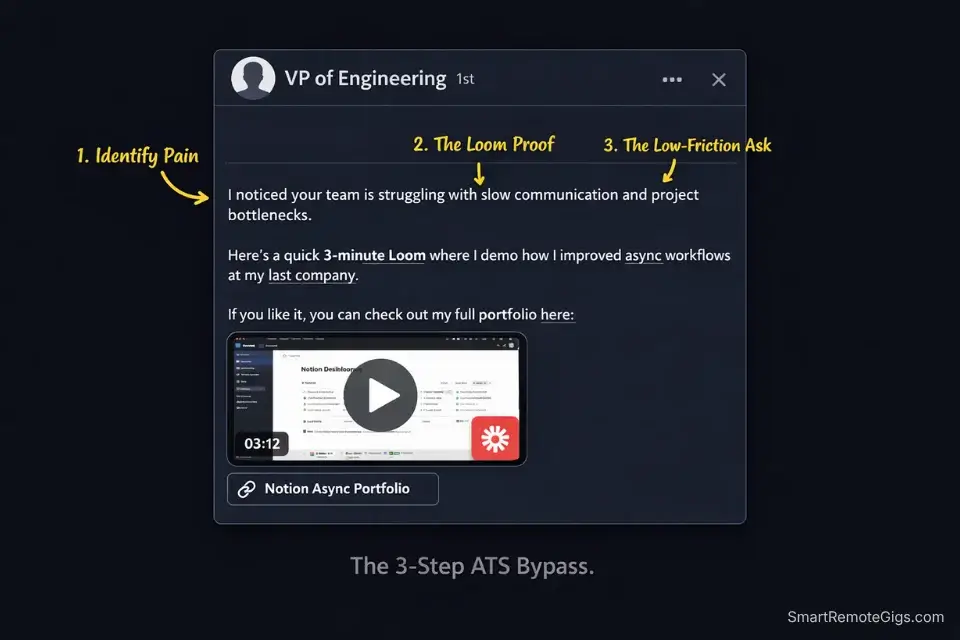
Don’t wait for a job posting. The best roles at Tier 1 async companies are filled before they’re listed, and waiting passively for a LinkedIn notification means you’re always competing against the candidate who already sent a direct pitch three weeks ago.
The direct outreach formula is simple and replicable:
Step 1: Identify the VP of Engineering, VP of Product, or Head of Operations at your target company on LinkedIn. These are the people who feel the PM pain directly—not the recruiter who is three steps removed from the actual problem.
Step 2: Record a 3-minute Loom video. Not a cover letter. A screen-recorded walkthrough of a specific async system you’ve built—your sprint architecture, your handoff protocol, your Notion workspace. Show the problem it solves. Show the outcome it produced. End with a specific, low-friction ask: “Happy to share the full template if useful, or to walk through how I’d adapt this for your team’s current sprint structure.”
Step 3: Send a short, targeted LinkedIn message with the Loom link and one sentence about why their specific operational context caught your attention. No generic introduction. No “I am writing to express my interest.” A specific observation and a specific offer.
This approach works because it bypasses the ATS entirely, demonstrates async communication competency in the medium of the outreach itself, and gives the hiring manager a concrete preview of your work before they’ve spent a minute of their time on a call.
For the written component of your direct outreach, leverage our proven project manager cover letter formula to craft a highly targeted pitch that gets opened.
🎁 Free Digital Asset: The Remote PM Command Center
This is the exact Notion workspace to reference and share in your direct outreach. Send the link alongside your Loom pitch. A hiring manager who clicks through to a real, structured async workspace has already seen more operational proof than any cover letter can provide.
Frequently Asked Questions
Where is the best place to find remote project manager jobs in 2026?
Skip the massive aggregators for senior roles. The highest-signal sources are: company career pages directly (GitLab, Buffer, Automattic, Zapier), niche remote job boards like We Work Remotely, Remote OK, and Himalayas, and direct LinkedIn outreach to hiring managers at target companies.
The candidates landing $140K+ async PM roles in 2026 are not finding them through Easy Apply—they are finding them through community reputation and proactive direct outreach.
Do fully remote project managers get paid less?
No—at top-tier async-first tech companies, US-market rates apply regardless of geography. GitLab, Automattic, and Zapier all pay competitive US-market compensation to distributed employees globally.
The caveat is that this premium applies specifically to candidates who can demonstrate high-level async operational competency and AI workflow fluency. PMs who can only demonstrate traditional facilitation skills will find the rate ceiling considerably lower.
What is the hardest part about working for a fully remote company?
The hardest part is not the timezone coordination or the tooling—both of those are solvable with the right systems. The hardest part is managing your own structure and protecting your deep work time when there are no external environmental cues to anchor your day.
Without a deliberately designed personal operating system—defined work blocks, async triage routines, hard boundaries on notification windows—the flexibility of full remote work becomes a source of anxiety rather than freedom.
The PMs who thrive long-term at async-first companies are the ones who apply the same systems thinking to their personal workflow that they apply to their teams.
The Verdict: The best companies to work for in 2026 don’t care what hours you keep—they care about your output, your systems, and your ability to lead without dragging anyone into a Zoom room. Target companies that publish their employee handbooks publicly. That transparency is the single most reliable indicator of a genuinely healthy remote culture.
At Smart Remote Gigs, we constantly monitor the hiring market to ensure our community only targets these elite, async-first organizations.
Skip the noisy aggregators and check the Smart Remote Job Board to find vetted roles at these exact companies. For a complete blueprint on advancing your career, read our guide on landing high-paying remote project manager jobs and download the Remote PM Command Center to prepare the portfolio you’ll share in your direct outreach.










![AI Content Writer Jobs: [My 2026 Survival Playbook]](https://smartremotegigs.com/wp-content/uploads/2026/04/ai-content-writer-jobs-survival-playbook-1024x577.webp)
![Remote Copywriting Jobs 2026: [High-Ticket Method]](https://smartremotegigs.com/wp-content/uploads/2026/04/remote-copywriting-jobs-high-ticket-method-guide-1024x577.webp)
![Remote Technical Writing Jobs: [The $80K/Yr Guide]](https://smartremotegigs.com/wp-content/uploads/2026/04/remote-technical-writing-jobs-hero.webp)