Starting a solo operation can feel like stepping into a void, which is why having a clear freelance business plan isn’t just a corporate exercise — it’s your financial survival map. I’ve been in the freelance trenches since 2019, and the single biggest mistake I see new solo operators make is either skipping the plan entirely or burying themselves in a bloated 40-page document that dies in a Google Drive folder.
That’s exactly why we built Smart Remote Gigs — to cut through the corporate noise and give independent contractors the agile, tested frameworks that actually generate revenue. This guide skips the fluff. You’ll build a working, agile 1-page plan in under an hour.
Why You Don’t Need a 50-Page Business Plan in 2026
The traditional business plan was built for two things: convincing a bank to give you a loan, and satisfying an MBA professor. You don’t need either.
In 2026, the freelance market rewards speed and iteration. Data from the Upwork Research Institute already confirmed that independent contractors now make up 38% of the U.S. workforce, making them the fastest-growing segment of the economy. The rules changed. Your planning format needs to keep up.
Here’s the truth: a 50-page plan forces you to answer questions you can’t possibly know yet — your competitor analysis, your 5-year market projections, your brand positioning relative to industry benchmarks. It’s fiction dressed as strategy.
What you actually need is a living document that tells you three things: who you serve, how much you need to make, and what you’re doing tomorrow morning to get there.
That’s it. That’s the whole plan.
Warning: Do not waste your first week of freelancing writing a mission statement. Focus on offers and outreach. A mission statement is for companies with 50 employees. You are a one-person revenue machine. Act like it.
The 1-Page Freelance Business Plan Template (Notion)
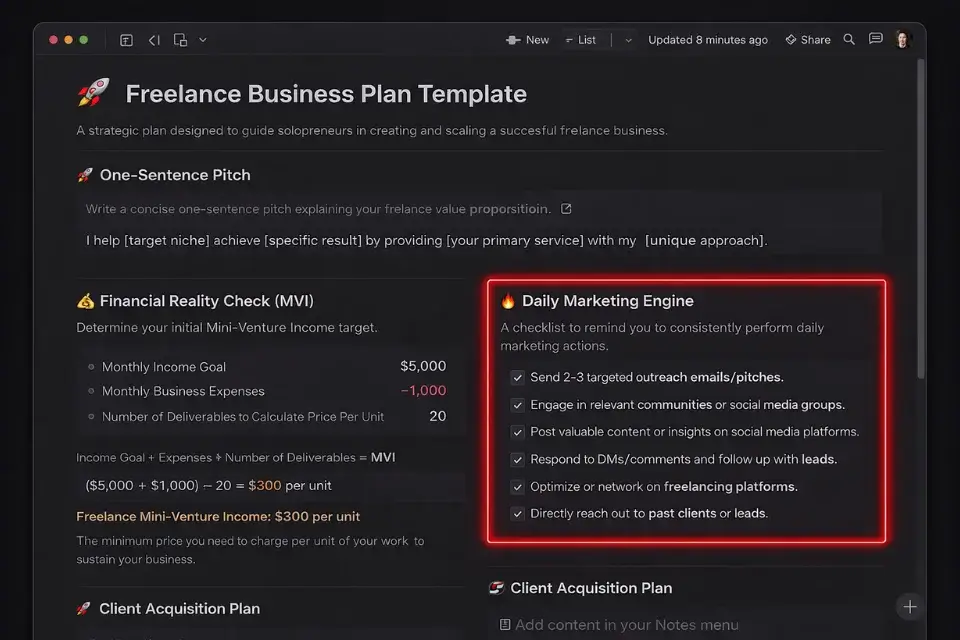
I’ve tested a dozen planning formats over the years — Google Sheets, Trello boards, paper notebooks, Airtable databases. Nothing comes close to Notion for an agile freelance operation.
The framework I use is built around three pillars:
- The Vision — Who you help and the exact problem you solve.
- The Financials — Your Minimum Viable Income (MVI), target revenue, and tax buffers.
- The Execution — The daily marketing and operational actions required to hit your number.
The template is a single Notion page with linked databases for client tracking, invoice status, and weekly goal reviews. The whole thing takes about 45 minutes to fill out the first time. If you want to skip straight to the structure, grab our free 1-page Notion business plan template and fill in the blanks as you work through each step below.
🎁 Free Digital Asset: 1-Page Business Plan
Direct link to the Notion Template download.
Step 1: Define Your Offer & Target Market (The “Who & What”)
The fastest path to consistent freelance income is radical specialization. Stop being a “web designer.” Start being a “Shopify conversion optimization designer for DTC skincare brands.”
This isn’t just positioning theory. When I narrowed my niche from “content writer” to “SaaS onboarding email sequences,” my close rate on proposals jumped from around 20% to over 60% in three months. The math is simple: specialists charge more, close faster, and get better referrals.
Your plan needs to answer these three questions with brutal precision:
- Who is your ideal client? (Industry, company size, geography, budget)
- What specific problem do you solve? (Not “I write content” — “I reduce SaaS churn by improving onboarding email sequences”)
- What is your primary deliverable? (Not “consulting” — “a 6-email onboarding sequence, delivered in 14 days”)
Pro Tip: Don’t validate your niche using “passion.” Validate it using active market demand. Search your niche on Upwork’s Talent Scout page, check what categories are labeled “High Demand” on LinkedIn Services Marketplace, and look at what B2B SaaS job boards are paying for contract work. Passion without a market is a hobby, not a business.
Once you have your three answers locked in, the rest of the plan writes itself — starting with the numbers, which is where most freelancers go completely blind.
Step 2: Freelance Financial Projections (Easy Math)
Most freelancers set revenue goals backwards. They say “I want to make $10k/month” without calculating what that actually requires operationally.
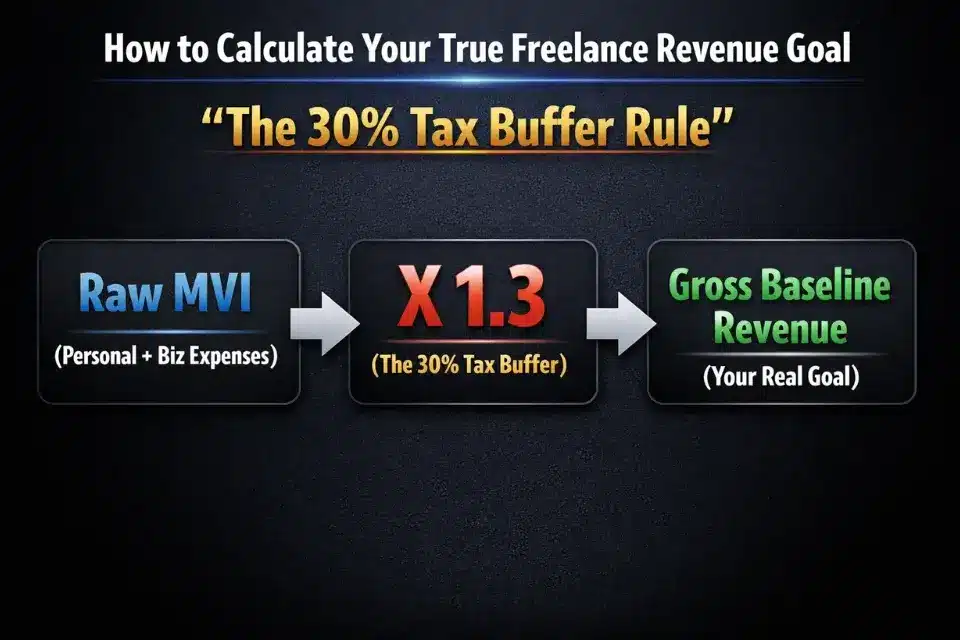
Here’s the framework I use. Start with your Minimum Viable Income (MVI) — the bare minimum you need to cover rent, food, health insurance, software, and taxes without touching savings. In the US, add roughly 30% on top of your take-home target to account for self-employment tax and quarterly estimated payments.
Then work forward:
- MVI Example: $5,000/month take-home → $6,500/month gross needed (after 30% tax buffer)
- Service Rate: $2,000 per project → need 3.25 projects/month minimum
- Target Revenue: $10,000/month → need 5 projects/month at $2,000 each
These aren’t scary numbers. They’re math. And once you see them as math, you stop treating revenue goals as wishful thinking and start treating them as a pipeline problem you can solve with consistent outreach. I’ve broken down the full spreadsheet logic — including retainer vs. project-based income modeling — in this freelance financial projections guide if you want to go deeper on the numbers.
Track your MVI before anything else. It’s your floor, not your ceiling.
QuickBooks
Best for: Freelancers who need to track invoices, expenses, and quarterly tax estimates without hiring an accountant on day one.
Step 3: Setting S.M.A.R.T. Freelance Business Goals
“Make more money” is not a goal. It’s a vibe.
A S.M.A.R.T. goal is Specific, Measurable, Achievable, Relevant, and Time-bound. When I’m coaching freelancers through their first business plan, this is where I see the most resistance — and the most dramatic improvement once people get it right.
Here’s the translation from vague aspiration to executable target:
Vague Goal | S.M.A.R.T. Version |
|---|---|
“Get more clients” | “Send 5 cold outreach emails every weekday for 8 weeks” |
“Make more money” | “Raise my base project rate from $1,500 to $2,500 by June 30” |
“Improve my portfolio” | “Publish 2 new case studies to my site by the end of the month” |
Each goal in your 1-page plan needs a weekly action attached to it. The goal is the destination. The action is the car. Without the car, you’re just standing in the driveway looking at a map.
Set no more than 3 primary goals per quarter. More than that and you’re just making a wish list. For a tested framework on hitting the $10k/month milestone specifically, our freelance business goals breakdown walks through exactly how to structure your quarterly OKRs.
Notion
Best for: Freelancers who want to manage goals, projects, and client wikis inside one connected workspace without juggling five different apps.
Step 4: Structuring Your Operation (LLC vs. Sole Proprietor)
This section is specifically for US-based freelancers. Skip it if you’re operating in the UK or EU — your legal structure is a different conversation.
When you start freelancing, you are automatically a Sole Proprietor by default. You don’t need to register anything. Your business income flows directly to your personal tax return via Schedule C.
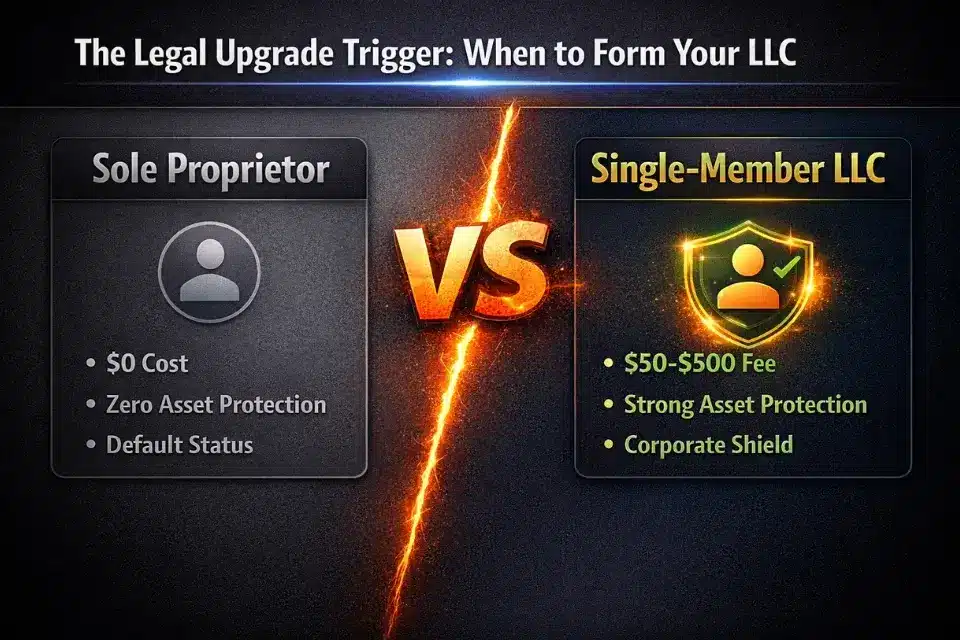
The question isn’t whether to start as a Sole Prop — you already are one. The question is when to upgrade to a Single-Member LLC.
My honest take: register an LLC once you’re pulling consistent revenue over $3,000/month. Before that, the administrative overhead isn’t worth it. After that, the liability protection and potential tax savings via S-Corp election absolutely are. Our full LLC vs. Sole Proprietor guide for freelancers covers the S-Corp election trigger point in detail — it’s one of the most misunderstood moves available to solo operators.
Here’s the at-a-glance breakdown:
Factor | Sole Proprietor | Single-Member LLC |
|---|---|---|
Cost to Start | $0 | $50–$500 (state filing fee) |
Personal Liability | Full personal exposure | Business assets separated from personal |
Tax Treatment | Pass-through (Schedule C) | Pass-through by default; S-Corp election available |
Admin Overhead | Minimal | Annual state reports, registered agent |
Credibility Signal | Lower | Higher (especially for B2B clients) |
Banking | Can use personal account (not recommended) | Separate business account required |
For a deeper breakdown of the S-Corp election strategy — which can save you $5,000–$15,000+ annually in self-employment taxes once you’re over $60k/year — the IRS Small Business Center is the authoritative source. Don’t take tax advice from a Reddit thread.
Step 5: The Tech Stack to Run Your 1-Page Plan
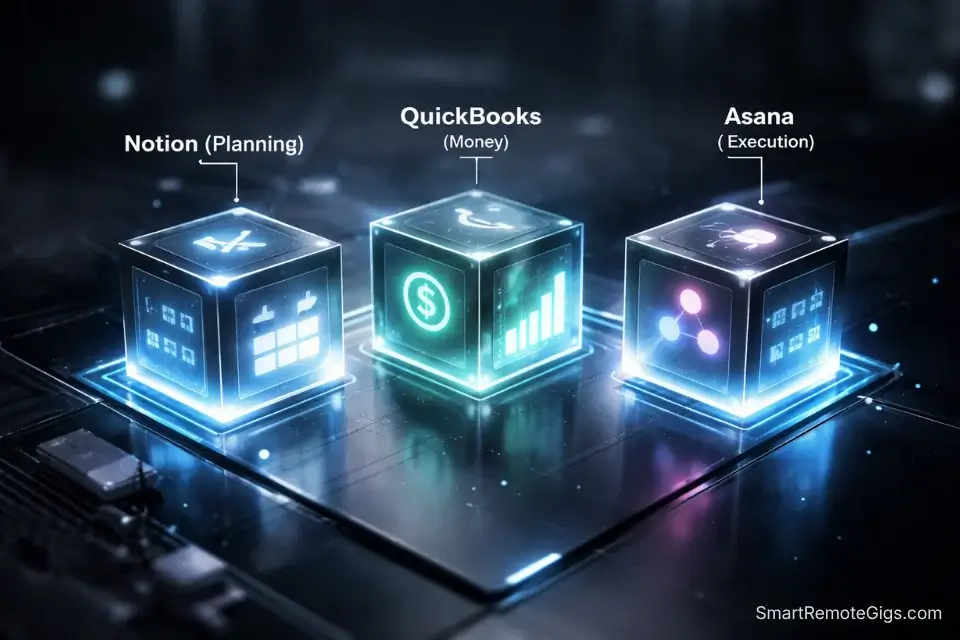
A lean operation runs on lean tools. My current stack has exactly four categories: project management, invoicing, communication, and contracts. Everything else is noise.
Here’s what I actively use and recommend in 2026:
For project management, I use Asana for anything involving multiple clients or ongoing retainers. Where Notion is my planning brain, Asana is my execution engine — it handles task dependencies, due dates, and client-facing project portals in a way that Notion’s freeform structure simply can’t replicate cleanly. If you’re juggling more than two active clients at once, Asana’s board and timeline views will save you from dropping balls. The honest drawback: the free tier is genuinely limited, and the premium plan at $13.49/month feels steep until you actually need the automation features — then it pays for itself fast.
For invoicing, I use QuickBooks Self-Employed for tax tracking and Wave for invoicing if you’re just starting out (Wave is free and handles the basics well).
For contracts, I use Bonsai — never send work without a signed contract, even for small projects.
For async client communication, Loom kills the “can we jump on a call?” spiral cold. Record a 3-minute walkthrough instead.
The goal of your tech stack is to remove yourself from administrative tasks so your billable hours actually go toward client work. I’ve tested and ranked the top seven tools for solo operators in this freelance tools guide for 2026 — it includes pricing comparisons and honest verdicts on what’s worth paying for.
One honest warning: don’t over-tool. I’ve seen freelancers spend more time optimizing their project management system than doing actual work. Pick something that’s 80% right and move on.

Asana
Best for: Freelancers managing multiple client projects simultaneously who need structured task dependencies, deadline tracking, and client-facing project visibility — without building it from scratch in Notion.
Frequently Asked Questions
Does a freelancer really need a business plan?
Yes — but keep it lean. A bloated business plan is theater. A 1-page plan is a financial and operational compass that keeps you focused on revenue-generating activity instead of busy work. Think of it less like a corporate document and more like a weekly dashboard you actually look at.
Can I write a freelance business plan in Notion?
Absolutely, and in my experience it’s the best tool for the job right now. Notion’s connected databases let you link your goals page directly to your client tracker, which is linked to your invoice log. Everything lives in one place and you can see your entire operation in a single view. The one real con: Notion’s infinite flexibility is also its biggest trap.
It’s very easy to spend two hours redesigning your dashboard instead of doing client work. Build a simple system, lock it in, and resist the urge to keep tweaking it. There’s a reason it dominates our best note-taking apps guide — but discipline is required.
What is the best business structure for a freelancer in the US?
Most people should start as a Sole Proprietor to reduce friction and validate their revenue before adding admin overhead. Once your income is consistent — say, $3k–$5k/month for 3+ months in a row — transition to a Single-Member LLC for asset protection. If you clear $60k+ annually, talk to a CPA about the S-Corp election. It’s one of the most underused tax strategies available to freelancers.
The Verdict & Final Action Step
The 1-page agile plan wins over traditional planning formats for one simple reason: it forces you to focus on what actually generates revenue.
No SWOT analysis. No market sizing exercises. No brand archetype worksheets. Just your offer, your number, and your daily actions.
Here’s your assignment: download the Notion template, fill in your MVI, and write three S.M.A.R.T. goals for the next 90 days. Do it today, before you talk yourself into waiting until the timing is perfect. The timing will never be perfect.
Verdict: The agile 1-page plan isn’t a shortcut — it’s the smarter format. Corporate planning frameworks were built for companies with departments, budgets, and shareholders. You have none of those. Build for the operation you actually run, not the one business school imagines. Download the 1-page Notion template, set your MVI, and start executing. Everything else is noise.
Complete 2026 Methodology: Creating an Agile Freelance Business Plan
The methodology behind this guide is built on one core principle we swear by at Smart Remote Gigs: a plan that doesn’t change your daily behavior is just a document.
Every section above is designed to produce a specific action — a niche statement, an MVI number, a daily outreach habit, a legal entity decision, a software stack. Put all five together and you have an operating system for your freelance business, not a filing cabinet artifact. That’s the exact remote-first playbook we champion here at Smart Remote Gigs.
Review your 1-page plan weekly. Update it quarterly. That’s it. That’s the whole system.