Manage Teams Across Time Zones 2026 [Async Masterclass]
 ·
Last Updated: March 25, 2026 ·
13 min read
·
Last Updated: March 25, 2026 ·
13 min read 
If you are losing sleep trying to manage teams across time zones, you are playing a losing game. In 2026, the highest-paid remote project managers don’t act as live meeting facilitators—they act as system architects who build asynchronous engines that keep work moving around the globe while they sleep.
I learned this through genuine pain. Early in my career, I slept in four-hour shifts just to overlap with my developers in Ukraine and my designers in California. I was a zombie. I nearly quit tech entirely until I realized the fundamental error: I was treating a global team like a local office.
That exact exhaustion—and the realization that most remote companies are still doing it wrong—is why we built Smart Remote Gigs. We wanted to give leaders the exact async frameworks to scale global output without sacrificing their health.
The moment I stopped chasing overlap and started architecting handoffs, everything changed. Here is the exact system that made it happen.
The Global Relay Race: How Work Moves Around the World
Phase | Timezone | Team | Task | Tool |
|---|---|---|---|---|
Phase 1 | PST — US | Strategy & Product | Scope definition, sprint briefs, decision logging | Notion |
Phase 2 | AEST — APAC | Engineering | AI ticket generation, code architecture, builds | Jira |
Phase 3 | CET — Europe | QA & Design | Testing, async video handoffs, design review | Slack / Loom |
The core insight: Work never stops, but nobody works more than 8 hours. The PM’s job is to design the baton pass between each phase—not to be present for all three.
The Core Rule of 2026: Stop Chasing “Overlap Hours”
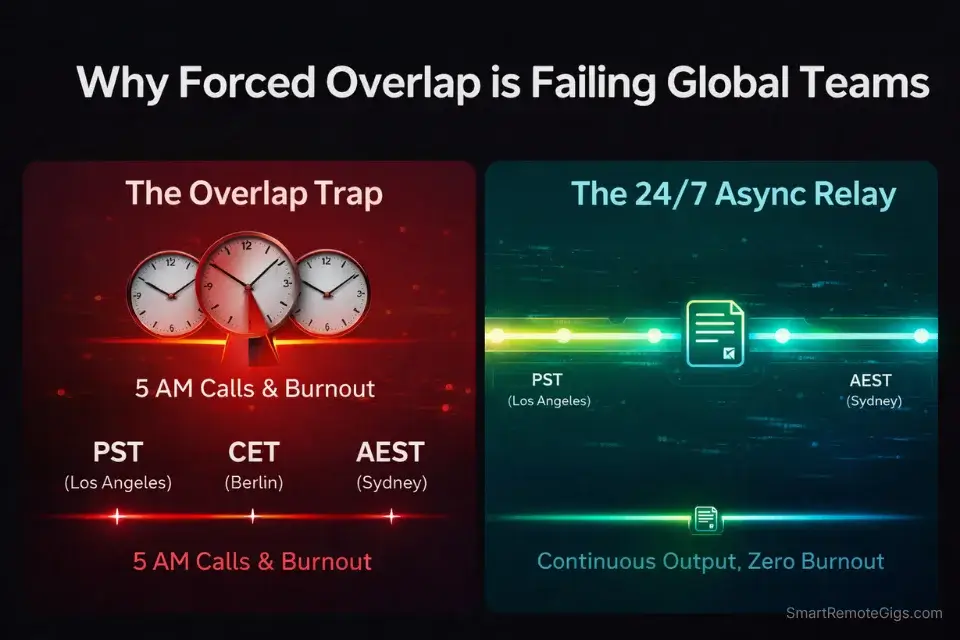
The instinct to force overlap is understandable. It feels like control. It feels like management. In reality, it is the single most destructive habit a remote PM can have, and the damage compounds in ways most managers don’t track.
Forced overlap destroys deep work. An engineer in Sydney who has to join a 7 AM call to satisfy a US PM’s need for live status updates loses their highest-quality cognitive hours to a meeting that could have been a Notion document. That cost doesn’t show up in a meeting log—it shows up in code quality, in missed estimates, and eventually in attrition.
The research is clear on this. Microsoft’s Work Trend Index has consistently found that employees who experience uninterrupted focus time report significantly higher productivity and lower burnout rates than those in high-meeting environments—and the effect is amplified for knowledge workers in distributed teams.
The philosophy underpinning everything in this guide is async-first communication. Before diving into the tactical stack, you must understand the core operating principle: work should progress through documented systems, not live conversations.
Warning: If your team cannot progress on a task without you being awake to answer a question, you do not have a workflow—you have a bottleneck. You are the single point of failure in a system that runs on your personal availability. Decentralizing your knowledge into written documentation is not optional; it is the entire job.
The shift from overlap-chaser to async architect is a mental model change before it’s a tool change. Once you accept that a team member being asleep is not a blocker—that a well-written ticket or handoff note is worth more than a live conversation—every tactical decision that follows becomes obvious.
Building the “Global Relay Race” Protocol
The relay race metaphor is precise, not decorative. In a relay race, the baton pass is the highest-risk moment. Drop the baton and the race is lost regardless of how fast each individual runner was. In a global async team, the handoff—the moment work transfers from one timezone to the next—is exactly that moment.
Most distributed teams drop the baton constantly and don’t know it. A developer in Singapore finishes a feature and marks the Jira ticket “Done” without context about what “done” means in this sprint’s definition. A designer in Berlin ships assets without specifying which states are final versus placeholder. A US PM writes a sprint brief that answers the questions they thought to ask, not the questions the APAC team will actually have when they wake up.
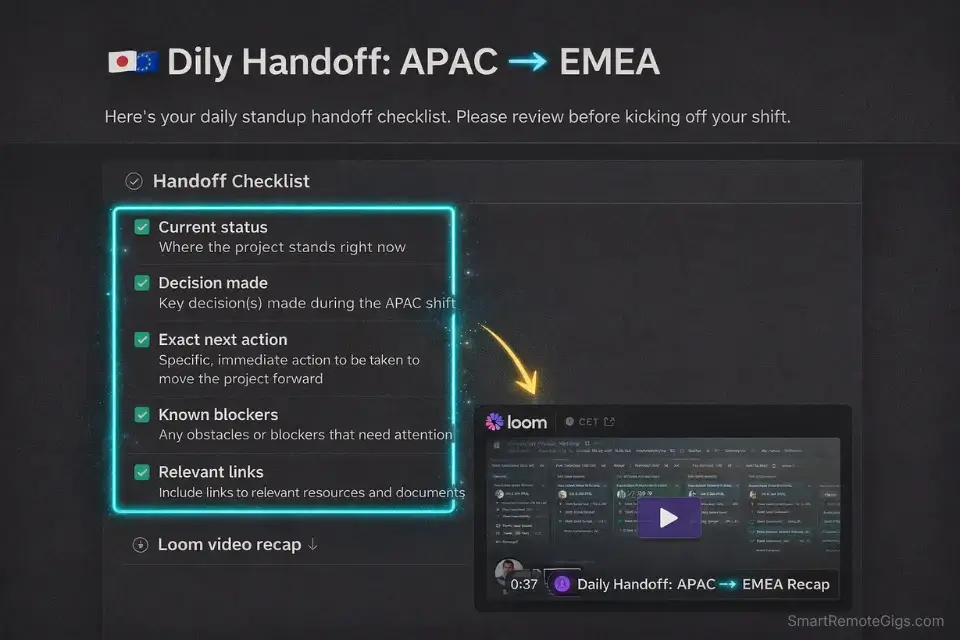
The Global Relay Race Protocol fixes this with a mandatory handoff structure. Every task that needs to continue in the next timezone gets a context package before the current team member signs off:
The Handoff Checklist:
- Current status — exactly where the work is, not where it’s supposed to be
- Decision made today — what was resolved, what is still open
- Exact next action — not “continue development” but “implement the error state for the login form, specs in Figma frame 4B”
- Known blockers — any dependency that could stop progress, with the relevant contact named
- Relevant links — Figma file, Jira ticket, Notion doc, Loom recording—everything in one place
This checklist lives inside the task itself—in the Asana task description, the Jira ticket, or the Notion project page—not in a Slack message that will be buried by morning.
The honest operational caveat before you build this system in Notion: without strict page hierarchy, naming conventions, and regular archiving rules enforced from day one, a Notion workspace becomes a disorganized dumping ground of outdated handoff notes within weeks. I’ve inherited Notion workspaces from previous PMs that were completely unusable—hundreds of pages with no clear structure, three different “current” versions of the same sprint brief, and handoff notes from six months ago sitting next to today’s. Nobody could find the single source of truth because there wasn’t one. Build the governance scaffolding before the team touches it, or the tool will work against you.
Notion
Best for: Async Documentation & Team Wiki
🎁 Free Digital Asset: The Remote PM Command Center
This Notion template includes the exact Handoff Checklist we use to pass work globally, pre-built into a reusable task template. Clone it, customize the checklist fields for your team’s workflow, and you have a production-ready global handoff system in under an hour.
The Ultimate Tech Stack for Global Teams
You cannot run a global team on email and hope. You need a connected stack where every tool has a specific role and the information flows between them without manual intervention.
Email fails global teams for a structural reason: it’s a bilateral communication channel in a multilateral work environment. When a decision gets made over email between two people, the other six people who need that context either get a forwarded thread with missing history or they never find out. On a distributed team operating across time zones, that information gap creates 8-hour delays at minimum and outright rework at worst.
The tools below represent the minimum viable stack for a global team in 2026. If you want to run an async relay race across continents, these are the non-negotiable platforms you must master before finalizing your setup.
Asana is the operational backbone for cross-timezone task management. Its timeline view gives every team member—regardless of timezone—a shared understanding of where the project is, what’s coming next, and who owns what. The portfolio view lets the PM monitor multiple streams simultaneously without pulling anyone into a status meeting.
The failure mode to know before you pitch it: Asana requires strict governance from day one. Without enforced task ownership, mandatory due dates, and consistent use of the handoff checklist fields, it becomes a checklist graveyard where nobody trusts the data. The tool is only as reliable as the discipline the PM builds around it—and that governance overhead is real.

Asana
Best for: Cross-Timezone Visual Timelines & Handoff Automation
Jira is non-negotiable for any global team with an engineering component. The ability to write structured acceptance criteria directly into tickets—so a developer in Sydney can start a task without a kickoff call with a PM in San Francisco—is the single most valuable feature for distributed teams. Combine that with automation rules that flag stalled tickets and AI-generated sprint summaries, and Jira becomes a self-monitoring delivery system.
The honest drawback: Jira’s configuration complexity is a genuine barrier. Getting the automation rules, custom workflows, and JQL views set up correctly takes significant upfront investment. Teams that deploy Jira without that investment end up with a chaotic backlog that creates more confusion than it resolves. Budget for the setup properly or it will cost you more in debugging later.

Jira
Best for: Developer Issue Tracking & Deep-Work Protection
Replacing the “Daily Standup” with AI Summaries
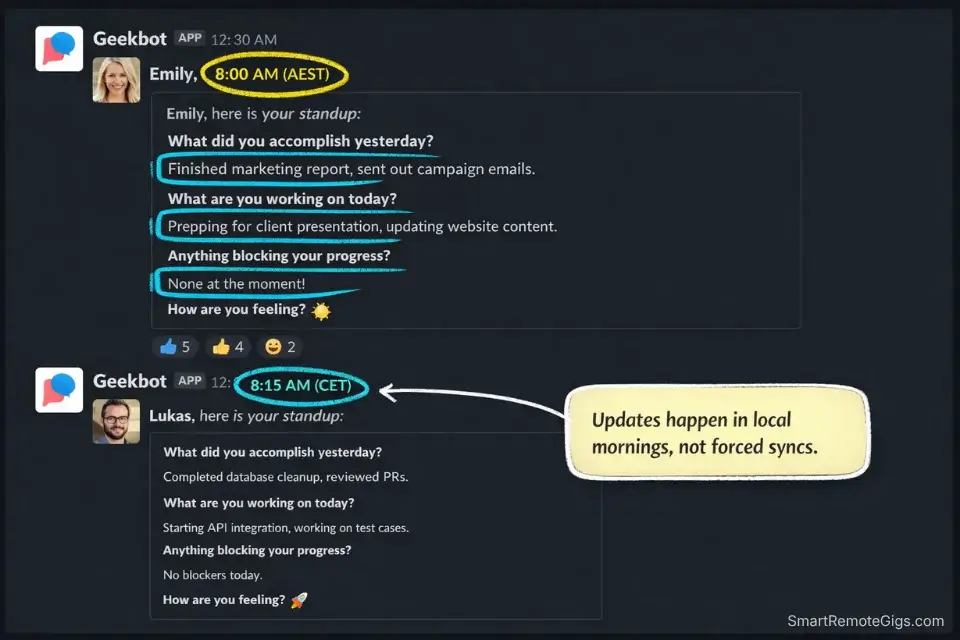
The daily standup is the most persistent relic of office-era project management, and it is the single biggest structural obstacle to running an effective global team.
The logic behind it was sound in 2010: get everyone in the same room, share blockers, align priorities, and start the day moving in the same direction. In a distributed team spanning four time zones, “the same room” requires someone to be awake at 5 AM. The alignment that was supposed to take 15 minutes now takes 15 minutes of meeting plus the productivity cost of the engineer who had to break their deep work block to attend, plus the cognitive overhead of context-switching back into focused work afterward. The math doesn’t work.
The 2026 replacement is fully automated. Geekbot or a custom Slack workflow prompts each team member to submit a structured text update when they log on—not at a fixed time, but at their own start-of-day. An AI summarization layer then aggregates those updates into a single digest, surfacing blockers, decisions needed, and sprint velocity signals, and posts it to the relevant channel. By the time the PM’s morning triage block starts, the full picture is already there.
To see exactly how this morning triage block integrates into a full workday without causing meeting bloat, read our hour-by-hour breakdown of a modern remote project manager’s daily schedule.
The caveat with Slack specifically: the async standup system only works if you enforce strict channel discipline across the whole team. Without it—without rules about threading, channel purpose, and notification settings—Slack devolves into a real-time chat feed that creates more interruption noise than the standup it replaced. The tool is the enabler. The PM’s governance rules are what actually make it async.

Slack
Best for: Automated Standups & AI Sprint Summaries
Pro Tip: Mandate that all end-of-day updates include a 3-minute Loom screen recording linked directly inside the Slack update or Asana task. Text loses tone, urgency, and context in ways that create misunderstandings across cultural and linguistic lines. A 3-minute async video with screen context eliminates the ambiguity that generates follow-up questions—and follow-up questions are the primary source of unnecessary cross-timezone pings.
Handling Escalations: When Async Fails
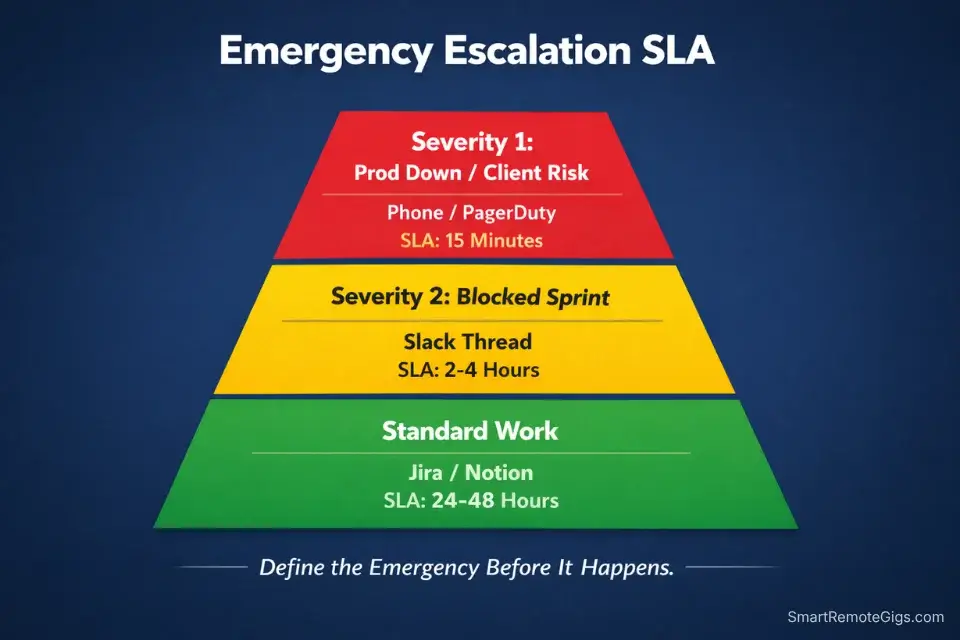
Async-first does not mean async-always. The system needs an emergency protocol, and every team member needs to know exactly what qualifies as an emergency before one happens.
The definition matters more than most PMs think. If the threshold for breaking async is vague—”when something is urgent”—every team member’s personal judgment about urgency will differ, and you’ll end up with async rules that erode gradually until you’re back to reactive communication patterns. The threshold has to be specific and written down.
A working emergency protocol defines three things explicitly:
1. What qualifies as a synchronous escalation:
Production is down. A client-facing deadline will be missed in the next 4 hours without a decision. A security incident is active. Financial or legal exposure is imminent. These are the only categories that justify breaking someone’s deep work block with an unscheduled contact.
2. The escalation channel:
Not Slack—too easy to miss. A dedicated emergency channel with distinct notification settings, a direct SMS or phone contact for the on-call PM, and a defined response SLA. Thirty minutes for Severity 1. Two hours for Severity 2. Everything else is async.
3. The post-escalation requirement:
Every synchronous escalation gets a written post-mortem within 24 hours in Notion. What happened, what decision was made, what system change prevents this from requiring a live call next time. This requirement does two things: it creates institutional memory, and it creates a mild friction cost for breaking async that keeps the threshold honest.
For a deeper read on the research behind async-first management and its measurable impact on distributed team performance, Stanford’s WFH Research project provides strong empirical grounding for the productivity arguments in this guide.
Frequently Asked Questions
How do you handle daily standups across time zones?
Eliminate live standups entirely. Transition to automated, text-based async updates via Geekbot, Slack workflow, or a similar tool that prompts each team member when they log on—not at a fixed time. Pair the text update with an AI summarization layer that aggregates the team’s updates into a single morning digest.
The result is better information quality, zero scheduling friction, and zero productivity cost for the team.
What is the best time zone for a remote project manager?
In a true async-first company, your time zone is operationally irrelevant—the systems run the team, not your availability. That said, for hybrid-remote companies that still maintain some live overlap requirements, EST and GMT offer the most useful partial overlap with both European and US West Coast working hours.
Both give you a 4–5 hour overlap window with Europe in the morning and a 4–5 hour overlap with PST in the afternoon without requiring extreme schedule adjustments.
How do you build team culture without real-time meetings?
Culture isn’t built on forced Zoom happy hours that half the team attends from a timezone that makes the timing miserable. It’s built through transparency, consistency, and respect—writing decisions down so everyone has context regardless of when they log on, protecting deep work blocks so people can do their best work, and creating informal async spaces where human connection happens naturally.
A #pets channel or a #currently-reading thread in Slack generates more genuine team cohesion than a mandatory Friday social call ever will, because it’s opt-in and it respects the fact that people are in different life contexts across different timezones.
The Verdict: The best remote project managers are effectively invisible. Their systems run so smoothly that time zones become a competitive advantage—24/7 continuous output—rather than a coordination tax. Your job is to orchestrate the relay race, not run every lap yourself.
At Smart Remote Gigs, we review thousands of global teams, and the ones that scale successfully all run on this exact async protocol.
Once your handoff systems are built, skip the chaotic corporate job boards and check the Smart Remote Job Board to find vetted employers who actually respect async boundaries. For a complete blueprint on advancing your career, read our guide on landing high-paying remote project manager jobs and explore our curated list of the top 20 tech companies actively hiring PMs this year.

![AI Content Writer Jobs: [My 2026 Survival Playbook]](https://smartremotegigs.com/wp-content/uploads/2026/04/ai-content-writer-jobs-survival-playbook-1024x577.webp)
![Remote Copywriting Jobs 2026: [High-Ticket Method]](https://smartremotegigs.com/wp-content/uploads/2026/04/remote-copywriting-jobs-high-ticket-method-guide-1024x577.webp)
![Remote Technical Writing Jobs: [The $80K/Yr Guide]](https://smartremotegigs.com/wp-content/uploads/2026/04/remote-technical-writing-jobs-hero.webp)