Managing a distributed workforce is pure chaos without the right systems. That’s why landing the best remote project manager jobs in 2026 isn’t about how well you run a Zoom meeting—it’s about how effectively you can replace them with AI and async workflows.
I made this mistake myself. When I moved from a traditional agency to a fully distributed tech company, I showed up ready to facilitate. Nobody cared. They wanted someone who could build a self-running machine. That shift cost me three months of credibility before I figured it out. That exact struggle is why we built Smart Remote Gigs—to help professionals bypass outdated “meeting scheduler” roles and connect directly with high-paying, async-first tech companies.
This guide is the blueprint I wish I had.
The 2026 Remote PM Snapshot
Category | Details |
|---|---|
Role Identity | From “Meeting Scheduler” → “Async Leader & AI Operator” |
Average Base Salary (US) | $110,000 – $160,000+ |
Core 2026 Skills | AI-driven Sprint Planning, Cross-Timezone Automation, Deep Work Protection |
Essential Certs | Agile, PMP, AI Prompt Engineering |
The 2026 Shift: Death of the “Meeting Scheduler”
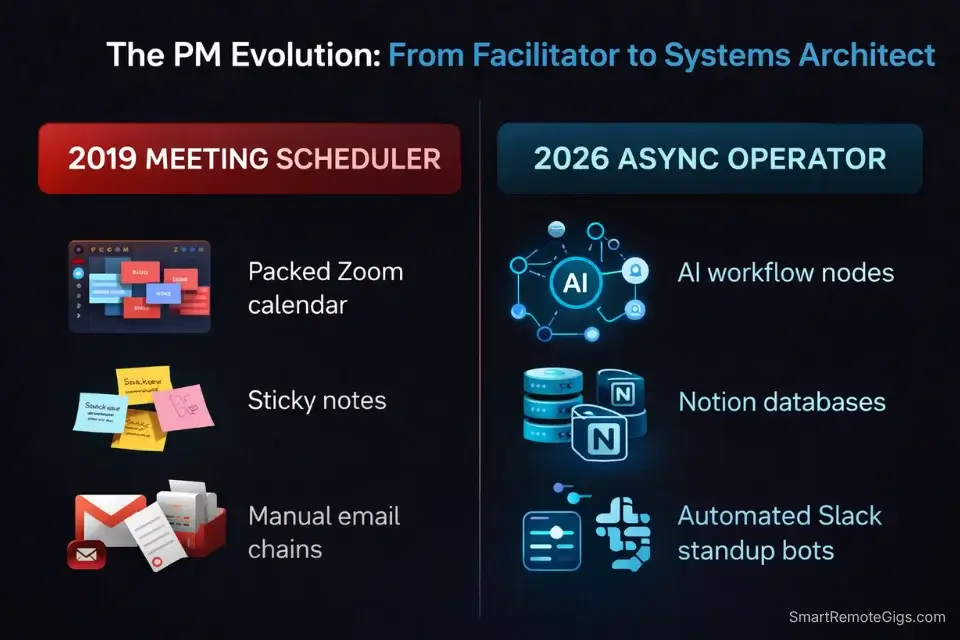
Top-tier remote companies don’t want a moderator. They want a systems architect.
The old model was simple: a PM’s value was measured in calendar density. In 2026, that is a red flag. Hiring managers at async-first companies actively screen out candidates who lead with meeting facilitation as their core skill. In fact, analyzing recent remote work statistics reveals a clear trend: while general remote job postings have stabilized, compensation for highly technical, async-capable managers continues to climb.
The old model was simple: a PM’s value was measured in calendar density. The more syncs you owned, the more “involved” you appeared. In 2026, that is a red flag. Hiring managers at async-first companies—think GitLab, Automattic, Basecamp—actively screen out candidates who lead with meeting facilitation as their core skill.
The companies paying $140K+ for remote PMs want someone who can design a workflow so tight that the team executes correctly even when the PM is asleep. They want automation, documentation, and decision-making frameworks that don’t require a live room.
Warning: If your resume highlights “hosting daily standups” or “facilitating weekly syncs” as core achievements, you are signaling to 2026 hiring managers that you consume company time. Reframe every bullet around the system you built, not the meeting you attended.
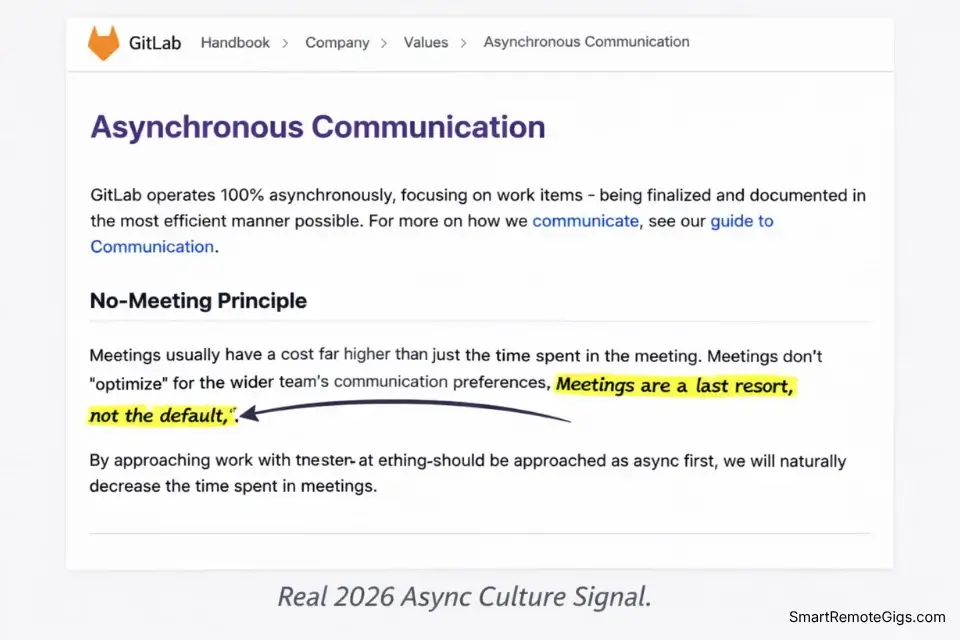
The shift is real and documented. GitLab’s public handbook—one of the most detailed remote work guides ever published—explicitly states that async-first communication is a core operating principle. They don’t hire PMs to talk. They hire them to architect.
Core Skills You Actually Need to Get Hired
The gap between a $75K PM and a $145K PM in 2026 comes down to a specific, learnable skill delta.
Old PM (Pre-2024) | 2026 Remote PM |
|---|---|
Manual follow-up emails | Automated Slack nudges via workflow bots |
Excel-based status tracking | AI-powered predictive timelines (Asana AI, Linear) |
Weekly status meetings | Auto-generated async video updates (Loom + AI summary) |
Calendar blocking for standups | Written async standups via Geekbot or Slack workflow |
Manually updating RAID logs | AI risk flagging embedded in sprint tooling |
Back-and-forth emails for approvals | Structured decision logs in Notion with async sign-off |
The single biggest skill you can add right now? AI prompt engineering for project workflows. I’m not talking about ChatGPT for meeting notes. I mean building repeatable prompts that generate sprint reports, risk assessments, and stakeholder updates from raw data dumps. That is a hard, demonstrable skill that most PMs still don’t have.
The Project Management Institute (PMI) has already integrated AI competency into its updated certification pathways. If you are looking to validate these skills, review our ranking of the top project management certifications to see which ones actually bypass ATS filters this year.
🎁 Free Digital Asset: The Remote PM Command Center
This is the exact Notion system I use to manage distributed teams without a single recurring sync. It includes async standup templates, sprint kickoff docs, and an AI prompt library for weekly reporting.
The Ultimate Remote PM Tech Stack (Must-Knows for Your Resume)
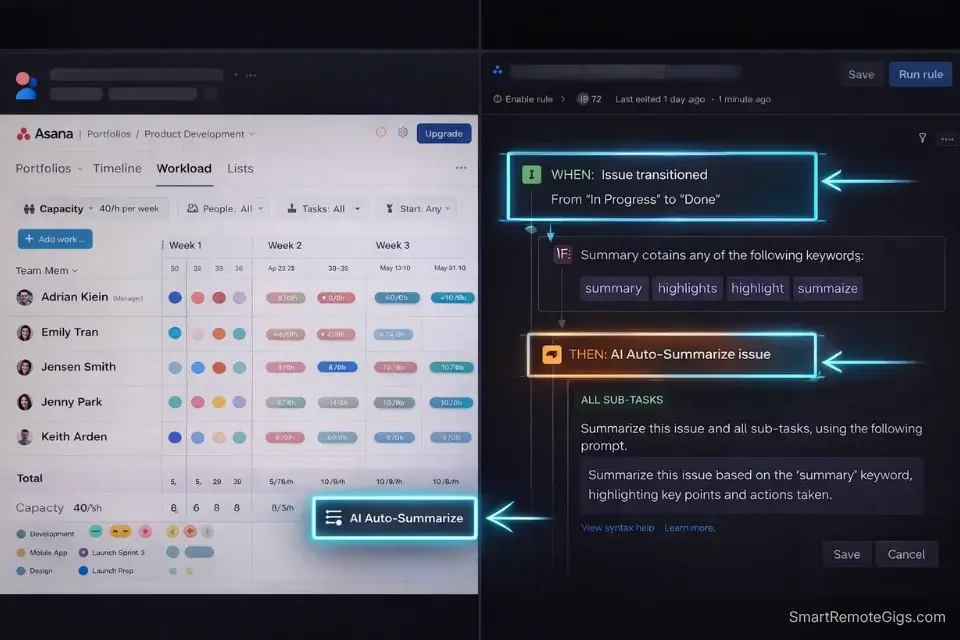
Software fluency is the differentiator. You don’t need to be a developer, but you need to be the most competent person in the room on these core tools. Here are the three non-negotiable platforms you must master to land any high-paying remote PM role in 2026.
Here are the three non-negotiables for any remote PM role.
Asana
Asana is the backbone of async project management at scale. What makes it worth putting on your resume in 2026 specifically is its AI-powered workload management—it can flag capacity issues before your team starts missing deadlines, which means less firefighting and more proactive leadership.
I use Asana for anything involving multiple teams and external stakeholders. The portfolio view alone saves me roughly four status update meetings a week. The rule tracking and custom rules engine let you build automations that would’ve required a developer two years ago.
That said, Asana has a real failure mode: if you don’t enforce strict task ownership and due-date hygiene from day one, it devolves into a graveyard of untracked subtasks and zombie projects. I’ve seen teams of 20 where nobody could tell you what was actually blocked versus just stale. The tool is only as disciplined as the system you build inside it.

Asana
Best for: Async Sprint Tracking & Cross-Team Visibility
Jira
Jira is still the standard for engineering sprint management, and if you’re managing developer teams without knowing it, that’s a dealbreaker. Atlassian’s recent AI integrations—specifically Atlassian Intelligence—have made it meaningfully smarter for backlog grooming and issue summarization.
The learning curve is real. Jira rewards PMs who invest time configuring it properly. Once you do, handoffs become structured, sprint velocity becomes trackable, and you stop chasing engineers for updates.
The gotcha: Jira is overkill for non-technical teams. Don’t force it where Asana works fine. The configuration overhead will kill your momentum.
Unsure which platform to specialize in? See our technical breakdown of Asana vs Jira for distributed teams.

Jira
Best for: Developer Handoffs & AI Issue Ticketing
Notion
Notion is where the system lives. Every async-first company I’ve worked with or researched runs its institutional knowledge through it. Onboarding docs, decision logs, project briefs, sprint retrospectives—all of it.
The reason Notion is non-negotiable in 2026 is Notion AI. It can auto-summarize meeting notes, generate project briefs from bullet points, and answer questions about your own documentation. That’s genuine leverage.
The honest drawback? Notion suffers badly from blank-page paralysis for new users and new teams. Drop someone into an empty workspace with no structure and they’ll either build a chaotic mess of nested pages or give up entirely within a week. You need to pre-build the scaffolding—templates, databases, linking conventions—before the team ever touches it. That setup cost is real and most PMs underestimate it.
Pro tip: Build a public-facing Notion portfolio of templates you’ve created. It’s one of the fastest ways to prove remote PM competency without a prior remote-specific job title.
Notion
Best for: Team Brainstorming & Async Documentation
Where to Find the Best Fully-Remote Opportunities
LinkedIn Easy Apply is where remote PM applications go to die. You’re competing with 400 people who clicked the same button. That’s not a strategy.
Here is where you actually find high-ticket roles:
- The Smart Remote Job Board: We constantly update our own curated board with vetted, high-paying async roles pulled from trusted platforms. It is the best direct source to bypass generic job aggregator noise.
- Niche Async Boards: Platforms like We Work Remotely and Himalayas offer a high signal-to-noise ratio.
- Direct Company Pages: For a targeted hit list, check out our guide on the top tech companies actively hiring PMs.
Pro Tip: When you find the right listing, do not send a generic application. Draft a highly targeted cover letter pitching an async solution to a specific company problem.
A Day in the Life: What You’ll Actually Do
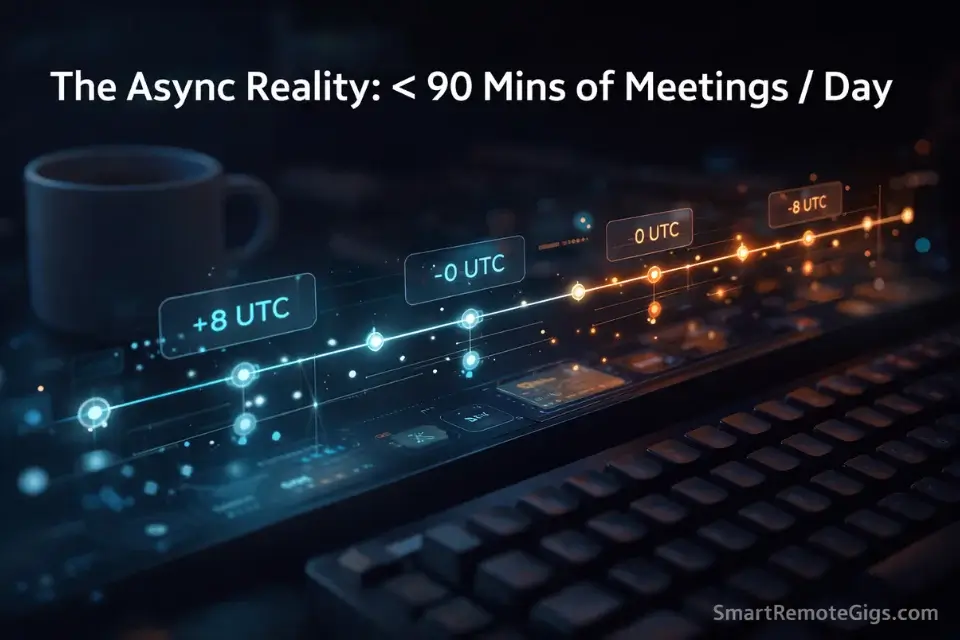
Forget the romanticized version. Here’s the real shape of a day managing distributed teams across time zones with AI.
7:00 AM — Check the async standup digest. Geekbot has already collected team updates overnight. I spend 15 minutes reading, not talking.
7:30 AM — Run my morning AI sweep. I’ve built a prompt that takes raw standup data and surfaces blockers, scope creep flags, and dependency risks in plain English. This replaces a 30-minute status meeting.
8:00 AM – 12:00 PM — Deep work block. No meetings, no Slack notifications. This is when I write briefs, review sprint health in Asana, and do strategic planning. This block is sacred, and I protect it structurally.
12:00 PM — Async video update via Loom. Three minutes, covering sprint status and decisions made. Dropped in the project Slack channel. No replies necessary.
2:00 PM – 4:00 PM — Overlap window with the European team. This is when any necessary live conversation happens. One 20-minute sync, max.
4:00 PM onward — Documentation, review Notion decision logs, and prep async briefs for tomorrow.
The result? Less than 90 minutes of live meetings per day. To see exactly how this schedule executes on a global scale, read how a modern remote PM structures their day and the exact framework used to manage global time zones effectively.
Frequently Asked Questions
Do remote project managers make good money?
Yes—specifically those with technical or AI operational skills. In the US market, senior remote PMs with async workflow expertise and tool fluency regularly clear $120K–$160K+. The ceiling is higher than most PMs realize because the pool of candidates who can actually operate async at scale is still relatively small.
Is it hard to get a remote project manager job with no experience?
It requires a deliberate pivot, not just a resume update. You need to prove you can manage remote workflows. The fastest path: build a portfolio of Notion templates, manage a public open-source project or volunteer coordination effort, and document the outcomes. Hiring managers want evidence, not claims.
How do I pass the final interview rounds?
You have to prove you build systems, not just host meetings. The best way to prepare is to practice the exact interview questions that technical recruiters at top remote companies are asking this year. They are highly specific, and focusing your answers on async conflict-resolution and deep-work protection is what secures the offer.
The Verdict: The remote PMs who win in 2026 treat themselves as systems engineers, not meeting hosts. Your job is not to manage people. Your job is to build the machine that manages the work.
At Smart Remote Gigs, our mission is to curate the exact opportunities that value these async skills, saving you from the LinkedIn “Easy Apply” trap.
Ready to start applying?
Download the Remote PM Command Center and pair it with our ATS-beating PM resume template to start landing interviews today.