
Stop Trading Your Sleep for Rent: The New Remote Reality
Finding legitimate remote jobs for college students shouldn’t require a degree in itself—but in 2026, most job boards still bury the good opportunities under corporate spam. After burning out during my junior year trying to balance 18 credits with graveyard diner shifts, I’ve spent three years vetting roles that actually respect your class schedule and pay more than campus dining hall wages.

Job Category | Best For | Avg. Pay (2026) | Flexibility Score |
|---|---|---|---|
AI Data Labeling | Tech-curious students | $18–$25/hr | 10/10 |
Virtual Tutoring | Academic high-achievers | $25–$45/hr | 7/10 |
Social Media Moderation | Night owls & Gen Z fluent | $15–$22/hr | 9/10 |
Micro-Tasking | Between-class grinders | $12–$18/hr | 10/10 |
Freelance Writing | English/Journalism majors | $20–$40/hr | 8/10 |
Virtual Assistant | Organized multitaskers | $16–$28/hr | 7/10 |
Transcription | Fast typists (70+ WPM) | $15–$25/hr | 9/10 |
Customer Support Chat | Patient communicators | $14–$22/hr | 6/10 |
The problem with traditional student jobs? They force you to choose between attending your Tuesday/Thursday lectures or paying rent. I watched my GPA tank to 2.7 while pulling overnight shifts—not because I was lazy, but because working 25 hours at minimum wage left zero energy for Organic Chemistry.
The landscape shifted dramatically between 2023 and 2026. Companies now actively recruit students for asynchronous remote work because we’re digital natives who context-switch faster than our professors update Canvas.
This isn’t about scraping together beer money. These are career-building roles with hourly rates that shame most campus jobs.
Pro Tip: Always use a separate Chrome Profile for work vs. school. It keeps your mental tabs organized and prevents you from accidentally submitting a client report to your sociology professor.
The shift from exploitative gig work to legitimate remote positions happened quietly. While corporate America argued about return-to-office mandates, smart companies realized hiring college students remotely gave them talented, tech-literate workers at competitive rates.
Let me walk you through the 15 roles I’ve vetted personally or watched classmates succeed with—plus the scam red flags that’ll save you weeks of wasted time.
The High-Growth “Big Three” Categories for 2026
These aren’t your parents’ student jobs. These categories exploded because of converging trends: AI’s insatiable hunger for training data, the maturation of the creator economy, and normalized asynchronous work.
1. AI Training & Data Labeling (The “Bored in Lecture” Job)

Companies like DataAnnotation, Remotasks, and Scale AI are desperately hiring students to help train large language models.
What you actually do: Rate chatbot responses for coherence, label images for autonomous vehicle datasets, categorize text sentiment, or transcribe audio snippets. It’s repetitive but oddly meditative—like digital assembly line work for the AI age.
Why it’s perfect for students: Zero commitment schedule. Log in for 20 minutes between Calculus and Economics, or grind for 6 hours on Sunday while your roommate nurses a hangover. Most platforms use a task queue system where you grab work when it’s available.
The pay range: $18–$25/hour for basic labeling. Specialized tasks like coding evaluation or medical image annotation hit $30–$40/hour if you qualify through assessment tests.
Real talk—the cons: The work is genuinely monotonous. You won’t build portfolio pieces or impressive resume bullets. You’re teaching AI to recognize stop signs, not launching rockets. But I know three students who funded entire semesters doing this while rewatching The Office.
The Verdict: Best for students who want maximum flexibility with zero emotional investment. It’s honest money that respects your unpredictable schedule.
2. Digital Support & Social Moderation

If you’re already spending 4 hours daily on Discord, Reddit, or TikTok, you might as well monetize that addiction.
Brands and creator communities need moderators to manage comments, enforce community guidelines, and respond to DMs. ModSquad and The Social Element hire students for shift-based moderation work.
What you actually do: Delete spam, ban trolls, escalate harassment cases, and occasionally engage with genuine community questions. Think digital bouncer with better hours and no drunk frat bros.
The hidden benefit: You learn platform algorithms, community psychology, and crisis de-escalation—skills that translate directly into social media marketing roles post-graduation.
The pay range: $15–$22/hour depending on platform complexity and shift timing. Late-night weekend shifts pay premium rates because that’s when the trolls emerge.
The cons: You’ll see humanity’s worst impulses daily. Racist comments, harassment, gore spam—it’s emotionally taxing. Some students burn out in 3 months. Set strict mental health boundaries.
Warning: Avoid any “reshipping” or “payment processing” roles targeting students. These are 100% scams designed to make you an unwitting money laundering accomplice. Legitimate remote jobs never ask you to receive packages at your dorm or cash checks on behalf of the company.
3. Niche Academic Tutoring
If you’re crushing Organic Chemistry, Differential Equations, or introductory Python, you can charge premium rates tutoring high schoolers or struggling underclassmen.
Platforms like Wyzant, Chegg Tutors, and Tutor.com connect you with students globally. But the real money lives in building your own client base through campus Facebook groups or Greek life networks.
The strategy: Start at $25/hour on platforms to accumulate reviews and testimonials. Transition to private clients at $40–$60/hour by junior year once you’ve proven results. I know a CS major who banked $8,000 in one semester teaching Python to freshmen business majors.
Time investment reality: Expect 30 minutes of prep for every hour of tutoring initially. As you refine explanations and build reusable materials, this drops to 10 minutes.
The bonus nobody mentions: Teaching forces you to master material at a deeper level. My students who tutor consistently score 10-15% higher on their own exams because explaining concepts cements understanding.
The cons: Scheduling is trickier than pure async work (7/10 flexibility). You’re locked into appointments. Cancellations happen constantly—build a 24-hour cancellation policy into your contracts from day one.
The Full 15: Job-by-Job Breakdown
4. Freelance Content Writing
If you can construct a coherent five-paragraph essay, you can get paid to write blog posts, product descriptions, or email newsletters for businesses.
Start on Upwork or Contently to build your portfolio. If you’re starting from scratch, make sure you follow our blueprint for landing your first Upwork job with no experience and master the art of writing a winning Upwork proposal. If you’re specifically an English major looking to leverage your degree, check out our full guide on remote jobs for English majors that pay well in 2026.
Expect 20–20–30/hour initially, scaling to 50–50–100/hour as you niche down into specialized topics. SaaS companies pay absurdly well for technical writing—a friend made $85/hour writing API documentation with just a sophomore CS background.
The reality check: Your first 10 clients will ghost you, haggle prices, or demand infinite revisions. This is the tax you pay for learning client management. By client 15, you’ll have developed the instincts to screen for quality clients during the proposal stage.
The cons: Inconsistent income until you build a stable client roster. Budget for 2-3 months of feast-or-famine earnings. Also, every English major thinks they can do this, so the low-end market is brutally competitive.
5. Virtual Assistant (VA) Work
Administrative support for overwhelmed entrepreneurs—managing email inboxes, scheduling calendar appointments, basic QuickBooks data entry, or conducting competitor research.
Belay and Time Etc hire students with strong organizational skills and attention to detail. For a deeper dive into this career path, read our complete guide to becoming a remote virtual assistant to see if your skills match the 2026 industry standards.
The skill you actually need: Obsessive attention to detail. One missed calendar invite or misrouted email can torpedo a client relationship. If you’re the friend who triple-checks GroupMe plans, you’ll excel here.
The cons: Moderate flexibility (7/10) because you’re working on someone else’s business hours. Client dependency can be stressful—if your primary client ghosts, your income vanishes overnight.
6. Transcription Services
Convert audio or video files into formatted text documents. Medical and legal transcription pay significantly more but require certification courses.
Rev and TranscribeMe are beginner-friendly entry points. You need to type 70+ WPM consistently to make the hourly math work out to $15–$25/hour.
The ergonomics warning I wish someone gave me: Invest in a proper keyboard and wrist rest immediately. Repetitive strain injuries are real, and your student health center won’t cover the physical therapy you’ll need. I developed carpal tunnel symptoms after 4 months of ignoring this advice.
The cons: The pay-per-minute structure means difficult audio (heavy accents, background noise, multiple speakers) can tank your effective hourly rate below minimum wage. You’ll need to develop ruthless audio quality assessment skills.
7. Online Research Assistant
Academics, grad students, and consultants need help gathering scholarly sources, formatting bibliographies in APA/MLA/Chicago, or running systematic literature reviews.
Post specialized gigs on Upwork or cold-email professors in your department directly. Pay ranges $18–$30/hour depending on research complexity and how desperate the client is.
The insider move: If you’re pre-med, pre-law, or considering grad school, this doubles as networking. I landed a co-author credit on a psychology research publication by doing literature review work for a professor—that credential opened doors to competitive grad programs.
The cons: Highly seasonal work. Demand spikes during academic conference deadlines (November, February, May) and dies completely during summer and winter breaks.
8. Graphic Design (Canva-Level)
You don’t need to be a Photoshop wizard drowning in Adobe Creative Cloud subscriptions. Small businesses desperately need Instagram story graphics, Facebook ad creatives, and Pinterest pins—all 100% achievable in Canva with zero formal training.
Charge 20–35/hour on Fiverr or 99designs. If you aren’t sure which platform offers the best rates for your style, check our head-to-head comparison of Upwork vs. Fiverr to see where design rates are highest.
The cons: Brutal price competition from international designers charging $5/hour. You differentiate by emphasizing fast turnaround, American time zones, and fluent English communication. Also, client taste is wildly subjective—you’ll create designs you’re proud of that clients hate for inexplicable reasons.
9. Customer Support Chat
Companies like LiveWorld and Support Shepherd hire students for text-based customer service roles helping troubleshoot software issues or answer product questions.
The catch: Shifts are usually fixed 4-hour blocks, so flexibility is moderate (6/10). You can’t just pop in for 30 minutes like AI labeling work. Pay ranges $14–$22/hour.
Why I still recommend it: You develop the underrated life skill of de-escalating angry humans via text-only communication. This translates into every future job—managing difficult coworkers, navigating tense emails, handling conflict without tone-of-voice cues.
The cons: Metrics-driven management. You’ll have response time targets, customer satisfaction scores, and resolution quotas. Some companies implement draconian “time between responses” tracking that feels dehumanizing.
10. Video Editing (Short-Form Content)
TikTok, Instagram Reels, and YouTube Shorts created explosive demand for quick-turnaround editors who understand platform-specific trends and can transform 40 minutes of rambling footage into a tight 60-second hook.
Learn basic cuts, transitions, and text overlays on CapCut (completely free, shockingly powerful). Then charge $25–$50 per finished video on Contra or by DMing creators directly on Instagram.
The ugly truth clients won’t tell you: They’ll send you 40 minutes of completely unusable raw footage filmed vertically in terrible lighting, then expect you to engineer a “viral” video. Set boundaries early about maximum raw footage length (I cap at 15 minutes of usable content per video).
The cons: High barrier to entry for equipment. You need a laptop that can handle video rendering without melting (minimum 16GB RAM, dedicated GPU helps). Budget Chromebooks won’t cut it. Also, scope creep is rampant—clients casually request “just one more revision” that takes 3 hours.
11. Podcast Editing & Show Notes
Podcasters need editors to remove filler words (“um,” “like,” “you know”), balance audio levels between hosts, add intro/outro music, and write SEO-optimized episode summaries.
Upwork is oversaturated with editors, but directly targeting podcasters on Twitter or in niche podcast Facebook groups works surprisingly well. Charge $30–$60/hour depending on episode length and editing complexity.
Tool that changes everything: Descript makes this absurdly easy with AI-powered transcription and text-based editing. You literally edit audio by deleting words from a transcript. The learning curve is 2 hours maximum.
The cons: Podcast editing is feast-or-famine. You’ll have one great client who publishes weekly, then they abruptly cancel their show and your income evaporates. Diversify across multiple clients immediately.
12. Survey & User Testing Platforms
Get paid $5–$15 for 10-20 minute tasks on platforms like UserTesting, Respondent, or Prolific. Companies need feedback on website prototypes, app interfaces, or product concepts.
The honest math: This isn’t a “job” so much as supplemental pocket money. You’ll realistically cap out at $100–$200/month unless you qualify for rare high-paying research studies (medical professionals, specific demographics, niche expertise).
The strategy: Sign up for all platforms simultaneously and check daily. The best-paying studies fill within minutes of posting.
The cons: Inconsistent availability. Some weeks you’ll have zero qualifying surveys. Also, getting disqualified after 5 minutes of screening questions without compensation is infuriating.
13. Email Marketing Assistant
Help small businesses write newsletters, manage subscriber lists in Mailchimp or ConvertKit, or set up automated welcome sequences and abandoned cart emails.
Pay ranges $20–$35/hour. The entire learning curve is 2 weeks of YouTube tutorials—email marketing isn’t rocket science, just organized consistency.
The opportunity: Most small business owners know they “should” do email marketing but have no idea where to start. Position yourself as the person who handles the entire thing soup-to-nuts.
The cons: Clients obsess over open rates and click-through percentages without understanding industry benchmarks. You’ll need to educate them constantly about realistic expectations (15-25% open rates are good, not bad).
14. Voiceover Work
If you have a decent USB microphone and clear speaking voice, audiobook narration, commercial voiceovers, or e-learning module voice work pays $100–$300 per finished hour of audio.
ACX (Amazon’s audiobook platform) and Voices.com are entry points. Building a demo reel is mandatory—record 2-3 sample scripts in different styles (conversational, authoritative, warm).
The barrier nobody mentions: You need a genuinely quiet recording space. Dorm rooms don’t cut it—roommate noises, hallway conversations, and HVAC systems ruin audio. Scout empty study rooms, reserve music practice rooms, or record in your car parked in a quiet lot.
The cons: Extremely high rejection rate initially. You’ll audition for 50 projects and land 1. Also, editing your own audio to broadcast quality is tedious—budget 2-3 hours of editing per 1 hour of finished audio until you master the workflow.
15. Micro-Freelancing (Hyper-Specific Fiverr Gigs)
Offer surgically specific services instead of generic categories: “I will convert your messy spreadsheet into a pivot-table dashboard,” “I will format your thesis to APA 7th edition standards,” “I will attend your Zoom meeting, take notes, and send a summary within 2 hours.”
The counter-intuitive secret: Extreme specificity outperforms broad offerings. For specific inspiration on what to sell, explore these 10 profitable Fiverr gig ideas for beginners in 2026. This avoids the ‘commodity trap’ of basic data entry.
Platform choice: Fiverr for one-off tasks, Upwork for ongoing relationships.
The cons: Race to the bottom on pricing. International freelancers will undercut you by 70%. Compete on speed, communication quality, and understanding of American business norms instead of price.
🛠️ The Tech You Actually Need (Without Breaking the Bank)
Laptop vs. Tablet reality: You need a real computer. iPads are phenomenal for note-taking and media consumption, completely useless for actual remote work. A $400 Chromebook handles 90% of these jobs (transcription, customer support, data labeling, writing).
For video editing or graphic design, budget minimum $600 for a Windows laptop with 16GB RAM and a dedicated graphics card. Check your university’s surplus equipment sales—I got a 2-year-old Dell for $300 that performed beautifully.
Internet speed requirements: Minimum 25 Mbps download for video calls and file uploads. Test your connection at Fast.com. If your dorm Wi-Fi is unreliable garbage (most are), invest in a mobile hotspot—Visible offers unlimited data for $25/month on Verizon’s network.
Microphone upgrade: The $20 Fifine USB microphone is shockingly good for tutoring calls or voiceover work. Don’t use laptop built-in mics—you sound like you’re calling from a submarine.
Noise-canceling headphones: Non-negotiable if you’re taking calls from a dorm. The Sony WH-1000XM5 ($280) are phenomenal but overkill. Budget-friendly Anker Soundcore Q30 ($80) blocks out roommate chaos effectively.
Desk setup: Your dorm desk is ergonomically catastrophic. A $25 laptop stand and $15 external keyboard prevent the neck and wrist pain that’ll plague you by midterms.
Pro Tip: If you’re on financial aid, check if your university offers tech grants. To ensure your workspace is professional without overspending, check out our list of essential home office tech for under $200. A $25 laptop stand and external keyboard prevent the neck pain that’ll plague you by midterms.
Setting up your space is key to staying sane. Learn how to balance your remote job and study schedule to avoid early burnout.
How to Spot a “Student-Targeted” Scam in 2026
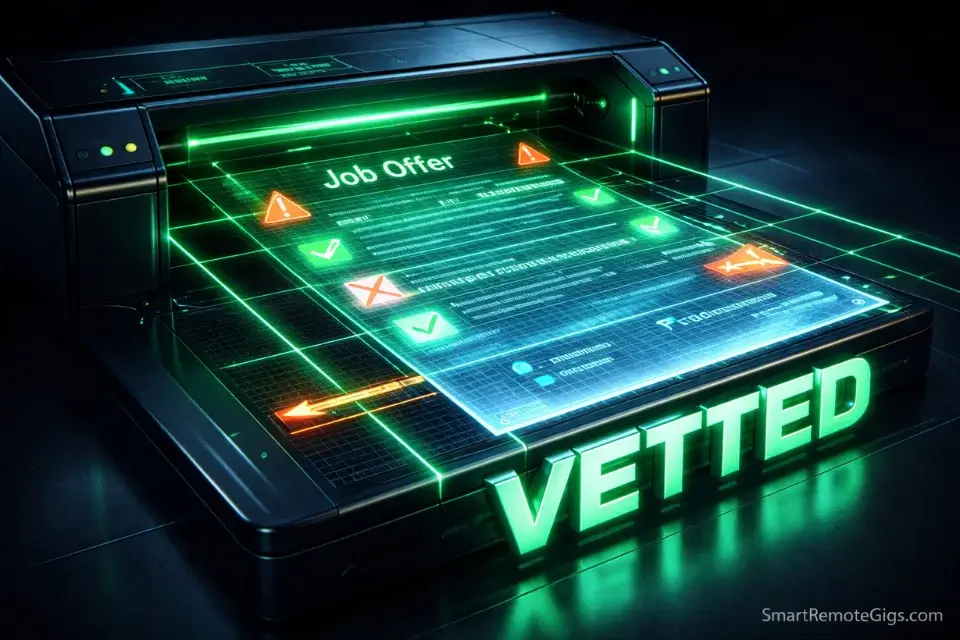
College students are prime targets for employment scams. Our combination of financial desperation, limited work experience, and trusting nature makes us profitable victims. Here’s how to avoid becoming a statistic:
Red Flag #1: WhatsApp/Telegram “Interviews”
Legitimate companies use Zoom, Google Meet, Microsoft Teams, or their own video platforms. If “HR” wants to conduct your entire interview via encrypted messaging apps, it’s 100% a scam. No exceptions.
Red Flag #2: Upfront Equipment or Training Fees
No legitimate employer asks you to purchase their proprietary software, pay for mandatory training materials, or buy a “starter kit.” This includes MLM schemes disguised as “social media marketing internships” or “brand ambassador programs.”
Red Flag #3: Check Cashing or Package Forwarding Requests
If a job involves receiving checks and depositing them into your personal account, accepting packages at your dorm address to forward elsewhere, or purchasing gift cards to send to the company, you’re being recruited as a money mule. This is a federal crime that will destroy your financial future. No legitimate business operates this way.
Red Flag #4: Unrealistic Pay for Entry-Level Work
“Earn $50/hour as a data entry clerk with no experience required!” is fiction. Real entry-level remote work pays $15–$25/hour. If it sounds too good to be true, it’s designed to bypass your critical thinking.
Red Flag #5: Pressure to Decide Immediately
Scammers create artificial urgency: “We’re only hiring 3 people and the position closes tonight!” Legitimate employers give you time to consider offers, ask questions, and review contracts.
How to verify legitimacy:
- Google the company name + “scam” or “reviews”
- Check Glassdoor for employee reviews (even negative reviews indicate a real company)
- Verify the recruiter’s email domain matches the official company website
- Search the recruiter’s LinkedIn profile for connection history
- Never provide your Social Security Number before receiving a formal written offer letter
Legit Platform Signals | Scam Red Flags |
|---|---|
Professional website with HTTPS security | Recruiter uses Gmail/Yahoo/Proton email |
Clear payment terms disclosed upfront | Vague job descriptions with no specifics |
Video interview via Zoom/Teams/Meet | Text-only communication via WhatsApp |
Glassdoor reviews (even mixed/negative) | Zero online presence or reviews anywhere |
Direct deposit or PayPal payments | Requests to cash checks or buy gift cards |
Takes 3-7 days to make hiring decision | Immediate job offer after 10-minute chat |
Asks for references or portfolio samples | No verification of skills or background |
Trust your instincts. If something feels off during the application process—vague answers, pressure tactics, requests that seem unusual—walk away. Legitimate opportunities will still exist tomorrow. Your financial security and criminal record won’t recover from scam involvement.
Frequently Asked Questions
What remote jobs pay the most for college students with no experience?
AI training and data labeling consistently delivers the best pay-to-barrier ratio at $18–$25/hour with literally zero prerequisites. Companies like DataAnnotation and Scale AI just need you to follow instructions and demonstrate basic internet literacy.
Customer Success roles at tech startups also pay well ($20–$30/hour) for students who can demonstrate strong written communication skills through a short trial project rather than traditional experience.
The secret these companies won’t advertise: they care far more about reliability and attention to detail than your resume. Show up consistently, follow processes precisely, and you’ll out-earn 90% of campus jobs within your first month.
The highest-earning students I know combine a stable base income from AI labeling (requires zero thought, perfect for brain-dead evenings) with a higher-paying skilled service like tutoring or writing during their peak mental performance hours.
Can I work a remote job while living in a dorm?
Absolutely yes, but your physical setup matters more than you think.
Invest in noise-canceling headphones immediately—the Anker Soundcore Q30 costs $80 and blocks out roommate chaos, hallway conversations, and door slamming. Use virtual backgrounds on video calls to hide your unmade bed and random roommate walking around in a towel.
The Wi-Fi problem is real: Most university networks have unpredictable stability. Test your connection at Fast.com—you need minimum 25 Mbps download for reliable video calls. If your dorm connection drops constantly, get a mobile hotspot as backup. I use Visible ($25/month unlimited) and it’s saved me during finals week network congestion.
Coordinate with roommates proactively: Block out “work hours” on a shared Google Calendar. My roommate and I developed a simple visual system—if my Bose headphones were on, I was in work mode and she’d text instead of interrupting. This eliminated 90% of friction.
Scout quiet backup locations: Empty study rooms after 8 PM, library collaboration spaces, academic building lounges on weekends, or even your car if you have one on campus. I kept a master list of 5 quiet spots with reliable Wi-Fi for important client calls.
The students who fail at dorm-based remote work are the ones who don’t establish boundaries and professional infrastructure. Treat it like a real job with dedicated workspace and scheduled hours, not something you squeeze in between TikTok scrolling sessions.
How many hours should a student work remotely without hurting their GPA?
The research-backed answer: 15-20 hours maximum.
Studies from the Georgetown University Center on Education and the Workforce show that working 15-20 hours per week actually improves time management skills and GPA for most students compared to not working at all. The structure forces better scheduling discipline.
Beyond 20 hours weekly, academic performance starts declining measurably. Beyond 25 hours, the decline accelerates sharply.
My personal formula that worked: Cap work hours at 1 hour per credit hour enrolled. Taking 15 credits? Maximum 15 work hours. Taking 18 credits during a tough semester? Drop to 12 work hours or accept that your GPA will suffer.
The nuance nobody mentions: It’s not just about total hours—it’s about when you work and your energy management. Working 3 hours at 11 PM after your brain is completely fried from studying is far worse than working 3 hours at 10 AM when you’re mentally sharp.
I track this obsessively: my writing quality at 9 AM earns $40/hour. The exact same writing task at 10 PM might take twice as long and produce half the quality, effectively earning $10/hour. Schedule your highest-paying, most cognitively demanding work during your peak mental performance windows.
The breaking point warning: If you find yourself choosing between finishing a work project and studying for a midterm, you’re working too many hours. If you’re pulling all-nighters to complete assignments because work ate your weekday evenings, you’re working too many hours. Your degree is the investment; remote work is just the funding mechanism.
Treat remote work like another class on your schedule: block it in Google Calendar, respect the boundaries, take it seriously, but don’t let it cannibalize sleep or study time. I’ve watched too many students optimize for short-term cash and sacrifice long-term career opportunities by graduating with a 2.5 GPA.
Conclusion: Your Degree and Your Income Can Coexist

The “work-study paradox” died somewhere between 2023 and 2026, and nobody sent out a press release.
You genuinely don’t have to choose between paying rent and attending your 9 AM Microeconomics lecture anymore. You don’t have to sacrifice your GPA on the altar of minimum-wage retail shifts that demand you stand for 6 hours scanning barcodes.
My specific recommendation for 2026: Start with AI data labeling platforms like DataAnnotation to build immediate cash flow. It’s truly zero-commitment, which means you can test remote work without risking your academic performance. Within 4-6 weeks, you’ll understand your capacity.
Then transition to a skill-based role by sophomore year—tutoring if you’re academically strong, freelance writing if you communicate well, or virtual assistant work if you’re hyper-organized. By junior year, you should be earning $25–$40/hour doing work that actually builds resume credentials instead of just filling your bank account.
The students who thrive financially during college aren’t grinding 30-hour weeks at Target. They’re the ones who figured out that asynchronous remote work lets you earn adult money on a fundamentally chaotic college schedule.
Stop trading your sleep for rent. Stop choosing between groceries and textbooks. Start working smarter than the system designed to exploit your desperation.
Ready to nail the remote job interview from your dorm room? Check out our guide: 12 Part-Time Remote Job Interview Questions & Answers.
Top-Rated Platforms for Student Remote Jobs (2026)
DataAnnotation
The leader in AI data training. Students can log in anytime to evaluate chatbot responses and train LLMs with zero commitment.
DataAnnotation wins for students because of its true 'work anytime' model. No interviews or set schedules make it the ultimate flexible gig.
Editor's Rating:
Price: $20
Visit Website
Wyzant
A premium tutoring marketplace where students can leverage their academic success to help others in specific subjects.
Wyzant allows you to set your own rates. For high-achieving college students, this is the fastest way to hit $50+/hr earnings.
Editor's Rating:
Price: $25
Visit Website
ModSquad
Global moderation services for gaming and e-commerce brands. Ideal for students who are night owls or active in digital communities.
ModSquad is excellent for building a resume in digital marketing. They offer shift-based work that fits well around semester schedules.
Editor's Rating:
Price: $15
Visit Website
Chegg
One of the largest student-focused platforms for textbook solutions and academic support across STEM and business subjects.
Chegg provides high volume. If you know your subject well, you can consistently earn without having to market yourself to individual clients.
Editor's Rating:
Price: $15
Visit Website
Rev
Transcription and captioning services. Perfect for students with high typing speeds who want task-based remote work.
Rev is a reliable entry point for remote work. The pay-per-minute model rewards speed, making it great for efficient typists.
Editor's Rating:
Price: $12
Visit Website